


The Versatility of MTN Bikes
 11-08-11 | 11:26 PM
#76
Senior Member

Joined: Sep 2006
Posts: 960
Likes: 80
 11-08-11 | 11:29 PM
#77

Bicycle Repair Man !!!
Joined: Sep 2007
Posts: 27,266
Likes: 150
From: YEG
Bikes: See my sig...
Mountain bikes make excellent tow vehicles due to their ability to rock some very low gearing... not that a nearly empty Chariot is much to drag around.
This bike's primary purpose is to rock the single track but I sometimes commute on it and use it for towing.

2001 Rocky Mountain Blizzard - Chariot trailer
This bike's primary purpose is to rock the single track but I sometimes commute on it and use it for towing.
2001 Rocky Mountain Blizzard - Chariot trailer
11-17-11 | 05:14 PM
#79

Tractorlegs
Joined: Oct 2011
Posts: 3,185
Likes: 60
From: El Paso, TX
Bikes: Schwinn Meridian Single-Speed Tricycle
11-17-11 | 06:32 PM
#80

Senior Member
Joined: Jun 2008
Posts: 2,978
Likes: 4
From: Atlanta
Bikes: Cannondale T700s and a few others
Let me present a different perspective...
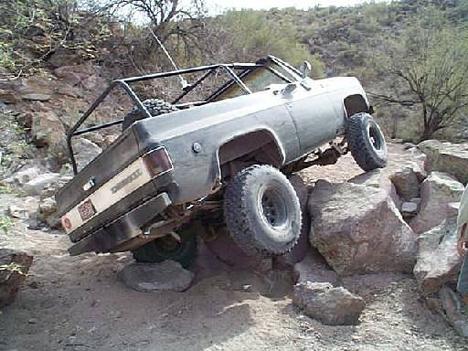
Jacked up Blazers are used for commuting. They're used for quick errands. They're used for trips. They're used for trail-blazing, and jumps. They are used for the casual recreational Sunday drive. They are used for utilitarian purposes. They are used for cross country events. They are used in racing. They traverse all terrains, without any difficulty. There are places that a jacked up truck can go that neither the family sedan or luxury car, would dare enter.
Doesn't make much sense, right? How often are many of us driving or riding over rocks that would really require a jacked up truck or a MTB?
I'm not discounting those of you who use MTBs for commuting. But, really, in their stock forms they aren't best suited for the task. I'm betting that most people who seriously intend to commute via MTB remove the knobby tires in favor of slicks or near-slicks, which takes away a lot of the offroad capability and versatility they initially have.
I would like to note however that one big exception would be for winter cycling in some areas, when we're talking about serious obstructions. During that time those knobby tires will help, and many people in those states often switch over to a 4WD/AWD vehicle as well. If I had to commute in places where the snow got thick, I'd want a MTB with seriously knobby tires and gears to get through anything. No questions asked.
Fortunately I live in an area that gets very little snow, and what we do get never sticks to the road. So I don't really need such a bike, much like I don't need a 4WD or AWD vehicle.
I've come from MTBs previously and found them to require more effort in general. Getting on a road bike for the first time was a 'whoa' moment. It almost pedaled itself.
.
.
.
Jacked up Blazers are used for commuting. They're used for quick errands. They're used for trips. They're used for trail-blazing, and jumps. They are used for the casual recreational Sunday drive. They are used for utilitarian purposes. They are used for cross country events. They are used in racing. They traverse all terrains, without any difficulty. There are places that a jacked up truck can go that neither the family sedan or luxury car, would dare enter.
Doesn't make much sense, right? How often are many of us driving or riding over rocks that would really require a jacked up truck or a MTB?
I'm not discounting those of you who use MTBs for commuting. But, really, in their stock forms they aren't best suited for the task. I'm betting that most people who seriously intend to commute via MTB remove the knobby tires in favor of slicks or near-slicks, which takes away a lot of the offroad capability and versatility they initially have.
I would like to note however that one big exception would be for winter cycling in some areas, when we're talking about serious obstructions. During that time those knobby tires will help, and many people in those states often switch over to a 4WD/AWD vehicle as well. If I had to commute in places where the snow got thick, I'd want a MTB with seriously knobby tires and gears to get through anything. No questions asked.
Fortunately I live in an area that gets very little snow, and what we do get never sticks to the road. So I don't really need such a bike, much like I don't need a 4WD or AWD vehicle.
I've come from MTBs previously and found them to require more effort in general. Getting on a road bike for the first time was a 'whoa' moment. It almost pedaled itself.
.
.
.
I hardly EVER ride my Ridgid on the street anymore though. I mostly ride my touring bikes.
 11-18-11 | 03:15 PM
#81

Senior Member
Joined: Jul 2010
Posts: 83
Likes: 0
From: mobile al
Bikes: old ten speed
The ones that are about 3 inches wide. Don't know the exact size, just go to walmart and look at the 80$ beach cruisers.
Or hell, here:
https://www.meijer.com/s/26-inch-huff...&cmpid=****ase
Or hell, here:
https://www.meijer.com/s/26-inch-huff...&cmpid=****ase
11-18-11 | 04:36 PM
#82

Senior Member
Joined: Nov 2007
Posts: 4,599
Likes: 158
From: Santa Fe, NM
Bikes: Vassago Moosknuckle Ti 29+ XTR, 90's Merckx Corsa-01 9sp Record, PROJECT: 1954 Frejus SuperCorsa
11-18-11 | 04:43 PM
#83
Bicycle Repair Man !!!
Joined: Sep 2007
Posts: 27,266
Likes: 150
From: YEG
Bikes: See my sig...
11-18-11 | 11:20 PM
#85

Senior Member

Joined: Aug 2011
Posts: 22,676
Likes: 2,642
From: CID
Bikes: 1991 Bianchi Eros, 1964 Armstrong, 1988 Diamondback Ascent, 1988 Bianchi Premio, 1987 Bianchi Sport SX, 1980s Raleigh mixte (hers), All-City Space Horse (hers)
11-18-11 | 11:24 PM
#86

Mad bike riding scientist


Joined: Nov 2004
Posts: 29,139
Likes: 6,195
From: Denver, CO
Bikes: Some silver ones, a red one, a black and orange one, and a few titanium ones
Just as the automobile evolved from the ox cart. Has about as much similarity too.
__________________
Stuart Black
Dreamin' of Bemidji Down the Mississippi (in part)
Plan Epsilon Around Lake Michigan in the era of Covid
Gold Fever Three days of dirt in Colorado
Pokin' around the Poconos A cold ride around Lake Erie
Dinosaurs in Colorado A mountain bike guide to the Purgatory Canyon dinosaur trackway
Solo Without Pie. The search for pie in the Midwest.
Picking the Scablands. Washington and Oregon, 2005. Pie and spiders on the Columbia River!
Stuart Black
Dreamin' of Bemidji Down the Mississippi (in part)
Plan Epsilon Around Lake Michigan in the era of Covid
Gold Fever Three days of dirt in Colorado
Pokin' around the Poconos A cold ride around Lake Erie
Dinosaurs in Colorado A mountain bike guide to the Purgatory Canyon dinosaur trackway
Solo Without Pie. The search for pie in the Midwest.
Picking the Scablands. Washington and Oregon, 2005. Pie and spiders on the Columbia River!
11-19-11 | 01:25 AM
#87

Real Men Ride Ordinaries
Joined: Sep 2008
Posts: 3,723
Likes: 3
A bit of an oversimplification as well, the standard story told is that of Repack Hill, the Schwinn Excelsior, and Gary Fisher. While that did happen, they weren't necessarily the first people to ride a bike off road, just the first people to turn those bikes into a successful business. Charlie Cunnningham, also of Marin built his first mountain bike entirely from scratch, using his aeronautical engineering background, and John Finley Scott of Davis built a mountain bike out of an old ten speed. I'm sure other people were doing other things as well, but thoes are the few stand-outs that I can think of off the top of my head.
11-19-11 | 01:37 AM
#88

The space coyote lied.
Joined: Sep 2008
Posts: 48,692
Likes: 10,961
From: dusk 'til dawn.
Bikes: everywhere
Way back in the day, like turn of the 20th century, most bikes sold were prepared for riding on dirt since there weren't many paved roads to be found.
Bob Crispin from up this way probably made the first MTB with a disc brake (rear only) in 1975.


Bob Crispin - NW 1st MTB #1 by Tankagnolo Bob, on Flickr
Bob Crispin from up this way probably made the first MTB with a disc brake (rear only) in 1975.
Bob Crispin - NW 1st MTB #1 by Tankagnolo Bob, on Flickr
 11-19-11 | 01:47 AM
#89

Senior Member
Joined: Sep 2009
Posts: 2,067
Likes: 73
From: USA
Bikes: 84 Pinarello Trevisio, 86 Guerciotti SLX, 96 Specialized Stumpjumper, 2010 Surly Cross Check, 88 Centurion Prestige, 73 Raleigh Sports, GT Force, Bridgestone MB4
I disagree, cyclecross bikes are more versatile and much more efficient on the road and mixed use. LC
11-19-11 | 02:20 AM
#90
Thread Starter
Banned
Joined: May 2011
Posts: 5,804
Likes: 0
From: Northern California
Bikes: Raleigh Grand Prix, Giant Innova, Nishiki Sebring, Trek 7.5FX
Therefore, it comes down to the type of terrain within a given area. Hell, on nothing but paved roads, a simple road bike would be ideal, but not versatile. Versatility is owned by that bike which can fill the most roles with the greatest amount of efficiency. The barometer for road efficiency will always be the given terrain.
So, in a way you could be right. However, in the total absence of pavement, you are so very wrong!
- Slim

Last edited by SlimRider; 11-19-11 at 03:54 AM.
11-19-11 | 03:17 AM
#93
The space coyote lied.
Joined: Sep 2008
Posts: 48,692
Likes: 10,961
From: dusk 'til dawn.
Bikes: everywhere
CX bikes and MTBs both have Geos that are all over the charts. Pretty tough to find a CX bike with a wheelbase as long as a MTB, though.
I guess the 1991 Gary Fisher Montare has a wheelbase about the same as some CX bikes. It was a pretty special MTB, though.

I guess the 1991 Gary Fisher Montare has a wheelbase about the same as some CX bikes. It was a pretty special MTB, though.
11-19-11 | 06:56 AM
#94
Tractorlegs
Joined: Oct 2011
Posts: 3,185
Likes: 60
From: El Paso, TX
Bikes: Schwinn Meridian Single-Speed Tricycle
A bit of an oversimplification as well, the standard story told is that of Repack Hill, the Schwinn Excelsior, and Gary Fisher. While that did happen, they weren't necessarily the first people to ride a bike off road, just the first people to turn those bikes into a successful business. Charlie Cunnningham, also of Marin built his first mountain bike entirely from scratch, using his aeronautical engineering background, and John Finley Scott of Davis built a mountain bike out of an old ten speed. I'm sure other people were doing other things as well, but thoes are the few stand-outs that I can think of off the top of my head.
__________________
********************************
Trikeman
Trikeman
11-19-11 | 08:03 AM
#95
Thread Starter
Banned
Joined: May 2011
Posts: 5,804
Likes: 0
From: Northern California
Bikes: Raleigh Grand Prix, Giant Innova, Nishiki Sebring, Trek 7.5FX
Actually I invented the mountain bike - in 1960 when I was seven years old. I don't remember the make or model of the bike in question, only that it was a Christmas gift. Over the next couple of years I, along with all the other seven year olds in the neighborhood, rode and rode and rode. We lived in Lakewood Colorado, west by Alameda Ave up there by Green Mountain and there is not one square inch of that mountain that we didn't ride on. The mountain bike was invented by thousands of us 7 year old kids bombing through the mountains and forests. We want our credit and some of the money, please
- Slim
11-19-11 | 08:50 AM
#96
Senior Member
Joined: Jun 2008
Posts: 2,978
Likes: 4
From: Atlanta
Bikes: Cannondale T700s and a few others
I have heard the Cruiser argument before. They were coasting down hill for a thrill and the Cruisers fit larger tires. They quickly dumped the heavy single speed cruiser frames for touring frames with 26 inch wheels laced to the multi speed hubs to get wider tires on them and gears to deal with the hills.
Its the same line as the BMX has it roots in the Stingray as bike thats really a kids sized cruiser.
70's Mountain bikes gemoetry was closer to Touring bikes when they first came out with the "Mountain bike" except they had 26inch wheels to make more room for wider tires primarily and flat bars. The Top tube length was close to the same as the seat tube. Now mountains tend to have long top tubes in relation to the seat tube to allow for climbing steep hills without slamming your knees into the bar.
Cross bikes are more of a road geometry with clearance for wider tires that are usualy 700c based and drop or dirt drops more like a road bike.
Last edited by Grim; 11-19-11 at 09:03 AM.
11-19-11 | 08:51 AM
#97
Mad bike riding scientist
Joined: Nov 2004
Posts: 29,139
Likes: 6,195
From: Denver, CO
Bikes: Some silver ones, a red one, a black and orange one, and a few titanium ones
Actually, the U.S. Army invented the mountain bike back in the 1890's. African-Americans were the first MTN bikers here in the United States of America. They were called, the Buffalo Soldiers. They traveled from Missoula, Montana, to St. Louis, Missouri, back in 1897. A total of 1,900 miles, as an experiment. The U.S. Infantry was thinking about riding special MTN bikes in order to have a greater advantage in surprise attacks upon possible enemies. Rather than have the sound of galoping hoofs of horses announce the planned attack from greater distances away, they could take greater advantage of the element of surprise. However, the invention of the motor car stifled the bicycle war implementation, as the motor car proved to be far to swift for any enemy to adequately prepare for the onslaught of an impending attack. Therefore, the first MTB, was a rigid hardtail, for certain!
- Slim
- Slim
Nor were they the first military application of bicycles. That distinction belongs to the French Army in the Franco-Prussian War of 1870. And those bikes were ordinaries.
Their bikes weren't even 'mountain bikes' since they were slightly modified Spaulding Roadsters. The bikes were modified to carry the heavier loads that soldiers had to carry but they were, essentially, the same bikes that consumers used that were build for the conditions of the roads in 1897...which was abysmal.
__________________
Stuart Black
Dreamin' of Bemidji Down the Mississippi (in part)
Plan Epsilon Around Lake Michigan in the era of Covid
Gold Fever Three days of dirt in Colorado
Pokin' around the Poconos A cold ride around Lake Erie
Dinosaurs in Colorado A mountain bike guide to the Purgatory Canyon dinosaur trackway
Solo Without Pie. The search for pie in the Midwest.
Picking the Scablands. Washington and Oregon, 2005. Pie and spiders on the Columbia River!
Stuart Black
Dreamin' of Bemidji Down the Mississippi (in part)
Plan Epsilon Around Lake Michigan in the era of Covid
Gold Fever Three days of dirt in Colorado
Pokin' around the Poconos A cold ride around Lake Erie
Dinosaurs in Colorado A mountain bike guide to the Purgatory Canyon dinosaur trackway
Solo Without Pie. The search for pie in the Midwest.
Picking the Scablands. Washington and Oregon, 2005. Pie and spiders on the Columbia River!
11-19-11 | 09:04 AM
#98
Mad bike riding scientist
Joined: Nov 2004
Posts: 29,139
Likes: 6,195
From: Denver, CO
Bikes: Some silver ones, a red one, a black and orange one, and a few titanium ones
Pass what ever it is your smoking over my way.
Mountain bikes gemoetry was closer to Touring bikes when they first came out with the "Mountain bike" except they had 26inch wheels to make more room for wider tires primarily and flat bars. The Top tube length was close to the same as the seat tube. Now mountains tend to have long top tubes in relation to the seat tube to allow for climbing steep hills without slamming your knees into the bar.
Cross bikes are more of a road geometry with clearance for wider tires that are usualy 700c based and drop or dirt drops more like a road bike.
Mountain bikes gemoetry was closer to Touring bikes when they first came out with the "Mountain bike" except they had 26inch wheels to make more room for wider tires primarily and flat bars. The Top tube length was close to the same as the seat tube. Now mountains tend to have long top tubes in relation to the seat tube to allow for climbing steep hills without slamming your knees into the bar.
Cross bikes are more of a road geometry with clearance for wider tires that are usualy 700c based and drop or dirt drops more like a road bike.
There's also more to the changes in mountain bike frames than just lengthening the top tube. The rear stays have been made shorter to tuck the wheel under the rider so that the wheel doesn't spin out as much, making climbing easier. The front to center of the bike has been made longer to balance the rider between the wheels so that the front wheel doesn't come off the ground while climbing and the rear wheel stays engaged. Head angles have been steepened to reduce wheel flop...a big problem with a 69 degree head angle of the Excelsior. The changes aren't about keeping the rider from bashing their knees but about making the bike a better hill climbing machine.
You are right about the tire width. That's just a small part of the differences and certainly not the primary one.
__________________
Stuart Black
Dreamin' of Bemidji Down the Mississippi (in part)
Plan Epsilon Around Lake Michigan in the era of Covid
Gold Fever Three days of dirt in Colorado
Pokin' around the Poconos A cold ride around Lake Erie
Dinosaurs in Colorado A mountain bike guide to the Purgatory Canyon dinosaur trackway
Solo Without Pie. The search for pie in the Midwest.
Picking the Scablands. Washington and Oregon, 2005. Pie and spiders on the Columbia River!
Stuart Black
Dreamin' of Bemidji Down the Mississippi (in part)
Plan Epsilon Around Lake Michigan in the era of Covid
Gold Fever Three days of dirt in Colorado
Pokin' around the Poconos A cold ride around Lake Erie
Dinosaurs in Colorado A mountain bike guide to the Purgatory Canyon dinosaur trackway
Solo Without Pie. The search for pie in the Midwest.
Picking the Scablands. Washington and Oregon, 2005. Pie and spiders on the Columbia River!
11-19-11 | 09:14 AM
#99
Senior Member
Joined: Jun 2008
Posts: 2,978
Likes: 4
From: Atlanta
Bikes: Cannondale T700s and a few others
Close but no cigar. The first production mountain bike geometry...the Specialized Stumpjumper...was closer to the Schwinn Excelsiors on which the Marin County mountain bikes were based. Touring bikes and touring bike geometry was a solid road bike geometry with slightly longer wheelbases and slightly slacker head angles than racing bicycles. In fact, cyclocross bikes were based off of touring bikes that racers used for winter training and touring bikes have little in common, frame-wise, with mountain bikes.
There's also more to the changes in mountain bike frames than just lengthening the top tube. The rear stays have been made shorter to tuck the wheel under the rider so that the wheel doesn't spin out as much, making climbing easier. The front to center of the bike has been made longer to balance the rider between the wheels so that the front wheel doesn't come off the ground while climbing and the rear wheel stays engaged. Head angles have been steepened to reduce wheel flop...a big problem with a 69 degree head angle of the Excelsior. The changes aren't about keeping the rider from bashing their knees but about making the bike a better hill climbing machine.
You are right about the tire width. That's just a small part of the differences and certainly not the primary one.
There's also more to the changes in mountain bike frames than just lengthening the top tube. The rear stays have been made shorter to tuck the wheel under the rider so that the wheel doesn't spin out as much, making climbing easier. The front to center of the bike has been made longer to balance the rider between the wheels so that the front wheel doesn't come off the ground while climbing and the rear wheel stays engaged. Head angles have been steepened to reduce wheel flop...a big problem with a 69 degree head angle of the Excelsior. The changes aren't about keeping the rider from bashing their knees but about making the bike a better hill climbing machine.
You are right about the tire width. That's just a small part of the differences and certainly not the primary one.
11-19-11 | 09:41 AM
#100

Senior Member
Joined: Oct 2011
Posts: 2,194
Likes: 4,081
From: Phx, AZ
Bikes: Trek Mtn Bike
another sliver of history
When we first moved to Phoenix in the 60s there was this huge empty lot across the street with an abandoned pit. The neighborhood kids were riding everything in there. Stingrays, 10 speeds, customs, motorcycles, etc.
There was an assortment of downramps with hillocks so you could coast down one ramp and jump the next hillock. The ramps were smoothed from all the kids riding up and down them. This was long before I ever heard of BMX or anything similar. I never learned to jump well. I did manage to land almost perfectly upside down with my schwinn varsity once.
Truth is I think all kids push the limits with whatever they have. Part of growing up.
There was an assortment of downramps with hillocks so you could coast down one ramp and jump the next hillock. The ramps were smoothed from all the kids riding up and down them. This was long before I ever heard of BMX or anything similar. I never learned to jump well. I did manage to land almost perfectly upside down with my schwinn varsity once.
Truth is I think all kids push the limits with whatever they have. Part of growing up.

