


Crank shifting while commuting
 11-16-12 | 04:30 AM
#1

Thread Starter
Senior Member
Joined: Oct 2012
Posts: 179
Likes: 0
Crank shifting while commuting
Hi there,
I use my bike mostly for commuting, and a little for touring.
I have a 11-13-15-18-21-24-28-32T cassette and a 28-38-48T crankset.
I ride 95% on the time on the 38T crank but realize I am hardly ever using a sprocket bigger than the 15T so I feel I am sometime under-exploiting my energy and could benefit from a bigger crank than 38T but shifting to 48T turns out quite tough pedaling...
So ideally, I would benefit from a bigger middle crank (40 or 42T) *and* a smaller big crank (~46T), and I like the idea of having the small crank as small as possible since I basically never use it, I like the idea of having it there for emergencies, for overly steep hills so don't care about speed or performance, the small crank is just an insurance of being able to climb anything at all...
I also like the idea of riding most of the time on the middle crank since it is the one to allow me without crossing the chain to use the whole range of sprockets which is convenient for commuting to have possibly a lower gear for starting in some conditions.
Now, I am fine as I am right now, but this whole shifting thing is bugging my mind... what would be the solution? because the cranksets I find are:
- either MTB ones, with the small crank as I want but a small-ish middle ring and a small big ring (24-34-42T) which is fine for the small one but too short for the other two.
- or race ones with cranks such as 30-42-52 which is alright although a bit much for the small one, perfect for the middle one but way too big for the big one.
It seems like my needs (perfect would be around 28-41-45) are exactly in between of the standards... is there a solution for me?
This is mostly hypothetical for the time being as I am merely just considering it... but still, it is frustrating that I have 2 unused cranks on my bike (the small emergency one is fine, but the big one should be usable IMO)
I use my bike mostly for commuting, and a little for touring.
I have a 11-13-15-18-21-24-28-32T cassette and a 28-38-48T crankset.
I ride 95% on the time on the 38T crank but realize I am hardly ever using a sprocket bigger than the 15T so I feel I am sometime under-exploiting my energy and could benefit from a bigger crank than 38T but shifting to 48T turns out quite tough pedaling...
So ideally, I would benefit from a bigger middle crank (40 or 42T) *and* a smaller big crank (~46T), and I like the idea of having the small crank as small as possible since I basically never use it, I like the idea of having it there for emergencies, for overly steep hills so don't care about speed or performance, the small crank is just an insurance of being able to climb anything at all...
I also like the idea of riding most of the time on the middle crank since it is the one to allow me without crossing the chain to use the whole range of sprockets which is convenient for commuting to have possibly a lower gear for starting in some conditions.
Now, I am fine as I am right now, but this whole shifting thing is bugging my mind... what would be the solution? because the cranksets I find are:
- either MTB ones, with the small crank as I want but a small-ish middle ring and a small big ring (24-34-42T) which is fine for the small one but too short for the other two.
- or race ones with cranks such as 30-42-52 which is alright although a bit much for the small one, perfect for the middle one but way too big for the big one.
It seems like my needs (perfect would be around 28-41-45) are exactly in between of the standards... is there a solution for me?
This is mostly hypothetical for the time being as I am merely just considering it... but still, it is frustrating that I have 2 unused cranks on my bike (the small emergency one is fine, but the big one should be usable IMO)
 11-16-12 | 04:39 AM
#2
Banned
Joined: Jul 2010
Posts: 8,543
Likes: 42
From: England / CPH
Bikes: 2010 Cube Acid / 2013 Mango FGSS
My MTB has a Shimano (FC-M422 44x32x22) and a Shimano HG50 11-32 cassette (11-12-14-16-18-21-24-28-32) on 559 (26") wheels.
I find that this wide range is enough for my commuting needs.
What are the other specs of your bike?
I find that this wide range is enough for my commuting needs.
What are the other specs of your bike?
11-16-12 | 05:08 AM
#4
Banned
Joined: Jul 2010
Posts: 8,543
Likes: 42
From: England / CPH
Bikes: 2010 Cube Acid / 2013 Mango FGSS
I don't think that the cross-chaining will make that much difference in wear unless you ride a huge amount (3-5000 miles/year.)
Just my .02€
 11-16-12 | 07:19 AM
#7

Senior Member
Joined: Jul 2011
Posts: 1,141
Likes: 5
From: Erie Penna.
FatBottomedGirl
Here is what I did on my touring bike that is mostly my commuter bike.
45-42-24 X 12,14,16,18,21,24,28,32,36
Here is my thread about what parts I used etc.
https://www.bikeforums.net/showthread...4-28-32-36)-o)
Here is a link to another explanation of the 42t center ring.
https://wheelsofchance.org/2009/08/28...-the-question/
I have thought a lot about this as it seems you have also and tried a lot of things until the light came on as to what was a perfect fit for me. There are several reasons I went with the 45t 42t combo. One was that that combo gave me a very good half step pattern, and in today’s 8,9,10 speed cassettes that is somewhat uncalled for. But most saying that are running very close spaced cassettes. With the wide spaced cassettes mtn like (non mega-range) I felt there was room for half step again. The next reason was with with two rings so close in size the 45t provided a much straighter chain line when on the smaller cogs, and it’s very noticeable when riding in those gears “smoother”.
I ride the bike like it was a double most of the time and have a great range of gears in tiny steps if needed with just the two rings. Then I have a totally different bike (mountain goat) when i make the harder soft shift down to the 24t granny. You may be happy with just a 26t granny especially if you use a 36t big cog cassette as I did. When I make the shift down to the granny I didn’t want just one bailout gear I wanted a range of at least 6 gears that took me up and overlapped a little the big ring range. Around here there are a lot of rolling hills and with this setup I didn’t find I needed to keep jumping between the granny and the bigger rings.
Most people riding road gear triples like a 52,42,30 have almost no use for the 52 as it gives you one or two more higher gears but they are so high most people can’t use them except going down hills. The 52,42 does give you a “one and a half step” pattern but it’s too complicated to use effectively and the 10 tooth jump is a nice shift but not as smooth as you would want to make it and then remember to shift twice in the back just to get a in between gear. When you are on the 52 and want the gear range you would get on the 45 you become cross chained to the point you are straighter on the center ring.
The unexpected plus I found after I got my gears dialed is how smooth the 3 tooth jump is. I have STI index shifting and it shifts so smooth now I find myself looking down thinking it didn’t shift when it did. If I want a half gear higher or lower I can just pop the front over and get it or pop the front over and shift the back one in the opposite direction. Very easy to learn and the shift is so easy I find myself even shifting under power just as I would on the cassette.
Here is what it looks like.
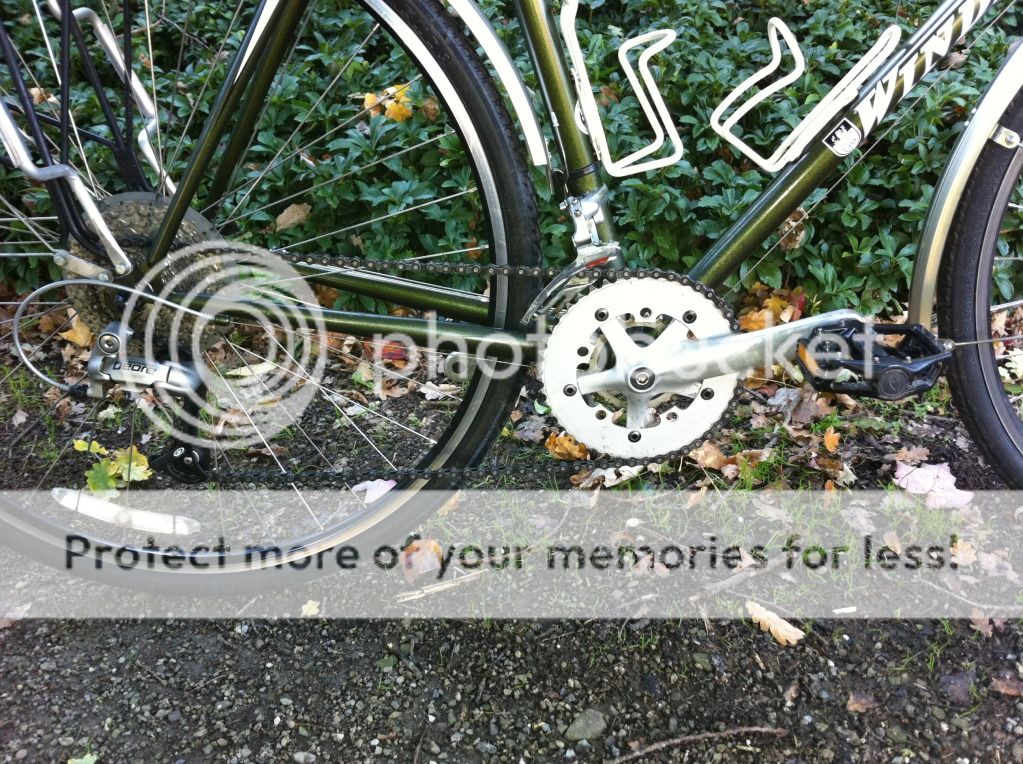
.
Here is what I did on my touring bike that is mostly my commuter bike.
45-42-24 X 12,14,16,18,21,24,28,32,36
Here is my thread about what parts I used etc.
https://www.bikeforums.net/showthread...4-28-32-36)-o)
Here is a link to another explanation of the 42t center ring.
https://wheelsofchance.org/2009/08/28...-the-question/
I have thought a lot about this as it seems you have also and tried a lot of things until the light came on as to what was a perfect fit for me. There are several reasons I went with the 45t 42t combo. One was that that combo gave me a very good half step pattern, and in today’s 8,9,10 speed cassettes that is somewhat uncalled for. But most saying that are running very close spaced cassettes. With the wide spaced cassettes mtn like (non mega-range) I felt there was room for half step again. The next reason was with with two rings so close in size the 45t provided a much straighter chain line when on the smaller cogs, and it’s very noticeable when riding in those gears “smoother”.
I ride the bike like it was a double most of the time and have a great range of gears in tiny steps if needed with just the two rings. Then I have a totally different bike (mountain goat) when i make the harder soft shift down to the 24t granny. You may be happy with just a 26t granny especially if you use a 36t big cog cassette as I did. When I make the shift down to the granny I didn’t want just one bailout gear I wanted a range of at least 6 gears that took me up and overlapped a little the big ring range. Around here there are a lot of rolling hills and with this setup I didn’t find I needed to keep jumping between the granny and the bigger rings.
Most people riding road gear triples like a 52,42,30 have almost no use for the 52 as it gives you one or two more higher gears but they are so high most people can’t use them except going down hills. The 52,42 does give you a “one and a half step” pattern but it’s too complicated to use effectively and the 10 tooth jump is a nice shift but not as smooth as you would want to make it and then remember to shift twice in the back just to get a in between gear. When you are on the 52 and want the gear range you would get on the 45 you become cross chained to the point you are straighter on the center ring.
The unexpected plus I found after I got my gears dialed is how smooth the 3 tooth jump is. I have STI index shifting and it shifts so smooth now I find myself looking down thinking it didn’t shift when it did. If I want a half gear higher or lower I can just pop the front over and get it or pop the front over and shift the back one in the opposite direction. Very easy to learn and the shift is so easy I find myself even shifting under power just as I would on the cassette.
Here is what it looks like.
.
11-16-12 | 07:34 AM
#8
Thread Starter
Senior Member
Joined: Oct 2012
Posts: 179
Likes: 0
bud16415: great stuff, it really feels we are mostly on the same page! very interesting! i will keep in mind your concept in case I actually do something about it!
scroca:
acidfast7,krobinson103: yeah, I suppose I should try to ride the 48T hoping to get used to it and do it despite the cross-chaining, it might be just the cost of getting used to it. After all I can go as low as to 48/18 without cross-chaining, and even 48/21 with a little crossing which is close in term of ratios to the range 38/13 to 38/18 and it is the 38/15 I usually ride the most so I suppose I could be fine.
scroca:
acidfast7,krobinson103: yeah, I suppose I should try to ride the 48T hoping to get used to it and do it despite the cross-chaining, it might be just the cost of getting used to it. After all I can go as low as to 48/18 without cross-chaining, and even 48/21 with a little crossing which is close in term of ratios to the range 38/13 to 38/18 and it is the 38/15 I usually ride the most so I suppose I could be fine.
11-16-12 | 07:51 AM
#9

The Recumbent Quant

Joined: Jan 2012
Posts: 3,094
Likes: 8
From: Fairfield, CT
Bikes: 2012 Cruzbike Sofrider, 2013 Cruzigami Mantis, 2016 Folding CruziTandem
bud16415: great stuff, it really feels we are mostly on the same page! very interesting! i will keep in mind your concept in case I actually do something about it!
scroca:
acidfast7,krobinson103: yeah, I suppose I should try to ride the 48T hoping to get used to it and do it despite the cross-chaining, it might be just the cost of getting used to it. After all I can go as low as to 48/18 without cross-chaining, and even 48/21 with a little crossing which is close in term of ratios to the range 38/13 to 38/18 and it is the 38/15 I usually ride the most so I suppose I could be fine.
scroca:
acidfast7,krobinson103: yeah, I suppose I should try to ride the 48T hoping to get used to it and do it despite the cross-chaining, it might be just the cost of getting used to it. After all I can go as low as to 48/18 without cross-chaining, and even 48/21 with a little crossing which is close in term of ratios to the range 38/13 to 38/18 and it is the 38/15 I usually ride the most so I suppose I could be fine.
Cheers,
Charles
11-16-12 | 08:11 AM
#10
Thread Starter
Senior Member
Joined: Oct 2012
Posts: 179
Likes: 0
So I agree with you that it makes sense I don't use that many gears, but since the terrain is easy, I should be able to use the faster gears more often, and not only when touring and I know there is 2 miles of downhill ahead of me...
11-16-12 | 08:38 AM
#11
Senior Member
Joined: May 2012
Posts: 119
Likes: 0
From: Sidereal Time
If your terrain is mostly flat and you are interested in keeping a good pace just keep it in the big ring. Here in the flat lands I'm usually pushing 52x19 on my old commuter road bike and save the 42T ring for really windy days. My commuter MTB has a 42T big ring and 8 speed cassette. I'll cross chain it all day before dropping to the 38T ring. I don't know what it is but the big ring just feels better once I got used to it. Cross chaining is a bit overblown IMO. A new cassette and chain, if I were to ever wear them out from cross chaining, would cost less than the tank of gas I don't need to buy so I don't worry about it.
11-16-12 | 08:44 AM
#12

Senior Member
Joined: Apr 2011
Posts: 15,278
Likes: 342
From: Alpharetta, GA
Bikes: Nashbar Road
Hi there,
I use my bike mostly for commuting, and a little for touring.
I have a 11-13-15-18-21-24-28-32T cassette and a 28-38-48T crankset.
I ride 95% on the time on the 38T crank but realize I am hardly ever using a sprocket bigger than the 15T so I feel I am sometime under-exploiting my energy and could benefit from a bigger crank than 38T but shifting to 48T turns out quite tough pedaling......
I use my bike mostly for commuting, and a little for touring.
I have a 11-13-15-18-21-24-28-32T cassette and a 28-38-48T crankset.
I ride 95% on the time on the 38T crank but realize I am hardly ever using a sprocket bigger than the 15T so I feel I am sometime under-exploiting my energy and could benefit from a bigger crank than 38T but shifting to 48T turns out quite tough pedaling......
You have a really wide range in the sprockets, 11-32. It would probably be more efficient and convenient for you to tighten that range up and keep the triple as it is. Also cheaper.
11-16-12 | 09:05 AM
#13
Senior Member
Joined: Jul 2011
Posts: 1,141
Likes: 5
From: Erie Penna.
FatBottomedGirl
I do think we might be on the same page as far as concept and we could be apart on each of our personal gearing needs. It’s dependent on so many things like our own strength and endurance and riding preference to mashing thru spinning. Combined weight of rider and cargo is a huge factor also, and where we ride hills, flats, mountains and combinations of all.
I found a combination of using a gear computer such as this and taking note of my cadence and gears and speeds to be helpful.
https://home.earthlink.net/~mike.sherman/shift.html
Fill in all the data on what you have now as best you can and then do “What if’s”.
The other thing you can do is take note of the gears you ride in most and the ones that you may be lacking and those you don’t use. For me the goal was to find a center/ center starting point, the middle ring and the middle cog. Because I wanted a setup that would commute and also tour I was looking actually for where I would want my center/ center in both cases. For me it worked out something like 42t front and 21t back. Before that I experimented with mtn bike crank sets and looking at the graphs I was convinced I had all the gear range I needed but something didn’t seem right for me and I finally figured it out the problem was my favorite gears were split between the two rings. When I got the road crank back on and riding the whole cassette sequentially off the center ring I was much happier, but then I had almost zero need for the big ring and thought about just taking it off and putting a chain guard in its place as many have done.
I’m not opposed to cross chaining and I do it as required. I don’t have any data on wear and mileage or wasted effort, but I can say it’s very noticeable running the straighter line in the tall gears. Maybe even more so than cross chaining off the granny. I think for me it might be because I find I slightly spin more on the low gears and slightly mash more on the tall gears.
Well my point is you don’t need to change anything on your bike to start evaluating new gears as you have most of the ranges (Gear Inches) on your gears now you would have on a new setup. You just need to ride and feel what you feel and then think where would I want that gear placed in my new gear setup.
As to just getting used to something, I don’t know. We all get more strength the more we ride and less strength as we age etc. If you are expecting a big change in your abilities do to gaining strength over the short term then I would say of course hold off. If you are about where you are going to be then I would say make changes that fit your bike best to you rather than adapting yourself to the bike.
I do think we might be on the same page as far as concept and we could be apart on each of our personal gearing needs. It’s dependent on so many things like our own strength and endurance and riding preference to mashing thru spinning. Combined weight of rider and cargo is a huge factor also, and where we ride hills, flats, mountains and combinations of all.
I found a combination of using a gear computer such as this and taking note of my cadence and gears and speeds to be helpful.
https://home.earthlink.net/~mike.sherman/shift.html
Fill in all the data on what you have now as best you can and then do “What if’s”.
The other thing you can do is take note of the gears you ride in most and the ones that you may be lacking and those you don’t use. For me the goal was to find a center/ center starting point, the middle ring and the middle cog. Because I wanted a setup that would commute and also tour I was looking actually for where I would want my center/ center in both cases. For me it worked out something like 42t front and 21t back. Before that I experimented with mtn bike crank sets and looking at the graphs I was convinced I had all the gear range I needed but something didn’t seem right for me and I finally figured it out the problem was my favorite gears were split between the two rings. When I got the road crank back on and riding the whole cassette sequentially off the center ring I was much happier, but then I had almost zero need for the big ring and thought about just taking it off and putting a chain guard in its place as many have done.
I’m not opposed to cross chaining and I do it as required. I don’t have any data on wear and mileage or wasted effort, but I can say it’s very noticeable running the straighter line in the tall gears. Maybe even more so than cross chaining off the granny. I think for me it might be because I find I slightly spin more on the low gears and slightly mash more on the tall gears.
Well my point is you don’t need to change anything on your bike to start evaluating new gears as you have most of the ranges (Gear Inches) on your gears now you would have on a new setup. You just need to ride and feel what you feel and then think where would I want that gear placed in my new gear setup.
As to just getting used to something, I don’t know. We all get more strength the more we ride and less strength as we age etc. If you are expecting a big change in your abilities do to gaining strength over the short term then I would say of course hold off. If you are about where you are going to be then I would say make changes that fit your bike best to you rather than adapting yourself to the bike.
11-16-12 | 09:20 AM
#14

Senior Member
Joined: Apr 2011
Posts: 720
Likes: 1
From: Atlanta, Georgia
Bikes: 2012 Cinelli Mystic Rat, Nashbar CX
Just shift down to the 21 or 24 when you shift to the big ring. There's no good reason to change the crank rings.
You have a really wide range in the sprockets, 11-32. It would probably be more efficient and convenient for you to tighten that range up and keep the triple as it is. Also cheaper.
You have a really wide range in the sprockets, 11-32. It would probably be more efficient and convenient for you to tighten that range up and keep the triple as it is. Also cheaper.
Since you are riding on mostly flat terrain, I think it would be wise to start slowly training your legs and body how to spin on the 48T. I guess if you really wanted to, you could get 46T if you feel you're still mashing on the biggun. But I think you will eventually train out of that and be putting the 48 back on. This would be more dependent on personal ability, and how your knees feel after spinning the big gear. If there is any pain in your knees, then you may want to gear the big one down.
11-16-12 | 10:59 AM
#15

Unlisted member
Joined: Dec 2005
Posts: 6,192
Likes: 435
From: Chicagoland
Bikes: Specialized Hardrock
One was that that combo gave me a very good half step pattern, and in today’s 8,9,10 speed cassettes that is somewhat uncalled for. But most saying that are running very close spaced cassettes. With the wide spaced cassettes mtn like (non mega-range) I felt there was room for half step again.
11-16-12 | 12:26 PM
#17

Really Old Senior Member


Joined: Feb 2007
Posts: 14,679
Likes: 1,916
From: Mid Willamette Valley, Orygun
Bikes: 87 RockHopper,2008 Specialized Globe. Both upgraded to 9 speeds. 2019 Giant Explore E+3
Ditto
I'd put an a 12-26 cassette.
That would allow you to use the middle ring almost exclusively as a 1X8 with nice, more closely spaced gears.
IF you need more speed or have hills, you can switch to the larger or smaller ring and still have nice, more closely spaced gears.
https://www.amazon.com/SRAM-PG850-8-S.../dp/B003WOQ5DM
I'd put an a 12-26 cassette.
That would allow you to use the middle ring almost exclusively as a 1X8 with nice, more closely spaced gears.
IF you need more speed or have hills, you can switch to the larger or smaller ring and still have nice, more closely spaced gears.
https://www.amazon.com/SRAM-PG850-8-S.../dp/B003WOQ5DM
11-16-12 | 12:29 PM
#18
Senior Member
Joined: Jul 2011
Posts: 1,141
Likes: 5
From: Erie Penna.
Adding a cog going from 7 to 8 speed cassette between a couple gears that are spaced to wide isn’t half step. Half step is having two chain rings close in size so that for any given cog on the cassette the ratio is half way between it and the next cog when shifting between rings. Half step plus granny is just adding a bailout range. In the old days with “10 speed” bikes 2X5 the steps in the back were pretty big and the desire for a half way between gear was great. In today’s world with 3X10 and such with tightly spaced cassettes there is little desire for half way between gears. In fact on the touring forum there is lots of talk about running 1X10 gearing as it simplifies the bike with the strong riders that tour ultra-light. If I lived in a flat part of the world I could easily see running a 1X setup.
The OP mentioned the desire to have a middle ring that is centered on the cassette allowing use of all the cogs. Any middle gear would work if you can find a cassette with tooth counts that work with their abilities. 11t is the starting tooth and the smallest you can find and if they seldom go past the 15t cog off the 38t ring the best 8 speed they could do would be a 11,12,13,14,15,16,17,18 if there is even such a thing in a compact cassette. The down side is the granny range goes way up.
Because the cassette is one thing to the two road rings and another thing to the Granny ring it’s always going to be some kind of compromise. One method they came up with is the mega-range cassette where the cogs are tightly spaced except the largest one and it’s huge in comparison. The idea is you just get one bailout granny combination to get you up any hill. Many people like a setup like this. I didn’t care for it because there are times that gear was so low it wasn’t needed you are looking at 3 or 4 MPH spinning as fast as you can and the next step was too high for the climb. But it is a good method of getting a tight cluster and still have a climbing cog like a 32t or a 36t.
Road bike riders and racers are very sensitive to slight changes in gearing and the thing that compromises when they can’t find their perfect gear is their cadence has to adjust and they are very sensitive to max output due to cadence change. For most of us say spinning 100RPM and changing a gear and having to do 95RPM that 5% change isn’t noticed too much. And if we are willing to give up some precision for a wider spacing between cogs to have a bigger inclusive range that’s what we do. I’m not proposing people worry about half step gearing just that if you have a wide spaced cassette and a triple the big ring really only gives you one or two more gears and in lots of cases such as the op they are getting too tall to be useful.
So you have a couple choices pick two rings that split the range like mtn cranks do, or get a center ring that works with all the cassette and keep the big ring for what it’s worth a high gear or two. I picked option 3 where the big ring gave me just one more gear within my useful range and all the rest of them half way between the middle rings, and a straight chain line on my tall gears.
I only posted in because it sounded like the OP was thinking down that road.
The OP mentioned the desire to have a middle ring that is centered on the cassette allowing use of all the cogs. Any middle gear would work if you can find a cassette with tooth counts that work with their abilities. 11t is the starting tooth and the smallest you can find and if they seldom go past the 15t cog off the 38t ring the best 8 speed they could do would be a 11,12,13,14,15,16,17,18 if there is even such a thing in a compact cassette. The down side is the granny range goes way up.
Because the cassette is one thing to the two road rings and another thing to the Granny ring it’s always going to be some kind of compromise. One method they came up with is the mega-range cassette where the cogs are tightly spaced except the largest one and it’s huge in comparison. The idea is you just get one bailout granny combination to get you up any hill. Many people like a setup like this. I didn’t care for it because there are times that gear was so low it wasn’t needed you are looking at 3 or 4 MPH spinning as fast as you can and the next step was too high for the climb. But it is a good method of getting a tight cluster and still have a climbing cog like a 32t or a 36t.
Road bike riders and racers are very sensitive to slight changes in gearing and the thing that compromises when they can’t find their perfect gear is their cadence has to adjust and they are very sensitive to max output due to cadence change. For most of us say spinning 100RPM and changing a gear and having to do 95RPM that 5% change isn’t noticed too much. And if we are willing to give up some precision for a wider spacing between cogs to have a bigger inclusive range that’s what we do. I’m not proposing people worry about half step gearing just that if you have a wide spaced cassette and a triple the big ring really only gives you one or two more gears and in lots of cases such as the op they are getting too tall to be useful.
So you have a couple choices pick two rings that split the range like mtn cranks do, or get a center ring that works with all the cassette and keep the big ring for what it’s worth a high gear or two. I picked option 3 where the big ring gave me just one more gear within my useful range and all the rest of them half way between the middle rings, and a straight chain line on my tall gears.
I only posted in because it sounded like the OP was thinking down that road.
11-16-12 | 02:35 PM
#19
Unlisted member
Joined: Dec 2005
Posts: 6,192
Likes: 435
From: Chicagoland
Bikes: Specialized Hardrock
Adding a cog going from 7 to 8 speed cassette between a couple gears that are spaced to wide isn’t half step. Half step is having two chain rings close in size so that for any given cog on the cassette the ratio is half way between it and the next cog when shifting between rings.
11-17-12 | 12:38 AM
#20
Senior Member
Joined: Nov 2011
Posts: 107
Likes: 0
I also noticed that a large big ring is essentially useless with the top 50% of a standard cassette... every gear is too damn tall. To overcome this I custom built my own 8 speed cassette which is 14, 15, 17, 19, 21, 23, 26, 34 and a 48-36-26 crankset (going to replace the 26 with a 22 when I get around to it). This 'moves up' the more useful gears to the middle of the cassette where all three chainrings can reach them. It also has the benefit of roughly 10% jumps between cogs except for the very top gear (7%) and lowest gear (34%). I am very pleased with the outcome of this setup. In order to make it happen I used a 13-26, took off the 13, 14T, put on a 14T first position cog (sheldon did this using the original 13T first position cog, but I found that the shifting sucked from 13-15, much smoother 14-15) and took a 34T from a megarange cassette and slid it on to the back for a 'bailout' gear. Anyways... no need for half step gearing in this setup. 48/14 gearing is plenty fast for me.
11-17-12 | 08:15 AM
#21
Senior Member
Joined: Apr 2011
Posts: 15,278
Likes: 342
From: Alpharetta, GA
Bikes: Nashbar Road
Before there's a heated controversy over cassette ratios (of all things), I recommend a closer ratio for OP because she indicated that after up-shifting to the big ring it was too hard. There's a big jump in the cassette gears she's in, and that's why she has trouble finding the ratios she likes.
The fact that I personally like a large range in cassette (I run 11-30 8-speed myself) does not influence my suggestion for OP.
The fact that I personally like a large range in cassette (I run 11-30 8-speed myself) does not influence my suggestion for OP.
11-28-12 | 05:50 AM
#23
Senior Member
Joined: Jul 2011
Posts: 1,141
Likes: 5
From: Erie Penna.
Tires whys it always have to be the tires?
Glad you made the change to the slicks. I have changed almost all my bikes over to smoother higher pressure tires and you are right it makes a big difference. If you are not going off road you will love them. And the difference in weight you really can feel when you take off.
Glad you made the change to the slicks. I have changed almost all my bikes over to smoother higher pressure tires and you are right it makes a big difference. If you are not going off road you will love them. And the difference in weight you really can feel when you take off.
11-28-12 | 10:51 AM
#24
Senior Member


Joined: Jul 2005
Posts: 6,945
Likes: 1,293
The modern paradigm of shifting a triple is this: granny rings for hills; middle ring for level ground; big ring when descending. That's it. Way too simple for some, hence this thread. You are not meant to be on the big ring on level ground, which is why it felt weird. Obviously you can go lower on the cassette and rock the big ring for awhile just because you can, but that wasn't the intent. If the terrain challenges are few then the answer was never to have contemplated something like a 42/46!! That wouldn't have even made sense in the 5 cog cluster days. In a scenario like you describe in the o.p. the answer would have been a compact double crankset. Less weight and no wasted gears.
Trust me, the bike designer thought about the gearing quite a bit before they decided on the gears you now have. Getting the slicks made a performance improvement, mainly, as another poster said, because of the higher tire pressure of the newer tires. If you are running the newer tires at the same pressure as your old tires I find it hard to imagine that there is any tangible improvement in rolling resistance. I know that I can pick up a gear, sometimes two on the very same tires by pumping them back to their rated pressure. There is a lesson your bike is trying to teach you.
When I came of age as a cyclist, all bikes you could easily buy had 42/52 doubles up front and a 14-28 5sp in back. That was it. No matter the brand or price range. That was the gearing setup. No one in my neighborhood ever rode in anything except top gear. You were worse than a wuss if you ever downshifted from top gear. God how times have changed. I don't even know what the gears are on my latest commuter. I got it used from a co-op and the previous owner was one of those paranoid commuter types who stripped every kind of identifying nameplate or decal off the bike. I'm too lazy to count teeth and really, it doesn't matter. I blow the doors of cyclists half my age. For sure I'm spinning lower gears than they are mashing but I'm going faster... ... imagine that...
H
11-28-12 | 11:42 AM
#25
Senior Member
Joined: Jul 2011
Posts: 1,141
Likes: 5
From: Erie Penna.
I have to admit I started skimming after awhile. Gear discussions tend to bring out the over analyst in most people. I was an avid reader of Bicyclist magazine long before I had the disposable income to become an avid bikie. Back in the days of 5 cog rear clusters and double cranksets you had interesting shift sequences: Half Step, Crossover, Half Step plus Granny.. ... do you ever wonder why you don't see in depth discussions of these shift patterns anymore? Another poster mentioned it: 8, 9, even 10 cog cassettes and triple cranksets have made gearing a non-issue. You guys would really get a jolt from a guy named Frank Berto who used to write a column in Bicycling Magazine in the 70's. I need to go back and read this thread in depth and wax nostalgic for the days when all this stuff was new and exciting.
The modern paradigm of shifting a triple is this: granny rings for hills; middle ring for level ground; big ring when descending. That's it. Way too simple for some, hence this thread. You are not meant to be on the big ring on level ground, which is why it felt weird. Obviously you can go lower on the cassette and rock the big ring for awhile just because you can, but that wasn't the intent. If the terrain challenges are few then the answer was never to have contemplated something like a 42/46!! That wouldn't have even made sense in the 5 cog cluster days. In a scenario like you describe in the o.p. the answer would have been a compact double crankset. Less weight and no wasted gears.
Trust me, the bike designer thought about the gearing quite a bit before they decided on the gears you now have. Getting the slicks made a performance improvement, mainly, as another poster said, because of the higher tire pressure of the newer tires. If you are running the newer tires at the same pressure as your old tires I find it hard to imagine that there is any tangible improvement in rolling resistance. I know that I can pick up a gear, sometimes two on the very same tires by pumping them back to their rated pressure. There is a lesson your bike is trying to teach you.
When I came of age as a cyclist, all bikes you could easily buy had 42/52 doubles up front and a 14-28 5sp in back. That was it. No matter the brand or price range. That was the gearing setup. No one in my neighborhood ever rode in anything except top gear. You were worse than a wuss if you ever downshifted from top gear. God how times have changed. I don't even know what the gears are on my latest commuter. I got it used from a co-op and the previous owner was one of those paranoid commuter types who stripped every kind of identifying nameplate or decal off the bike. I'm too lazy to count teeth and really, it doesn't matter. I blow the doors of cyclists half my age. For sure I'm spinning lower gears than they are mashing but I'm going faster... ... imagine that...
H
The modern paradigm of shifting a triple is this: granny rings for hills; middle ring for level ground; big ring when descending. That's it. Way too simple for some, hence this thread. You are not meant to be on the big ring on level ground, which is why it felt weird. Obviously you can go lower on the cassette and rock the big ring for awhile just because you can, but that wasn't the intent. If the terrain challenges are few then the answer was never to have contemplated something like a 42/46!! That wouldn't have even made sense in the 5 cog cluster days. In a scenario like you describe in the o.p. the answer would have been a compact double crankset. Less weight and no wasted gears.
Trust me, the bike designer thought about the gearing quite a bit before they decided on the gears you now have. Getting the slicks made a performance improvement, mainly, as another poster said, because of the higher tire pressure of the newer tires. If you are running the newer tires at the same pressure as your old tires I find it hard to imagine that there is any tangible improvement in rolling resistance. I know that I can pick up a gear, sometimes two on the very same tires by pumping them back to their rated pressure. There is a lesson your bike is trying to teach you.
When I came of age as a cyclist, all bikes you could easily buy had 42/52 doubles up front and a 14-28 5sp in back. That was it. No matter the brand or price range. That was the gearing setup. No one in my neighborhood ever rode in anything except top gear. You were worse than a wuss if you ever downshifted from top gear. God how times have changed. I don't even know what the gears are on my latest commuter. I got it used from a co-op and the previous owner was one of those paranoid commuter types who stripped every kind of identifying nameplate or decal off the bike. I'm too lazy to count teeth and really, it doesn't matter. I blow the doors of cyclists half my age. For sure I'm spinning lower gears than they are mashing but I'm going faster... ... imagine that...
H
I was looking yesterday at some old Sheldon Brown pages and some updates made by John Allen and ran across something they were contemplating. It’s listed under Half-Step, a Second Look. The whole page is a good read on the history of gearing, but this part is the last entry at the bottom of the page.
https://www.sheldonbrown.com/gear-theory.html
I don’t disagree most people are using the 3 rings as you describe. And most of them never use the 52t ring on down hills at least without crossing the chain a ways. The straightest chain line on that ring is the 52-12 or 52-13 or something tall like that. I don’t think very many people are going to see the merit to my half-step+granny with a wide 9 speed cluster 24, 42, 45 x 12-36. I think a few would like it given the chance to ride it. Most people are riding on the center ring and the big ring is almost all duplication. If they get up on the big ring they drop down two on the cassette and are in the same gear for all practical purposes. That’s with triple road gears. The other group road riding have more like mountain gearing in order to get a wide range and some good low gears and they are a combination of overlap and splitting the road range over the two rings.
Those were my reasons for trying the revisited half step + granny. Basically for two reasons Full wide range off the center ring with a way to fill in the gaps everyone complains about with wide spaced cassettes. The second reason is having some usable tall gears with a straight chain line.
I do wonder sometimes how much thought bike manufactures put into this. I have seen some rather crazy setups come factory.