


Night Commuting: Finding Great Lights
 06-20-13 | 03:28 AM
#51

Senior Member
Joined: Mar 2013
Posts: 473
Likes: 2
From: Singapore
Bikes: Cruzbike Flamingo folding conversion, Oyama East Village
I've been using the Niteflux RedZone 8 as a rear light for around two months now.
These are self contained USB chargeable 8W dual bulb lights. They are pretty powerful and don't need to be directed in any direction. They also seem to be quite well made ans so far I've had no problems with them.
The website is here:
https://niteflux.com/
As a front light I've been using a much cheaper 4 LED solar rechargeable light. The light works quite well but of late has started to act up on me. Perhaps the internal electronics isn't so great. I'm considering changing to pre-ordering the White Zone 8. But you should decide if you want to see or be seen when it comes to front lights. For me it's the latter, so the White Zone should be alright.
These are self contained USB chargeable 8W dual bulb lights. They are pretty powerful and don't need to be directed in any direction. They also seem to be quite well made ans so far I've had no problems with them.
The website is here:
https://niteflux.com/
As a front light I've been using a much cheaper 4 LED solar rechargeable light. The light works quite well but of late has started to act up on me. Perhaps the internal electronics isn't so great. I'm considering changing to pre-ordering the White Zone 8. But you should decide if you want to see or be seen when it comes to front lights. For me it's the latter, so the White Zone should be alright.
 06-20-13 | 07:35 AM
#52

Certified Bike Brat
Joined: Jan 2011
Posts: 4,251
Likes: 6
From: Montreal, Quebec
'Great lights' are relative. Both hub generator lights and battery powered lights have advantages and disadvantages. Generators aren't stellar for off road use and anyone looking for a headlight or worklight for use off the bike has to deal with both the fact that neither a hub generator nor a conventiobal bike light is an ideal choice.
And then there's cost - seems like anything that costs more than $50 gets lots of 'but I can get this on eBay for $30' comments. So what ever happened to good old imagination? A couple years back I posted a thread in this forum that got lots of views and not too many comments.
So lets spell things out. Vision X lighting managed to come out with a 2" square 10W LED about 5 years ago. They're not only avaible in different lens configurations, they interlock with each other so that arrays of different sizes can be built. And they're intended fot industrial use so they'll run off anything from 9VDC to 50VDC.
So I've been running with these now for a couple years now after modding some helmet and bike mounts and so far there's nothing else on the market I'll even remotely consider swapping them for. Not only can I get 9 hrs of run time from a battery pack the size of my iphone - they're also intended to replace those 50W 12V recessed halogen ceiling spotlights and a round interface bolts right on. Primarily intended for use on yachts, they work just great around the house for that application. Reducing power consumption from 50W to 10 over a dozen fixtures adds up fast and the lights basicly pay for themselves within a couple years.
So what I'm currently riding with now is not only a great lighting system relative to anything else I've seen - it was basicly 'free' considering how much its reduced the electric bill.
And then there's cost - seems like anything that costs more than $50 gets lots of 'but I can get this on eBay for $30' comments. So what ever happened to good old imagination? A couple years back I posted a thread in this forum that got lots of views and not too many comments.
So lets spell things out. Vision X lighting managed to come out with a 2" square 10W LED about 5 years ago. They're not only avaible in different lens configurations, they interlock with each other so that arrays of different sizes can be built. And they're intended fot industrial use so they'll run off anything from 9VDC to 50VDC.
So I've been running with these now for a couple years now after modding some helmet and bike mounts and so far there's nothing else on the market I'll even remotely consider swapping them for. Not only can I get 9 hrs of run time from a battery pack the size of my iphone - they're also intended to replace those 50W 12V recessed halogen ceiling spotlights and a round interface bolts right on. Primarily intended for use on yachts, they work just great around the house for that application. Reducing power consumption from 50W to 10 over a dozen fixtures adds up fast and the lights basicly pay for themselves within a couple years.
So what I'm currently riding with now is not only a great lighting system relative to anything else I've seen - it was basicly 'free' considering how much its reduced the electric bill.
 06-20-13 | 07:58 PM
#54

aka Tom Reingold


Joined: Jan 2009
Posts: 44,138
Likes: 6,363
From: New York, NY, and High Falls, NY, USA
Bikes: 1962 Rudge Sports, 1971 Raleigh Super Course, 1971 Raleigh Pro Track, 1974 Raleigh International, 1975 Viscount Fixie, 1982 McLean, 1996 Lemond (Ti), 2002 Burley Zydeco tandem
If you think keeping your battery charged is not much work, you might get a fresh look at it when you no longer have to do it. It's heavenly. So much that CAN go wrong just goes away.
Battery powered lights as a supplement are great but if you have dynamo lights and everything is working, then you can use both battery and dynamo powered lights. I often use two battery tail lights as well as my dynamo headlight and tail light.
Also, when you start using a light designed to be a headlight, you start appreciating where all those extra lumens were being wasted. My little headlight doesn't emit much energy, but it puts plenty of light where I need it. I feel confident at 25 mph on a dark road. That's pretty fast. What more could I want?
Battery powered lights as a supplement are great but if you have dynamo lights and everything is working, then you can use both battery and dynamo powered lights. I often use two battery tail lights as well as my dynamo headlight and tail light.
Also, when you start using a light designed to be a headlight, you start appreciating where all those extra lumens were being wasted. My little headlight doesn't emit much energy, but it puts plenty of light where I need it. I feel confident at 25 mph on a dark road. That's pretty fast. What more could I want?
__________________
Tom Reingold, tom@noglider.com
New York City and High Falls, NY
Blogs: The Experienced Cyclist; noglider's ride blog
“When man invented the bicycle he reached the peak of his attainments.” — Elizabeth West, US author
Please email me rather than PM'ing me. Thanks.
Tom Reingold, tom@noglider.com
New York City and High Falls, NY
Blogs: The Experienced Cyclist; noglider's ride blog
“When man invented the bicycle he reached the peak of his attainments.” — Elizabeth West, US author
Please email me rather than PM'ing me. Thanks.
06-20-13 | 09:29 PM
#55
Senior Member
Joined: Feb 2011
Posts: 1,123
Likes: 49
Bikes: 29er commuter/tourer, 26er commuter/tourer, folding mixed-mode commuter
I would like to eventually try hub dynamo powered lighting, but right now I'm still using my bike's original wheels, so I lack the hub generator.
The first think I noticed when I got back into cycling in 2009 was that flashlights costed half or less of what dedicated bike lights cost. So I bought some some Surefire 6P hosts and some LED drop-ins to try. I've tried many different combinations of Cree XR-E, MC-E, XP-G, and XM-L emitters, as well as some others. The setups I've used have varied from about 100 lumens to about 1000 (actual, not claimed) lumens.
I've learned a lot along the way.
Beam profile is far more important than brightness. My current light is about 100 lumens, and works better than any of the brighter setups that I've tried, because it puts the light where I need it and not where I don't.
The right beam profile varies with typical cycling speeds. The faster one's typical cruising speed, the more throw required and the less spill desired. For slow cyclists, more spill and less throw is required.
Personally, I like to be able to see about ten seconds ahead. I don't need my path lit up like daylight that far out, but if there are large obstacles, I want to see them. I want enough warning to be able to plan and act accordingly (at a relaxed pace) instead of just react. If I can do that at a relaxed pace at typical cruising speeds, then I have a safety cushion for faster sprints and downhills.
I don't like to illuminate an area wider than I can reasonably ride into, assuming the way is clear, at speed i.e., if it isn't an out, I don't want to waste battery power lighting it up.
Because the optimal beam profile depends so much on speed, I find it impossible to make a credible recommendation to anyone without knowing about how they ride. The same light I might recommend highly to one rider I might warn another rider against.
Although it has little to do with functionality or safety, I recommend using a light that emits a tint that the user finds pleasant to look at. Personally, I don't like cool white tints, so I don't want to have to follow cool white tinted beam for 2-4 hours at a time.
Whenever possible, single cell lights are preferable to multi-cell lights, since they allow a little bit more energy in the same volume. (This doesn't apply if an external battery pack is being used.) Especially for single celled lights, hosts that accept 18 mm cells are preferable to those that only accept 17 mm cells. In addition to the increased cell volume, the latest, greatest battery chemistries tend to be available in 18650 (The first 2 digits represent cell diameter in millimeters, the next two represent cell length) cells first.
Buy quality rechargeable cells (and a good quality charger). This is especially important for multi-cell flashlights. In my experience, cheap cells, such as Ultrafire or Trustfire, do not last for as many years or charging cycles as higher quality cells, such as AW. My last battery bill for my bike lights was about $100, but those cells will save me about $100 each month for 3 years or more, since I will no longer need to purchase primary cells for any night rides under about 5 hours (about half that in cold winter temperatures).
The first think I noticed when I got back into cycling in 2009 was that flashlights costed half or less of what dedicated bike lights cost. So I bought some some Surefire 6P hosts and some LED drop-ins to try. I've tried many different combinations of Cree XR-E, MC-E, XP-G, and XM-L emitters, as well as some others. The setups I've used have varied from about 100 lumens to about 1000 (actual, not claimed) lumens.
I've learned a lot along the way.
Beam profile is far more important than brightness. My current light is about 100 lumens, and works better than any of the brighter setups that I've tried, because it puts the light where I need it and not where I don't.
The right beam profile varies with typical cycling speeds. The faster one's typical cruising speed, the more throw required and the less spill desired. For slow cyclists, more spill and less throw is required.
Personally, I like to be able to see about ten seconds ahead. I don't need my path lit up like daylight that far out, but if there are large obstacles, I want to see them. I want enough warning to be able to plan and act accordingly (at a relaxed pace) instead of just react. If I can do that at a relaxed pace at typical cruising speeds, then I have a safety cushion for faster sprints and downhills.
I don't like to illuminate an area wider than I can reasonably ride into, assuming the way is clear, at speed i.e., if it isn't an out, I don't want to waste battery power lighting it up.
Because the optimal beam profile depends so much on speed, I find it impossible to make a credible recommendation to anyone without knowing about how they ride. The same light I might recommend highly to one rider I might warn another rider against.
Although it has little to do with functionality or safety, I recommend using a light that emits a tint that the user finds pleasant to look at. Personally, I don't like cool white tints, so I don't want to have to follow cool white tinted beam for 2-4 hours at a time.
Whenever possible, single cell lights are preferable to multi-cell lights, since they allow a little bit more energy in the same volume. (This doesn't apply if an external battery pack is being used.) Especially for single celled lights, hosts that accept 18 mm cells are preferable to those that only accept 17 mm cells. In addition to the increased cell volume, the latest, greatest battery chemistries tend to be available in 18650 (The first 2 digits represent cell diameter in millimeters, the next two represent cell length) cells first.
Buy quality rechargeable cells (and a good quality charger). This is especially important for multi-cell flashlights. In my experience, cheap cells, such as Ultrafire or Trustfire, do not last for as many years or charging cycles as higher quality cells, such as AW. My last battery bill for my bike lights was about $100, but those cells will save me about $100 each month for 3 years or more, since I will no longer need to purchase primary cells for any night rides under about 5 hours (about half that in cold winter temperatures).
06-21-13 | 09:41 PM
#56
Senior Member
Joined: Jul 2008
Posts: 6,431
Likes: 44
From: Minneapolis, MN
I mean there's a limit somewhere, but I would easily take a 200 lumen light with a good beam pattern over a 400 or 600 lumen light any time.
06-22-13 | 11:01 AM
#57
Senior Member

Joined: Feb 2011
Posts: 4,681
Likes: 253
From: Minnesota
Bikes: N+1=5
I use battery light on my high end road bike, don't get me wrong.
But I could easily ask the opposite question.
1. Why use a battery light that requires you take it on and off the bike each time you lock it up?
With a dynamo light it just works - it's just on the bike and that's it.
2. Why use a battery light that you constantly have to recharge? Every time you use it - take it off the bike, recharge it, try to remember to put it back on the bike it's done charging.
<snip>
xxxxxxxxxxxxxxxxxxxxxxxxxxxxxxxxxxxxxxxxxxxxxxxxxxxxxxxxxxxxxxxx
The bottom line is that my dynamo light **just works**. It's always on the bike, there's no need to neurotically remember to charge the battery, to remember to put it back on the bike, to wonder if the battery is dying and how much life it has left in it...etc etc etc. It Just Works. That's it. No drama, no wondering, no maintenance and "oh I should have remembered that". It's like if you could buy an electric car that charged at home and charged in 5 minutes on the road - you'd never have to stop at a gas station again except on long trips to recharge. It's just nice.
But I could easily ask the opposite question.
1. Why use a battery light that requires you take it on and off the bike each time you lock it up?
With a dynamo light it just works - it's just on the bike and that's it.
2. Why use a battery light that you constantly have to recharge? Every time you use it - take it off the bike, recharge it, try to remember to put it back on the bike it's done charging.
<snip>
xxxxxxxxxxxxxxxxxxxxxxxxxxxxxxxxxxxxxxxxxxxxxxxxxxxxxxxxxxxxxxxx
The bottom line is that my dynamo light **just works**. It's always on the bike, there's no need to neurotically remember to charge the battery, to remember to put it back on the bike, to wonder if the battery is dying and how much life it has left in it...etc etc etc. It Just Works. That's it. No drama, no wondering, no maintenance and "oh I should have remembered that". It's like if you could buy an electric car that charged at home and charged in 5 minutes on the road - you'd never have to stop at a gas station again except on long trips to recharge. It's just nice.
In addition, you don't have any power loss in propulsion and, while I haven't checked, you don't have the added weight.
As for the arguments about failures of batteries, lights, etc... - those are no different than failures in the rest of the dynamo light or in the light itself. Given that the dynamo is more complex, it's likely to have an MTBF (mean time between failure) that is worse. But for purposes of discussion, I think it could generously be stipulated to be the same and in practice would be found to be pretty similar. Either way, one would be foolish to ride without a backup light given the safety consequences of not having light when or if one or the other system fails.
Cold weather riding - again, no big deal. A little heat pack in the battery pack (those iron based air ones) work very well for long rides, or having a cord and keeping the battery in your jacket. Even then, batteries are amazingly resilient in cold weather and I have some considerable experience with this as a ski patroller - lights and radios as well as cordless drills (hazard marking) will hold up very well down to very low temps. True for chemistries like NiMH (drills and radios), radios and lights (li-ion or NiMH). Yes, there is a loss, but it's easily compensated by an extra battery carried in your jacket. Most of the bike lights have very small batteries where this is just not a problem.
Then the dynamo system fails badly when it comes to cost - custom built wheel etc...
So, again, I don't see the attractiveness of a dynamo system unless one is someplace or has some application where recharging is not an option. It's driven by a time when batteries were not available and battery driven lights were not as bright.
J.
06-22-13 | 03:35 PM
#58
Senior Member
Joined: Jul 2008
Posts: 6,431
Likes: 44
From: Minneapolis, MN
(Rolls Eyes) Riiiiight, those are "specious" but your claim that "remembering" to come in out of the rain is a problem, or that buying a heat pack for every time you ride to warm up the battery are totally reasonable...
Buy whatever you want for a light. There are some advantages to battery lights as well, like being able to move it between different bikes. But for a light that "just works" on one bike, with no screwing around with charging, batteries, spare batteries, etc, a dynamo light is better.
Your idea of battery lights being better, is from a time when lights weren't very efficient and you needed batteries to get a decent amount of light.
This is an image of a dynamo light from that time - 2008 -

Clearly this is a "be seen and don't ride to fast" kind of light. I wouldn't have bothered with a dynamo hub if this was all I was getting.
But here's an image from last year with a dynamo light (the Cyo - around $100, I own it) -
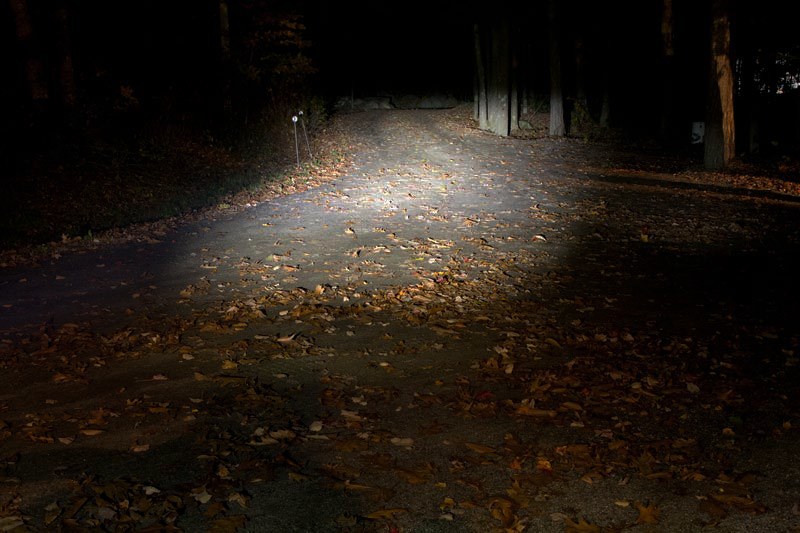
Here's an image from this year's dynamo light (The Luxos U - $160 to $240 depending on model) -
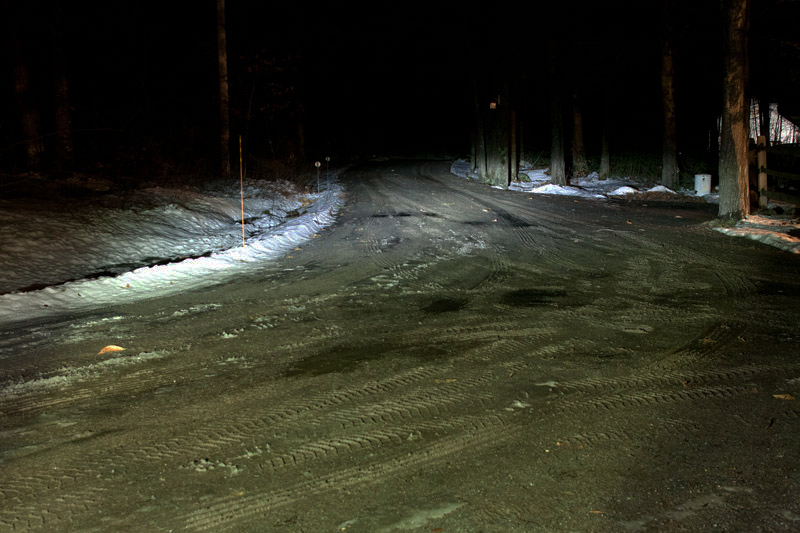
(Images from Peter White's site - note that it's not greenish in person, it's just a camera white balance problem).
These images are a little brighter and clearer than you'd see in real life - but in real life they're better or as good as my battery lights in actual use as well. In order actually beat my battery lights in real use, I have to run a Sec 900 on high and Seca 1400 on medium - 2 batteries, very expensive, and blinding even for some cars.
If someone wants to be as cheap as possible in the short term while still having enough light to ride with, a battery light is the way to go. If someone wants the least daily-hassle light to use, a dynamo is better.
Buy whatever you want for a light. There are some advantages to battery lights as well, like being able to move it between different bikes. But for a light that "just works" on one bike, with no screwing around with charging, batteries, spare batteries, etc, a dynamo light is better.
Your idea of battery lights being better, is from a time when lights weren't very efficient and you needed batteries to get a decent amount of light.
This is an image of a dynamo light from that time - 2008 -
Clearly this is a "be seen and don't ride to fast" kind of light. I wouldn't have bothered with a dynamo hub if this was all I was getting.
But here's an image from last year with a dynamo light (the Cyo - around $100, I own it) -
Here's an image from this year's dynamo light (The Luxos U - $160 to $240 depending on model) -
(Images from Peter White's site - note that it's not greenish in person, it's just a camera white balance problem).
These images are a little brighter and clearer than you'd see in real life - but in real life they're better or as good as my battery lights in actual use as well. In order actually beat my battery lights in real use, I have to run a Sec 900 on high and Seca 1400 on medium - 2 batteries, very expensive, and blinding even for some cars.
If someone wants to be as cheap as possible in the short term while still having enough light to ride with, a battery light is the way to go. If someone wants the least daily-hassle light to use, a dynamo is better.
06-22-13 | 04:22 PM
#59
Certified Bike Brat
Joined: Jan 2011
Posts: 4,251
Likes: 6
From: Montreal, Quebec
You know, these are specious arguments. If you use an all in one sort of light (i.e. L&M Taz 1200) and if you have the presence of mind (a low bar) to just put it on the charger when you are done, it's much simpler. You don't forget to put your bike away when done, right? I mean, this argument is valid for the sort of person that has difficulty in remembering to come in out of the rain and it's all solved by having an extra battery and having one on the charger.
In addition, you don't have any power loss in propulsion and, while I haven't checked, you don't have the added weight.
As for the arguments about failures of batteries, lights, etc... - those are no different than failures in the rest of the dynamo light or in the light itself. Given that the dynamo is more complex, it's likely to have an MTBF (mean time between failure) that is worse. But for purposes of discussion, I think it could generously be stipulated to be the same and in practice would be found to be pretty similar. Either way, one would be foolish to ride without a backup light given the safety consequences of not having light when or if one or the other system fails.
Cold weather riding - again, no big deal. A little heat pack in the battery pack (those iron based air ones) work very well for long rides, or having a cord and keeping the battery in your jacket. Even then, batteries are amazingly resilient in cold weather and I have some considerable experience with this as a ski patroller - lights and radios as well as cordless drills (hazard marking) will hold up very well down to very low temps. True for chemistries like NiMH (drills and radios), radios and lights (li-ion or NiMH). Yes, there is a loss, but it's easily compensated by an extra battery carried in your jacket. Most of the bike lights have very small batteries where this is just not a problem.
Then the dynamo system fails badly when it comes to cost - custom built wheel etc...
So, again, I don't see the attractiveness of a dynamo system unless one is someplace or has some application where recharging is not an option. It's driven by a time when batteries were not available and battery driven lights were not as bright.
J.
In addition, you don't have any power loss in propulsion and, while I haven't checked, you don't have the added weight.
As for the arguments about failures of batteries, lights, etc... - those are no different than failures in the rest of the dynamo light or in the light itself. Given that the dynamo is more complex, it's likely to have an MTBF (mean time between failure) that is worse. But for purposes of discussion, I think it could generously be stipulated to be the same and in practice would be found to be pretty similar. Either way, one would be foolish to ride without a backup light given the safety consequences of not having light when or if one or the other system fails.
Cold weather riding - again, no big deal. A little heat pack in the battery pack (those iron based air ones) work very well for long rides, or having a cord and keeping the battery in your jacket. Even then, batteries are amazingly resilient in cold weather and I have some considerable experience with this as a ski patroller - lights and radios as well as cordless drills (hazard marking) will hold up very well down to very low temps. True for chemistries like NiMH (drills and radios), radios and lights (li-ion or NiMH). Yes, there is a loss, but it's easily compensated by an extra battery carried in your jacket. Most of the bike lights have very small batteries where this is just not a problem.
Then the dynamo system fails badly when it comes to cost - custom built wheel etc...
So, again, I don't see the attractiveness of a dynamo system unless one is someplace or has some application where recharging is not an option. It's driven by a time when batteries were not available and battery driven lights were not as bright.
J.
Last edited by Burton; 06-24-13 at 02:30 AM.
06-23-13 | 11:09 AM
#60
Senior Member
Joined: Feb 2011
Posts: 4,681
Likes: 253
From: Minnesota
Bikes: N+1=5
The range and availability of battery lights that give great output is huge. So is the relative magnitude sale of battery lights to dynamos. Those two facts alone put to rest the idea that battery lights don't "just work" and that they are not reliable nor difficult to use. As well, the market seems to say that they are pretty easy to use or the sales volumes would not be what they are. And there is not a 6-10W loss of power (not at all insignificant), there is no need for custom built wheel and hub (which is heavier rotating weight) etc...
I would expect that dynamos are reliable but I would not expect them to be any more reliable than a simple battery (I'd put the actual light assembly as a wash). I would also point out they are full of single points of failure as a mechanism both the dynamo it's self and various parts in the dynamo. A battery light can cover the single point of failure issue by carrying an extra battery. One cannot carry an extra dynamo hubbed wheel.
So, it remains that other than fascination with the gadget, I don't see the benefit of a dynamo in the predominance of bike lighting applications except where there is no ability to charge a battery.
FWIW, having taken countless beamshots myself, and being an amateur photographer, I well understand that I can make pretty much any beamshot look how I want it to look by fiddling with the exposure. But, even presuming those are the exactly representative beamshots, it's pretty simple to get a decent light with a great beam these days in the battery camp - and you'd have more choices than you'd probably want to look at.
J.
I would expect that dynamos are reliable but I would not expect them to be any more reliable than a simple battery (I'd put the actual light assembly as a wash). I would also point out they are full of single points of failure as a mechanism both the dynamo it's self and various parts in the dynamo. A battery light can cover the single point of failure issue by carrying an extra battery. One cannot carry an extra dynamo hubbed wheel.
So, it remains that other than fascination with the gadget, I don't see the benefit of a dynamo in the predominance of bike lighting applications except where there is no ability to charge a battery.
FWIW, having taken countless beamshots myself, and being an amateur photographer, I well understand that I can make pretty much any beamshot look how I want it to look by fiddling with the exposure. But, even presuming those are the exactly representative beamshots, it's pretty simple to get a decent light with a great beam these days in the battery camp - and you'd have more choices than you'd probably want to look at.
J.
06-23-13 | 08:28 PM
#61
Certified Bike Brat
Joined: Jan 2011
Posts: 4,251
Likes: 6
From: Montreal, Quebec
Already posted multiple pages of photos and details. I'm sure you can dig it up if you look. But this is the latest installation on another bike:

This is a beamshot of a conventional bike light:

and this is what I prefer to ride with myself:

I didn't bother playing with the exposures. All the shots were taken with an iPhone. I'm sure any reasonable people can see the differences in horizontal coverage and decide if they're important to them or not. The vertical coverage is identical. The target circle is 100 feet across.
This is a beamshot of a conventional bike light:
and this is what I prefer to ride with myself:
I didn't bother playing with the exposures. All the shots were taken with an iPhone. I'm sure any reasonable people can see the differences in horizontal coverage and decide if they're important to them or not. The vertical coverage is identical. The target circle is 100 feet across.
06-23-13 | 11:55 PM
#62
Senior Member
Joined: Mar 2012
Posts: 239
Likes: 0
From: jakarta, ID
Bikes: "26" kona kula watt team carbon, "700c" colnago CLX, "700" colnago c59
Cateye EL-540 use for 5 month now using aa battery sanyo xxx, is very convienient and not blind cars from opposite site. In high mode can run about 3hr+ more than cat eye said, minus thing is to bulky.
06-24-13 | 12:35 AM
#63
Senior Member
Joined: Jul 2008
Posts: 6,431
Likes: 44
From: Minneapolis, MN
The range and availability of battery lights that give great output is huge. So is the relative magnitude sale of battery lights to dynamos. Those two facts alone put to rest the idea that battery lights don't "just work" and that they are not reliable nor difficult to use. As well, the market seems to say that they are pretty easy to use or the sales volumes would not be what they are. And there is not a 6-10W loss of power (not at all insignificant), there is no need for custom built wheel and hub (which is heavier rotating weight) etc...
I would expect that dynamos are reliable but I would not expect them to be any more reliable than a simple battery (I'd put the actual light assembly as a wash). I would also point out they are full of single points of failure as a mechanism both the dynamo it's self and various parts in the dynamo. A battery light can cover the single point of failure issue by carrying an extra battery. One cannot carry an extra dynamo hubbed wheel.
So, it remains that other than fascination with the gadget, I don't see the benefit of a dynamo in the predominance of bike lighting applications except where there is no ability to charge a battery.
FWIW, having taken countless beamshots myself, and being an amateur photographer, I well understand that I can make pretty much any beamshot look how I want it to look by fiddling with the exposure. But, even presuming those are the exactly representative beamshots, it's pretty simple to get a decent light with a great beam these days in the battery camp - and you'd have more choices than you'd probably want to look at.
J.
I would expect that dynamos are reliable but I would not expect them to be any more reliable than a simple battery (I'd put the actual light assembly as a wash). I would also point out they are full of single points of failure as a mechanism both the dynamo it's self and various parts in the dynamo. A battery light can cover the single point of failure issue by carrying an extra battery. One cannot carry an extra dynamo hubbed wheel.
So, it remains that other than fascination with the gadget, I don't see the benefit of a dynamo in the predominance of bike lighting applications except where there is no ability to charge a battery.
FWIW, having taken countless beamshots myself, and being an amateur photographer, I well understand that I can make pretty much any beamshot look how I want it to look by fiddling with the exposure. But, even presuming those are the exactly representative beamshots, it's pretty simple to get a decent light with a great beam these days in the battery camp - and you'd have more choices than you'd probably want to look at.
J.
06-24-13 | 01:05 AM
#64

Senior Member

Joined: Feb 2005
Posts: 2,584
Likes: 107
From: Scranton, PA, USA
Bikes: '77 Centurion "Pro Tour"; '67 Carlton "The Flyer"; 1984 Ross MTB (stored at parents' house)
I've been using the Sanyo, probably the cheapest Dynohub, and I haven't noticed the slight increase in weight, the drag, or the tiny increase in moment of inertia in practice.
To be difficult about these things makes no sense to me, since I take great pride in being the source of my own energy. If I really wanted to conserve the calories burned by those 8-10 watts of output, I'd be burning dinosaur carcasses rather than burritos.
There's no need to buy terribly expensive stuff and build your own wheel, either. There's a seller on E-Bay who has a $95 wheel with the Sanyo, shipped. I'm sure it'll lead me down the path of upgrading, but I'm going to hold onto this wheel for a low budget commuter build down the road.
I'm not sure it's the answer for everyone, but I think the market share has been depressed by the historical problems the systems faced when they were powering light bulbs and some of the misconceptions that should be quelled by the capacitance in the standlight features. Even after short rides I have to discharge the capacitor with a conductor after returning home to my apartment because the rear, with no switch, will stay lit for 10-15 minutes of bright red light and makes my place like a disco lounge. Modern LED technology, the attendant electronics, optics and manufacturing have done wonders for these systems. I recall looking about 7-8 years ago and just buying a high power halogen lamp. When I looked again this year (mostly because I'm interested in solid state electronics and LEDs in particular, since I've been making solar cells for the past 5 years or so) I was absolutely shocked and disappointed I hadn't done the switch sooner.
To be difficult about these things makes no sense to me, since I take great pride in being the source of my own energy. If I really wanted to conserve the calories burned by those 8-10 watts of output, I'd be burning dinosaur carcasses rather than burritos.
There's no need to buy terribly expensive stuff and build your own wheel, either. There's a seller on E-Bay who has a $95 wheel with the Sanyo, shipped. I'm sure it'll lead me down the path of upgrading, but I'm going to hold onto this wheel for a low budget commuter build down the road.
I'm not sure it's the answer for everyone, but I think the market share has been depressed by the historical problems the systems faced when they were powering light bulbs and some of the misconceptions that should be quelled by the capacitance in the standlight features. Even after short rides I have to discharge the capacitor with a conductor after returning home to my apartment because the rear, with no switch, will stay lit for 10-15 minutes of bright red light and makes my place like a disco lounge. Modern LED technology, the attendant electronics, optics and manufacturing have done wonders for these systems. I recall looking about 7-8 years ago and just buying a high power halogen lamp. When I looked again this year (mostly because I'm interested in solid state electronics and LEDs in particular, since I've been making solar cells for the past 5 years or so) I was absolutely shocked and disappointed I hadn't done the switch sooner.
06-24-13 | 06:57 AM
#65

Mad bike riding scientist
Joined: Nov 2004
Posts: 29,139
Likes: 6,196
From: Denver, CO
Bikes: Some silver ones, a red one, a black and orange one, and a few titanium ones
Your idea of battery lights being better, is from a time when lights weren't very efficient and you needed batteries to get a decent amount of light.
Clearly this is a "be seen and don't ride to fast" kind of light. I wouldn't have bothered with a dynamo hub if this was all I was getting.
But here's an image from last year with a dynamo light (the Cyo - around $100, I own it) -
Here's an image from this year's dynamo light (The Luxos U - $160 to $240 depending on model) -
(Images from Peter White's site - note that it's not greenish in person, it's just a camera white balance problem).
These images are a little brighter and clearer than you'd see in real life - but in real life they're better or as good as my battery lights in actual use as well. In order actually beat my battery lights in real use, I have to run a Sec 900 on high and Seca 1400 on medium - 2 batteries, very expensive, and blinding even for some cars.
If someone wants to be as cheap as possible in the short term while still having enough light to ride with, a battery light is the way to go. If someone wants the least daily-hassle light to use, a dynamo is better.
There is also the problem of multiple lights on multiple bikes. Even $160 adds up if you want to use more than one bike for commuting. I have 7, with several different wheel configurations so I would need several dynamo hubs and several light systems compared to the ease of simply moving the light from bike to bike.
Dynamo systems also suffer from some other problems such as a lack of ability to use multiple lamps, especially a helmet mounted lamp. The cord from a helmet light to a Camelbak is hard enough to deal with, I couldn't imagine a cord running down to the bike.
But let's not what drives light innovation and has since the mid90s...off-road use. Commuters reap the benefit of the technology but the technology isn't made for us. Dynamo systems just don't work for off-road use where you might have to stop for a trail object or where you might be traveling at slow (<3 mph) speed or you might have to walk and/or carry your bike some distance. Dynamos just aren't practical there so there is little incentive to work on their development.
__________________
Stuart Black
Dreamin' of Bemidji Down the Mississippi (in part)
Plan Epsilon Around Lake Michigan in the era of Covid
Gold Fever Three days of dirt in Colorado
Pokin' around the Poconos A cold ride around Lake Erie
Dinosaurs in Colorado A mountain bike guide to the Purgatory Canyon dinosaur trackway
Solo Without Pie. The search for pie in the Midwest.
Picking the Scablands. Washington and Oregon, 2005. Pie and spiders on the Columbia River!
Stuart Black
Dreamin' of Bemidji Down the Mississippi (in part)
Plan Epsilon Around Lake Michigan in the era of Covid
Gold Fever Three days of dirt in Colorado
Pokin' around the Poconos A cold ride around Lake Erie
Dinosaurs in Colorado A mountain bike guide to the Purgatory Canyon dinosaur trackway
Solo Without Pie. The search for pie in the Midwest.
Picking the Scablands. Washington and Oregon, 2005. Pie and spiders on the Columbia River!
06-24-13 | 09:58 AM
#66
Senior Member
Joined: Feb 2011
Posts: 1,123
Likes: 49
Bikes: 29er commuter/tourer, 26er commuter/tourer, folding mixed-mode commuter
Fair point. Some lights are easier to switch between bikes than others. But often, two different bikes see different typical speeds or riding environments, in which case a single light won't be well suited for both bikes. It isn't as easy as selecting a brighter mode. Different riding speeds and environments require (optimally) different beam shapes, which is typically beyond the capability of a single light.
I have lots of time and money invested in my battery powered lights. I love them. I have over $200 invested in just the rechargeable cells that I use regularly. Still, I can think of very few good reasons to choose a battery powered light of a generator powered light on an on-road bike.
One would be the ease and quickness with which some battery powered lights can be removed from the bike. (For me, this is a positive, but it's a negative if one doesn't actually remove the lights when not riding the bike.) A "permanently" mounted light is not as theft resistant as a light that the owner removes from the bike when not in use, if the owner actually removes it.
Another reason is that a battery powered light, particularly a good flashlight (or two) mounted to the bar is quite useful when off the bike.
Neither reason is compelling.
06-24-13 | 10:15 AM
#67

Señior Member
Joined: Sep 2005
Posts: 13,748
Likes: 10
From: Michigan
Bikes: Windsor Fens, Giant Seek 0 (2014, Alfine 8 + discs)
It's easy enough to find bright lights for $30, but that doesn't make them good bike lights. At that price point, a bike light if far more likely to be junk than not. The CCT is likely to be way too high, and the electronics are unlikely to be potted. At that price point, many lights will have poor thermal management (a very big deal for bright LEDs). Those lights aren't going to provide a beam nearly as good, or as well suited for cycling, as a quality generator light.
__________________
Work: the 8 hours that separates bike rides.
Work: the 8 hours that separates bike rides.
06-24-13 | 10:28 AM
#68
Senior Member
Joined: Feb 2011
Posts: 1,123
Likes: 49
Bikes: 29er commuter/tourer, 26er commuter/tourer, folding mixed-mode commuter
For some speeds and environments, the old MagicShines are fine. It wouldn't work for me, personally, but for some riders it might be a good choice.
Potted electronics increase the reliability of the light, particularly in a high vibration application such as cycling. Potting does make some repairs impossible, though most people lack the tools and/or knowledge to make such repairs.
Potted electronics increase the reliability of the light, particularly in a high vibration application such as cycling. Potting does make some repairs impossible, though most people lack the tools and/or knowledge to make such repairs.
06-24-13 | 11:04 AM
#69
Certified Bike Brat
Joined: Jan 2011
Posts: 4,251
Likes: 6
From: Montreal, Quebec
Multiple bikes represent a challenge for lights? Why isn't it a challenge for tires? Or shifters? Or seats? Or wheelsets? Or suspension systems? Or anything else? I'm currently running more than five bikes myself and the lighting system is pretty much the cheapest component I have to consider. Personally if I needed permanent lighting systems on any bike and generators were the choice - they've all have generators. If I wanted battery systems - they'd all have their own batteries and lights. I occasionally lend stuff out for group rides and it means everyone is properly equipped.
06-24-13 | 11:35 AM
#71
Senior Member
Joined: Feb 2011
Posts: 1,123
Likes: 49
Bikes: 29er commuter/tourer, 26er commuter/tourer, folding mixed-mode commuter
Different environments (optimally) require different beam profiles.
One can certainly use one light on every bike they ride, but it is a compromise, much like how most riders could get by with only one bike, even though a dedicated bike for each ride type (e.g., road riding or mountain biking) would be better (provided owning multiple bikes is an option).
One can certainly use one light on every bike they ride, but it is a compromise, much like how most riders could get by with only one bike, even though a dedicated bike for each ride type (e.g., road riding or mountain biking) would be better (provided owning multiple bikes is an option).
06-24-13 | 11:36 AM
#72
Senior Member
Joined: Feb 2011
Posts: 1,123
Likes: 49
Bikes: 29er commuter/tourer, 26er commuter/tourer, folding mixed-mode commuter
06-24-13 | 12:41 PM
#73
Senior Member
Joined: Jul 2008
Posts: 6,431
Likes: 44
From: Minneapolis, MN
The original question posted by Aznman was about cheap and bright light systems which, I think, has been adequately answered. I'm not adverse to spending money on bikes and bike equipment but I don't consider $160 to $240 to fall into that category. It's very difficult to compete with bright lights that cost less than $30.
There is also the problem of multiple lights on multiple bikes. Even $160 adds up if you want to use more than one bike for commuting. I have 7, with several different wheel configurations so I would need several dynamo hubs and several light systems compared to the ease of simply moving the light from bike to bike.
Dynamo systems also suffer from some other problems such as a lack of ability to use multiple lamps, especially a helmet mounted lamp. The cord from a helmet light to a Camelbak is hard enough to deal with, I couldn't imagine a cord running down to the bike.
But let's not what drives light innovation and has since the mid90s...off-road use. Commuters reap the benefit of the technology but the technology isn't made for us. Dynamo systems just don't work for off-road use where you might have to stop for a trail object or where you might be traveling at slow (<3 mph) speed or you might have to walk and/or carry your bike some distance. Dynamos just aren't practical there so there is little incentive to work on their development.
There is also the problem of multiple lights on multiple bikes. Even $160 adds up if you want to use more than one bike for commuting. I have 7, with several different wheel configurations so I would need several dynamo hubs and several light systems compared to the ease of simply moving the light from bike to bike.
Dynamo systems also suffer from some other problems such as a lack of ability to use multiple lamps, especially a helmet mounted lamp. The cord from a helmet light to a Camelbak is hard enough to deal with, I couldn't imagine a cord running down to the bike.
But let's not what drives light innovation and has since the mid90s...off-road use. Commuters reap the benefit of the technology but the technology isn't made for us. Dynamo systems just don't work for off-road use where you might have to stop for a trail object or where you might be traveling at slow (<3 mph) speed or you might have to walk and/or carry your bike some distance. Dynamos just aren't practical there so there is little incentive to work on their development.
 (Wait...if there's zombies the torch might have the advantage... )
The OP asked -
"For night commuting, most people would say this: don't just go for good lights, go for great lights...So what is the cheapest great quality lights that will last a long time? Should it use battery, or should it use other energy sources?"
The no-maintenance aspect of a dynamo light, and it's better beam pattern for road and trail riding might be worth the money for the OP, or it might not. But it definitely sounds like it's worth mentioning.
06-24-13 | 01:18 PM
#74
Senior Member
Joined: Nov 2008
Posts: 7,239
Likes: 8
From: Bay Area, Calif.
What light 'requires' that you take it off each time you lock up? I rarely do and have only had one light stolen - it was a dynamo light. My battery lights have never been touched.
06-24-13 | 06:44 PM
#75
Senior Member
Joined: Jul 2008
Posts: 6,431
Likes: 44
From: Minneapolis, MN
You're the first person I've heard of who's had a dynamo light stolen. It's certainly not impossible, and I know some more recent dynamo lights come with special screw heads to make it even more difficult. Unfortunately, at a certain point almost anything can be stolen off your bike - your derailler, handlebars, etc, are all just held on by screws.
I can see a point that if you're leaving your bike locked up outside in a super sketchy neighborhood at night, maybe you need the ability to remove the light, which most dynamo lights usually don't have. Personally I'm able to just never leave my bike locked up anywhere like that, but it's not always an option for everyone.
Last edited by PaulRivers; 06-24-13 at 07:27 PM.

