


Camera mounting question
 08-31-17 | 12:44 PM
#1

Thread Starter
Senior Member
Joined: Aug 2017
Posts: 2,114
Likes: 239
From: Mid Atlantic / USA
Bikes: 2017 Specialized Crosstrail / 2013 Trek Crossrip Elite
Camera mounting question
For those of you who have forward facing bike mounted cameras (not helmet cams) do you mount them to the frame or to the handlebars?
Does it matter?
I figured the frame would be a more stable option, but it's a little harder to do. The handlebars move more so I'm wondering if you get too much wobble and shaking.
Or am I overthinking this and is doesn't really matter as long as the camera is aimed forward?
Does it matter?
I figured the frame would be a more stable option, but it's a little harder to do. The handlebars move more so I'm wondering if you get too much wobble and shaking.
Or am I overthinking this and is doesn't really matter as long as the camera is aimed forward?
 08-31-17 | 04:08 PM
#2

Me duelen las nalgas

Joined: Aug 2015
Posts: 13,519
Likes: 2,832
From: Texas
Bikes: Centurion Ironman, Trek 5900, Univega Via Carisma, Globe Carmel
Handlebar on my hybrids, stem on the road bike. I use mine for traffic documentation. If I'm stopped I can aim the camera toward a potential problem. That's harder to do with the camera mounted on the head tube or elsewhere on the frame.
However the handlebar mounted camera can't readily be aimed while moving, unless I physically move the camera on the ballhead mount. But I need to crank the ballhead mount very tightly to prevent creeping so it's a compromise. Usually I leave the camera/mount in one position.
Image stability depends on the road. On smooth pavement it's fine. Not too bad on our crushed limestone MUP and most passable gravel roads. It's worst on chipseal and striated concrete. I doubt any rigid mount could ensure vibration-free videos on chipseal. I'm pretty sure my camera has built in vibration reduction, although I don't know whether it's sensor based, lens based or software. There's a slight jello effect in videos recorded on really rough pavement, but better than YouTube's optional software stabilization, which often produces a hallucinogenic jello warp drive effect.
There are spring loaded or shock absorbing type mounts designed to reduce vibration, although the main effect appears to be protecting electronics from vibration damage, not improving video stability. A Steadicam type floating mount would need to be impractically bulky for normal bike riding.
Some of the most serious commuters who feel the need to record their rides have front and rear bike mounted cams and helmet cams. This seems to be more common in urban areas with streets that are too narrow for the heavy traffic volume and/or vehicle speed. Some cities in England seem to have this problem, and some YouTubers post their worst encounters, demonstrating various angles from two or three cameras.
For recording fine details in typical US license plates you need 60 fps or faster, and either bright enough light to force a fast shutter speed, or good enough low light sensitivity and wide dynamic range to record details at night. My Ion Speed Pro is fine in daylight but mediocre at night. Noise and poor dynamic range obscure fine detail, so all I can usually record is the shape, color and general image of a car. The license plates are usually blown out featureless white because Texas plates are reflective white.
I don't know if any action cams can do much better. We'd need a Sony one-inch type sensor for better nighttime performance with lower noise and better dynamic range. I don't see that happening anytime soon. Most action cams still use compromised teensy sensors, which do offer the advantage of depth of field to record more from near to far in reasonably sharp focus. And some dash cams have good low light performance, although they aren't designed for bicycles and aren't weatherproof as-is.
However the handlebar mounted camera can't readily be aimed while moving, unless I physically move the camera on the ballhead mount. But I need to crank the ballhead mount very tightly to prevent creeping so it's a compromise. Usually I leave the camera/mount in one position.
Image stability depends on the road. On smooth pavement it's fine. Not too bad on our crushed limestone MUP and most passable gravel roads. It's worst on chipseal and striated concrete. I doubt any rigid mount could ensure vibration-free videos on chipseal. I'm pretty sure my camera has built in vibration reduction, although I don't know whether it's sensor based, lens based or software. There's a slight jello effect in videos recorded on really rough pavement, but better than YouTube's optional software stabilization, which often produces a hallucinogenic jello warp drive effect.
There are spring loaded or shock absorbing type mounts designed to reduce vibration, although the main effect appears to be protecting electronics from vibration damage, not improving video stability. A Steadicam type floating mount would need to be impractically bulky for normal bike riding.
Some of the most serious commuters who feel the need to record their rides have front and rear bike mounted cams and helmet cams. This seems to be more common in urban areas with streets that are too narrow for the heavy traffic volume and/or vehicle speed. Some cities in England seem to have this problem, and some YouTubers post their worst encounters, demonstrating various angles from two or three cameras.
For recording fine details in typical US license plates you need 60 fps or faster, and either bright enough light to force a fast shutter speed, or good enough low light sensitivity and wide dynamic range to record details at night. My Ion Speed Pro is fine in daylight but mediocre at night. Noise and poor dynamic range obscure fine detail, so all I can usually record is the shape, color and general image of a car. The license plates are usually blown out featureless white because Texas plates are reflective white.
I don't know if any action cams can do much better. We'd need a Sony one-inch type sensor for better nighttime performance with lower noise and better dynamic range. I don't see that happening anytime soon. Most action cams still use compromised teensy sensors, which do offer the advantage of depth of field to record more from near to far in reasonably sharp focus. And some dash cams have good low light performance, although they aren't designed for bicycles and aren't weatherproof as-is.
08-31-17 | 04:45 PM
#3

Senior Member
Joined: Oct 2014
Posts: 261
Likes: 0
From: SF East Bay
Bikes: Cevelo R5, Spyder Bike, Fuji Rubaix Pro,Gary Fisher Sugar
For those of you who have forward facing bike mounted cameras (not helmet cams) do you mount them to the frame or to the handlebars?
Does it matter?
I figured the frame would be a more stable option, but it's a little harder to do. The handlebars move more so I'm wondering if you get too much wobble and shaking.
Or am I overthinking this and is doesn't really matter as long as the camera is aimed forward?
Does it matter?
I figured the frame would be a more stable option, but it's a little harder to do. The handlebars move more so I'm wondering if you get too much wobble and shaking.
Or am I overthinking this and is doesn't really matter as long as the camera is aimed forward?
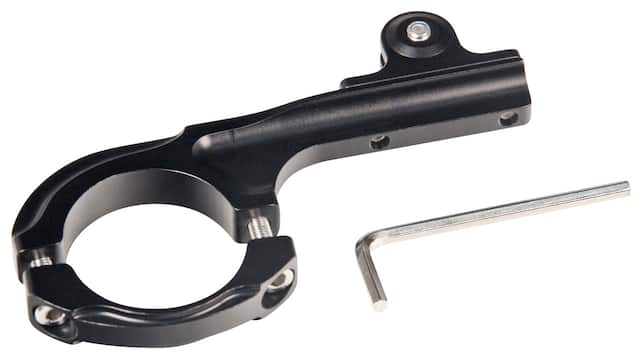
If you like bars in the frame. I like this because you can see when brake and shift.

Or the clean look mount it under the computer



 08-31-17 | 07:42 PM
#5
- Soli Deo Gloria -
Joined: Aug 2015
Posts: 14,779
Likes: 743
From: Northwest Georgia
Bikes: 2018 Rodriguez Custom Fixed Gear, 2017 Niner RLT 9 RDO, 2015 Bianchi Pista, 2002 Fuji Robaix
For road riding, my experience is that a mount which attaches to the bike with as little flex as possible provides the most stable image. It seems counter-intuitive but mounts with rubber bushings or any cushioning amplify vibration.
I use a NUT-R mount which turns with the wheel.

The Barfly mount pictured below with a light instead of a GoPro also turns with steering input.

I use a NUT-R mount which turns with the wheel.
The Barfly mount pictured below with a light instead of a GoPro also turns with steering input.
09-01-17 | 08:44 AM
#6

Senior Member


Joined: Jul 2008
Posts: 30,446
Likes: 4,535
From: 25 miles northwest of Boston
Bikes: Bottecchia Sprint, GT Timberline 29r, Marin Muirwoods 29er, Trek FX Alpha 7.0
I alternate between bars & helmet & even hand hold sometimes for effect
Last edited by rumrunn6; 03-07-18 at 02:44 PM.


