


Schwinn Bike Computer HELP!!!!
 09-16-08 | 08:57 PM
#1
Thread Starter
Newbie
Joined: Sep 2008
Posts: 2
Likes: 0
Schwinn Bike Computer HELP!!!!
So I bought one of those 12 function bike computers made by schwinn. My tires are 26x2.3. So what should my wheel factor be. It says to multiply the wheel diameter in milimeters by 3.1416. I gave the chart below but I want it as accurate as possible.
Thanks in advance!!!
Schwinn Bike Computer Wheel Size numbers
Wheel Diameter Number
20" 1596
22" 1759
24" 1916
26" (650A) 2073
26.5" (Tubular) 2117
26.6" (700x25C) 2124
26.8" (700x28C) 2136
27" (700x32C) 2155
28" (700B) 2237
w/ tire
ATB 24X1.75 1888
ATB 26x1.4 1995
ATB 26x1.5 2030
ATB 26x1.75 2045
ATB 26x2 (650B) 2099
27x1 2136
27x1 1/4 2155
Thanks in advance!!!
Schwinn Bike Computer Wheel Size numbers
Wheel Diameter Number
20" 1596
22" 1759
24" 1916
26" (650A) 2073
26.5" (Tubular) 2117
26.6" (700x25C) 2124
26.8" (700x28C) 2136
27" (700x32C) 2155
28" (700B) 2237
w/ tire
ATB 24X1.75 1888
ATB 26x1.4 1995
ATB 26x1.5 2030
ATB 26x1.75 2045
ATB 26x2 (650B) 2099
27x1 2136
27x1 1/4 2155
Last edited by Binski99`; 09-17-08 at 06:01 PM.
 09-16-08 | 09:14 PM
#2

Strong with the Fred
Joined: May 2008
Posts: 970
Likes: 2
From: Dallas, TX
I have a newer schwinn computer and an older one that lists a size of Wheel diameter w/tire: 26x2 (650B)- Wheel factor: 2099. That looks to be the closest, hope that helps.
Ernest
PS: Wonder if your list is a misprint since it says that factor for a 23x2 is 2099 which wouldn't really make sense. Now that I read both of my lists closely, they both say the same thing with the 26x2 wheel. Yours must be a misprint. 26x2 is the closest to your wheel with tire size.
Ernest
PS: Wonder if your list is a misprint since it says that factor for a 23x2 is 2099 which wouldn't really make sense. Now that I read both of my lists closely, they both say the same thing with the 26x2 wheel. Yours must be a misprint. 26x2 is the closest to your wheel with tire size.
Last edited by Big_e; 09-16-08 at 09:22 PM.
09-16-08 | 09:22 PM
#3

Senior Member

Joined: Jul 2002
Posts: 6,956
Likes: 6
but I want it as accurate as possible.
The usual method is to make a mark on the tire, align the mark to a starting mark on the floor, then roll forward until the mark on the tire is pointing at the floor again, jump off, and mark the floor with your ending point. Now measure the distance between the starting and ending marks.
09-16-08 | 11:56 PM
#5
Senior Member
Joined: Jul 2002
Posts: 6,956
Likes: 6
 09-17-08 | 07:30 PM
#7
Strong with the Fred
Joined: May 2008
Posts: 970
Likes: 2
From: Dallas, TX
Ernest
09-17-08 | 07:51 PM
#8
Senior Member
Joined: Jul 2002
Posts: 6,956
Likes: 6
Absolutely certain, yeah
 It's a question I have to answer a lot (LBS mechanic since 1989).
 If the computer were trying to detect the linear velocity at which the magnet is travelling, then it would matter, because the further out the magnet is located, the faster its linear velocity. But that's not how the computer computes speed. It looks at the frequency of sensor impulses, which is independent of the magnet's location on the spoke. For a given ground speed, any point on the spoke will pass by the sensor at the same frequency.
And that's a good thing, or else it would be very difficult to set up bike computers accurately!
On a separate note, I like to put the magnet at the crossing point of the spokes too, for wired computers (for wireless, I put the sensor as close to the bars as possible). Many spoke magnets can engage two spokes at the crossing point, keeping the magnet from getting bumped out of position as time goes by.
Last edited by mechBgon; 09-17-08 at 07:55 PM.
09-17-08 | 08:49 PM
#9

747 Freight Pilot
Joined: Aug 2008
Posts: 458
Likes: 0
From: Ohio, USA
Bikes: Rivendell, Bike-Friday Pocket-Rocket and one home made fixed gear
All you are doing is multiplying diameter by 3.14 (aka "Pie") to get circumference. Basic math. Some computers want centimeters, some want millimeters, others want some goofy formula. Your's just wants millimeters which is not uncommon. A roll out test will give you the most accurate results.
But for future reference, Sheldon Brown has a master-chart of most all wheel sizes.
https://sheldonbrown.com/cyclecomputer-calibration.html
In your case...use column "F"
Don't get too anal about this. Even if you only use the chart instead of a roll out, you still have better accuracy than the speedometer/odometer on most autos. FWIW .... I just use charts myself.
But for future reference, Sheldon Brown has a master-chart of most all wheel sizes.
https://sheldonbrown.com/cyclecomputer-calibration.html
In your case...use column "F"
Don't get too anal about this. Even if you only use the chart instead of a roll out, you still have better accuracy than the speedometer/odometer on most autos. FWIW .... I just use charts myself.
09-17-08 | 09:49 PM
#10
Senior Member
Joined: Aug 2008
Posts: 73
Likes: 0
Absolutely certain, yeah It's a question I have to answer a lot (LBS mechanic since 1989).
If the computer were trying to detect the linear velocity at which the magnet is travelling, then it would matter, because the further out the magnet is located, the faster its linear velocity. But that's not how the computer computes speed. It looks at the frequency of sensor impulses, which is independent of the magnet's location on the spoke. For a given ground speed, any point on the spoke will pass by the sensor at the same frequency.
And that's a good thing, or else it would be very difficult to set up bike computers accurately!
On a separate note, I like to put the magnet at the crossing point of the spokes too, for wired computers (for wireless, I put the sensor as close to the bars as possible). Many spoke magnets can engage two spokes at the crossing point, keeping the magnet from getting bumped out of position as time goes by.
It's a question I have to answer a lot (LBS mechanic since 1989). If the computer were trying to detect the linear velocity at which the magnet is travelling, then it would matter, because the further out the magnet is located, the faster its linear velocity. But that's not how the computer computes speed. It looks at the frequency of sensor impulses, which is independent of the magnet's location on the spoke. For a given ground speed, any point on the spoke will pass by the sensor at the same frequency.
And that's a good thing, or else it would be very difficult to set up bike computers accurately!
On a separate note, I like to put the magnet at the crossing point of the spokes too, for wired computers (for wireless, I put the sensor as close to the bars as possible). Many spoke magnets can engage two spokes at the crossing point, keeping the magnet from getting bumped out of position as time goes by.
Hey thanks,
that makes sence. I remember hooking one of these up to my brothers bike years ago and they had you messure a point on the spoke. Good to know that is no longer nessary.
Cheers
09-18-08 | 08:17 AM
#11
Junior Member
Joined: Aug 2008
Posts: 9
Likes: 0
Originally Posted by Sheldon Brown
With one-magnet cyclecomputers, you usually have a choice of several places on the wheel to attach the spoke magnet, depending on the spoke pattern of the wheel. Generally, it is best to mount the magnet as close in toward the hub as possible. The closer in you mount it, the more slowly it will pass by the sensor, giving the sensor's magnetic switch more time to respond. If the magnet is too far out, the computer may give erratic readings at higher speeds.
[emphasis added]
09-18-08 | 09:10 AM
#12
Senior Member
Joined: Jul 2002
Posts: 6,956
Likes: 6
https://sheldonbrown.com/cyclecomputer-installation.html
[emphasis added]
[emphasis added]
Put the magnet where you prefer (unless it's a wireless sensor, in which case I suggest placing it as close to the handlebars as practical, for obvious reasons).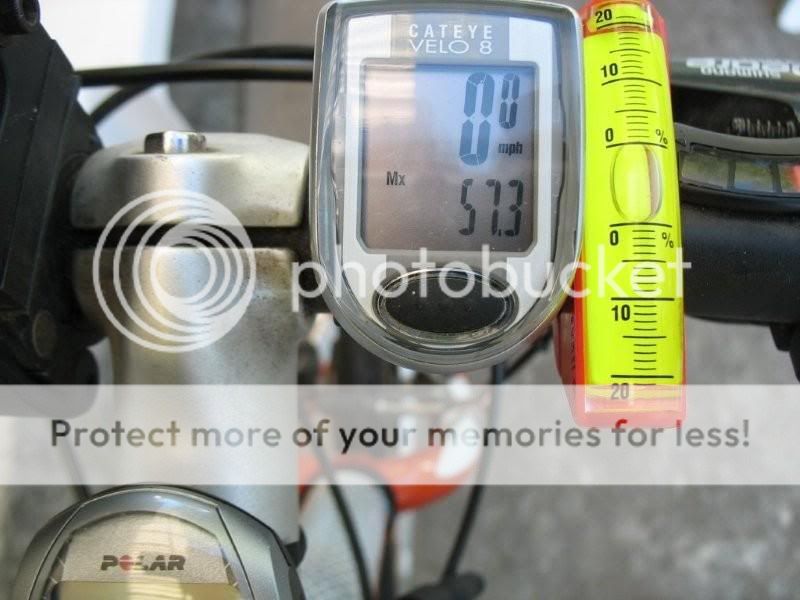
Last edited by mechBgon; 09-18-08 at 09:29 AM.
09-19-10 | 05:57 PM
#13
Newbie
Joined: Sep 2010
Posts: 2
Likes: 0
All the thing does is count the times the wheel goes around so it doesn't matter at all where the magnet is located.
09-22-10 | 06:27 PM
#14

Senior Member

Joined: Dec 2007
Posts: 1,032
Likes: 71
From: Western Ma.
Bikes: Diamondback "parkway" Spec. "expedition
To make sure I had the right #'s in the computer, I found a road marker that started in 0 and rode till I hit 1 mile.
I was a fraction off, not enough to make a difference
I was a fraction off, not enough to make a difference

Thread
Thread Starter
Forum
Replies
Last Post
nutmegTN
Clydesdales/Athenas (200+ lb / 91+ kg)
20
07-10-11 08:38 AM
