


Do you know your FPT?
 01-04-25 | 02:24 PM
#126
Senior Member


Joined: May 2021
Posts: 3,143
Likes: 2,353
From: San Francisco
Bikes: addict, aethos, creo, vanmoof, sirrus, public ...
since all the experts are here … i have always been a little confused about what’s commonly referred to as FTP. i understood that physiologically it was a balanced state between aerobic and anaerobic activity where you’re not producing too much lactate (or whatever else it is) to sustain the effort. but the question is… for how long?
many definitions seem to be the maximum you can do for an hour, but if you crash hard after that hour it’s not really balanced and sustainable, is it?
my power curve is very flat, and the effort i could sustain for 45 minutes is not really much different than 3 hours. if i know without any doubt that i could regularly sustain an uninterrupted average power (not weighted or normalized) of say 200w for 3+ hours, and 225w for 1 hour without feeling too spent, is FTP even knowable from those data points or does it require an all out to the edge of failure effort to discover it?
the idea that FTP represents an unsustainable effort except for the length of time tested seems wrong to me.
many definitions seem to be the maximum you can do for an hour, but if you crash hard after that hour it’s not really balanced and sustainable, is it?
my power curve is very flat, and the effort i could sustain for 45 minutes is not really much different than 3 hours. if i know without any doubt that i could regularly sustain an uninterrupted average power (not weighted or normalized) of say 200w for 3+ hours, and 225w for 1 hour without feeling too spent, is FTP even knowable from those data points or does it require an all out to the edge of failure effort to discover it?
the idea that FTP represents an unsustainable effort except for the length of time tested seems wrong to me.
__________________
 01-04-25 | 02:32 PM
#127

Senior Member
Joined: May 2021
Posts: 11,620
Likes: 7,017
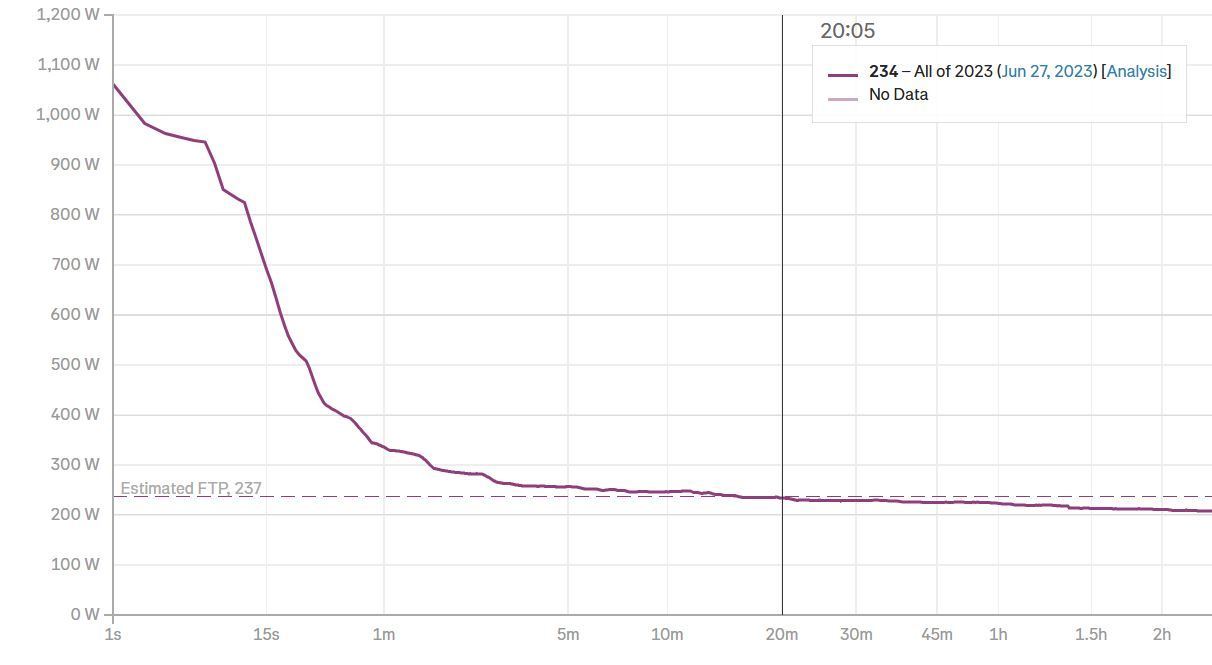
I also use PILLAR which estimates FTP much more consistently using exactly the same input data.
 01-04-25 | 02:48 PM
#128
Senior Member
Joined: May 2021
Posts: 11,620
Likes: 7,017
since all the experts are here … i have always been a little confused about what’s commonly referred to as FTP. i understood that physiologically it was a balanced state between aerobic and anaerobic activity where you’re not producing too much lactate (or whatever else it is) to sustain the effort. but the question is… for how long?
many definitions seem to be the maximum you can do for an hour, but if you crash hard after that hour it’s not really balanced and sustainable, is it?
my power curve is very flat, and the effort i could sustain for 45 minutes is not really much different than 3 hours. if i know without any doubt that i could regularly sustain an uninterrupted average power (not weighted or normalized) of say 200w for 3+ hours, and 225w for 1 hour without feeling too spent, is FTP even knowable from those data points or does it require an all out to the edge of failure effort to discover it?
the idea that FTP represents an unsustainable effort except for the length of time tested seems wrong to me.
many definitions seem to be the maximum you can do for an hour, but if you crash hard after that hour it’s not really balanced and sustainable, is it?
my power curve is very flat, and the effort i could sustain for 45 minutes is not really much different than 3 hours. if i know without any doubt that i could regularly sustain an uninterrupted average power (not weighted or normalized) of say 200w for 3+ hours, and 225w for 1 hour without feeling too spent, is FTP even knowable from those data points or does it require an all out to the edge of failure effort to discover it?
the idea that FTP represents an unsustainable effort except for the length of time tested seems wrong to me.
So those two riders would have quite different 1 hour power, but the same FTP and any training power zones defined from it.
01-04-25 | 02:58 PM
#129
Perceptual Dullard

Joined: Sep 2009
Posts: 2,918
Likes: 1,755
since all the experts are here … i have always been a little confused about what’s commonly referred to as FTP. i understood that physiologically it was a balanced state between aerobic and anaerobic activity where you’re not producing too much lactate (or whatever else it is) to sustain the effort. but the question is… for how long?
many definitions seem to be the maximum you can do for an hour, but if you crash hard after that hour it’s not really balanced and sustainable, is it?
my power curve is very flat, and the effort i could sustain for 45 minutes is not really much different than 3 hours. if i know without any doubt that i could regularly sustain an uninterrupted average power (not weighted or normalized) of say 200w for 3+ hours, and 225w for 1 hour without feeling too spent, is FTP even knowable from those data points or does it require an all out to the edge of failure effort to discover it?
the idea that FTP represents an unsustainable effort except for the length of time tested seems wrong to me.
many definitions seem to be the maximum you can do for an hour, but if you crash hard after that hour it’s not really balanced and sustainable, is it?
my power curve is very flat, and the effort i could sustain for 45 minutes is not really much different than 3 hours. if i know without any doubt that i could regularly sustain an uninterrupted average power (not weighted or normalized) of say 200w for 3+ hours, and 225w for 1 hour without feeling too spent, is FTP even knowable from those data points or does it require an all out to the edge of failure effort to discover it?
the idea that FTP represents an unsustainable effort except for the length of time tested seems wrong to me.
[Edited to add] So I don't pay *a lot* of attention to FTP: I pay *some* attention to it, but only loosely. I pay more attention to what my entire MMP curve looks like, and where it looks unusually low (and increasingly rarely over the years, where it looks unusually high). I think the entirety of the MMP curve tells me more than a single number like FTP. Actually, although I look at the MMP, I don't do much analytically with it: I usually switch into Joules view (from watts view) and do analysis on that.
Last edited by RChung; 01-04-25 at 03:27 PM.
01-04-25 | 03:50 PM
#130
Senior Member
Joined: May 2021
Posts: 3,143
Likes: 2,353
From: San Francisco
Bikes: addict, aethos, creo, vanmoof, sirrus, public ...
...The lactate is steady but you can't exercise indefinitely even with steady lactate. A similar observation applies to CP (critical power): there does appear to be a physiological plateau but it's not an unlimited plateau. So although lactate (and thus FTP) can't tell you the whole story, it can tell you some (a reasonable amount?) of the story. How much of the whole story it tells varies by individual...
since FTP is not a truly indefinite condition, i feel like it should be represented as "FTP60" or something, meaning the threshold of power beyond which the effort cannot be sustained for the time increment referenced. i think that's how most people are using it anyway, and the debate is about which numbers OTHER than an all out ideal circumstance 60 minute to collapse effort can estimate that value.
 01-04-25 | 04:07 PM
#132
Perceptual Dullard
Joined: Sep 2009
Posts: 2,918
Likes: 1,755
since FTP is not a truly indefinite condition, i feel like it should be represented as "FTP60" or something, meaning the threshold of power beyond which the effort cannot be sustained for the time increment referenced. i think that's how most people are using it anyway, and the debate is about which numbers OTHER than an all out ideal circumstance 60 minute to collapse effort can estimate that value.
01-04-25 | 04:29 PM
#133
Senior Member
Joined: May 2021
Posts: 11,620
Likes: 7,017
since FTP is not a truly indefinite condition, i feel like it should be represented as "FTP60" or something, meaning the threshold of power beyond which the effort cannot be sustained for the time increment referenced. i think that's how most people are using it anyway, and the debate is about which numbers OTHER than an all out ideal circumstance 60 minute to collapse effort can estimate that value.
Whether or not you care much about that FTP “state” depends on what you are going to do with it. People typically use it to define training power zones and as a single point fitness tracker. Personally I prefer to look at my whole power curve and prefer the Wahoo 4 point power benchmark, which estimates FTP, but also 3 other points on the power curve.
I think it’s also iworth noting that people rarely go beyond measuring their max 20 min power as an estimate for FTP, which assumes everyone has the same extrapolation factor, often 0.95 x 20 min power. This is clearly not true so at best it is a rough estimate of power in a slightly vague threshold state!
01-04-25 | 08:31 PM
#134
Senior Member
Joined: May 2021
Posts: 3,143
Likes: 2,353
From: San Francisco
Bikes: addict, aethos, creo, vanmoof, sirrus, public ...
I think it's probably mistaken to think of FTP as an indefinite condition. I think a better way to think about FTP is of a real threshold: that if you're 5 watts below FTP you can hold that for considerably longer than you can hold 5 watts above FTP. So FTP isn't really defined in terms of TTE (time to exhaustion), it sort of more like a point where the duration curve changes slope. (It doesn't help that almost all graphical representations of the MMP curve use a log transformed time axis).
I find this hard to rationalise too. But I think you have to think of FTP more in terms of power in a threshold physiological “state” or “balance” rather than power over a fixed time period. Your FTP60 is literally 60 min power, but that could be at or below an individual’s FTP depending on how long they are able to hold their FTP physiological “state”.
Whether or not you care much about that FTP “state” depends on what you are going to do with it. People typically use it to define training power zones and as a single point fitness tracker. Personally I prefer to look at my whole power curve and prefer the Wahoo 4 point power benchmark, which estimates FTP, but also 3 other points on the power curve.
I think it’s also iworth noting that people rarely go beyond measuring their max 20 min power as an estimate for FTP, which assumes everyone has the same extrapolation factor, often 0.95 x 20 min power. This is clearly not true so at best it is a rough estimate of power in a slightly vague threshold state!
Whether or not you care much about that FTP “state” depends on what you are going to do with it. People typically use it to define training power zones and as a single point fitness tracker. Personally I prefer to look at my whole power curve and prefer the Wahoo 4 point power benchmark, which estimates FTP, but also 3 other points on the power curve.
I think it’s also iworth noting that people rarely go beyond measuring their max 20 min power as an estimate for FTP, which assumes everyone has the same extrapolation factor, often 0.95 x 20 min power. This is clearly not true so at best it is a rough estimate of power in a slightly vague threshold state!
01-04-25 | 09:07 PM
#135

Senior Member
Joined: Mar 2024
Posts: 1,948
Likes: 784
From: San Diego
Bikes: Columbine, Lynskey GR300, Paramount Track Bike, Colnago Super (4), Santana Tandems (1995 & 2007), Gary Fisher Piranha (retired), Bianchi Track Bike, a couple of Honda mountain bikes
Newbie question. What is “MMP”?
01-04-25 | 11:25 PM
#137
Perceptual Dullard
Joined: Sep 2009
Posts: 2,918
Likes: 1,755
my interest has always been in the power zones - my heart rate changes relatively little compared to RPE, and when it does it could easily be time of day, caffeine, time since taking meds, a cold, that i had always hoped power based zones would be a consistent guide. but i think the whole concept is somewhat useless if you're not willing or able to do a "maximum effort" for at least 20 min.
01-05-25 | 06:40 AM
#138
Senior Member
Joined: May 2021
Posts: 11,620
Likes: 7,017
my interest has always been in the power zones - my heart rate changes relatively little compared to RPE, and when it does it could easily be time of day, caffeine, time since taking meds, a cold, that i had always hoped power based zones would be a consistent guide. but i think the whole concept is somewhat useless if you're not willing or able to do a "maximum effort" for at least 20 min.
Wahoo addressed this issue with their 4DP test which provides power estimates at 4 points on your power curve, including FTP as the lowest point. It then uses those 4 points to set interval training power zones. I find this much better for setting AC and MAP interval power targets, which would be too low for me based on FTP alone. The 4DP test itself is absolutely brutal!
PILLAR uses a 5 point analysis of your power curve (from sprint to endurance) to set training interval targets and to track and report your progress. Like XERT, it doesn’t require a specific test, as long as your data includes some serious efforts across the power range.
01-08-25 | 01:10 PM
#139
Full Member

Joined: Sep 2015
Posts: 394
Likes: 98
It pegged the FTP at the inflection point after a relatively flat region on the PDC. It's an alternative to testing. Your PDC is incomplete, you didn't ride much, or rode very steady.
02-09-25 | 07:11 AM
#140

Senior Member

Joined: Jan 2006
Posts: 2,443
Likes: 1,999
From: Atlantic Beach Florida
Apparently FTP has fallen out of favor of most professional cyclists. I haven't listened to the video yet, because I'm getting ready to head out on a ride, but hopefully will check it out later.
02-09-25 | 02:46 PM
#141
Gruppetto Bob


Joined: Sep 2020
Posts: 11,512
Likes: 11,717
From: Seattle-ish
Bikes: Orbea Orca, Bianchi Infinito & Campione de Mundo
Have not watched the video yet. For me, FTP is a personal benchmark on fitness versus comparing mine to other people since we all have such different body types, experience, training habits etc.
__________________
“A watt saved is a watt earned” 🚴🏻♂️
 Not a CAT
“A watt saved is a watt earned” 🚴🏻♂️
02-09-25 | 03:43 PM
#142

Senior Member
Joined: Jul 2023
Posts: 2,009
Likes: 1,243
From: "Driftless" WI
Bikes: 1972 Motobecane Grand Record, 2023 Specialized Tarmac SL7,'26 Spesh Diverge, '22 Kona Dew+
While I think FTP has value, making comparisons might lead one down a rabbit hole if not done with caution.
02-10-25 | 07:03 AM
#144
Lurker
Joined: Feb 2025
Posts: 33
Likes: 11
Bikes: Trail429, Anthem, ECR
Yeah, I had to stop watching it after he continued to talk to the 2nd expert about the 1-hour ftp power.
As to the thread topic, I ride mtb with no power meter, but have a stationary bike (with a power meter) I do my zone 2 work, and occasional interval workouts, inside. Since I retired a little over 2 years ago (55 yo now), I've had time to pay some attention to ftp, and way more time to ride my bike, so my ftp is up from 235ish in Jan 2023 to somewhere between 300-325 now.
I was over 325 around Thanksgiving, but had a back/shoulder issue right after, so I backed off to zone 2 only and have been focusing on PT on the back/shoulder. Started riding outside and doing intensity a couple weeks ago, and am pleasantly surprised how quickly I'm getting back up to speed.
As to the thread topic, I ride mtb with no power meter, but have a stationary bike (with a power meter) I do my zone 2 work, and occasional interval workouts, inside. Since I retired a little over 2 years ago (55 yo now), I've had time to pay some attention to ftp, and way more time to ride my bike, so my ftp is up from 235ish in Jan 2023 to somewhere between 300-325 now.
I was over 325 around Thanksgiving, but had a back/shoulder issue right after, so I backed off to zone 2 only and have been focusing on PT on the back/shoulder. Started riding outside and doing intensity a couple weeks ago, and am pleasantly surprised how quickly I'm getting back up to speed.
02-10-25 | 11:16 AM
#145
Gruppetto Bob
Joined: Sep 2020
Posts: 11,512
Likes: 11,717
From: Seattle-ish
Bikes: Orbea Orca, Bianchi Infinito & Campione de Mundo
Yeah, I had to stop watching it after he continued to talk to the 2nd expert about the 1-hour ftp power.
As to the thread topic, I ride mtb with no power meter, but have a stationary bike (with a power meter) I do my zone 2 work, and occasional interval workouts, inside. Since I retired a little over 2 years ago (55 yo now), I've had time to pay some attention to ftp, and way more time to ride my bike, so my ftp is up from 235ish in Jan 2023 to somewhere between 300-325 now.
I was over 325 around Thanksgiving, but had a back/shoulder issue right after, so I backed off to zone 2 only and have been focusing on PT on the back/shoulder. Started riding outside and doing intensity a couple weeks ago, and am pleasantly surprised how quickly I'm getting back up to speed.
As to the thread topic, I ride mtb with no power meter, but have a stationary bike (with a power meter) I do my zone 2 work, and occasional interval workouts, inside. Since I retired a little over 2 years ago (55 yo now), I've had time to pay some attention to ftp, and way more time to ride my bike, so my ftp is up from 235ish in Jan 2023 to somewhere between 300-325 now.
I was over 325 around Thanksgiving, but had a back/shoulder issue right after, so I backed off to zone 2 only and have been focusing on PT on the back/shoulder. Started riding outside and doing intensity a couple weeks ago, and am pleasantly surprised how quickly I'm getting back up to speed.

__________________
“A watt saved is a watt earned” 🚴🏻♂️
Not a CAT
“A watt saved is a watt earned” 🚴🏻♂️
02-10-25 | 11:35 AM
#146
Lurker
Joined: Feb 2025
Posts: 33
Likes: 11
Bikes: Trail429, Anthem, ECR
Nooooo, I just got here! (bikeforums, not 50+) Besides wanting to build a solid base of fitness to hopefully slow the inevitable downward trend, I really just wanted to keep up with my friends, and maybe overshoot a little so my perceived effort to keep up is comfortable. I overshot the overshoot, and may need new friends now .
.
02-10-25 | 12:35 PM
#147

climber has-been
Joined: Dec 2004
Posts: 9,156
Likes: 6,048
From: Palo Alto, CA
Bikes: Scott Addict RC Pro & R1, Felt Z1
I just don't see much value in FTP. I mean, what is the actionable result from knowing what it is? Setting your zones? I don't need an FTP to know where my zones are. Perceived effort is all I need.
Is FTP helpful to show you where your fitness sits? Not super helpful to me. I think the Best Efforts Power Curve is a lot better at that. Mine is telling me that my fitness is off from peak last year (but it's February, so). Or maybe I need to start pushing harder on rides.

Also...
All I have to say to you, MikeMunson , with those power numbers, I sure hope you weigh at least 200 lbs.
Is FTP helpful to show you where your fitness sits? Not super helpful to me. I think the Best Efforts Power Curve is a lot better at that. Mine is telling me that my fitness is off from peak last year (but it's February, so). Or maybe I need to start pushing harder on rides.
Also...
__________________
Ride, Rest, Repeat. ROUVY: terrymorse

Ride, Rest, Repeat. ROUVY: terrymorse
Last edited by terrymorse; 02-10-25 at 12:39 PM.
02-10-25 | 04:40 PM
#148

Senior Member
Joined: Jul 2013
Posts: 2,781
Likes: 511
From: Missouri
Bikes: Giant Propel, Cannondale SuperX, BMC Time Machine, Univega Alpina Ultima
__________________
Formerly fastest rider in the grupetto, currently slowest guy in the peloton

Formerly fastest rider in the grupetto, currently slowest guy in the peloton
02-10-25 | 09:14 PM
#149
Lurker
Joined: Feb 2025
Posts: 33
Likes: 11
Bikes: Trail429, Anthem, ECR
Yeah, I'm just over 200#. I'm fat, though, and trying to lose 20-25#. I lost 15# while the power was increasing last year. It'll be interesting to see how much of that power I can retain while losing weight. Picking up a couple more mph would be (more) fun.
FTP (and w/kg) are certainly useful for setting zones, and as a measure of fitness. I've been using heart rate for almost 10 years, and have a pretty good handle on how my HR behaves and how different conditions affect it, and for zones. The HR zones haven't really changed in a long time, so without power, increased performance/fitness is measured with speed...lots of factors go into speed when on a mountain bike. So, watts are fun to watch increase and they're pretty clean as far as being a measure of fitness. I don't have a power meter on any of my mtbs, so HR is still tracked and I can combine that with calculators to estimate power for outdoor rides, but that power estimate is mostly just useful to cross-check the indoor power meter results.
FTP (and w/kg) are certainly useful for setting zones, and as a measure of fitness. I've been using heart rate for almost 10 years, and have a pretty good handle on how my HR behaves and how different conditions affect it, and for zones. The HR zones haven't really changed in a long time, so without power, increased performance/fitness is measured with speed...lots of factors go into speed when on a mountain bike. So, watts are fun to watch increase and they're pretty clean as far as being a measure of fitness. I don't have a power meter on any of my mtbs, so HR is still tracked and I can combine that with calculators to estimate power for outdoor rides, but that power estimate is mostly just useful to cross-check the indoor power meter results.
03-31-25 | 11:01 AM
#150


Senior Member
Joined: Apr 2005
Posts: 17,196
Likes: 761
From: Ann Arbor, MI
Bikes: 1980 Masi, 1984 Mondonico, 1984 Trek 610, 1980 Woodrup Giro, 2005 Mondonico Futura Leggera ELOS, 1967 PX10E, 1971 Peugeot UO-8


 .
.