


Using a S&S coupled bike as a folder?


 03-14-24 | 06:27 PM
#27
Highly Enriched Driftium


Joined: Apr 2017
Posts: 6,742
Likes: 2,180
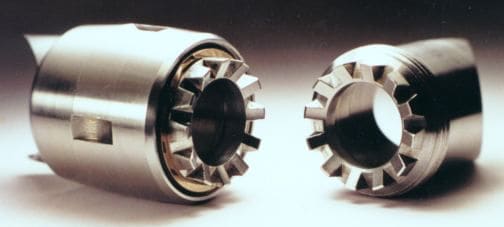
Like a typical dog clutch. I can see just the slightest bit of taper to the teeth, to be tight and take up any wear over time. Good design. I might have put some radius at the bottom of each inner corner, but I'm sure the current design is completely adequate.
The lugs on each outer side, I could easily see that being brazed to a chrome-moly steel frame, just like traditional lugs, even with a welded frame. Although that would most certainly damage the original paint. What I wonder about is, how is it attached to an aluminum frame, bonded (epoxy), or if that is only suitable for steel frames? Same question for carbon, although a) I doubt a carbon frame for touring, and b) torque couplings negate the weight savings of carbon if someone was traveling with a racing frame.
If I recall, some quality brand frames about 30-40 years ago were bonded tubes into lugs, but problems showed up over time.
I'll also add, folders typically have fail-safes, secondary latches, to prevent coming undone while riding. I don't see one on the coupler above. I would have designed a spring-loaded collar or lever that engages the spanner wrench cutouts, or an additional part that can be added to lock things. Or at the very least, once put together, put bright nail polish on both sides of the interface (should stay close position each time), easily seen when riding, as a quick check.
The lugs on each outer side, I could easily see that being brazed to a chrome-moly steel frame, just like traditional lugs, even with a welded frame. Although that would most certainly damage the original paint. What I wonder about is, how is it attached to an aluminum frame, bonded (epoxy), or if that is only suitable for steel frames? Same question for carbon, although a) I doubt a carbon frame for touring, and b) torque couplings negate the weight savings of carbon if someone was traveling with a racing frame.
If I recall, some quality brand frames about 30-40 years ago were bonded tubes into lugs, but problems showed up over time.
I'll also add, folders typically have fail-safes, secondary latches, to prevent coming undone while riding. I don't see one on the coupler above. I would have designed a spring-loaded collar or lever that engages the spanner wrench cutouts, or an additional part that can be added to lock things. Or at the very least, once put together, put bright nail polish on both sides of the interface (should stay close position each time), easily seen when riding, as a quick check.
Last edited by Duragrouch; 03-14-24 at 06:39 PM.
 03-14-24 | 09:21 PM
#28
Guest

Joined: Dec 2004
Posts: 1,606
Likes: 1,443
Like a typical dog clutch. I can see just the slightest bit of taper to the teeth, to be tight and take up any wear over time. Good design. I might have put some radius at the bottom of each inner corner, but I'm sure the current design is completely adequate.
The lugs on each outer side, I could easily see that being brazed to a chrome-moly steel frame, just like traditional lugs, even with a welded frame. Although that would most certainly damage the original paint. What I wonder about is, how is it attached to an aluminum frame, bonded (epoxy), or if that is only suitable for steel frames? Same question for carbon, although a) I doubt a carbon frame for touring, and b) torque couplings negate the weight savings of carbon if someone was traveling with a racing frame.
If I recall, some quality brand frames about 30-40 years ago were bonded tubes into lugs, but problems showed up over time.
I'll also add, folders typically have fail-safes, secondary latches, to prevent coming undone while riding. I don't see one on the coupler above. I would have designed a spring-loaded collar or lever that engages the spanner wrench cutouts, or an additional part that can be added to lock things. Or at the very least, once put together, put bright nail polish on both sides of the interface (should stay close position each time), easily seen when riding, as a quick check.
The lugs on each outer side, I could easily see that being brazed to a chrome-moly steel frame, just like traditional lugs, even with a welded frame. Although that would most certainly damage the original paint. What I wonder about is, how is it attached to an aluminum frame, bonded (epoxy), or if that is only suitable for steel frames? Same question for carbon, although a) I doubt a carbon frame for touring, and b) torque couplings negate the weight savings of carbon if someone was traveling with a racing frame.
If I recall, some quality brand frames about 30-40 years ago were bonded tubes into lugs, but problems showed up over time.
I'll also add, folders typically have fail-safes, secondary latches, to prevent coming undone while riding. I don't see one on the coupler above. I would have designed a spring-loaded collar or lever that engages the spanner wrench cutouts, or an additional part that can be added to lock things. Or at the very least, once put together, put bright nail polish on both sides of the interface (should stay close position each time), easily seen when riding, as a quick check.
Also, note:
I've had folding latches and "sail safes" fail while on a ride.
03-14-24 | 10:06 PM
#29
Highly Enriched Driftium
Joined: Apr 2017
Posts: 6,742
Likes: 2,180
I went looking for how the couplers attach to frame tubes, found this article, doesn't say, but (circa 2022) a bunch of new coupler systems on the market, this article covers 5 of them:
https://www.bicycling.com/bikes-gear...bike-couplers/
 03-16-24 | 08:16 AM
#30
Senior Member


Joined: Aug 2010
Posts: 12,728
Likes: 2,105
From: Madison, WI
Bikes: 1961 Ideor, 1966 Perfekt 3 Speed AB Hub, 1994 Bridgestone MB-6, 2006 Airnimal Joey, 2009 Thorn Sherpa, 2013 Thorn Nomad MkII, 2015 VO Pass Hunter, 2017 Lynskey Backroad, 2017 Raleigh Gran Prix, 1980s Bianchi Mixte on a trainer. Others are now gone.
I have never noticed any flex or noise on the S&S couplers. They are greased, so any creaking would be unlikely.
A bike shop manager told me that some people that were not careful with their Ritchey Break Away bikes had some creaking noise where the top clamps are. I do not understand why that would occur, I am only relaying what a bike shop manager said. My road bike has the Ritchey Break Away system. The bike is badged as a Raleigh Grand Prix, but the Ritchey logo is cast into one of the seat bolt clamps, photo below. The way this works is that the rear triangle has a seatpost clamp. The top tube that is separate has a seatpost clamp. So, with seatpost installed, it is solid as the seatpost holds the top tube to the rear triangle. But without a seatpost, the top tube is separate from the rear triangle. That is why it is so hard to visually see a coupler, the seatpost is the coupler. That shop manager told me to make sure I am pressing down on the top tube when I tighten the top tube clamp and tighten that clamp after the other one. You can see part of the Grand Prix model name in the photo.
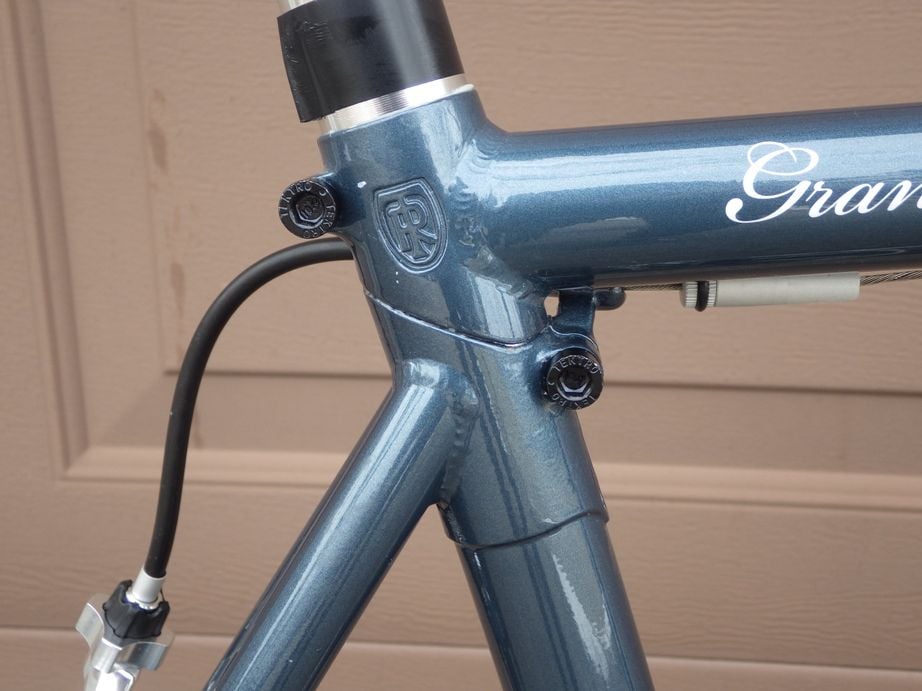
In the photo you can see a brake cable splitter under the top tube. Cables stay on the bike when split, but you use a threaded spliter to disconnect the two halves of the cables.
Disregard the black tape on the seatpost, this was the first day I had the bike and I was using the tape as a marker while I got things adjusted.
A bike shop manager told me that some people that were not careful with their Ritchey Break Away bikes had some creaking noise where the top clamps are. I do not understand why that would occur, I am only relaying what a bike shop manager said. My road bike has the Ritchey Break Away system. The bike is badged as a Raleigh Grand Prix, but the Ritchey logo is cast into one of the seat bolt clamps, photo below. The way this works is that the rear triangle has a seatpost clamp. The top tube that is separate has a seatpost clamp. So, with seatpost installed, it is solid as the seatpost holds the top tube to the rear triangle. But without a seatpost, the top tube is separate from the rear triangle. That is why it is so hard to visually see a coupler, the seatpost is the coupler. That shop manager told me to make sure I am pressing down on the top tube when I tighten the top tube clamp and tighten that clamp after the other one. You can see part of the Grand Prix model name in the photo.
In the photo you can see a brake cable splitter under the top tube. Cables stay on the bike when split, but you use a threaded spliter to disconnect the two halves of the cables.
Disregard the black tape on the seatpost, this was the first day I had the bike and I was using the tape as a marker while I got things adjusted.
03-16-24 | 08:24 AM
#31
Senior Member
Joined: Aug 2010
Posts: 12,728
Likes: 2,105
From: Madison, WI
Bikes: 1961 Ideor, 1966 Perfekt 3 Speed AB Hub, 1994 Bridgestone MB-6, 2006 Airnimal Joey, 2009 Thorn Sherpa, 2013 Thorn Nomad MkII, 2015 VO Pass Hunter, 2017 Lynskey Backroad, 2017 Raleigh Gran Prix, 1980s Bianchi Mixte on a trainer. Others are now gone.
As far as I know, S&S couplers are not available for aluminum frames, but couplers have been welded to titanium frames. And of course you can weld the stainless couplers to a steel frame. Bilenky has added couplers to a lot of frames.
Home Page
03-16-24 | 08:35 AM
#32
Senior Member
Joined: Aug 2010
Posts: 12,728
Likes: 2,105
From: Madison, WI
Bikes: 1961 Ideor, 1966 Perfekt 3 Speed AB Hub, 1994 Bridgestone MB-6, 2006 Airnimal Joey, 2009 Thorn Sherpa, 2013 Thorn Nomad MkII, 2015 VO Pass Hunter, 2017 Lynskey Backroad, 2017 Raleigh Gran Prix, 1980s Bianchi Mixte on a trainer. Others are now gone.
...
I'll also add, folders typically have fail-safes, secondary latches, to prevent coming undone while riding. I don't see one on the coupler above. I would have designed a spring-loaded collar or lever that engages the spanner wrench cutouts, or an additional part that can be added to lock things. Or at the very least, once put together, put bright nail polish on both sides of the interface (should stay close position each time), easily seen when riding, as a quick check.
I'll also add, folders typically have fail-safes, secondary latches, to prevent coming undone while riding. I don't see one on the coupler above. I would have designed a spring-loaded collar or lever that engages the spanner wrench cutouts, or an additional part that can be added to lock things. Or at the very least, once put together, put bright nail polish on both sides of the interface (should stay close position each time), easily seen when riding, as a quick check.
I noticed it because when I was taking my bike outside the front door on my condo, when I dropped the rear wheel on the ground, instead of that bouncing noise it also made a noise I was not used to hearing so I looked to see what was causing that, it was the looseness in the downtube coupler that caused the new additional noise.
I put sleeves from inner tube rubber over each end of the S&S "nut" to keep the dirt out of the threads. That also would make it harder for the threads to start unthreading by themselves from vibration. I previously had this photo in post 5, above, you can see the rubber sleeves.
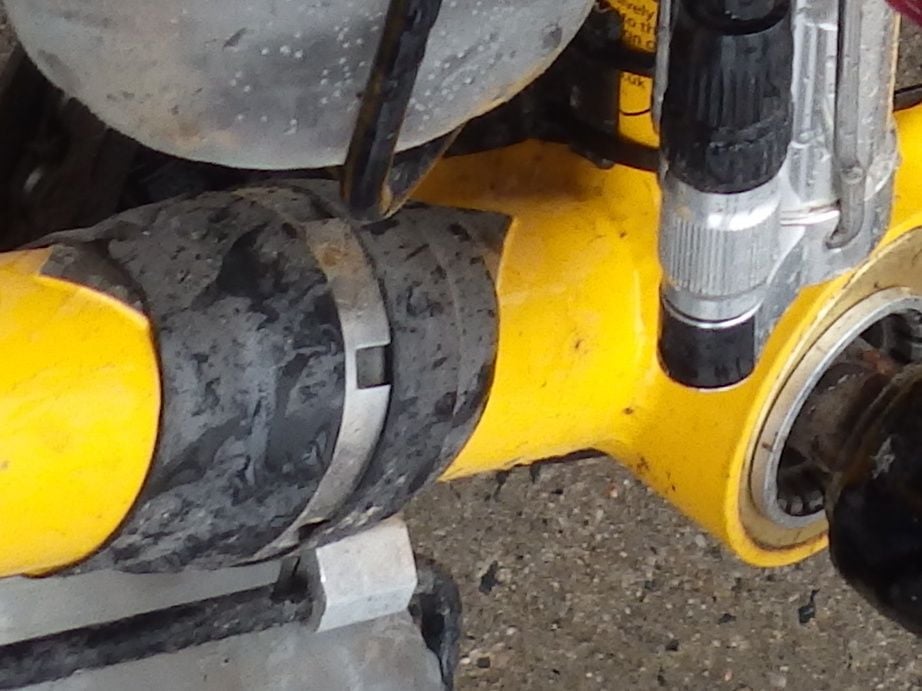
I have never heard of anyone riding a bike and having the two halves come apart, but I suspect if the downtube coupler was loose enough, the bike would handle poorly as a warning.
03-16-24 | 09:32 AM
#33

Senior Member

Joined: Aug 2011
Posts: 2,752
Likes: 139
From: Paris, France
 03-16-24 | 02:04 PM
#34
Highly Enriched Driftium
Joined: Apr 2017
Posts: 6,742
Likes: 2,180
Ritchey Break Away system on a Raleigh: A link I posted above listed 5 different coupler systems and how they work, and they mentioned that the Ritchey system has been licensed for use on other brands for coupled bikes from the factory.
