


Is Cold Setting Frames for wider hubs a Hack?
 01-08-18 | 09:48 PM
#1

Thread Starter
Tortoise Wins by a Hare!
Joined: Feb 2006
Posts: 7,393
Likes: 945
From: Looney Tunes, IL
Bikes: Wabi Special FG, Raleigh Roper, Nashbar AL-1, Miyata One Hundred, '70 Schwinn Lemonator and More!!
Is Cold Setting Frames for wider hubs a Hack?
Prying frames open with levers to allow wider hubs always seemed like a hack to me, so I've never done it. I suppose with an "expert" set up it might work out perfect, but most aren't going to have this... One side will end up bent more than the other, stays bent in different locations, miss aligned dropouts, chainring to hub chainline less than ideal, etc. I'm curious as to what the expert frame builders say about the practice of cold setting older frames for wider hubs? Can it be done properly? Is it usually?
 01-08-18 | 10:47 PM
#3

Senior Member


Joined: Apr 2011
Posts: 12,657
Likes: 4,794
Prying frames open with levers to allow wider hubs always seemed like a hack to me, so I've never done it. I suppose with an "expert" set up it might work out perfect, but most aren't going to have this... One side will end up bent more than the other, stays bent in different locations, miss aligned dropouts, chainring to hub chainline less than ideal, etc. I'm curious as to what the expert frame builders say about the practice of cold setting older frames for wider hubs? Can it be done properly? Is it usually?
All that is necessary is firm grip on both dropouts and pulling them apart with your hands. Because it is just even pressure applied simultaneously, it opens the sides evenly with no marring. After both sides have moved the necessary 2mm, you can confirm that they spread evenly and then square the dropouts. Pull, measure, pull, measure.
I can't remember how many steel frames I've done, they always came out symmetrical without requiring correction. People make it sound like this very small alteration is complex or dangerous - but it is less of tweak than correcting the derailleur hanger.
01-08-18 | 11:08 PM
#4
Randomhead
Joined: Aug 2008
Posts: 25,930
Likes: 4,825
From: Happy Valley, Pennsylvania
if you are talking a vintage frame, then I almost guarantee the rear triangle has been moved around for alignment purposes. I prefer clamping the bb and bending the stays one at a time, although I have done it by standing on one dropout and pulling on the other.
01-09-18 | 12:58 AM
#5
Senior Member
Joined: Apr 2011
Posts: 12,657
Likes: 4,794
If you clamp things down you create more opportunity for an asymmetric result. If you apply symmetrical force to a symmetrical frame you'll get symmetrical results.
It requires some force to spread the stays with a opening-the-chips motion, but I'm not a body builder.
It requires some force to spread the stays with a opening-the-chips motion, but I'm not a body builder.
01-09-18 | 09:56 AM
#6

Senior Member


Joined: Feb 2012
Posts: 19,354
Likes: 5,473
From: Rochester, NY
Bikes: Stewart S&S coupled sport tourer, Stewart Sunday light, Stewart Commuting, Stewart Touring, Co Motion Tandem, Stewart 3-Spd, Stewart Track, Fuji Finest, Mongoose Tomac ATB, GT Bravado ATB, JCP Folder, Stewart 650B ATB
Like Eric I prefer to clamp the BB faces and work one side at a time. I have seen, and done, asymmetrical widening when using only one's hands/arms to spread the drop outs. Most times I can point to the heavily dimpled driveside chain stay and it's reduced cross section as to why that side was the one that moved more. Cheap bikes suffer from this more often then well made ones do.
I don't consider the well done realignment a hack but sadly it can be easily done in a wrong way. Andy
I don't consider the well done realignment a hack but sadly it can be easily done in a wrong way. Andy
01-09-18 | 10:29 AM
#7

Senior Member
Joined: Jul 2006
Posts: 11,484
Likes: 4,892
From: San Jose (Willow Glen) Ca
Bikes: Kirk Custom JK Special, 86 De Rosa Pro, '84 Team Miyata,(dura ace old school) 80?? SR Semi-Pro 600 Arabesque
Sheldon covers this pretty well. i did this once and had good results
https://www.sheldonbrown.com/frame-spacing.html
https://www.sheldonbrown.com/frame-spacing.html
__________________
Life is too short not to ride the best bike you have, as much as you can.
Life is too short not to ride the best bike you have, as much as you can.
01-09-18 | 01:38 PM
#8
Senior Member
Joined: Mar 2008
Posts: 8,687
Likes: 297
Sheldon covers this pretty well. i did this once and had good results
https://www.sheldonbrown.com/frame-spacing.html
https://www.sheldonbrown.com/frame-spacing.html
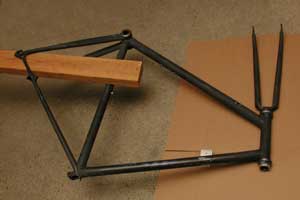
I put the frame on a workbench with the rear stays overhanging the edge.
Then I insert the board from the front.
By pushing down on the board I push the top stay up, while the bottom stay is left unaffected.
Once sufficient displacement is achieved, I flip the bike over and do the other side.
01-09-18 | 01:44 PM
#9
Senior Member
Joined: Apr 2009
Posts: 39,897
Likes: 3,865
From: New Rochelle, NY
Bikes: too many bikes from 1967 10s (5x2)Frejus to a Sumitomo Ti/Chorus aluminum 10s (10x2), plus one non-susp mtn bike I use as my commuter
Prying frames open with levers to allow wider hubs always seemed like a hack to me,..... One side will end up bent more than the other, stays bent in different locations, miss aligned dropouts, chainring to hub chainline less than ideal, etc. .... Can it be done properly? Is it usually?
__________________
FB
Chain-L site
An ounce of diagnosis is worth a pound of cure.
Just because I'm tired of arguing, doesn't mean you're right.
“One accurate measurement is worth a thousand expert opinions” - Adm Grace Murray Hopper - USN
WARNING, I'm from New York. Thin skinned people should maintain safe distance.
FB
Chain-L site
An ounce of diagnosis is worth a pound of cure.
Just because I'm tired of arguing, doesn't mean you're right.
“One accurate measurement is worth a thousand expert opinions” - Adm Grace Murray Hopper - USN
WARNING, I'm from New York. Thin skinned people should maintain safe distance.
01-09-18 | 03:29 PM
#10
Senior Member
Joined: Dec 2009
Posts: 507
Likes: 13
As mentioned old steel frames were routinely wrestled into shape. It's really nowhere near as complex or dangerous as you may think.
Get an old disposable steel frame and practice manipulating it precisely. You're barely moving things. It's not like bending a paper clip back and forth until it breaks.
Get an old disposable steel frame and practice manipulating it precisely. You're barely moving things. It's not like bending a paper clip back and forth until it breaks.
01-09-18 | 03:32 PM
#11
Senior Member
Joined: Aug 2012
Posts: 681
Likes: 283
From: Seattle
This is not a hack and I performed this many many times successfully on all sorts of bikes as we went from 126mm rear spacing to 130mm for road bikes. Often times after someone stuck a 130mm rear wheel in and broke their axle because the dropouts were splayed and bowing the axle.
A vice is your friend. You might get it evenly spaced going freestyle but you take chances. Use a vice, go slowly, you aren't moving it much and then use a string to measure.
Obviously has to be steel and the alignment of the dropouts has to be done after the stays are wider. Park makes a tool that makes the job very quick, accurate and easy.
A vice is your friend. You might get it evenly spaced going freestyle but you take chances. Use a vice, go slowly, you aren't moving it much and then use a string to measure.
Obviously has to be steel and the alignment of the dropouts has to be done after the stays are wider. Park makes a tool that makes the job very quick, accurate and easy.
__________________
https://www.flickr.com/photos/54319503@N05/
https://www.draper-cycles.com
https://www.flickr.com/photos/54319503@N05/
https://www.draper-cycles.com
Last edited by duanedr; 01-09-18 at 03:35 PM.
01-09-18 | 09:53 PM
#12
Randomhead
Joined: Aug 2008
Posts: 25,930
Likes: 4,825
From: Happy Valley, Pennsylvania
Of course, it does require the ability to measure, but this is the framebuilding forum, you can't make something if you can't measure it.
01-09-18 | 10:22 PM
#13
Senior Member
Joined: Apr 2011
Posts: 12,657
Likes: 4,794
that makes no sense. And untold thousands of steel frames have been aligned using this same method. Bend one at a time, measure. Tweak until you get that side right. Bend the other one. By pulling them apart, you have no idea.
Of course, it does require the ability to measure, but this is the framebuilding forum, you can't make something if you can't measure it.
Of course, it does require the ability to measure, but this is the framebuilding forum, you can't make something if you can't measure it.
When someone on a forum asks about doing something, I'm going to assume I'm not addressing either a shop mechanic or a frame builder, but someone doing it for themselves without a frame alignment table. So when I picture the kind of ham-fisted mistakes levers and clamps can do, I recommend a method which generally works very well because it is self aligning and doesn't involve putting levers on paint and thin tubing.
So what is it that doesn't make sense, exactly?
01-09-18 | 10:32 PM
#14
Senior Member
Joined: Apr 2009
Posts: 39,897
Likes: 3,865
From: New Rochelle, NY
Bikes: too many bikes from 1967 10s (5x2)Frejus to a Sumitomo Ti/Chorus aluminum 10s (10x2), plus one non-susp mtn bike I use as my commuter
What dosn't make sense to me is the assumption that the stays will magically move the same amount.
First of all they're rarely identical with the right typically having more crimping which can affect it's flex and bending properties.
The other issue I see relates to how steel flexes and then bends. As each stay flexes the resistance increases, and there'll be decent symmetry. However when the first reaches it's yield point, the flex property changes, so it'll start to take a set, while the other is still flexing. The fact that it's now yielding may prevent it's stiffer companion from ever reaching it's yield limit.
There are ways to manage this, but blind faith in symmetry isn't one of them. It may work well, or at least good enough, but there's no assurance that it will.
For those reasons, I'm a proponent of the one leg at a time approach, even for home mechanics. With minimum though and effort, the forces can be applied so only one side moves, leaving the other as a reference point. Them the roles can be reversed and the 2nd side bent, using the new position of the 1st as the reference. This offers 100% reliable control of the process without reliance on blind faith.
First of all they're rarely identical with the right typically having more crimping which can affect it's flex and bending properties.
The other issue I see relates to how steel flexes and then bends. As each stay flexes the resistance increases, and there'll be decent symmetry. However when the first reaches it's yield point, the flex property changes, so it'll start to take a set, while the other is still flexing. The fact that it's now yielding may prevent it's stiffer companion from ever reaching it's yield limit.
There are ways to manage this, but blind faith in symmetry isn't one of them. It may work well, or at least good enough, but there's no assurance that it will.
For those reasons, I'm a proponent of the one leg at a time approach, even for home mechanics. With minimum though and effort, the forces can be applied so only one side moves, leaving the other as a reference point. Them the roles can be reversed and the 2nd side bent, using the new position of the 1st as the reference. This offers 100% reliable control of the process without reliance on blind faith.
__________________
FB
Chain-L site
An ounce of diagnosis is worth a pound of cure.
Just because I'm tired of arguing, doesn't mean you're right.
“One accurate measurement is worth a thousand expert opinions” - Adm Grace Murray Hopper - USN
WARNING, I'm from New York. Thin skinned people should maintain safe distance.
FB
Chain-L site
An ounce of diagnosis is worth a pound of cure.
Just because I'm tired of arguing, doesn't mean you're right.
“One accurate measurement is worth a thousand expert opinions” - Adm Grace Murray Hopper - USN
WARNING, I'm from New York. Thin skinned people should maintain safe distance.
Last edited by FBinNY; 01-09-18 at 10:43 PM.
01-09-18 | 11:08 PM
#15
Senior Member
Joined: Apr 2011
Posts: 12,657
Likes: 4,794
What dosn't make sense to me is the assumption that the stays will magically move the same amount.
First of all they're rarely identical with the right typically having more crimping which can affect it's flex and bending properties.
The other issue I see relates to how steel flexes and then bends. As each stay flexes the resistance increases, and there'll be decent symmetry. However when the first reaches it's yield point, the flex property changes, so it'll start to take a set, while the other is still flexing. The fact that it's now yielding may prevent it's stiffer companion from ever reaching it's yield limit.
There are ways to manage this, but blind faith in symmetry isn't one of them. It may work well, or at least good enough, but there's no assurance that it will.
For those reasons, I'm a proponent of the one leg at a time approach, even for home mechanics. With minimum though and effort, the forces can be applied so only one side moves, leaving the other as a reference point. Them the roles can be reversed and the 2nd side bent, using the new position of the 1st as the reference. This offers 100% reliable control of the process without reliance on blind faith.
First of all they're rarely identical with the right typically having more crimping which can affect it's flex and bending properties.
The other issue I see relates to how steel flexes and then bends. As each stay flexes the resistance increases, and there'll be decent symmetry. However when the first reaches it's yield point, the flex property changes, so it'll start to take a set, while the other is still flexing. The fact that it's now yielding may prevent it's stiffer companion from ever reaching it's yield limit.
There are ways to manage this, but blind faith in symmetry isn't one of them. It may work well, or at least good enough, but there's no assurance that it will.
For those reasons, I'm a proponent of the one leg at a time approach, even for home mechanics. With minimum though and effort, the forces can be applied so only one side moves, leaving the other as a reference point. Them the roles can be reversed and the 2nd side bent, using the new position of the 1st as the reference. This offers 100% reliable control of the process without reliance on blind faith.
You say that the two sides are unlikely to hit yield at the same time and that means that one will bend more than the other. That really isn't how it works - when the steel begins to yield it still takes increasing force - more than the force to bend below yield. So the resistance to further bending is sufficient to make the other stay move beyond yield. Your post appears to suggests that the force required goes down after yield.
If frames didn't like to flex symmetrically they would not be much fun to ride.
Anyway, despite all the outrage, it is easier to just pull the stays apart without all the levers and clamps. Should you get so unlucky that your stays end up bending asymmetrically, then break out the tools. But I don't understand making something more complicated than it needs to be "just in case" when there is no unilateral outcome. We're moving each stay 2mm, after all. No need to go Rube Golderberg on it right away.
How many of you objectors have ever tried this to report a problem with it?
01-09-18 | 11:32 PM
#16
Senior Member
Joined: Apr 2009
Posts: 39,897
Likes: 3,865
From: New Rochelle, NY
Bikes: too many bikes from 1967 10s (5x2)Frejus to a Sumitomo Ti/Chorus aluminum 10s (10x2), plus one non-susp mtn bike I use as my commuter
Where is this blind faith stuff coming from? Check your work.
You say that the two sides are unlikely to hit yield at the same time and that means that one will bend more than the other. That really isn't how it works - when the steel begins to yield it still takes increasing force - more than the force to bend below yield. So the resistance to further bending is sufficient to make the other stay move beyond yield. Your post appears to suggests that the force required goes down after yield.......
You say that the two sides are unlikely to hit yield at the same time and that means that one will bend more than the other. That really isn't how it works - when the steel begins to yield it still takes increasing force - more than the force to bend below yield. So the resistance to further bending is sufficient to make the other stay move beyond yield. Your post appears to suggests that the force required goes down after yield.......
As for the question of flex symmetry, it doesn't really matter because the rear triangle is tied together by the axle, so it doesn't matter if the stays would flex equally if they weren't married. In this way they can be comparable to two unmatched solo riders riding a tandem.
And yes, what I disparage as blind faith can often work, and I said that. What I said is that it isn't reliable, and it isn't.
__________________
FB
Chain-L site
An ounce of diagnosis is worth a pound of cure.
Just because I'm tired of arguing, doesn't mean you're right.
“One accurate measurement is worth a thousand expert opinions” - Adm Grace Murray Hopper - USN
WARNING, I'm from New York. Thin skinned people should maintain safe distance.
FB
Chain-L site
An ounce of diagnosis is worth a pound of cure.
Just because I'm tired of arguing, doesn't mean you're right.
“One accurate measurement is worth a thousand expert opinions” - Adm Grace Murray Hopper - USN
WARNING, I'm from New York. Thin skinned people should maintain safe distance.
01-09-18 | 11:39 PM
#17
Senior Member
Joined: Apr 2011
Posts: 12,657
Likes: 4,794
01-09-18 | 11:47 PM
#18
Senior Member
Joined: Apr 2009
Posts: 39,897
Likes: 3,865
From: New Rochelle, NY
Bikes: too many bikes from 1967 10s (5x2)Frejus to a Sumitomo Ti/Chorus aluminum 10s (10x2), plus one non-susp mtn bike I use as my commuter
Way back when, back in the Bronze Age, I did it the way you describe, and generally had good luck. But as things evolved and everybody started measuring stuff to the last micron, I was forced to change and moved to my current method because, even though I would be OK with minor errors, others weren't anymore.
__________________
FB
Chain-L site
An ounce of diagnosis is worth a pound of cure.
Just because I'm tired of arguing, doesn't mean you're right.
“One accurate measurement is worth a thousand expert opinions” - Adm Grace Murray Hopper - USN
WARNING, I'm from New York. Thin skinned people should maintain safe distance.
FB
Chain-L site
An ounce of diagnosis is worth a pound of cure.
Just because I'm tired of arguing, doesn't mean you're right.
“One accurate measurement is worth a thousand expert opinions” - Adm Grace Murray Hopper - USN
WARNING, I'm from New York. Thin skinned people should maintain safe distance.
01-10-18 | 12:03 AM
#19
Senior Member
Joined: Apr 2011
Posts: 12,657
Likes: 4,794
Way back when, back in the Bronze Age, I did it the way you describe, and generally had good luck. But as things evolved and everybody started measuring stuff to the last micron, I was forced to change and moved to my current method because, even though I would be OK with minor errors, others weren't anymore.
01-10-18 | 12:15 AM
#20
Senior Member
Joined: Apr 2009
Posts: 39,897
Likes: 3,865
From: New Rochelle, NY
Bikes: too many bikes from 1967 10s (5x2)Frejus to a Sumitomo Ti/Chorus aluminum 10s (10x2), plus one non-susp mtn bike I use as my commuter
It doesn't really matter how far off the bike ends up, first because it's easily corrected when checked, and secondly because small errors don't matter. The issue isn't being functionally OK, it's a question of appearance and image because folks fret over this nonsense. I don't want to be in a position of defending work that a client (wrongly) believes is not good enough.
There's also what I've learned in my 40 years manufacturing stuff. I'm not a believer in inspect and correct, and prefer inspect and confirm. By that I mean I try to use methods that reliably ensure that the results will pass QC, rather than need to be reworked.
Something like 50 years ago someone gave me a pencil with an eraser at both ends. On it was "If you don't have time to do it right, where will you find the time to do it over?" I've kept it for decades, and adopted the philosophy in my manufacturing operations, and by extension on bike work.
__________________
FB
Chain-L site
An ounce of diagnosis is worth a pound of cure.
Just because I'm tired of arguing, doesn't mean you're right.
“One accurate measurement is worth a thousand expert opinions” - Adm Grace Murray Hopper - USN
WARNING, I'm from New York. Thin skinned people should maintain safe distance.
FB
Chain-L site
An ounce of diagnosis is worth a pound of cure.
Just because I'm tired of arguing, doesn't mean you're right.
“One accurate measurement is worth a thousand expert opinions” - Adm Grace Murray Hopper - USN
WARNING, I'm from New York. Thin skinned people should maintain safe distance.
01-10-18 | 12:40 AM
#21
Senior Member
Joined: Apr 2011
Posts: 12,657
Likes: 4,794
You're reading more into what i say than what I put into it. First of all, I said (3 times now) that the simultaneous method often works, so interpreting that to mean that every bike is off at all is extremely selective reading.
It doesn't really matter how far off the bike ends up, first because it's easily corrected when checked, and secondly because small errors don't matter. The issue isn't being functionally OK, it's a question of appearance and image because folks fret over this nonsense. I don't want to be in a position of defending work that a client (wrongly) believes is not good enough.
There's also what I've learned in my 40 years manufacturing stuff. I'm not a believer in inspect and correct, and prefer inspect and confirm. By that I mean I try to use methods that reliably ensure that the results will pass QC, rather than need to be reworked.
Something like 50 years ago someone gave me a pencil with an eraser at both ends. On it was "If you don't have time to do it right, where will you find the time to do it over?" I've kept it for decades, and adopted the philosophy in my manufacturing operations, and by extension on bike work.
It doesn't really matter how far off the bike ends up, first because it's easily corrected when checked, and secondly because small errors don't matter. The issue isn't being functionally OK, it's a question of appearance and image because folks fret over this nonsense. I don't want to be in a position of defending work that a client (wrongly) believes is not good enough.
There's also what I've learned in my 40 years manufacturing stuff. I'm not a believer in inspect and correct, and prefer inspect and confirm. By that I mean I try to use methods that reliably ensure that the results will pass QC, rather than need to be reworked.
Something like 50 years ago someone gave me a pencil with an eraser at both ends. On it was "If you don't have time to do it right, where will you find the time to do it over?" I've kept it for decades, and adopted the philosophy in my manufacturing operations, and by extension on bike work.
If the first measure was not centered, then I would apply leverage to one side. I just have never had to do that in 10 or more of these I have done for myself or customers. The results were always symmetrical to the limits of a Park frame alignment tool to measure and right on 130mm.
01-10-18 | 01:45 AM
#22
Senior Member
Joined: Mar 2008
Posts: 8,687
Likes: 297
What dosn't make sense to me is the assumption that the stays will magically move the same amount.
First of all they're rarely identical with the right typically having more crimping which can affect it's flex and bending properties.
The other issue I see relates to how steel flexes and then bends. As each stay flexes the resistance increases, and there'll be decent symmetry. However when the first reaches it's yield point, the flex property changes, so it'll start to take a set, while the other is still flexing. The fact that it's now yielding may prevent it's stiffer companion from ever reaching it's yield limit.
There are ways to manage this, but blind faith in symmetry isn't one of them. It may work well, or at least good enough, but there's no assurance that it will.
For those reasons, I'm a proponent of the one leg at a time approach, even for home mechanics. With minimum though and effort, the forces can be applied so only one side moves, leaving the other as a reference point. Them the roles can be reversed and the 2nd side bent, using the new position of the 1st as the reference. This offers 100% reliable control of the process without reliance on blind faith.
First of all they're rarely identical with the right typically having more crimping which can affect it's flex and bending properties.
The other issue I see relates to how steel flexes and then bends. As each stay flexes the resistance increases, and there'll be decent symmetry. However when the first reaches it's yield point, the flex property changes, so it'll start to take a set, while the other is still flexing. The fact that it's now yielding may prevent it's stiffer companion from ever reaching it's yield limit.
There are ways to manage this, but blind faith in symmetry isn't one of them. It may work well, or at least good enough, but there's no assurance that it will.
For those reasons, I'm a proponent of the one leg at a time approach, even for home mechanics. With minimum though and effort, the forces can be applied so only one side moves, leaving the other as a reference point. Them the roles can be reversed and the 2nd side bent, using the new position of the 1st as the reference. This offers 100% reliable control of the process without reliance on blind faith.
Never gotten it good enough to be content with the result from spreading both simultaneously.
Particularly dimpled chainstays can be very obviously different in characteristics.
A workbench or sturdy table, a plank and some blocks. Or a pair of thick books.
Not really things that are hard to come by.
Oh, and perhaps a strap to protect the brake bridge.
01-10-18 | 09:24 AM
#23
Randomhead
Joined: Aug 2008
Posts: 25,930
Likes: 4,825
From: Happy Valley, Pennsylvania
what didn't make sense to me was that doing this in a controlled fashion bending one stay at a time was somehow worse than pulling them apart. But I'm sure the OP has walked away in horror at this point.
01-10-18 | 03:50 PM
#24
Senior Member
Joined: Apr 2011
Posts: 12,657
Likes: 4,794
With the right tools (alignment table), anything is possible. When you are using ad hoc tools the risk of messing something up increases with every additional tool applied to the frame.
Some people are very natural mechanics - they have a good feel for the kind of force that needs to be applied and the potential for tools slipping and stress risers. Most people do not have that sort of sense for things and half the threads in the mechanic section demonstrates this.
Spreading the frame with a minimum of tools decreases the chance of crushed tubes, scuffed paint and applying too much force. It is a very gentle method, and the only downside is that it might require going back to a lever if it isn't opening symmetrically - which in both my and FBinNY's experience is actually rare.
It is the most conservative and safe approach.