


Fork Rake and Stuff
 02-20-18 | 01:46 PM
#1

Thread Starter
Senior Member


Joined: Feb 2012
Posts: 19,353
Likes: 5,471
From: Rochester, NY
Bikes: Stewart S&S coupled sport tourer, Stewart Sunday light, Stewart Commuting, Stewart Touring, Co Motion Tandem, Stewart 3-Spd, Stewart Track, Fuji Finest, Mongoose Tomac ATB, GT Bravado ATB, JCP Folder, Stewart 650B ATB
Fork Rake and Stuff
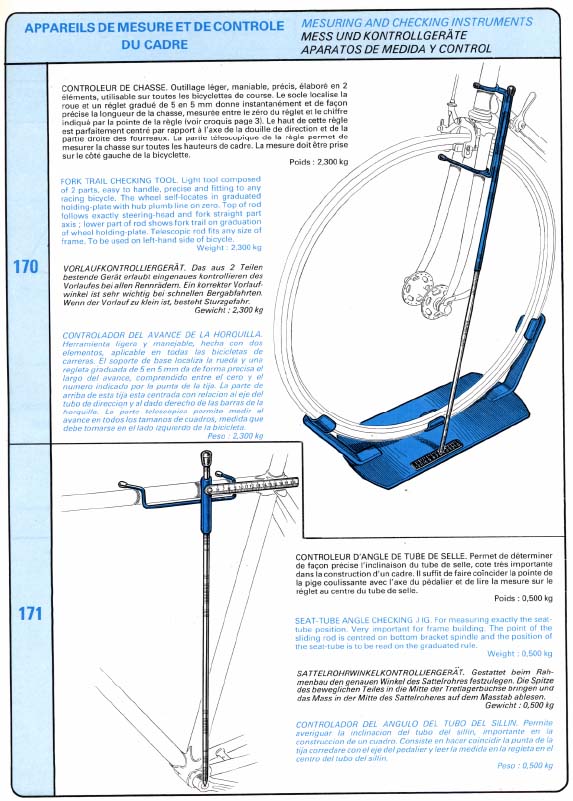
There's an interesting thread which started with measuring rake to talking about steering/handling/trail. Andy
Correct way to measure a fork
Correct way to measure a fork


 02-26-18 | 04:23 PM
#4


Senior Member

Joined: Apr 2005
Posts: 17,196
Likes: 761
From: Ann Arbor, MI
Bikes: 1980 Masi, 1984 Mondonico, 1984 Trek 610, 1980 Woodrup Giro, 2005 Mondonico Futura Leggera ELOS, 1967 PX10E, 1971 Peugeot UO-8
02-26-18 | 06:52 PM
#5
Thread Starter
Senior Member
Joined: Feb 2012
Posts: 19,353
Likes: 5,471
From: Rochester, NY
Bikes: Stewart S&S coupled sport tourer, Stewart Sunday light, Stewart Commuting, Stewart Touring, Co Motion Tandem, Stewart 3-Spd, Stewart Track, Fuji Finest, Mongoose Tomac ATB, GT Bravado ATB, JCP Folder, Stewart 650B ATB
I have a 171 tool and have used it only a few times to measure seat tube angle. Works well as long as you level the drop outs.
I would lone to have a 170. Not too hard to make, I know. To answer Kontack- The tool knows the angle because it sits on center with the steerer and upper blade, which back then were in line with each other. But the head tube angle need not be know as the trail is read directly from a scale. Once trail is known a head angle can be calculated, if needed.
I think it's cool to see these old tools. Reminds one that what we talk about here is the same as what was talked about 50 years ago. Andy.
I would lone to have a 170. Not too hard to make, I know. To answer Kontack- The tool knows the angle because it sits on center with the steerer and upper blade, which back then were in line with each other. But the head tube angle need not be know as the trail is read directly from a scale. Once trail is known a head angle can be calculated, if needed.
I think it's cool to see these old tools. Reminds one that what we talk about here is the same as what was talked about 50 years ago. Andy.
02-26-18 | 07:52 PM
#6

Senior Member


Joined: Apr 2011
Posts: 12,652
Likes: 4,793
I have a 171 tool and have used it only a few times to measure seat tube angle. Works well as long as you level the drop outs.
I would lone to have a 170. Not too hard to make, I know. To answer Kontack- The tool knows the angle because it sits on center with the steerer and upper blade, which back then were in line with each other. But the head tube angle need not be know as the trail is read directly from a scale. Once trail is known a head angle can be calculated, if needed.
I think it's cool to see these old tools. Reminds one that what we talk about here is the same as what was talked about 50 years ago. Andy.
I would lone to have a 170. Not too hard to make, I know. To answer Kontack- The tool knows the angle because it sits on center with the steerer and upper blade, which back then were in line with each other. But the head tube angle need not be know as the trail is read directly from a scale. Once trail is known a head angle can be calculated, if needed.
I think it's cool to see these old tools. Reminds one that what we talk about here is the same as what was talked about 50 years ago. Andy.
03-04-18 | 11:24 AM
#7
Banned
Joined: Jun 2010
Posts: 43,586
Likes: 1,380
From: NW,Oregon Coast
Bikes: 8
My heavy touring bike's fork was built with a bi plate crown, offset there parallel to the steering axis, and blades raked less..
opposite end of the (gram) scale from something for a Colnago..
opposite end of the (gram) scale from something for a Colnago..
03-04-18 | 09:56 PM
#9
Thread Starter
Senior Member
Joined: Feb 2012
Posts: 19,353
Likes: 5,471
From: Rochester, NY
Bikes: Stewart S&S coupled sport tourer, Stewart Sunday light, Stewart Commuting, Stewart Touring, Co Motion Tandem, Stewart 3-Spd, Stewart Track, Fuji Finest, Mongoose Tomac ATB, GT Bravado ATB, JCP Folder, Stewart 650B ATB
Eric- the tool established a line parallel to the steerer axis, which also intersects the road along a scale zeroes om the tire contact patch. Andy
03-04-18 | 10:30 PM
#10
Randomhead
Joined: Aug 2008
Posts: 25,930
Likes: 4,825
From: Happy Valley, Pennsylvania
ok, I didn't really see that the pointer is at the ground level. There are plenty of forks that wouldn't work on, even back then, I think. Needs 2 attachments at the steerer and an adjustable bar to go across the blades.
03-04-18 | 11:25 PM
#11
Thread Starter
Senior Member
Joined: Feb 2012
Posts: 19,353
Likes: 5,471
From: Rochester, NY
Bikes: Stewart S&S coupled sport tourer, Stewart Sunday light, Stewart Commuting, Stewart Touring, Co Motion Tandem, Stewart 3-Spd, Stewart Track, Fuji Finest, Mongoose Tomac ATB, GT Bravado ATB, JCP Folder, Stewart 650B ATB
I don't disagree that this tool is now very dated in current application. I still think it's cool. Some year I'll get around to making one, maybe  Andy
Andy
Andy
03-04-18 | 11:32 PM
#12

Senior Member
Joined: Oct 2014
Posts: 14,164
Likes: 5,295
From: Portland, OR
Bikes: (2) ti TiCycles, 2007 w/ triple and 2011 fixed, 1979 Peter Mooney, ~1983 Trek 420 now fixed and ~1973 Raleigh Carlton Competition gravel grinder
My issue with both 170 and 171 is that they both make assumptions: 170 that the fork axis is along the steerer axis. (I have heard it said that Peugeots of the day often ere built with forks that "trailed" a touch, ie where the fork axis was steeper than the steerer axis.) The 171 assumes the top tube is horizontal. On traditional bikes, usually, yes. But on a hastily jigged bike. maybe not.
I would prefer tools that give correct measurements without assuming good workmanship.
Ben
I would prefer tools that give correct measurements without assuming good workmanship.
Ben
03-05-18 | 08:41 AM
#15
Thread Starter
Senior Member
Joined: Feb 2012
Posts: 19,353
Likes: 5,471
From: Rochester, NY
Bikes: Stewart S&S coupled sport tourer, Stewart Sunday light, Stewart Commuting, Stewart Touring, Co Motion Tandem, Stewart 3-Spd, Stewart Track, Fuji Finest, Mongoose Tomac ATB, GT Bravado ATB, JCP Folder, Stewart 650B ATB
I think you all are missing what these two tools were all about. In the era these were made in this was pretty leading edge stuff. The knowledge base that we have these days is so much greater then what was commonly known back then. These tools needed no other instrument then the supplied ruler and the fully built bike. What a quick way to check bikes that one only has for a few minutes.
With the directly measured dimensions these tools make easy to get one can design a frame, no angles are needed to be known, just rise over run. I think this thread has once again shown that we are so caught up in the way we currently look at frame parameters that we are blind to other ways to do the same thing, methods that don't depend on computers, design programs or calculators.
Sure these tools have their limitations and assumptions but that can be said for any measuring method. Andy
With the directly measured dimensions these tools make easy to get one can design a frame, no angles are needed to be known, just rise over run. I think this thread has once again shown that we are so caught up in the way we currently look at frame parameters that we are blind to other ways to do the same thing, methods that don't depend on computers, design programs or calculators.
Sure these tools have their limitations and assumptions but that can be said for any measuring method. Andy
03-05-18 | 10:46 AM
#16
Senior Member
Joined: Apr 2011
Posts: 12,652
Likes: 4,793
I think you all are missing what these two tools were all about. In the era these were made in this was pretty leading edge stuff. The knowledge base that we have these days is so much greater then what was commonly known back then. These tools needed no other instrument then the supplied ruler and the fully built bike. What a quick way to check bikes that one only has for a few minutes.
With the directly measured dimensions these tools make easy to get one can design a frame, no angles are needed to be known, just rise over run. I think this thread has once again shown that we are so caught up in the way we currently look at frame parameters that we are blind to other ways to do the same thing, methods that don't depend on computers, design programs or calculators.
Sure these tools have their limitations and assumptions but that can be said for any measuring method. Andy
With the directly measured dimensions these tools make easy to get one can design a frame, no angles are needed to be known, just rise over run. I think this thread has once again shown that we are so caught up in the way we currently look at frame parameters that we are blind to other ways to do the same thing, methods that don't depend on computers, design programs or calculators.
Sure these tools have their limitations and assumptions but that can be said for any measuring method. Andy
Last edited by Kontact; 03-05-18 at 10:49 AM.
03-05-18 | 11:48 AM
#17
Randomhead
Joined: Aug 2008
Posts: 25,930
Likes: 4,825
From: Happy Valley, Pennsylvania
I think if you were replicating someone's bike, checking the seat angle that way would probably be a good idea. I think the trail measuring device would be pretty interesting to use, updated to match current bikes a bit better.
Andy, I think people probably solved for the angle. You could get Nervex lugs in every half degree size.
Andy, I think people probably solved for the angle. You could get Nervex lugs in every half degree size.
03-05-18 | 07:31 PM
#18
Thread Starter
Senior Member
Joined: Feb 2012
Posts: 19,353
Likes: 5,471
From: Rochester, NY
Bikes: Stewart S&S coupled sport tourer, Stewart Sunday light, Stewart Commuting, Stewart Touring, Co Motion Tandem, Stewart 3-Spd, Stewart Track, Fuji Finest, Mongoose Tomac ATB, GT Bravado ATB, JCP Folder, Stewart 650B ATB
Var 171 measures set back from the vertical line extending up from the BB's center to the seat tube's center. This is the short side of a right triangle. The vertical is the long side and the seat tube is the hypotenuse. From these you could derive the angles but this set back, for a certain "frame size", could be directly transferred to a drawing (and therefore establishing the seat tube angle). Here's a shot of my 171 and it's horizontal scale. Andy
03-05-18 | 07:47 PM
#19
Senior Member
Joined: Apr 2011
Posts: 12,652
Likes: 4,793
Var 171 measures set back from the vertical line extending up from the BB's center to the seat tube's center. This is the short side of a right triangle. The vertical is the long side and the seat tube is the hypotenuse. From these you could derive the angles but this set back, for a certain "frame size", could be directly transferred to a drawing (and therefore establishing the seat tube angle). Here's a shot of my 171 and it's horizontal scale. Andy
In theory, you could build a frame just by knowing all the center to center lengths of the tubes without referencing angles at all.
03-05-18 | 08:16 PM
#20
Thread Starter
Senior Member
Joined: Feb 2012
Posts: 19,353
Likes: 5,471
From: Rochester, NY
Bikes: Stewart S&S coupled sport tourer, Stewart Sunday light, Stewart Commuting, Stewart Touring, Co Motion Tandem, Stewart 3-Spd, Stewart Track, Fuji Finest, Mongoose Tomac ATB, GT Bravado ATB, JCP Folder, Stewart 650B ATB
A ruler/tape measure will give you the other sides dimensions. Not every tool lives in a world independent of others. The 148mm isn't a number without relationships.
Since most all main frames are not true triangles but 4 sided, with unequal angles/sides, it's configuration can shift. The four sides can maintain their dimensions but the angles between adjacent sides can range/vary. Establish any one of the 4 angles and with set side lengths the remaining angles are also set.
I've tried to explain how this tool's data can be used. It seems that I can't find the words to do this. Sorry. Andy
Since most all main frames are not true triangles but 4 sided, with unequal angles/sides, it's configuration can shift. The four sides can maintain their dimensions but the angles between adjacent sides can range/vary. Establish any one of the 4 angles and with set side lengths the remaining angles are also set.
I've tried to explain how this tool's data can be used. It seems that I can't find the words to do this. Sorry. Andy
03-06-18 | 06:42 AM
#21
Randomhead
Joined: Aug 2008
Posts: 25,930
Likes: 4,825
From: Happy Valley, Pennsylvania
Yes, you need at least one angle to copy a frame, not just tube lengths. And tube lengths are somewhat difficult to measure with the accuracy required, some redundancy is nice. In a world with only horizontal top tubes, it's a pretty useful tool. I have a fitstik, which is a pain to use. That hook system would be nicer than sloppy velcro. I want to make an x-y tool eventually.
03-06-18 | 08:26 AM
#22
My dim memory of the Var 171 tool is that it was simply meant to be used to ensure that the relationship between the forward/back position of the nose of a rider's saddle and the center of the bottom bracket would be reproducible for setting up the rider's next bike (or the same bike after disassembly).
Just looked it up, and there's an illustration on page 134 of the 1972 edition of the C.O.N.I. "Cycling" book that shows how to measure that dimension for fitting a bike to a rider.
On the other hand, the illustration for the Var 171 tool does include a note indicating that the tool is to be used for checking the seat tube angle ("very important for frame building").
Just looked it up, and there's an illustration on page 134 of the 1972 edition of the C.O.N.I. "Cycling" book that shows how to measure that dimension for fitting a bike to a rider.
On the other hand, the illustration for the Var 171 tool does include a note indicating that the tool is to be used for checking the seat tube angle ("very important for frame building").
Last edited by Trakhak; 03-06-18 at 11:08 AM.
03-06-18 | 09:15 AM
#23

Senior Member
Joined: Apr 2004
Posts: 6,357
Likes: 167
From: Sacramento CA
Bikes: Too Many
Looks like more of a tool for bike fitting than for frame building as mentioned above.
__________________
I'm not one for fawning over bicycles, but I do believe that our bikes communicate with us, and what this bike is saying is, "You're an idiot." BikeSnobNYC
I'm not one for fawning over bicycles, but I do believe that our bikes communicate with us, and what this bike is saying is, "You're an idiot." BikeSnobNYC
03-06-18 | 08:17 PM
#25
Randomhead
Joined: Aug 2008
Posts: 25,930
Likes: 4,825
From: Happy Valley, Pennsylvania
drywall square is too prosaic. Although I do have a metric drywall square in my wishlist on amazon.
Have to think about where my CONI book is, I'd like to see the picture of it being used for fitting. Would have been nice if they had put the ruler on a separate slider, it would be really great for positioning saddles if it had that.
Have to think about where my CONI book is, I'd like to see the picture of it being used for fitting. Would have been nice if they had put the ruler on a separate slider, it would be really great for positioning saddles if it had that.