


First Frame Build Questions
 07-31-19 | 01:38 PM
#1

Thread Starter
Junior Member

Joined: Mar 2019
Posts: 143
Likes: 80
From: Seattle, WA, USA
Bikes: 1982 Bianchi Nuovo Racing, 2012 Cervelo RS Rival, 20xx Redline Conquest (Commuter/Rain Bike)
First Frame Build Questions
I've always wanted to build myself a custom lugged steel bike frame. The idea is to build a classic steel road frame with lively 74 degree angles like the steel racers I rode as a kid.
I found a Columbus SL Tubeset and matching lugs from Nova, and once received, cut each tube to length (size 58.5 c-c) using a tube angle jig that worked with a 1/2" drill motor and a hole saw arbor that a buddy loaned me.
I built a frame jig primarily from 80/20 extrusion, with some machined and threaded cones to center the bottom bracket, head tube, and seat tube, as well as an extension using an old rear axle for centering and aligning the rear dropouts.
I'm getting close to being ready to assemble the frame with flux in the joints and clamp it into the jig to begin brazing, but I have a question about the joints at the seattube to toptube, toptube to headtube, and headtube to downtube. I have read that since the toptube is captured at both ends, failing to drill a hole in at least one of the tubes (head and seat) behind the lug will cause air to be trapped which will heat and try to expand without the hole to let the hot air escape.
My question (finally!) is would it be ok to drill out each of the three joints to lighten the frame, which I'd like to do as this is a dream build for me, or would this affect the structural integrity or stiffness of the build?
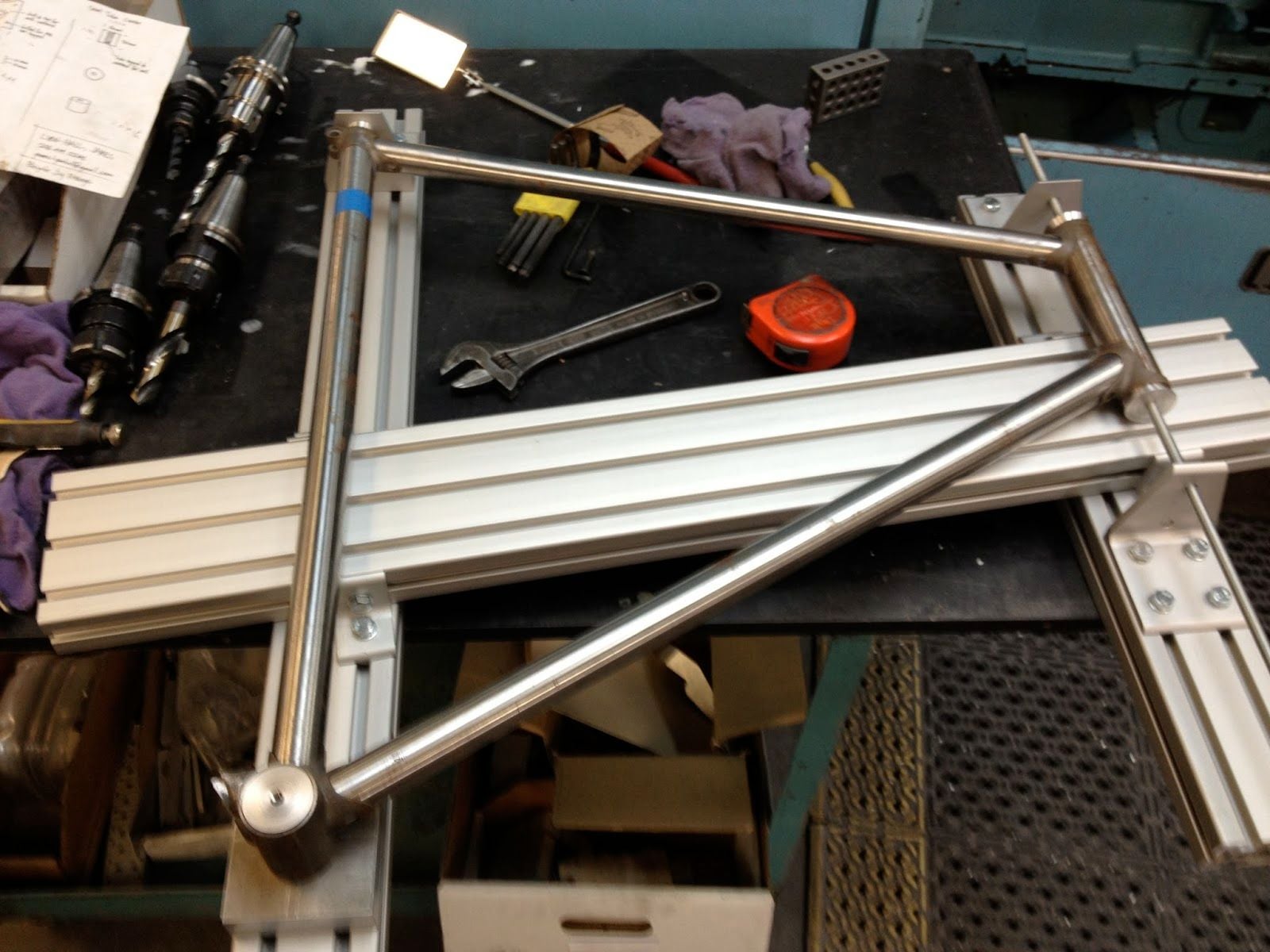
I found a Columbus SL Tubeset and matching lugs from Nova, and once received, cut each tube to length (size 58.5 c-c) using a tube angle jig that worked with a 1/2" drill motor and a hole saw arbor that a buddy loaned me.
I built a frame jig primarily from 80/20 extrusion, with some machined and threaded cones to center the bottom bracket, head tube, and seat tube, as well as an extension using an old rear axle for centering and aligning the rear dropouts.
I'm getting close to being ready to assemble the frame with flux in the joints and clamp it into the jig to begin brazing, but I have a question about the joints at the seattube to toptube, toptube to headtube, and headtube to downtube. I have read that since the toptube is captured at both ends, failing to drill a hole in at least one of the tubes (head and seat) behind the lug will cause air to be trapped which will heat and try to expand without the hole to let the hot air escape.
My question (finally!) is would it be ok to drill out each of the three joints to lighten the frame, which I'd like to do as this is a dream build for me, or would this affect the structural integrity or stiffness of the build?
 07-31-19 | 05:33 PM
#3


Senior Member

Joined: Jun 2004
Posts: 3,161
Likes: 571
From: Torrance, CA
Bikes: Homebuilt steel
I like to drill large vent holes partly because it allows water to flow inside to wash the flux. It's also nice to drain out excessive rust preventive spray applied after completion.
07-31-19 | 05:48 PM
#4
Senior Member

Joined: Nov 2012
Posts: 5,196
Likes: 1,941
This spring I brazed up the main tubes for a touring frame and decided not to vent the top tube joints. Not a problem. Did not experience any blow outs from heat. Of course I am unable to get in the top tube to flush it, but that will be another chapter in this story at some other time.
In a previous frame I used 3/4 hole at the head tube to vent with. The seat stays were not vented either. Does not seem to affect anything from were I sit. Long term corrosion may be an issue, but I doubt it.
In a previous frame I used 3/4 hole at the head tube to vent with. The seat stays were not vented either. Does not seem to affect anything from were I sit. Long term corrosion may be an issue, but I doubt it.
07-31-19 | 06:16 PM
#5
Randomhead
Joined: Aug 2008
Posts: 25,930
Likes: 4,825
From: Happy Valley, Pennsylvania
I have heard people say they had breakage on frames with vent holes bigger than 3/8", but there are plenty of counterexamples. I have always drilled 1/4" vent holes, but went larger on this most recent frame.
I think you should go with 3/8" and not worry about a little weight. It's negligible. Hopefully your dreams will get bigger after this frame.
I think you should go with 3/8" and not worry about a little weight. It's negligible. Hopefully your dreams will get bigger after this frame.
07-31-19 | 07:29 PM
#6

Senior Member

Joined: Feb 2012
Posts: 19,359
Likes: 5,492
From: Rochester, NY
Bikes: Stewart S&S coupled sport tourer, Stewart Sunday light, Stewart Commuting, Stewart Touring, Co Motion Tandem, Stewart 3-Spd, Stewart Track, Fuji Finest, Mongoose Tomac ATB, GT Bravado ATB, JCP Folder, Stewart 650B ATB
I've made vent hole from tiny 1/8" ones to hugs 1/2". Can't say the diameter made any difference in how the frame turned out. It is nice to be able to drain/shake stuff out so I currently drill about 1/4" holes.
I learned to vent every tube, to not get cute with vent locations and follow my painter's preferences as to tube ID access questions. Andy
I learned to vent every tube, to not get cute with vent locations and follow my painter's preferences as to tube ID access questions. Andy
__________________
AndrewRStewart
AndrewRStewart
08-01-19 | 02:59 PM
#7
Thread Starter
Junior Member
Joined: Mar 2019
Posts: 143
Likes: 80
From: Seattle, WA, USA
Bikes: 1982 Bianchi Nuovo Racing, 2012 Cervelo RS Rival, 20xx Redline Conquest (Commuter/Rain Bike)
Wow, thanks all for the informative responses! Sounds like the general consensus is that drilling larger holes won't affect the frame's riding character noticably and will aid in the ability to vent moisture and apply steel treatments to the inside of the frame.
Andy, you mentioned your painter's preferences. Are there implications for painting that I haven't considered?
Andy, you mentioned your painter's preferences. Are there implications for painting that I haven't considered?
08-01-19 | 07:41 PM
#8
Senior Member
Joined: Feb 2012
Posts: 19,359
Likes: 5,492
From: Rochester, NY
Bikes: Stewart S&S coupled sport tourer, Stewart Sunday light, Stewart Commuting, Stewart Touring, Co Motion Tandem, Stewart 3-Spd, Stewart Track, Fuji Finest, Mongoose Tomac ATB, GT Bravado ATB, JCP Folder, Stewart 650B ATB
Maybe. Your cover will sell your book. People look at the paint job as the first (and often the last) aspect in determining the grade of your work. So if you want your work to be highly thpught of you need a nice paint job. For that you need a painter who wants to do a good job. For that you want a painter who isn't finding reasons to not work on your job.
I have had about 13 different painters over the years (including myself early on) and learned that making their job easier made my bikes look better. So when you have "hidden" vent hole locations, when sand or stripper chemicals are trapped in tubes and that perfect combo of time/heat/air pressure/position hasn't been found then the paint starts the hidden **** finds it's way out and onto the wet paint Don't assume that a list of the vent locations are going to be followed 2 months later when the painter is applying that last coat of clear. Or when a dip tank fluid can't drain and keeps dribbling out of a tube's single vent over time.
Either a tube should be completely sealed off or have two vent holes. Andy
I have had about 13 different painters over the years (including myself early on) and learned that making their job easier made my bikes look better. So when you have "hidden" vent hole locations, when sand or stripper chemicals are trapped in tubes and that perfect combo of time/heat/air pressure/position hasn't been found then the paint starts the hidden **** finds it's way out and onto the wet paint
Don't assume that a list of the vent locations are going to be followed 2 months later when the painter is applying that last coat of clear. Or when a dip tank fluid can't drain and keeps dribbling out of a tube's single vent over time. Either a tube should be completely sealed off or have two vent holes. Andy
__________________
AndrewRStewart
AndrewRStewart

