


Stem spacer material
 10-31-19 | 10:38 AM
#1
Thread Starter
Full Member

Joined: Nov 2015
Posts: 206
Likes: 58
Stem spacer material
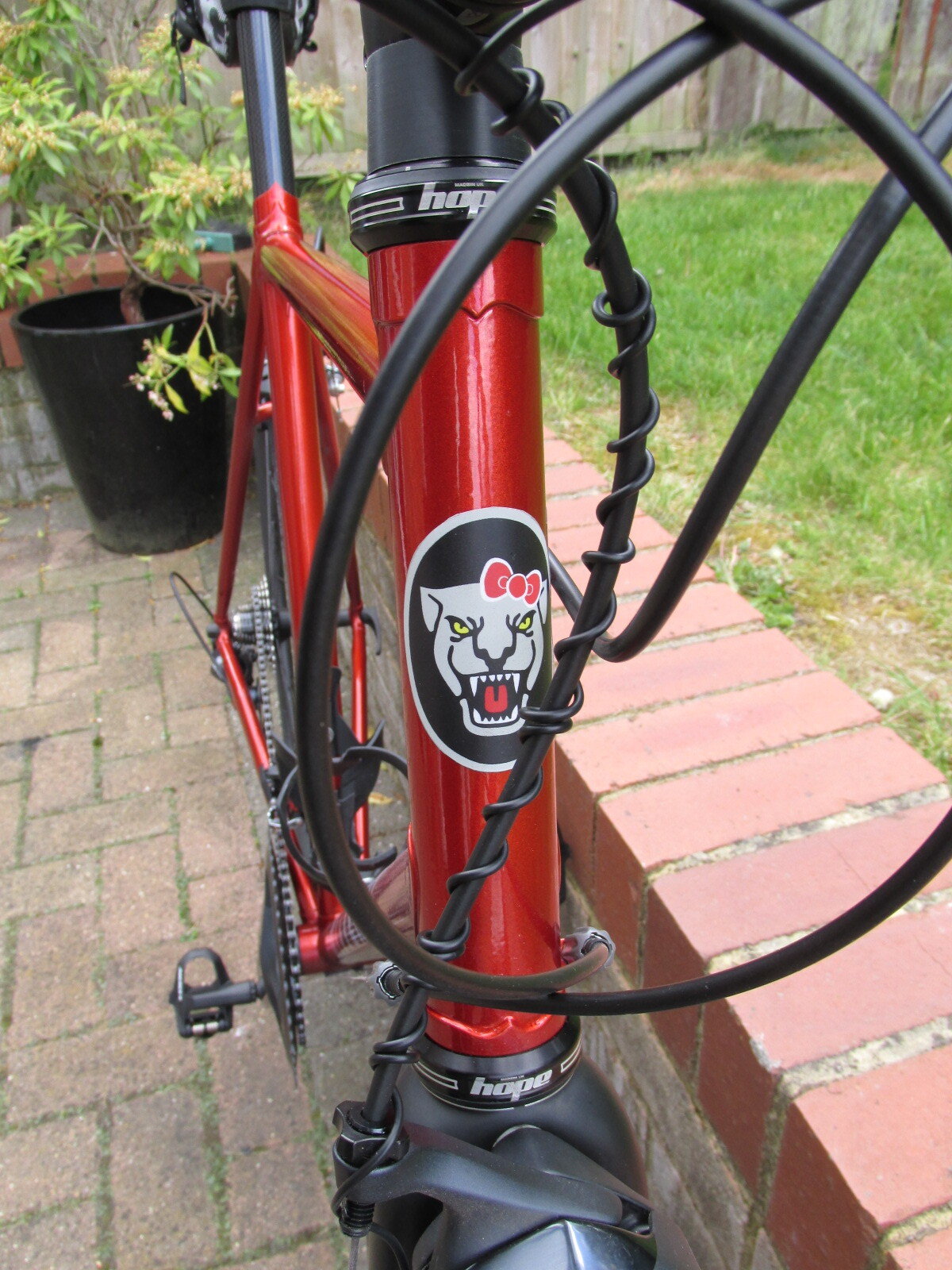
When I assembled my new frame a few months back, I machined a one piece tapered steerer/stem spacer from a piece of delrin/acetal. The stock spacers I had were very clumsy looking.
At the time I did consider the material choice and concluded that being loaded in compression only it would be fine. Carbon spacers are commonly used, the epoxy giving the compressive strength and in this respect delrin must be about comparable with Epoxy. I chose delrin over alloy as it is black and will not tarnish.
I have been riding the bike for months now with no problem, no loosening of the headset etc, but for some reason I am now having doubts. Does anyone have a view on this?
Spacer can be seen in this pic:
At the time I did consider the material choice and concluded that being loaded in compression only it would be fine. Carbon spacers are commonly used, the epoxy giving the compressive strength and in this respect delrin must be about comparable with Epoxy. I chose delrin over alloy as it is black and will not tarnish.
I have been riding the bike for months now with no problem, no loosening of the headset etc, but for some reason I am now having doubts. Does anyone have a view on this?
Spacer can be seen in this pic:
 10-31-19 | 12:39 PM
#3
Thread Starter
Full Member
Joined: Nov 2015
Posts: 206
Likes: 58
10-31-19 | 01:31 PM
#4
Senior Member
Joined: Jun 2012
Posts: 351
Likes: 9
From: harrisburg, pennsylvania
Bikes: 1976 Schwinn Super Le Tour, tricked out with modern components. Shimano Alfine 11 internal gear hub. Dynamo hub. Titanium racks and bottle cages. Mercier Kilo Wide Tire dropbar singlespeed
Great idea
When I assembled my new frame a few months back, I machined a one piece tapered steerer/stem spacer from a piece of delrin/acetal. The stock spacers I had were very clumsy looking.
At the time I did consider the material choice and concluded that being loaded in compression only it would be fine. Carbon spacers are commonly used, the epoxy giving the compressive strength and in this respect delrin must be about comparable with Epoxy. I chose delrin over alloy as it is black and will not tarnish.
I have been riding the bike for months now with no problem, no loosening of the headset etc, but for some reason I am now having doubts. Does anyone have a view on this?
Spacer can be seen in this pic:
At the time I did consider the material choice and concluded that being loaded in compression only it would be fine. Carbon spacers are commonly used, the epoxy giving the compressive strength and in this respect delrin must be about comparable with Epoxy. I chose delrin over alloy as it is black and will not tarnish.
I have been riding the bike for months now with no problem, no loosening of the headset etc, but for some reason I am now having doubts. Does anyone have a view on this?
Spacer can be seen in this pic:
 10-31-19 | 03:55 PM
#6


Senior Member

Joined: Jun 2004
Posts: 3,153
Likes: 563
From: Torrance, CA
Bikes: Homebuilt steel
It wouldn't bother me either. Sounds like a good idea even. I sweat a lot and corrosion develops on the stem and spacers creating creaking noises and even corroding the spacer to the steerer tube. Chris King headsets have these thin plastic washers that help that situation but a plastic spacer would be even better I think.
Last edited by Nessism; 11-01-19 at 08:40 AM.
10-31-19 | 04:19 PM
#7


Non omnino gravis
Joined: Feb 2015
Posts: 8,552
Likes: 1,739
From: SoCal, USA!
Bikes: Nekobasu, Pandicorn, Lakitu
I turned a one-piece bearing cap + spacer for my wife's bike out of Delrin-- and not even real delrin, but generic acetal homopolymer from McMaster-- and it's been on the bike for over 5 years.
Delrin is outstandingly strong, and should (and does) serve perfectly well as stem spacer material. I mean c'mon, I have some FSA branded spacers here made of acrylic.
Delrin is outstandingly strong, and should (and does) serve perfectly well as stem spacer material. I mean c'mon, I have some FSA branded spacers here made of acrylic.
__________________

10-31-19 | 06:50 PM
#8
Senior Member

Joined: Dec 2009
Posts: 507
Likes: 13
From a plastic supplier:
Delrin behaves like most engineering materials in that as temperature increases, elongation increases and strength decreases. Delrin has a tensile strength at room temperature of 10,000 psi, no true yield point and a stiff flexural modulus of 410,000 psi.
Delrin has outstanding fatigue resistance, almost indefinitely withstanding cyclic compressive/tensile stressing 5,000 psi.
Delrin does not permanently deform or retain dents, and has good impact toughness. The higher molecular weight resin formulations will deliver even greater toughness.
The Delrin-steel coefficient of friction is very low (0.1-0.3), and friction values remain virtually unchanged over a wide range of temperatures, loads and relative surface speeds
Sounds like more spacers should use this material.
Delrin behaves like most engineering materials in that as temperature increases, elongation increases and strength decreases. Delrin has a tensile strength at room temperature of 10,000 psi, no true yield point and a stiff flexural modulus of 410,000 psi.
Delrin has outstanding fatigue resistance, almost indefinitely withstanding cyclic compressive/tensile stressing 5,000 psi.
Delrin does not permanently deform or retain dents, and has good impact toughness. The higher molecular weight resin formulations will deliver even greater toughness.
The Delrin-steel coefficient of friction is very low (0.1-0.3), and friction values remain virtually unchanged over a wide range of temperatures, loads and relative surface speeds
Sounds like more spacers should use this material.

 11-08-19 | 02:16 PM
#12
Senior Member
Joined: Nov 2012
Posts: 5,187
Likes: 1,936
I have a Cadex frame cut up into pieces that were used in another project and I plan on using some of the tubes to make a single spacer around 30mm in length. Should work just fine. Though of using PVC pipe, but ID does not fit the steerer.
