


Custom Stem
 08-19-24 | 04:58 PM
#26
Senior Member


Joined: Aug 2012
Posts: 684
Likes: 283
From: Seattle
What flux did you use? So far I have only used it on lawn sculptures made from silverware, but the Cycle Design nickel silver flux made things so much easier. I will never use Type B on nickel silver again, unless it's after the zombie apocalypse and I need to make something to survive.
__________________
https://www.flickr.com/photos/54319503@N05/
https://www.draper-cycles.com
https://www.flickr.com/photos/54319503@N05/
https://www.draper-cycles.com
 08-20-24 | 02:30 AM
#27

Senior Member


Joined: Apr 2009
Posts: 3,812
Likes: 5,701
From: Seattle
The third frame I ever made was for me. Talking about a whole frame from start to finish, not counting the hundred or so tandems I had worked on, as the apprentice at Santana in the '70s. It was a lugless touring frame made with "regular" 531 DB, not superlight but not Tourist gauge either. As in .9 DT and ST, .8 TT, decently light for back then. The first two frames were lugged racing bikes and I was ready to try something different
Instead of doing as I'd been taught (where's the fun in that?), I looked at the filler rod catalog and just ordered the strongest stuff, Allstate #11, which is nickel-silver. Let's call it NS for short. I just used the normal paste flux for brass, whatever we used back then. The fillets were a bear to file smooth because the stuff is very tough to file. I did some multi-day tours, up to a week with full camping gear, often enough on dirt roads, a decent strength test. Then a few years later I sold it to a guy who was going to ride it around the world. I never heard from that guy again, so maybe he died when the frame threw him in a ditch? But I did tell him I'd fix it if it broke, so I hope he'd have told me. I like to think that frame is still out there, being ridden. I can dream can't I?
I've done a bit of brazing with NS since then, and in all that time, I've never heard of cracking while cooling (or at other times).
Paul Brodie, in his Youtube channel, has showed us how he made lugless MTBs BITD, and unless he only recently started using NS, it sounds like that's how he did all of them. What's that, hundreds, or is it thousands? I dunno how prolific he was. But he didn't make the fillet with NS, he only brazed the tubes with NS (some call it "tinning") and then followed that by fillet-brazing with brass. (He calls it bronze, same thing.) Same flux, and I don't think it's NS-specific flux he's using. Obviously he wasn't using SS tubing, so brass was an option. Why then wouldn't he just do the whole joint in brass? Why 2 different fillers on each joint? You'd have to ask him. But I doubt he saw any cracking after the NS brazing step, or he wouldn't have kept doing it.
Yes this is long-winded and somewhat irrelevant since Duane's problem was with thick-wall SS, not thinwall Cr-Mo or 531. I just wanted to point out that NS has been successfully used to make bike frames, and they didn't crack while cooling. So Duane's experience must have more to do with the SS, or maybe the thick wall, or both.
Instead of doing as I'd been taught (where's the fun in that?), I looked at the filler rod catalog and just ordered the strongest stuff, Allstate #11, which is nickel-silver. Let's call it NS for short. I just used the normal paste flux for brass, whatever we used back then. The fillets were a bear to file smooth because the stuff is very tough to file. I did some multi-day tours, up to a week with full camping gear, often enough on dirt roads, a decent strength test. Then a few years later I sold it to a guy who was going to ride it around the world. I never heard from that guy again, so maybe he died when the frame threw him in a ditch? But I did tell him I'd fix it if it broke, so I hope he'd have told me. I like to think that frame is still out there, being ridden.
I can dream can't I?I've done a bit of brazing with NS since then, and in all that time, I've never heard of cracking while cooling (or at other times).
Paul Brodie, in his Youtube channel, has showed us how he made lugless MTBs BITD, and unless he only recently started using NS, it sounds like that's how he did all of them. What's that, hundreds, or is it thousands? I dunno how prolific he was. But he didn't make the fillet with NS, he only brazed the tubes with NS (some call it "tinning") and then followed that by fillet-brazing with brass. (He calls it bronze, same thing.) Same flux, and I don't think it's NS-specific flux he's using. Obviously he wasn't using SS tubing, so brass was an option. Why then wouldn't he just do the whole joint in brass? Why 2 different fillers on each joint? You'd have to ask him. But I doubt he saw any cracking after the NS brazing step, or he wouldn't have kept doing it.
Yes this is long-winded and somewhat irrelevant since Duane's problem was with thick-wall SS, not thinwall Cr-Mo or 531. I just wanted to point out that NS has been successfully used to make bike frames, and they didn't crack while cooling. So Duane's experience must have more to do with the SS, or maybe the thick wall, or both.
08-20-24 | 07:27 AM
#28
Randomhead
Joined: Aug 2008
Posts: 25,930
Likes: 4,825
From: Happy Valley, Pennsylvania
At Trek in the '70s, we used either silver or nickel silver. Never on stainless though. Tbh, I never knew nickel silver took more heat until I started building again 15 years ago. I don't think the extra heat is apparent unless you are working with stainless. It's within the upper range of normal brass flux, which is why Paul Brodie can use his gasfluxer. Stainless seems to have a property where it's easy to overheat. Maybe it's easier to notice just because it's shiny, IDK. But unlike more normal steels, it gets a cruft on it when that happens that makes it hard to flow out filler. I didn't see that behavior when using the Cycle Design flux, but that also helped the filler flow out more easily at a lower temperature, so that also probably helped.
When I worked at Trek, I developed symptoms of what the internet now tells me is a sensitivity to nickel silver. So I don't use it unless I'm feeling cheap and working with stainless. You can go through a lot of fillet pro ($) making lawn sculptures. I also wear a mask now because of Mr. Bulgier.
On the subject of gasfluxers, doesn't the same flux work with brass and silver? That would be nice. I have a drawer full of flux jars.
When I worked at Trek, I developed symptoms of what the internet now tells me is a sensitivity to nickel silver. So I don't use it unless I'm feeling cheap and working with stainless. You can go through a lot of fillet pro ($) making lawn sculptures. I also wear a mask now because of Mr. Bulgier.
On the subject of gasfluxers, doesn't the same flux work with brass and silver? That would be nice. I have a drawer full of flux jars.
08-20-24 | 07:47 AM
#29

Senior Member
Joined: Feb 2012
Posts: 19,381
Likes: 5,528
From: Rochester, NY
Bikes: Stewart S&S coupled sport tourer, Stewart Sunday light, Stewart Commuting, Stewart Touring, Co Motion Tandem, Stewart 3-Spd, Stewart Track, Fuji Finest, Mongoose Tomac ATB, GT Bravado ATB, JCP Folder, Stewart 650B ATB
All of the gas fluxers I have used (4 IIRC) had only one type of liquid flux in them, good for either brass/bronze or silvers. But I found the need for paste flux too and in the end decided that the gas fluxer was doing far less of the work flux is suppose to do, compared to the paste and sold off the fluxer.
I had thought that the basic foundation chemistry for silver and brass/bronze paste fluxes is the same but for additives that vary the temp the flux is most active at and influence for how long it is active. Andy
I had thought that the basic foundation chemistry for silver and brass/bronze paste fluxes is the same but for additives that vary the temp the flux is most active at and influence for how long it is active. Andy
__________________
AndrewRStewart
AndrewRStewart
08-20-24 | 04:36 PM
#30

Old fart

Joined: Nov 2004
Posts: 26,411
Likes: 5,350
From: Appleton WI
Bikes: Several, mostly not name brands.
What flux did you use? So far I have only used it on lawn sculptures made from silverware, but the Cycle Design nickel silver flux made things so much easier. I will never use Type B on nickel silver again, unless it's after the zombie apocalypse and I need to make something to survive.
08-20-24 | 07:29 PM
#31
Senior Member
Joined: Aug 2012
Posts: 684
Likes: 283
From: Seattle
The quoting got too confusing so I'll just add some clarification and thoughts:
The thickness of the clamp was .065" 304 stainless and the extension was .125" 304 stainless. The extension didn't crack at all so I suspect the difference in thickness forced the stress/contraction into the clamp material in addition to requiring a little more heat than 2 pieces of .065 would.
Stainless doesn't transfer heat like 4130 or other standard steels so when it comes up to temp, the heat stays very localized and goes from too cold to perfect to 'dang, now I have to start over' in the blink of an eye. After this experience, I'm thinking a bigger/softer flame might help spread the heat and not keep it so concentrated as typical O/A fillet brazing flame does.
NS is a PITA to file! I don't even try. Frankly, I don't like tinning with it like Paul does. Mostly out of fear that something is going on between the layers that I don't understand.
JohnDThompson I use NS fairly regularly with Gasflux B on steel with good results. My sense is using NS, B flux and stainless is just a combination that is fraught with potential problems.
The thickness of the clamp was .065" 304 stainless and the extension was .125" 304 stainless. The extension didn't crack at all so I suspect the difference in thickness forced the stress/contraction into the clamp material in addition to requiring a little more heat than 2 pieces of .065 would.
Stainless doesn't transfer heat like 4130 or other standard steels so when it comes up to temp, the heat stays very localized and goes from too cold to perfect to 'dang, now I have to start over' in the blink of an eye. After this experience, I'm thinking a bigger/softer flame might help spread the heat and not keep it so concentrated as typical O/A fillet brazing flame does.
NS is a PITA to file! I don't even try. Frankly, I don't like tinning with it like Paul does. Mostly out of fear that something is going on between the layers that I don't understand.
JohnDThompson I use NS fairly regularly with Gasflux B on steel with good results. My sense is using NS, B flux and stainless is just a combination that is fraught with potential problems.
__________________
https://www.flickr.com/photos/54319503@N05/
https://www.draper-cycles.com
https://www.flickr.com/photos/54319503@N05/
https://www.draper-cycles.com
08-21-24 | 07:43 AM
#32
Randomhead
Joined: Aug 2008
Posts: 25,930
Likes: 4,825
From: Happy Valley, Pennsylvania
Someone with better heat control than me might not have trouble with type B on stainless either, it's just that the cycle designs flux makes it a lot easier. I can't imagine using either on a steel-only joint.
08-21-24 | 11:18 AM
#33
Old fart
Joined: Nov 2004
Posts: 26,411
Likes: 5,350
From: Appleton WI
Bikes: Several, mostly not name brands.
08-21-24 | 02:20 PM
#34
Senior Member
Joined: Apr 2009
Posts: 3,812
Likes: 5,701
From: Seattle
I wonder if the flux-coated NS rod might be worth a try? It seems to be favored in industry — at least when I search for it, I get more hits for FC than bare. Being a finicky type about not having any burnt flux showing when done, I'd probably use paste flux too, with the FC rod supplying more as you go so you don't run "dry". I don't mean for normal bikeframe stuff, I mean more for like Duane's use-case, a thick SS part that takes a lot of heat.
I think I heard somewhere that the flux from the rod doesn't soak off in water, or not well. (Also true of some generic paste or powder flux like you'd get at the local welding shop.) I gather you're expected to hammer it off? Thinwall bike tubes don't like that treatment very much. (Finally, a use for the angry caveman smiley)
It's painful for me to watch when people use only the powder, heating the rod and sticking it in the can of powder to make it stick to the rod. But I guess long ago that was "the way".
I think I heard somewhere that the flux from the rod doesn't soak off in water, or not well. (Also true of some generic paste or powder flux like you'd get at the local welding shop.) I gather you're expected to hammer it off? Thinwall bike tubes don't like that treatment very much.
(Finally, a use for the angry caveman smiley)It's painful for me to watch when people use only the powder, heating the rod and sticking it in the can of powder to make it stick to the rod. But I guess long ago that was "the way".
08-21-24 | 02:50 PM
#35
Senior Member
Joined: Apr 2009
Posts: 3,812
Likes: 5,701
From: Seattle
I found it files OK if your file is brand new (sharp). The difficulty isn't so much the hardness, more the 'slipperiness' — the file wants to glide off without biting (and nick the adjacent steel), so you have to press on the file enough to make it cut. A carbide burr cuts it just fine, hardly noticeable difference from brass. And of course abrasives (cartridge roll, dynafile) work too.
Luckily I was warned about the difficulty in filing. I made and filed a couple test joints before I committed to making a whole frame.
Funny story, after I built and painted the frame, hung parts and rode it, I decided I'd made the toptube too long. So I cut the entire head tube off, re-mitered TT & DT some amount shorter ( I think it was a half-inch) and put on a new HT. Luckily paint was free to me, they didn't charge me for the amount of Imron I used. So anyway, I still have the original HT with the TT & DT joints. I sectioned it to see how I did. Full penetration (tiny inside fillet all around), no voids, and if there's any undercutting of the steel, I can't see it. Overall I am pleased that it came out so nice — I've seen lugless frames from much more experienced builders (e.g. Alex Singer) that show a substantial trough around the fillet from filing. But I had smoothed a mile of fillet on Santanas before I made my own. That's the job they made the apprentice do, not because it requires less skill, only because it's an unpleasant job that they (the two journeymen) didn't want to do! Those very first Santanas when we all were first learning probably aren't very good.
Luckily I was warned about the difficulty in filing. I made and filed a couple test joints before I committed to making a whole frame.
Funny story, after I built and painted the frame, hung parts and rode it, I decided I'd made the toptube too long. So I cut the entire head tube off, re-mitered TT & DT some amount shorter ( I think it was a half-inch) and put on a new HT. Luckily paint was free to me, they didn't charge me for the amount of Imron I used. So anyway, I still have the original HT with the TT & DT joints. I sectioned it to see how I did. Full penetration (tiny inside fillet all around), no voids, and if there's any undercutting of the steel, I can't see it. Overall I am pleased that it came out so nice — I've seen lugless frames from much more experienced builders (e.g. Alex Singer) that show a substantial trough around the fillet from filing. But I had smoothed a mile of fillet on Santanas before I made my own. That's the job they made the apprentice do, not because it requires less skill, only because it's an unpleasant job that they (the two journeymen) didn't want to do! Those very first Santanas when we all were first learning probably aren't very good.
08-21-24 | 04:53 PM
#36
Randomhead
Joined: Aug 2008
Posts: 25,930
Likes: 4,825
From: Happy Valley, Pennsylvania
I built my tandem with powdered flux. There may still be some under the paint (j/k, I hope).
I built 10ish frames with that flux, although mostly lugged with silver, so that would just be the bridges and dropouts. A number of those were after Trek, so it was even more painful because I was used to the chemical treatment system they had. I like having some powdered flux around, even though I almost never use it.
I built 10ish frames with that flux, although mostly lugged with silver, so that would just be the bridges and dropouts. A number of those were after Trek, so it was even more painful because I was used to the chemical treatment system they had. I like having some powdered flux around, even though I almost never use it.
08-21-24 | 05:07 PM
#37
semi-retired framebuilder
Joined: Dec 2007
Posts: 151
Likes: 595
From: Halifax, Nova Scotia, Canada
Bikes: twenty-three at last count
When I started building frames back in 1990, the first dozen or so were lugged with 56% silver.
At the time, I owned an ‘84 Ritchey Competition/Annapurna and was blown away by Tom Ritchey’s brazing. At the Interbike in Anaheim in’91, I think, I asked Tom what brazing rods he used; he seemed a little non-plussed, then said “Allstate #11” - ie nickel silver. I subsequently bought a bunch of it.
I built my first dozen fillet bikes with it, and yes, a pain to file for sure, but once I got a little more proficient I could get it to go where I wanted it to be with minimal filing. It wasn’t until many years later that I started using low fuming bronze for fillets.
One of my more satisfying nickel-silver builds was a hardtail frame for my wife - built it in two long days start to finish with minimal filing, everything just came out so well, miters tight, minimal cleanup. First fillet frame where I felt I was in control, a nice feeling. I always scraped off the flux coating and used paste flux.
Mark Beaver
Tamarack Cycles
Halifax, NS
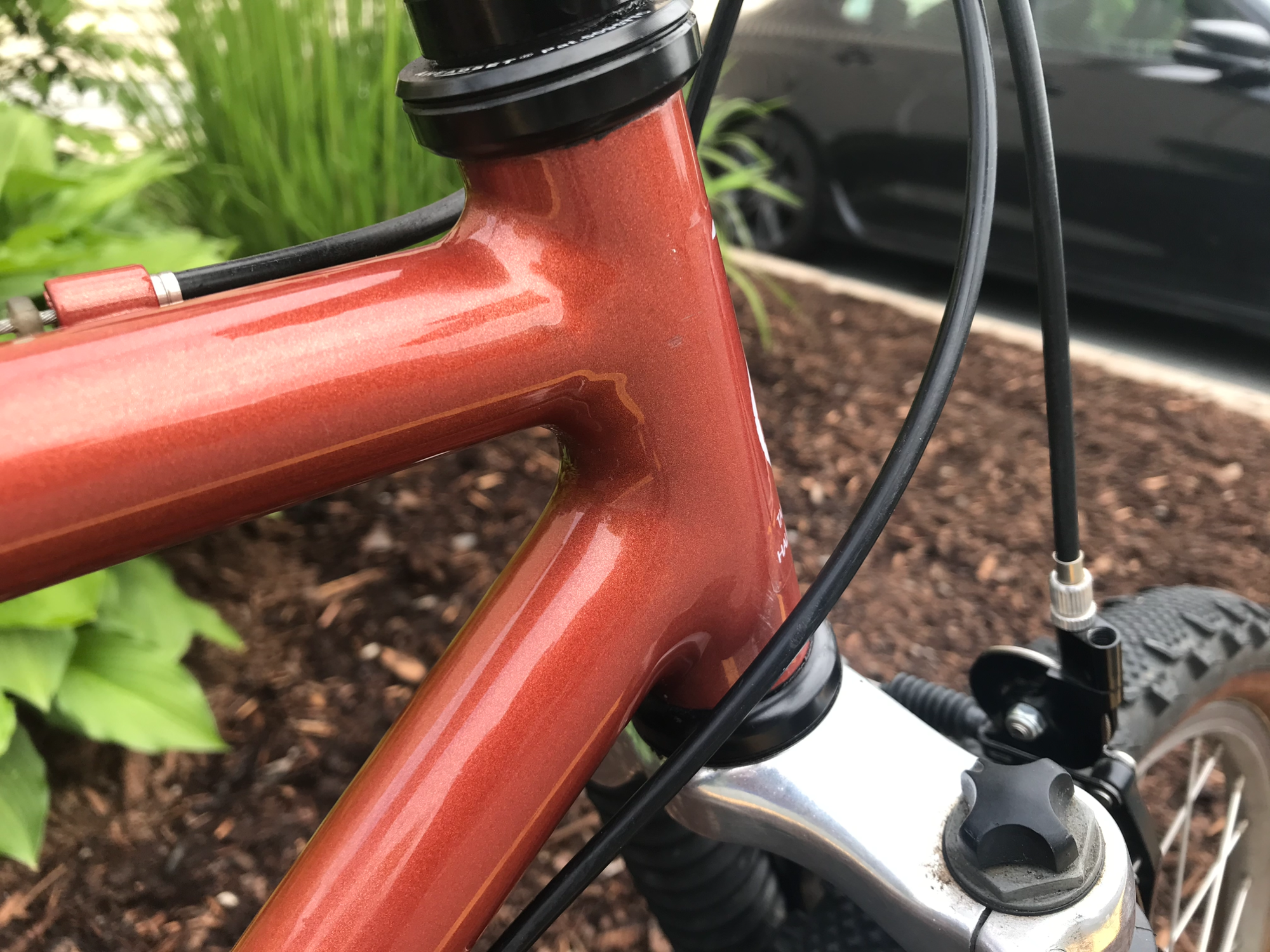
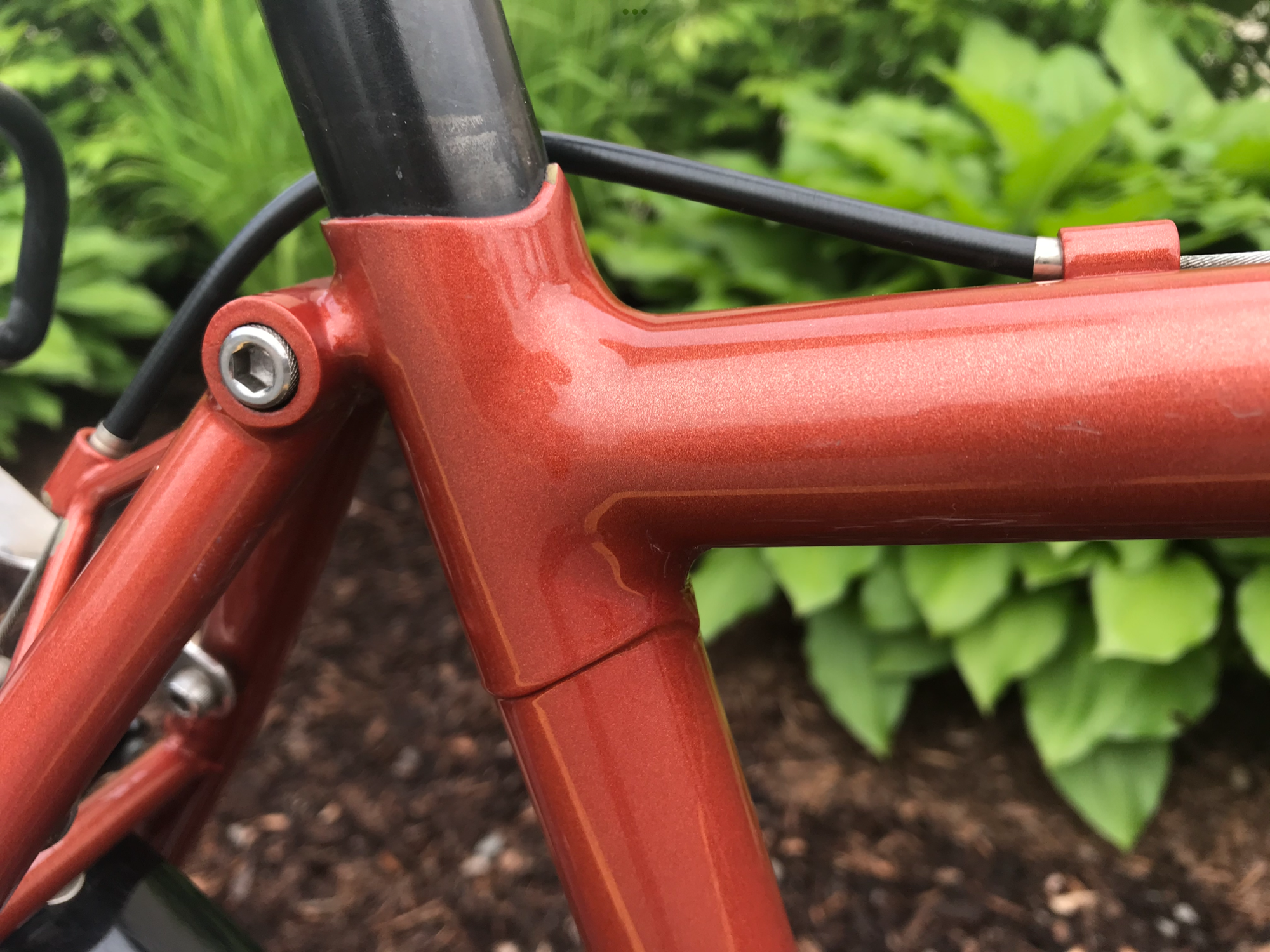
At the time, I owned an ‘84 Ritchey Competition/Annapurna and was blown away by Tom Ritchey’s brazing. At the Interbike in Anaheim in’91, I think, I asked Tom what brazing rods he used; he seemed a little non-plussed, then said “Allstate #11” - ie nickel silver. I subsequently bought a bunch of it.
I built my first dozen fillet bikes with it, and yes, a pain to file for sure, but once I got a little more proficient I could get it to go where I wanted it to be with minimal filing. It wasn’t until many years later that I started using low fuming bronze for fillets.
One of my more satisfying nickel-silver builds was a hardtail frame for my wife - built it in two long days start to finish with minimal filing, everything just came out so well, miters tight, minimal cleanup. First fillet frame where I felt I was in control, a nice feeling. I always scraped off the flux coating and used paste flux.
Mark Beaver
Tamarack Cycles
Halifax, NS
08-21-24 | 06:51 PM
#38
Randomhead
Joined: Aug 2008
Posts: 25,930
Likes: 4,825
From: Happy Valley, Pennsylvania
Those are some nice fillets, but I'm glad nobody ever told me to use nickel silver.
I guess nobody in backwoods Virginia ever heard of it. I had to drive an hour just to get to the closest welding supply.
I guess nobody in backwoods Virginia ever heard of it. I had to drive an hour just to get to the closest welding supply.
08-24-24 | 11:12 AM
#39
Old fart
Joined: Nov 2004
Posts: 26,411
Likes: 5,350
From: Appleton WI
Bikes: Several, mostly not name brands.
I think I heard somewhere that the flux from the rod doesn't soak off in water, or not well. (Also true of some generic paste or powder flux like you'd get at the local welding shop.) I gather you're expected to hammer it off? Thinwall bike tubes don't like that treatment very much.
08-24-24 | 11:36 AM
#40
Randomhead
Joined: Aug 2008
Posts: 25,930
Likes: 4,825
From: Happy Valley, Pennsylvania
I made paste flux out of powdered flux, for science. I put it in boiling water, I vaguely remember it taking more than one shot in the microwave. I think that means that it will soak off if you get the parts hot enough, but I've never felt like doing that experiment. Might take superheated steam, I should look for a used instant pot at the thrift store.
08-24-24 | 04:21 PM
#41
Senior Member
Joined: Apr 2009
Posts: 3,812
Likes: 5,701
From: Seattle
I made paste flux out of powdered flux, for science. I put it in boiling water, I vaguely remember it taking more than one shot in the microwave. I think that means that it will soak off if you get the parts hot enough, but I've never felt like doing that experiment. Might take superheated steam, I should look for a used instant pot at the thrift store.
In case my wife reads this: I would never do that, honey!
Our pressure cooker isn't quite big enough to fit a bike frame though.
