


Silver vs. Brass/Bronze Question
 11-09-25 | 06:56 AM
#1
Thread Starter
Senior Member

Joined: Dec 2011
Posts: 2,908
Likes: 249
From: NE Ohio
Bikes: 1992 Serotta Colorado II,Co-Motion Speedster, Giant Escape Hybrid, 1977 Schwinn Super Le Tour
Silver vs. Brass/Bronze Question
While cycling home from the bike shop yesterday a question popped into my mind!
Is there a "strength " difference on a brazed fillet joint between silver & brass/bronze?
Fortunately I did not let my mind wonder too long as a big buck ran out on the road followed by a hawk!
Is there a "strength " difference on a brazed fillet joint between silver & brass/bronze?
Fortunately I did not let my mind wonder too long as a big buck ran out on the road followed by a hawk!
 11-09-25 | 09:52 AM
#2

Old fart


Joined: Nov 2004
Posts: 26,345
Likes: 5,251
From: Appleton WI
Bikes: Several, mostly not name brands.
IMO, not really, if properly done. Silver requires tighter tolerances than brass, doesn't fill voids as well, and is reluctant to build into a fillet. But it melts at a lower temperature than brass, reducing the heat-affected zone on the tubing, and flows very nicely to fill lugs and minimize clean-up work.
 11-09-25 | 11:57 AM
#3
Senior Member
Joined: Aug 2012
Posts: 680
Likes: 283
From: Seattle
LFB has higher tensile (65-70kpsi) and shear strength so it is stronger than say 38%/Fillet Pro (40-50k psi tensile). As John points out, silver is a bit trickier to build fillets with - though I suspect he's referring to 56% instead of 38%. 38% builds fillets pretty nicely but heat control is critical. LFB is more forgiving in my experience. For me, 56% for building a fillet is just silly. I"d have silver all over the place before I built any kind of meaningful fillet!
Practically, the silver fillets should be somewhat bigger than the brass ones because of the lower strength. I think most of us make (or maybe historically) our brass ones bigger than necessary for strength anyway. There's a formula for calculating how much overlap is required for a lap joint (lugs) but I haven't seen one for filleted T joints.
Practically, the silver fillets should be somewhat bigger than the brass ones because of the lower strength. I think most of us make (or maybe historically) our brass ones bigger than necessary for strength anyway. There's a formula for calculating how much overlap is required for a lap joint (lugs) but I haven't seen one for filleted T joints.
__________________
https://www.flickr.com/photos/54319503@N05/
https://www.draper-cycles.com
https://www.flickr.com/photos/54319503@N05/
https://www.draper-cycles.com
Last edited by duanedr; 11-09-25 at 12:24 PM. Reason: clarity
11-09-25 | 03:57 PM
#4
Senior Member

Joined: Dec 2019
Posts: 1,187
Likes: 387
I was interested to see Paul Brodie attaching seat stays with silver, without really a fillet, just using the kind that flows in. My understanding is that silver is the strongest way to do that kind of joint. But if you don't have a decent fillet, or some surface area such as is provided by a lug, a "flowed-in" joint like that will not be as strong as a weld or a fillet braze, i.e. will it ultimately fail before the parent tube does.
On another video (Cobra Framebuilding) he attached a SS bridge like that, and then I think IIRC redid it because people expressed concerns about strength. I'm sure it's fine for a bridge tube, and if Brodie attaches SS like that, also fine for those, because he has never had a failure. But I suspect it isn't as strong as the parent metal. I could test it but my brazing skills suck too much and I only have a MAPP so I don't think it would tell us much useful
On another video (Cobra Framebuilding) he attached a SS bridge like that, and then I think IIRC redid it because people expressed concerns about strength. I'm sure it's fine for a bridge tube, and if Brodie attaches SS like that, also fine for those, because he has never had a failure. But I suspect it isn't as strong as the parent metal. I could test it but my brazing skills suck too much and I only have a MAPP so I don't think it would tell us much useful
11-09-25 | 07:24 PM
#5

Senior Member
Joined: Feb 2012
Posts: 19,349
Likes: 5,466
From: Rochester, NY
Bikes: Stewart S&S coupled sport tourer, Stewart Sunday light, Stewart Commuting, Stewart Touring, Co Motion Tandem, Stewart 3-Spd, Stewart Track, Fuji Finest, Mongoose Tomac ATB, GT Bravado ATB, JCP Folder, Stewart 650B ATB
My understanding of using 56% silver for a filleted joint is that it can be prone to cracking. I have been told that silver slightly contracts on cooling and in a fillet it is the center that cools last, thus potentially beginning the joint's life with an internal crack.
Yet I have attached many (in my small production) seat stays to a lug's side with only 56% silver and have had good results. Or, at least, any bad ones had nothing to do with the filler... And I'd say that I've seen far more brass/bronze attached stays with issues then silvered ones (which should be the case as the number of silvered stay bikes is actually rather small compared to brass/bronze).
I've always thought that silver likes a large surface area to wet out on to (large as compared to the joint's parts and stresses), very clean prep and when right can be fast and very cleanly done with little later clean up. Great for lugs and thin wall located braze ons. LFB/brass is less cleanliness concerned, it's flux harder to soak off, handled larger gaps well (what fillets mostly are) and can cause distortion far more readily. Oh and it's cheaper to get.
That last bit is one reason why I began years ago to use LFB (GasFlux CO-4) as much as I could. Andy.
Yet I have attached many (in my small production) seat stays to a lug's side with only 56% silver and have had good results. Or, at least, any bad ones had nothing to do with the filler... And I'd say that I've seen far more brass/bronze attached stays with issues then silvered ones (which should be the case as the number of silvered stay bikes is actually rather small compared to brass/bronze).
I've always thought that silver likes a large surface area to wet out on to (large as compared to the joint's parts and stresses), very clean prep and when right can be fast and very cleanly done with little later clean up. Great for lugs and thin wall located braze ons. LFB/brass is less cleanliness concerned, it's flux harder to soak off, handled larger gaps well (what fillets mostly are) and can cause distortion far more readily. Oh and it's cheaper to get.
That last bit is one reason why I began years ago to use LFB (GasFlux CO-4) as much as I could. Andy.
__________________
AndrewRStewart
AndrewRStewart
11-09-25 | 08:47 PM
#6

Senior Member


Joined: Apr 2009
Posts: 3,719
Likes: 5,504
From: Seattle
I was interested to see Paul Brodie attaching seat stays with silver, without really a fillet, just using the kind that flows in. My understanding is that silver is the strongest way to do that kind of joint. But if you don't have a decent fillet, or some surface area such as is provided by a lug, a "flowed-in" joint like that will not be as strong as a weld or a fillet braze, i.e. will it ultimately fail before the parent tube does.
On another video (Cobra Framebuilding) he attached a SS bridge like that, and then I think IIRC redid it because people expressed concerns about strength. I'm sure it's fine for a bridge tube, and if Brodie attaches SS like that, also fine for those, because he has never had a failure. But I suspect it isn't as strong as the parent metal. I could test it but my brazing skills suck too much and I only have a MAPP so I don't think it would tell us much useful
On another video (Cobra Framebuilding) he attached a SS bridge like that, and then I think IIRC redid it because people expressed concerns about strength. I'm sure it's fine for a bridge tube, and if Brodie attaches SS like that, also fine for those, because he has never had a failure. But I suspect it isn't as strong as the parent metal. I could test it but my brazing skills suck too much and I only have a MAPP so I don't think it would tell us much useful
Here's one with the stay mitered sorta half-way to a fastback; I call it Half-Fast™ (say it out loud...) The little cap is brass-brazed to the stay, which then gets mitered to fit the lug, and silver brazed. This is not the fast way to do stays, not even half-fast as in how long it takes. Only for "special" bikes (my wife's and mine mostly).

 11-10-25 | 04:04 AM
#8
Senior Member
Joined: Feb 2020
Posts: 4,001
Likes: 2,317
11-10-25 | 04:08 AM
#9
Senior Member
Joined: Dec 2019
Posts: 1,187
Likes: 387
11-10-25 | 05:44 AM
#10
Senior Member
Joined: Apr 2009
Posts: 3,719
Likes: 5,504
From: Seattle
Yes this style has plenty of surface area and should be very strong. The ones Brodie did (that I was surprised by) were just mitred straight in (I think it's called the "shot-in" style?). So that you only really have contact along the cross-section of the tube (although it is cut at a fairly steep angle).
It's a pretty reliable method, failures are rare, although we had a thread here last year about some brand that was breaking there, Kona maybe? Pretty sure it was the seat tube that cracked, not the weld.
If the seat tube isn't reinforced with a lug there, it had better be a fairly thick tube, for example the externally-butted seat tubes made extra thick at the top for just that reason. But you almost never see the braze (or weld) break, it's almost always the seat tube. That said, if you use high silver-content filler, your miters had better be perfect.
11-10-25 | 06:49 AM
#11
Old fart
Joined: Nov 2004
Posts: 26,345
Likes: 5,251
From: Appleton WI
Bikes: Several, mostly not name brands.
I was interested to see Paul Brodie attaching seat stays with silver, without really a fillet, just using the kind that flows in. My understanding is that silver is the strongest way to do that kind of joint. But if you don't have a decent fillet, or some surface area such as is provided by a lug, a "flowed-in" joint like that will not be as strong as a weld or a fillet braze, i.e. will it ultimately fail before the parent tube does.
11-10-25 | 06:53 AM
#12
Old fart
Joined: Nov 2004
Posts: 26,345
Likes: 5,251
From: Appleton WI
Bikes: Several, mostly not name brands.
11-10-25 | 02:13 PM
#13
Senior Member
Joined: Apr 2009
Posts: 3,719
Likes: 5,504
From: Seattle

Note the extended spoon on the back of the lug to reinforce the ST for the SS attach.
I love how the '75 catalog says the added rigidity from this is "a necessity for top competition", while their top model the Team Pro, had side-attached stays. What a load of "marketing".
Sorry, I know this isn't the C&V forum, I'm just C&V myself.
11-10-25 | 07:10 PM
#14
Senior Member
Joined: Feb 2012
Posts: 19,349
Likes: 5,466
From: Rochester, NY
Bikes: Stewart S&S coupled sport tourer, Stewart Sunday light, Stewart Commuting, Stewart Touring, Co Motion Tandem, Stewart 3-Spd, Stewart Track, Fuji Finest, Mongoose Tomac ATB, GT Bravado ATB, JCP Folder, Stewart 650B ATB
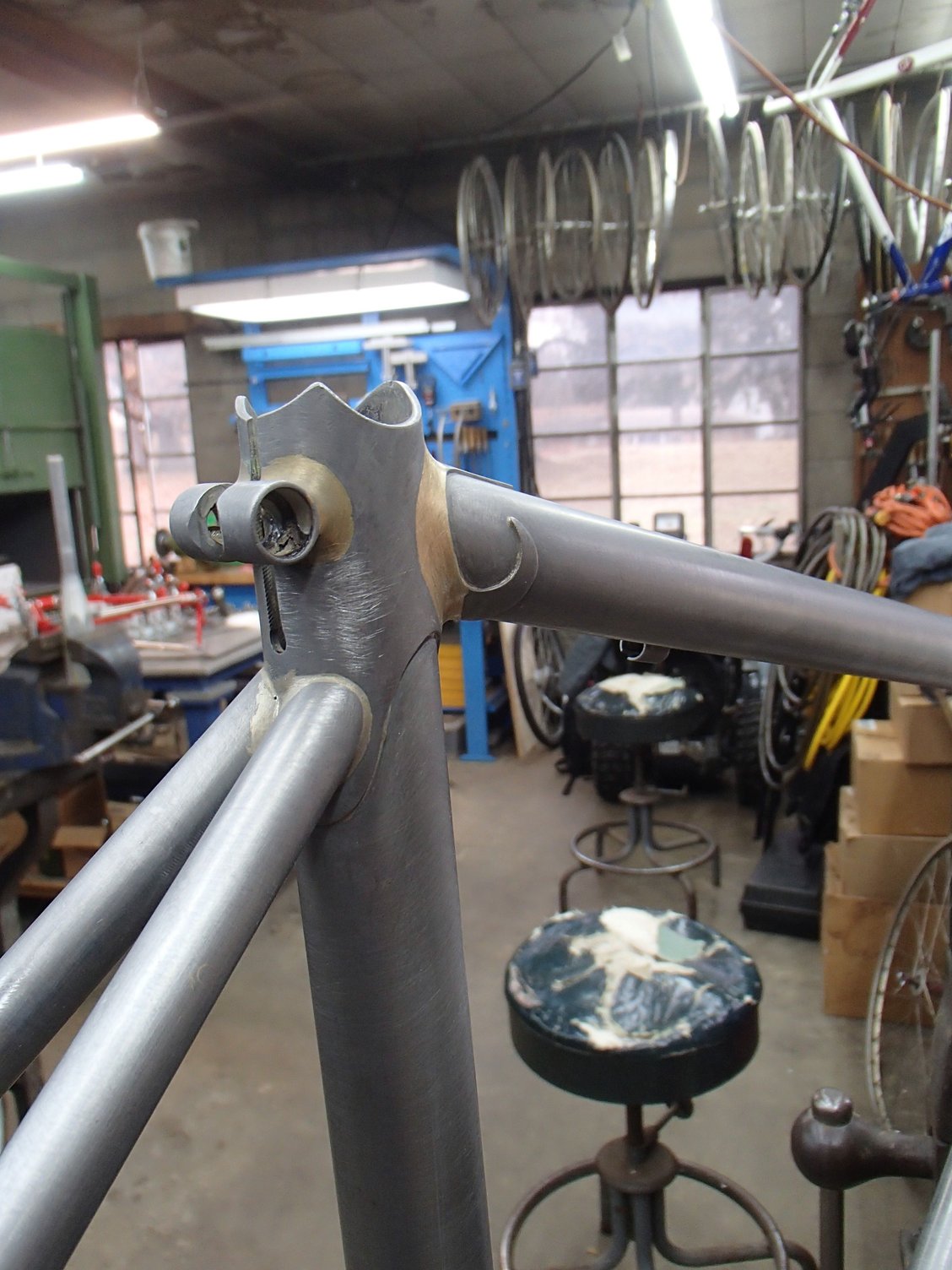
I recently finished the paint work on this frame. Back in the day if the frame was Italian it was a "fastback" and if English it was called a "Brampton/Victor". And the French were too smart to use this style Andy
Andy
__________________
AndrewRStewart
AndrewRStewart
11-11-25 | 08:23 AM
#16
framebuilder
Joined: Dec 2009
Posts: 1,788
Likes: 2,707
From: Niles, Michigan
20 some years ago when we started making the frames for our Ukrainian transportation bicycles ourselves, I brazed the kickstand plate on our prototype frame with 56% silver. I thought this would make putting them on easier for someone without a lot of brazing experience. Making these frames was a training ground for some of my students after taking a class. The kickstand on this bicycle we made for testing broke off. A kickstand has a lot of leverage stressing the joint. The plate was brazed on properly with a nice silver fillet on each side of the plate where it connected to both chain stays. I switched of course to doing the plates with brass and we never had any trouble since then. The moral of the story was that in a circumstance like a kickstand plate, brass is stronger than 56% silver. I"d also add there are not many other joints on a frame similar to a kickstand plate. Wouldn't worry a second about a silver fillet failing on a main triangle.
Andy's fork mishap where he blew the top plate off of the fork blade while attaching the top decoration after filing his vent hole is another illustration of silver not making as strong a fillet as brass. Now in this situation I don't think the silver will fail under normal use. In fact I'll still have students braze them with silver because silver is still strong enough for that purpose. Keep in mind that the melting point of bronze is about 400º hotter than silver so that is going to have a negative impact too. For beginners, it is easy to go over the temperature window of brass causing real damage to the steel where going over the same amount with silver doesn't have as negative an impact.
Andy's fork mishap where he blew the top plate off of the fork blade while attaching the top decoration after filing his vent hole is another illustration of silver not making as strong a fillet as brass. Now in this situation I don't think the silver will fail under normal use. In fact I'll still have students braze them with silver because silver is still strong enough for that purpose. Keep in mind that the melting point of bronze is about 400º hotter than silver so that is going to have a negative impact too. For beginners, it is easy to go over the temperature window of brass causing real damage to the steel where going over the same amount with silver doesn't have as negative an impact.
11-11-25 | 08:46 AM
#17
Senior Member
Joined: Feb 2012
Posts: 19,349
Likes: 5,466
From: Rochester, NY
Bikes: Stewart S&S coupled sport tourer, Stewart Sunday light, Stewart Commuting, Stewart Touring, Co Motion Tandem, Stewart 3-Spd, Stewart Track, Fuji Finest, Mongoose Tomac ATB, GT Bravado ATB, JCP Folder, Stewart 650B ATB
11-12-25 | 03:54 PM
#18


Senior Member
Joined: Jun 2004
Posts: 3,148
Likes: 554
From: Torrance, CA
Bikes: Homebuilt steel
My stays are similarly attached with silver. Never had a failure using this method, but next frame I make will use a stay plug in the end, to increase the bonding surface area.
