


Geometry question - seat tube angle
 08-08-07 | 09:30 AM
#1

Thread Starter
Senior Member


Joined: Apr 2007
Posts: 4,129
Likes: 56
From: Munising, Michigan, USA
Bikes: Priority 600, Priority Continuum, Devinci Dexter
Geometry question - seat tube angle
I hope this forum is a reasonable place to ask this question: what is the effect of seat tube angle on bike fit, and specifically on how much of a rider's weight lands forward onto the bars? Is the effect significant?
The reason I ask is that I have new bike that I'm trying to dial in, and I can't seem to adjust things in a way that avoids putting too much of my weight onto the bars. The bike in question has a 74-degree seat tube angle. My previous bikes have had 73 degree seat tube angles. Could that one degree be significant? Am I fighting the basic geometry of the bike that I'm trying to adjust?
The reason I ask is that I have new bike that I'm trying to dial in, and I can't seem to adjust things in a way that avoids putting too much of my weight onto the bars. The bike in question has a 74-degree seat tube angle. My previous bikes have had 73 degree seat tube angles. Could that one degree be significant? Am I fighting the basic geometry of the bike that I'm trying to adjust?
 08-08-07 | 02:39 PM
#2

Senior Member
Joined: Dec 2005
Posts: 5,603
Likes: 0
From: northern California
Bikes: Bruce Gordon BLT, Cannondale parts bike, Ecodyne recumbent trike, Counterpoint Opus 2, miyata 1000
You got me. Try going to Sheldon Brown's web site and asking him. he is a general Guru for questions like that. Then please post the answer. In my ignorance I would ask if you have tried moving the handlebars up and back.
08-08-07 | 06:39 PM
#3
shut up and ride
Joined: Nov 2005
Posts: 1,947
Likes: 0
From: noho
Bikes: supersix hi-mod,burley duet tandem,woodrup track,cannondale cross,specialized road
how have you set up the new bike? is the saddle in the same location in relation to the bottom bracket as you other bike? or is the saddle in the same position on the seatpost which would put your position about a cm forward of your old bike? if the top tube and stem is the same length as your previous bike then everything will be placed forward.
08-09-07 | 11:32 AM
#4
Thread Starter
Senior Member
Joined: Apr 2007
Posts: 4,129
Likes: 56
From: Munising, Michigan, USA
Bikes: Priority 600, Priority Continuum, Devinci Dexter
Ken, yes, I've tried many adjustments: six stems, two, and soon to be three bars, tilting and sliding the seat all different ways, three different grips. I'm actually going to go back and retry some of what I've tried. Maybe the problem lies with me. Maybe my posture on the bike is poor.
The bike is a hybrid that is very, very close to a mountain bike. I've been able to ride it out in the woods without much trouble. But on roads I seem to run into hand and wrist pain after only a few miles (as in 2-3 miles).
I'd love to sit and talk to the guy at Specialized who designed the bike's frame, but that'll never happen. I find it interesting, for example, that the frame size is larger (18" versus 17") than that of my all-mountain bike, but that the effective top-tube is actually less. Adding a longer stem feels wrong. I've tried it. I actually "feel" more stretched out on the 18" bike than on the 17" bike, and that's despite the shorter effective top-tube, and the measurably shorter distance from saddle to bars.
I'm going to revisit my previous experiments. Possibly I blew through some stem and bar combinations without giving them enough of a try.
The bike is a hybrid that is very, very close to a mountain bike. I've been able to ride it out in the woods without much trouble. But on roads I seem to run into hand and wrist pain after only a few miles (as in 2-3 miles).
I'd love to sit and talk to the guy at Specialized who designed the bike's frame, but that'll never happen. I find it interesting, for example, that the frame size is larger (18" versus 17") than that of my all-mountain bike, but that the effective top-tube is actually less. Adding a longer stem feels wrong. I've tried it. I actually "feel" more stretched out on the 18" bike than on the 17" bike, and that's despite the shorter effective top-tube, and the measurably shorter distance from saddle to bars.
I'm going to revisit my previous experiments. Possibly I blew through some stem and bar combinations without giving them enough of a try.
08-09-07 | 01:11 PM
#5


Decrepit Member
Joined: Aug 2005
Posts: 10,488
Likes: 92
From: Santa Rosa, California
Bikes: Waterford 953 RS-22, several Paramounts
EDIT - Doh! You were talking about the seat tube angle. Forget everything I said below about the steeper head tube. Nonetheless, I don't think a 1° steeper seat tube will make a noticeable difference in weight distribution, and still think using a reference like The Custom Bicycle to help you with your fit would be useful.
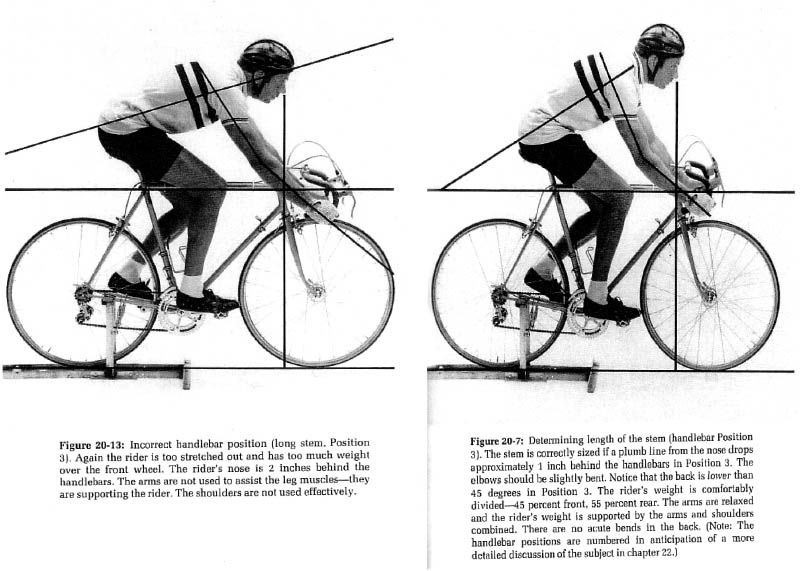
I don't believe the 1° steeper head tube angle will make any noticeable difference in fore-and-aft weight distribution, particularly in the proportion of body weight on the handlebar. I think your fit problem and the wrist pain you're experiencing are more related to being too stretched out and an error in the angle your arms and wrists are to the angle of the bar drops. The wrists should be straight. If you hold your wrists straight before you touch the bars and the grasp the bar at the spot where your wrists are straight, you have found the "correct" position. You may have to change change the angle of the drops slightly relative to horizontal in order to feel comfortable.
What the change in head tube angle will do is affect the steering. Former framebuilder Dave Moulton has a blog piece on head tube angle and steering that's worth reading. He also has another blog piece on trail and fork rake that's also pertinent, since head tube angle and fork rake (or offset, as some call it) determine trail.
The Custom Bicycle by Kolin and de la Rosa offers priceless advice on setting up a quality bicycle, and has several series of photographs with the subtle differences between setting up a bike for comfortable all day rides and being in pain after an hour or so. I've found it an invaluable tool in setting up my bikes.
I don't believe the 1° steeper head tube angle will make any noticeable difference in fore-and-aft weight distribution, particularly in the proportion of body weight on the handlebar. I think your fit problem and the wrist pain you're experiencing are more related to being too stretched out and an error in the angle your arms and wrists are to the angle of the bar drops. The wrists should be straight. If you hold your wrists straight before you touch the bars and the grasp the bar at the spot where your wrists are straight, you have found the "correct" position. You may have to change change the angle of the drops slightly relative to horizontal in order to feel comfortable.
What the change in head tube angle will do is affect the steering. Former framebuilder Dave Moulton has a blog piece on head tube angle and steering that's worth reading. He also has another blog piece on trail and fork rake that's also pertinent, since head tube angle and fork rake (or offset, as some call it) determine trail.
The Custom Bicycle by Kolin and de la Rosa offers priceless advice on setting up a quality bicycle, and has several series of photographs with the subtle differences between setting up a bike for comfortable all day rides and being in pain after an hour or so. I've found it an invaluable tool in setting up my bikes.

Last edited by Scooper; 08-09-07 at 03:02 PM.
08-09-07 | 04:41 PM
#6
Senior Member
Joined: Aug 2005
Posts: 1,936
Likes: 0
It makes no difference whatsoever, except to the extent that you run out of adjustment room for the saddle fore-and-aft. For example, if the seat tube angle is very steep, you might not be able to put the saddle back far enough for *you* and your riding style (because you run out of room on the saddle rail), or vice versa. Other than that, a few degrees more or less makes no difference at all. You don't sit on the seat tube, you sit on the saddle.
08-21-07 | 08:27 PM
#7

Senior Member

Joined: Apr 2005
Posts: 17,195
Likes: 761
From: Ann Arbor, MI
Bikes: 1980 Masi, 1984 Mondonico, 1984 Trek 610, 1980 Woodrup Giro, 2005 Mondonico Futura Leggera ELOS, 1967 PX10E, 1971 Peugeot UO-8
I hope this forum is a reasonable place to ask this question: what is the effect of seat tube angle on bike fit, and specifically on how much of a rider's weight lands forward onto the bars? Is the effect significant?
The reason I ask is that I have new bike that I'm trying to dial in, and I can't seem to adjust things in a way that avoids putting too much of my weight onto the bars. The bike in question has a 74-degree seat tube angle. My previous bikes have had 73 degree seat tube angles. Could that one degree be significant? Am I fighting the basic geometry of the bike that I'm trying to adjust?
The reason I ask is that I have new bike that I'm trying to dial in, and I can't seem to adjust things in a way that avoids putting too much of my weight onto the bars. The bike in question has a 74-degree seat tube angle. My previous bikes have had 73 degree seat tube angles. Could that one degree be significant? Am I fighting the basic geometry of the bike that I'm trying to adjust?
I find percieved weight on the bars confusing. Once I set up my Woodrup, and felt hand pressure. I ended up moving my bars down a centimeter, and the hand pressure became really low. I figure the bar now is where my hands want to be, and the higher bar was "in their way."
08-22-07 | 12:13 PM
#8
Old biker
Joined: Jun 2006
Posts: 252
Likes: 0
From: Radium Springs, NM
Bikes: Custom Cammack touring road and 1987 Fisher Hoo Koo E Koo
It makes no difference whatsoever, except to the extent that you run out of adjustment room for the saddle fore-and-aft. For example, if the seat tube angle is very steep, you might not be able to put the saddle back far enough for *you* and your riding style (because you run out of room on the saddle rail), or vice versa. Other than that, a few degrees more or less makes no difference at all. You don't sit on the seat tube, you sit on the saddle.
Anyhoo, that's my opinion. Take if for what it's worth.
And don't get me started on the straight tube front forks that are the current fad.
08-22-07 | 02:06 PM
#9
Banned
Joined: Aug 2005
Posts: 5,115
Likes: 4
There isn't any question that seat position is critical, or can be critical to fit. However, on my 58 cm frame the distance from centre of BB to where the seat post clamps the saddle wires is 27.25 inches. On the horizontal, the difference between 73 and 74 degrees is .46". So as has been said, it isn't any difference as long as your seat post and saddle allow you to get where you need to go. In most cases people are running out of space to move the seat back and 74 would make that worse. There should be a seat post that would allow it though. I would go back to the bike that you originally fit and just recreate the position.
08-22-07 | 02:18 PM
#10
Senior Member
Joined: Aug 2005
Posts: 1,936
Likes: 0
I can guarantee you that if the seat is in the same place relative to the bottom bracket as it was before, whether the seat tube is 73 or 74 degrees makes absolutely no difference whatsoever. It's just a support for the seat. With a 74 deg seat tube, you won't be able to put the same saddle quite as far back as you would have with the 73 deg seat tube. But that won't matter at all unless you already did have your saddle all the way back on that first bike. How are you measuring where your seat is? Not by where the seatpost clamp is on the rails of the saddle I hope - because since your seat tube is one degree steeper, it won't be in the same place as before. Are the crankarms the same length as before? Maybe it's your handlebars that aren't quite in the same place as before. Is your saddle level?
08-23-07 | 12:17 PM
#11
Old biker
Joined: Jun 2006
Posts: 252
Likes: 0
From: Radium Springs, NM
Bikes: Custom Cammack touring road and 1987 Fisher Hoo Koo E Koo
All the replies to your question have merit. Rider to bike fit is a subject that large books have been written about. Adjusting a bike to fit your body and riding style can be frustrating and take time. A new bike with different geometry is going to feel different to you even if it's adjusted to the exact same measurements. As an aside, I have never riden a 74 degree seat tube bike that I was comfy on. For me personally those upright angled "criterium" bikes provide a twitchy bone jarring ride. But then I'm more of a century/touring rider and definitely not a racer.
The way I adjust my bikes is to take my Allen wrenches and such with me on a at least a 15 mile ride. 25 is better and make a very small adjustments to what ever doesn't feel right - usually 1/8" or less - and ride for 5 more miles. Just tooling around a parking lot doesn't do it. It takes a number of miles for your body to adjust and tell you if you moved the component in the right direction and amount. This morning I rode my touring bike that I had just installed new pedals on last nite. It was immediatly clear I needed to lower the saddle. I lowered it 1/8" and was back to my former comfort. I rode another 15 miles and all was well.
The way I adjust my bikes is to take my Allen wrenches and such with me on a at least a 15 mile ride. 25 is better and make a very small adjustments to what ever doesn't feel right - usually 1/8" or less - and ride for 5 more miles. Just tooling around a parking lot doesn't do it. It takes a number of miles for your body to adjust and tell you if you moved the component in the right direction and amount. This morning I rode my touring bike that I had just installed new pedals on last nite. It was immediatly clear I needed to lower the saddle. I lowered it 1/8" and was back to my former comfort. I rode another 15 miles and all was well.
08-24-07 | 11:20 AM
#13
Senior Member
Joined: Feb 2001
Posts: 12,948
Likes: 9
From: England
When seatposts came in one style, you could use seat-tube angle to provide more or less saddle layback over the BB. Now that we have a wide variety of seatpost laybacks, from inline to extra-long, you dont need a special seat-tube angle to position your saddle relative to the pedals.
I switched from a std model to an in-line model to emulate a steep seatpost and reduce my horizontal distance to the pedals.
I switched from a std model to an in-line model to emulate a steep seatpost and reduce my horizontal distance to the pedals.
08-24-07 | 08:04 PM
#14
Senior Member
Joined: Dec 2005
Posts: 7,848
Likes: 4
I agree with charlesc... 1 degree makes a lot of differences in the way the rider feels the frame (well some people cant feel a difference between a colnago master and a 50 bucks wallmart bike anyways). somehow as stepper the angle the faster the feel because u are more over the pedals but the bike gets more hmm... i dont want to use the word stiff but well probably u guys got the idea... a 73 degrees bikes is very soft, the chainstays are longer also those 2things makes the frame very soft... in a 75 degrees frame for sure u'll feel all the pots and holes on the road, not compfortable but the bike for sure is ver very fast... well thats my 1+.. done listen to me ok im drunk! 
08-29-07 | 04:26 AM
#15
ex frame builder
Joined: Aug 2004
Posts: 523
Likes: 5
Seat angle has little or no effect on weight distribution. This has to do with the difference in height and reach between the saddle and the handlebars. On a road bike your weight should be distributed between your hands and your butt on the saddle, and not excessive amounts of weight on either. I wrote about the subject recently here.
__________________
History, photos and tech articles on "Dave's Bike Blog." 'dave moulton' Registry including a Picture Gallery https://www.davemoultonregistry.com/
History, photos and tech articles on "Dave's Bike Blog." 'dave moulton' Registry including a Picture Gallery https://www.davemoultonregistry.com/
