


Bambooo!

 07-08-10 | 07:03 AM
#106
Senior Member

Joined: Dec 2009
Posts: 507
Likes: 13
I always sand the bamboo(mostly to remove cosmetic blemishes) and coat the entire frame with Epoxy. Ideally that should be lightly sanded and coated a with a UV resistant Varnish as Epoxy breaks down under long term sun exposure.
I actually didn't bother with that with the first few frames since the total amount of time that a bike is in direct sunlight isn't necessarily that long.
I just wanted to get riding it. It can always be varnished later.
I would still recommend coating the bamboo in some way. It's very hygroscopic and the more stable you keep it the less stress you'll get on the frame through moisture cycling.
You can get a surfboard building epoxy that is more UV resistant and that's probably a good shortcut.
I figure it takes about 5 ounces of 6k Carbon tow to make a frame. Depending on your technique of applying it you may use much more initially and then sand a good deal of it away.
I actually didn't bother with that with the first few frames since the total amount of time that a bike is in direct sunlight isn't necessarily that long.
I just wanted to get riding it. It can always be varnished later.
I would still recommend coating the bamboo in some way. It's very hygroscopic and the more stable you keep it the less stress you'll get on the frame through moisture cycling.
You can get a surfboard building epoxy that is more UV resistant and that's probably a good shortcut.
I figure it takes about 5 ounces of 6k Carbon tow to make a frame. Depending on your technique of applying it you may use much more initially and then sand a good deal of it away.
07-08-10 | 09:47 AM
#108
Senior Member
Joined: Dec 2009
Posts: 507
Likes: 13
There is 1200 yards or so in a pound of 6k so you can do the math 
Many people use the 12k and honestly I think I'll go that route the next time. It's harder to wet out with Epoxy but it builds up faster.
The 6k can have you feel like you're trying to wrap something with dental floss.
Many people use the 12k and honestly I think I'll go that route the next time. It's harder to wet out with Epoxy but it builds up faster.
The 6k can have you feel like you're trying to wrap something with dental floss.
07-08-10 | 01:23 PM
#109
Senior Member
Joined: Jan 2010
Posts: 61
Likes: 0
From: Cambridge, MA
The thing I would worry about for coating the frame with epoxy, is it being too brittle and cracking. Also, the West epoxy, with fast hardener specifically says that it is not intended for clear coating. West Systems does have a hardener though that is meant for this.
I used 12k tow, and I did not have trouble wetting it out. All I did was do a lot of fairly thing layers. I got 5000 meters of it, because it was relatively cheap in that size off ebay, and after finishing it looks like I have not even used any of the bobbin.
I used 12k tow, and I did not have trouble wetting it out. All I did was do a lot of fairly thing layers. I got 5000 meters of it, because it was relatively cheap in that size off ebay, and after finishing it looks like I have not even used any of the bobbin.
07-08-10 | 05:13 PM
#111
Senior Member
Joined: Dec 2009
Posts: 507
Likes: 13
Epoxy suitable for wetting out composite material is not brittle. A carbon bike is technically a continuous Epoxy coating.
There would be no reason for it to crack or flake unless you actually break the frame. A thin layer of Epoxy does not weigh a lot. It's just easier to coat the sanded lugs and continue with the coating onto the rest of the frame.
I don't use WEST but the unsuitable for clear coating remark has to do more with the clarity of the finish. That's for when you build a wooden boat and want it to look like it's just wood.
When you're wrapping carbon lugs you want the slowest hardener you can get to allow more working time anyway.
There would be no reason for it to crack or flake unless you actually break the frame. A thin layer of Epoxy does not weigh a lot. It's just easier to coat the sanded lugs and continue with the coating onto the rest of the frame.
I don't use WEST but the unsuitable for clear coating remark has to do more with the clarity of the finish. That's for when you build a wooden boat and want it to look like it's just wood.
When you're wrapping carbon lugs you want the slowest hardener you can get to allow more working time anyway.
07-08-10 | 07:59 PM
#112

Senior Member
Joined: Apr 2009
Posts: 100
Likes: 0
I use tung oil, but I'm not sure if it has any UV protection.
Question: Does anyone think it would be possible to use bamboo in a fork? Would this result in certain death?
Question: Does anyone think it would be possible to use bamboo in a fork? Would this result in certain death?
Last edited by RoboMonkey; 07-08-10 at 08:38 PM.
07-08-10 | 10:01 PM
#114
Senior Member
Joined: Sep 2005
Posts: 4,697
Likes: 12
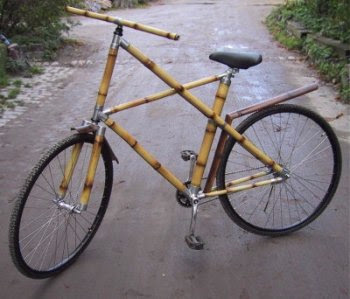
It's doable, but I would not use it for more than coffee shop rides.
I've used a bike tube as a bladder to layer the inside of a tube with carbon to stiffen it. I would be worried about the amount of flex otherwise.
 07-11-10 | 09:13 PM
#118
Senior Member
Joined: Sep 2005
Posts: 4,697
Likes: 12
Flex is a problem with bamboo.
Try wrapping your chain stays with carbon.
Other than that there is not a lot you can do with this frame.
On your next frame use a larger diameter of bamboo for the main triangle.
It's a learning process and your next frame will be better than the first.
Having a first frame that is rideable is a great start.
My first is hanging on the wall with a shattered down tube.
It's a never ending experiment to build the perfect bike.
Try wrapping your chain stays with carbon.
Other than that there is not a lot you can do with this frame.
On your next frame use a larger diameter of bamboo for the main triangle.
It's a learning process and your next frame will be better than the first.
Having a first frame that is rideable is a great start.
My first is hanging on the wall with a shattered down tube.
It's a never ending experiment to build the perfect bike.
07-12-10 | 07:21 AM
#119
Senior Member
Joined: Dec 2009
Posts: 507
Likes: 13
Bamboo requires Aluminum size diameter for optimum stiffness. Yours looks more like a steel bike.
I've never had a problem when using bamboo of larger size for at least the downtube.
The necessity of stiffening the rear triangle doesn't seem to be a problem. Short pieces of bamboo are virtually flex free. I shorten the chainstays as much as possible. The frame I posted has a rear triangle that's borderline too stiff.
I do select slightly thicker walled pieces for the drive side of the triangle.
I'll get some pics up of my latest.
I've never had a problem when using bamboo of larger size for at least the downtube.
The necessity of stiffening the rear triangle doesn't seem to be a problem. Short pieces of bamboo are virtually flex free. I shorten the chainstays as much as possible. The frame I posted has a rear triangle that's borderline too stiff.
I do select slightly thicker walled pieces for the drive side of the triangle.
I'll get some pics up of my latest.
07-18-10 | 11:49 AM
#121
Senior Member
Joined: Oct 2009
Posts: 1,921
Likes: 5
From: England, currently dividing my time between university in Guildford and home just outside Reading
Bikes: Too many to list here!
What specific resins and hardeners are people using for these bikes? I'm thinking of using West System 105 resin and 205 hardener, would that work?
Also, how much epoxy are we talking here? I assume a 1.2 Kg pack would be sufficient.
Also, how much epoxy are we talking here? I assume a 1.2 Kg pack would be sufficient.
07-18-10 | 06:23 PM
#123
Senior Member
Joined: Dec 2009
Posts: 507
Likes: 13
Any of the standard boatbuilding epoxies are adequate. They all seem to claim to be "the best" anyway. MAS, WEST, System Three Silver Tip. I've used them all and you can't really notice any difference.
I think MAS is a bit lower in toxicity of the fumes so that's good if you are going to be working with the stuff extensively.
Boo Bicycles uses WEST.
I think MAS is a bit lower in toxicity of the fumes so that's good if you are going to be working with the stuff extensively.
Boo Bicycles uses WEST.
07-20-10 | 02:19 PM
#124
Senior Member
Joined: Jan 2010
Posts: 61
Likes: 0
From: Cambridge, MA
I've been doing a bit of experimenting with bamboo while I wait for some parts to arrive, and I've found some interesting things. I've been splitting short lengths of bamboo in half and gluing them back together, and have found that this does not seem to decrease the strenth in any way. Once they have been glued, I split them from the inside out, and none of them have cracked along the glue lines. This means that one could split your bamboo tubes in half, apply a protective coating to the inside, and then just glue the two halves back together when you build the frame. I tried using both a diagonal cut, for more surface area, and a cut perpendicular to the outside, and neither broke.


An interesting point this leads to, is the fact that you can then make bladed bamboo tubes, if you have large enough diameter bamboo available:

To maximize surface area on the bladed tube, I cut a right angle in one side, and a notch in the other, as shown:

There is probably very little practical application for bladed tubes, but It would look pretty awesome. If I were to actually do this in a bike, it would probably just be for the down tube.
I did not break the glue joints on any of these, and I was not even using epoxy- I just used regular wood glue.
It's funny how I am not quite even finished with my first bike, and I have already planned out a second one!
An interesting point this leads to, is the fact that you can then make bladed bamboo tubes, if you have large enough diameter bamboo available:
To maximize surface area on the bladed tube, I cut a right angle in one side, and a notch in the other, as shown:
There is probably very little practical application for bladed tubes, but It would look pretty awesome. If I were to actually do this in a bike, it would probably just be for the down tube.
I did not break the glue joints on any of these, and I was not even using epoxy- I just used regular wood glue.
It's funny how I am not quite even finished with my first bike, and I have already planned out a second one!
07-20-10 | 04:45 PM
#125
Senior Member
Joined: Dec 2009
Posts: 507
Likes: 13
It's not surprising that splitting bamboo and gluing it back together doesn't affect the strength. That's because bamboo has little resistance to splitting anyway. Gluing it together would make the glue line the strongest part of the tube.
I've also played around with the aero boo concept.
You don't need to split the tubes to coat the inside with epoxy though. Just punch the nodes out cap one end and partially fill the tube with epoxy, swirl it around to coat the interior and dump out the excess.
I've also played around with the aero boo concept.
You don't need to split the tubes to coat the inside with epoxy though. Just punch the nodes out cap one end and partially fill the tube with epoxy, swirl it around to coat the interior and dump out the excess.