


Understanding trail
 12-09-14 | 12:57 PM
#1


Thread Starter
Senior Curmudgeon
Joined: Jan 2005
Posts: 3,856
Likes: 2
From: Directly above the center of the earth
Bikes: Varies by day
Understanding trail
Hello frame building ladies & gents.
I know this question has been discussed before, but when I do a search, I get ten-gazillion threads on trail riding. So pardon my (vast) ignorance, but please explain to me in newbie terms exactly how the head tube angle and fork interact (or don't) to create trail. If I understand correctly, more trail makes the bike more stable, less makes it quicker handling (within reasonable parameters). Since "modern" bikes use far (FAR) steeper head tube angles than bikes of my youth, they should be more difficult to ride with no hands. I may just be getting old, but that does seem to be the case.
So below are two illustrations that I crudely made in MS Word. The first is intended to illustrate a bike with forks essentially parallel to the head tube, the second a bike with the forks raked at an angle to the head tube. If it is the angle of the steering tube to the vertical axis of the wheel that determines the trail, then both bikes should have the exact same trail, and should handle equally. If, however, the rake of the forks changes the effective rake of the head tube, then the "raked" fork should provide more effective trail and handle more stably.
Which is correct, please, and why?

OK - Having Googled some diagrams - it DOES appear that the head tube determines the steering axis. That being the case, forks with NO rake should provide more trail than raked forks and handle more stably. Is this correct?
If so, then does anyone make forks with REVERSE rake? That should also increase trail, yes?
I know this question has been discussed before, but when I do a search, I get ten-gazillion threads on trail riding. So pardon my (vast) ignorance, but please explain to me in newbie terms exactly how the head tube angle and fork interact (or don't) to create trail. If I understand correctly, more trail makes the bike more stable, less makes it quicker handling (within reasonable parameters). Since "modern" bikes use far (FAR) steeper head tube angles than bikes of my youth, they should be more difficult to ride with no hands. I may just be getting old, but that does seem to be the case.
So below are two illustrations that I crudely made in MS Word. The first is intended to illustrate a bike with forks essentially parallel to the head tube, the second a bike with the forks raked at an angle to the head tube. If it is the angle of the steering tube to the vertical axis of the wheel that determines the trail, then both bikes should have the exact same trail, and should handle equally. If, however, the rake of the forks changes the effective rake of the head tube, then the "raked" fork should provide more effective trail and handle more stably.
Which is correct, please, and why?
OK - Having Googled some diagrams - it DOES appear that the head tube determines the steering axis. That being the case, forks with NO rake should provide more trail than raked forks and handle more stably. Is this correct?
If so, then does anyone make forks with REVERSE rake? That should also increase trail, yes?
Last edited by FarHorizon; 12-09-14 at 01:12 PM.
 12-09-14 | 01:11 PM
#2
Senior Member
Joined: Sep 2006
Posts: 201
Likes: 8
From: Bozeman MT
Bikes: Kirk
You'll answer your own question if you make your red line bisect the head tube and project to the floor. You show it in line with the fork blades - it should be the centerline of the head tube.
Once you do that and play with the rake, head tube angle and wheel diameter you'll see that the 3 things combine to result in a given amount of trail.
I hope that I've said that well.........
dave
Once you do that and play with the rake, head tube angle and wheel diameter you'll see that the 3 things combine to result in a given amount of trail.
I hope that I've said that well.........
dave
12-09-14 | 01:17 PM
#3

Senior Member


Joined: Apr 2004
Posts: 6,357
Likes: 167
From: Sacramento CA
Bikes: Too Many

__________________
I'm not one for fawning over bicycles, but I do believe that our bikes communicate with us, and what this bike is saying is, "You're an idiot." BikeSnobNYC
I'm not one for fawning over bicycles, but I do believe that our bikes communicate with us, and what this bike is saying is, "You're an idiot." BikeSnobNYC
12-09-14 | 01:21 PM
#4
Randomhead
Joined: Aug 2008
Posts: 25,930
Likes: 4,825
From: Happy Valley, Pennsylvania
As Dave notes, the line that defines trail is the centerline of the head tube and, in general, does not go through the hub axle. Older bikes with slack head angles don't necessarily have high trail, they also had a large rake in comparison to today's bicycles.
there are bikes with reverse rake, generally used for motorpacing. I believe this is actually to get the rider closer to the motorcycle though.
there are bikes with reverse rake, generally used for motorpacing. I believe this is actually to get the rider closer to the motorcycle though.
12-09-14 | 01:35 PM
#5

Decrepit Member
Joined: Aug 2005
Posts: 10,488
Likes: 92
From: Santa Rosa, California
Bikes: Waterford 953 RS-22, several Paramounts
 12-09-14 | 03:50 PM
#6
Thread Starter
Senior Curmudgeon
Joined: Jan 2005
Posts: 3,856
Likes: 2
From: Directly above the center of the earth
Bikes: Varies by day
I may have to let this one go & pick something more roomy. Thanks again for all the good info.
 12-10-14 | 06:27 AM
#8
Senior Member
Joined: Feb 2011
Posts: 807
Likes: 10
I don't think the angled toptube was intended to affect wheelbase. In mountain bikes, it helps decrease standover height. In road bikes, Giant was the first to popularize angled toptubes in their "compact" frames. I think that was in the mid to late 90s. I've never really figured out why riders thought this was better than a level toptube on a road bike. I'm sure Giant used it to claim a lighter frame since they were essentially transferring metal from the frame to the seat post. Lately, angled toptubes have been a way to increase headtube length without increasing standover. That way, with threadless stems, the bars can come up higher without a huge stack of spacers or a really high rise stem. That's my impression anyway. I still like a level toptube.
12-10-14 | 10:31 AM
#9

Senior Member

Joined: Feb 2012
Posts: 19,352
Likes: 5,470
From: Rochester, NY
Bikes: Stewart S&S coupled sport tourer, Stewart Sunday light, Stewart Commuting, Stewart Touring, Co Motion Tandem, Stewart 3-Spd, Stewart Track, Fuji Finest, Mongoose Tomac ATB, GT Bravado ATB, JCP Folder, Stewart 650B ATB
There is far more to steering response then one simple number, as in trail. This is why after 150 years of bike making we're still talking about what makes a good handling bike. here are some of the factors- steering axis angle, rake/offset, tire diameter (and these three determine trail), front center VS rear center lengths, Bb height, wheel/tire inertia/mass, stem length, bar width, center of mass of the bike/rider system and I've probably left out other factors.
I've looked at this since 1979 and still feel that my understanding is incomplete. Part of the challenge is that as many people write about steering design there are opinions as to what kind of result is best. Right now a low trail geometry is in fashion with some riders. If you look at what racers use (and we all know that what racers do is really the only guide that counts ) a long trail design is better. And of course few mention a head angle or wheel mass when discussing this.
So I suggest that you first get schooled on the terms and relationships. Then at some point you have to start riding the various designs to develop your own opinions as to what design you find handles best. Some of the publications and information sources I've used are Bicycling Science by David Gordon Wilson (get the third edition which has Jim Papadopoulos contributing). The mentioned Moulton blog. Bicycle Quarterly and Jan Heine. These are a good start. But beware of the opinion that gets published as fact.
Look up the old Scientific American article "the un rideable bicycle" (I might have the title wrong). It was a bunch of smart guys trying to design a bike which couldn't be ridden or steered. They found that pretty much any design they tried was able to be ridden, some were far more stable then others though.
As to other aspects of frame/bike design- I agree that the current fashion of really short chain stays is miss placed. My take on this is because stay length is easily measured (and BTW trail isn't easy to accurately measure, most claims rely on manufactures supplied angle and rake dimensions) stay length is used by the marketing departments to their advantage. Longer stays result in smoother chain runs, more cog/ring combos being useable, more stable bike handling in general and a host of other real world advantages.
Wheelbase is only a result of all the other factors that go into a bike design. Like the riders fit/contact points, the steering geometry, the stay length and possible need for clearance with feet/bags, the BB height and more. So again, since measuring wheelbase is easy it's used by marketing to their advantage.
Top tubes only hold the frame together, provide a cockpit for rider fit, and influence frame stiffness (especially when heavily loaded).
Do you see a pattern here. The easy stuff to talk about is claimed to be important and the hard to measure stuff is subject to opinions claimed as facts.
Lastly the bike's design to be best at the type of riding one does off road is vastly different then for on road. How the rider positions themselves, how they move and 'work' the bike, how the bike's relationship with the ground changes is very different off road then on. How the bike handles added weight or needed accessories isn't a design factor for an off road performance bike. So it's no surprise that your experience is what it is. Andy.
I've looked at this since 1979 and still feel that my understanding is incomplete. Part of the challenge is that as many people write about steering design there are opinions as to what kind of result is best. Right now a low trail geometry is in fashion with some riders. If you look at what racers use (and we all know that what racers do is really the only guide that counts
) a long trail design is better. And of course few mention a head angle or wheel mass when discussing this. So I suggest that you first get schooled on the terms and relationships. Then at some point you have to start riding the various designs to develop your own opinions as to what design you find handles best. Some of the publications and information sources I've used are Bicycling Science by David Gordon Wilson (get the third edition which has Jim Papadopoulos contributing). The mentioned Moulton blog. Bicycle Quarterly and Jan Heine. These are a good start. But beware of the opinion that gets published as fact.
Look up the old Scientific American article "the un rideable bicycle" (I might have the title wrong). It was a bunch of smart guys trying to design a bike which couldn't be ridden or steered. They found that pretty much any design they tried was able to be ridden, some were far more stable then others though.
As to other aspects of frame/bike design- I agree that the current fashion of really short chain stays is miss placed. My take on this is because stay length is easily measured (and BTW trail isn't easy to accurately measure, most claims rely on manufactures supplied angle and rake dimensions) stay length is used by the marketing departments to their advantage. Longer stays result in smoother chain runs, more cog/ring combos being useable, more stable bike handling in general and a host of other real world advantages.
Wheelbase is only a result of all the other factors that go into a bike design. Like the riders fit/contact points, the steering geometry, the stay length and possible need for clearance with feet/bags, the BB height and more. So again, since measuring wheelbase is easy it's used by marketing to their advantage.
Top tubes only hold the frame together, provide a cockpit for rider fit, and influence frame stiffness (especially when heavily loaded).
Do you see a pattern here. The easy stuff to talk about is claimed to be important and the hard to measure stuff is subject to opinions claimed as facts.
Lastly the bike's design to be best at the type of riding one does off road is vastly different then for on road. How the rider positions themselves, how they move and 'work' the bike, how the bike's relationship with the ground changes is very different off road then on. How the bike handles added weight or needed accessories isn't a design factor for an off road performance bike. So it's no surprise that your experience is what it is. Andy.
12-11-14 | 07:41 AM
#10
Thread Starter
Senior Curmudgeon
Joined: Jan 2005
Posts: 3,856
Likes: 2
From: Directly above the center of the earth
Bikes: Varies by day
Hi [MENTION=391685]Andrew R Stewart[/MENTION] -
I understand what you say, and I'm the first to admit that I don't understand frame design. I parrot what I've read, but no, there's no true understanding. Nor do I want to invest the time and effort to get there.
To use a phrase - "I want to learn to tell time - not how to build clocks."
My current bike is not an easy or comfortable ride. Since often a "test ride" doesn't reveal as much as one might like, and since a new bike IS such a substantial investment, I'm trying to learn what to look for in order to avoid past mistakes.
The best bike I've ever owned was an actual racing bike (?!) that I'd bought from a gent at a yard sale. On that bike, my body was so balanced that I could ride comfortably with my hands an inch above the brake hoods. The bike had been custom-painted for his team, and I never knew the actual brand. I could easily ride for long distances and around gentle curves without the need to place my hands on the handlebars. Despite this, I'm not sure that the original owner and I were the same height or leg length, so the "fit" may have been fortuitous.
I'm now older and heavier, and want substantially-wider, more-durable tires than what were on the road bike. I do, however, want to return to that comfortable ride and fit. I've had subsequent bikes "fit" to me at the bike shop using "knee over the pedal spindle" thought, and the result was far from satisfactory. I don't want to race, I just want a comfortable bike that I can ride for long distances and ride without hands.
I believe that one factor in such a ride will be a longer wheelbase (possibly starting with longer chain stays). A more relaxed head tube angle with more trail should also (theoretically) help. Of course, I may be wrong... What characteristics in a bike SHOULD I look for that will provide the comfort and fit that I'm looking for?
PS: Please don't recommend the local bike shop. The kids who work there are interested in racing, and have no clue how to even communicate with me about the characteristics I'm looking for (and I'm a fair communicator).
Cordially - FH
I understand what you say, and I'm the first to admit that I don't understand frame design. I parrot what I've read, but no, there's no true understanding. Nor do I want to invest the time and effort to get there.
To use a phrase - "I want to learn to tell time - not how to build clocks."
My current bike is not an easy or comfortable ride. Since often a "test ride" doesn't reveal as much as one might like, and since a new bike IS such a substantial investment, I'm trying to learn what to look for in order to avoid past mistakes.
The best bike I've ever owned was an actual racing bike (?!) that I'd bought from a gent at a yard sale. On that bike, my body was so balanced that I could ride comfortably with my hands an inch above the brake hoods. The bike had been custom-painted for his team, and I never knew the actual brand. I could easily ride for long distances and around gentle curves without the need to place my hands on the handlebars. Despite this, I'm not sure that the original owner and I were the same height or leg length, so the "fit" may have been fortuitous.
I'm now older and heavier, and want substantially-wider, more-durable tires than what were on the road bike. I do, however, want to return to that comfortable ride and fit. I've had subsequent bikes "fit" to me at the bike shop using "knee over the pedal spindle" thought, and the result was far from satisfactory. I don't want to race, I just want a comfortable bike that I can ride for long distances and ride without hands.
I believe that one factor in such a ride will be a longer wheelbase (possibly starting with longer chain stays). A more relaxed head tube angle with more trail should also (theoretically) help. Of course, I may be wrong... What characteristics in a bike SHOULD I look for that will provide the comfort and fit that I'm looking for?
PS: Please don't recommend the local bike shop. The kids who work there are interested in racing, and have no clue how to even communicate with me about the characteristics I'm looking for (and I'm a fair communicator).
Cordially - FH
Last edited by FarHorizon; 12-11-14 at 07:55 AM.
12-11-14 | 11:28 AM
#11
Banned
Joined: Jun 2010
Posts: 43,586
Likes: 1,380
From: NW,Oregon Coast
Bikes: 8
does anyone make forks with REVERSE rake?
IE, Following in the slipstream of someone on a motorbike.
pix https://4.bp.blogspot.com/_oIsCw57t7L...iss-stayer.jpg
https://farm4.staticflickr.com/3038/2...3a55680b11.jpg
https://farm3.static.flickr.com/2175/...c156ed74_m.jpg
https://www.classiclightweights.co.uk...te-stayer1.JPG
https://www.pezcyclingnews.com/photos...lesch-koga.jpg
one application for Beneficial Low trail front geometry ... is when There Is a heavy load on the front wheel .. Porteur rack Bikes .
in such a situation turning the wheel , over the center, involves Lifting the load .. with less trail that is less ..
Have 2 small Wheel Folding Bikes, both are Low Trail, both handle steadier with a load on the front.
Last edited by fietsbob; 12-15-14 at 10:06 AM.
12-11-14 | 12:42 PM
#12
Senior Member
Joined: Feb 2011
Posts: 807
Likes: 10
I don't know what your budget is but a handmade custom from a good builder would probably leave a smile on your face.
A used vintage steel frame in good condition might also work well for a lower price. There is a website, the Frame Geometry Project, I think, that lists the numbers on a large number of frames through the years. Might be a good place to look.
It sounds like you want some fairly specific numbers to look for though. Tom Kellogg has written that a trail of about 56mm gives you a "neutral" steering feel. Lower trail will feel "quicker", more trail "slower. I trust his judgement. He doesn't say but I bet the headtube angle that the number is based on is close to 73.
I like chainstays that are about 420mm on my bikes. I ride a square 56 frame. 420 seems to give me a nice ride and my own theory is that short or long chainstays don't have a very large influence on how quick or slow a bike feels until you go to extremes. I think most of what we like or dislike about steering quickness comes from the front end geo, not as much from the back end. Just my guess. No data to back it up.
A used vintage steel frame in good condition might also work well for a lower price. There is a website, the Frame Geometry Project, I think, that lists the numbers on a large number of frames through the years. Might be a good place to look.
It sounds like you want some fairly specific numbers to look for though. Tom Kellogg has written that a trail of about 56mm gives you a "neutral" steering feel. Lower trail will feel "quicker", more trail "slower. I trust his judgement. He doesn't say but I bet the headtube angle that the number is based on is close to 73.
I like chainstays that are about 420mm on my bikes. I ride a square 56 frame. 420 seems to give me a nice ride and my own theory is that short or long chainstays don't have a very large influence on how quick or slow a bike feels until you go to extremes. I think most of what we like or dislike about steering quickness comes from the front end geo, not as much from the back end. Just my guess. No data to back it up.
Last edited by busdriver1959; 12-11-14 at 12:50 PM.
12-11-14 | 03:55 PM
#14
Thread Starter
Senior Curmudgeon
Joined: Jan 2005
Posts: 3,856
Likes: 2
From: Directly above the center of the earth
Bikes: Varies by day
Probably right, but I want something unusual in addition to the touring frame - I want a single speed drive train. Where I live, there isn't a significant hill for hundreds of miles. Every touring frame I've seen is designed for multiple gears, with vertical dropouts that virtually preclude use of a single-speed hub. In fact, I'd be happy with a coaster brake hub and one less hand brake...
12-11-14 | 05:37 PM
#15
Banned
Joined: Jun 2010
Posts: 43,586
Likes: 1,380
From: NW,Oregon Coast
Bikes: 8
with vertical dropouts that virtually preclude use of a single-speed hub.
Universal Cycles -- Paul Melvin Chain Tensioner .. Universal Cycles -- Rohloff Twin Pulley Chain Tensioners
there are single Pulley type too .. Universal Cycles -- Surly Singleator .. Universal Cycles -- 4-Jeri SS Chain Tensioner
Just needs be a freewheel single speed not a Fixed gear ..
** a short cage RD will do as well , just use the stroke limit screws to center it under your 1 cog..
Last edited by fietsbob; 12-11-14 at 05:46 PM.
12-11-14 | 07:20 PM
#16
Thread Starter
Senior Curmudgeon
Joined: Jan 2005
Posts: 3,856
Likes: 2
From: Directly above the center of the earth
Bikes: Varies by day
Thanks, [MENTION=197614]fietsbob[/MENTION] - that opens lots of additional choices.
12-11-14 | 10:20 PM
#17
Decrepit Member
Joined: Aug 2005
Posts: 10,488
Likes: 92
From: Santa Rosa, California
Bikes: Waterford 953 RS-22, several Paramounts
It's difficult for me to completely understand the issue you have with your current ride, but I'll offer some comments about my own favorite bike which is supremely comfortable (for me, at least) on week long 100 miles/day "credit card" tours. I should say that at 72, I'm no spring chicken and am not as flexible as I was fifty years ago.
My custom Waterford RS-22 (road-sport geometry) has a 73° head tube angle and 42mm of fork rake, resulting in 59mm of trail. The chainstays are 432mm long, which is a tad longer than most modern frames, but gives me plenty of heel clearance with panniers. The handling is stable but lively, with no surprises.
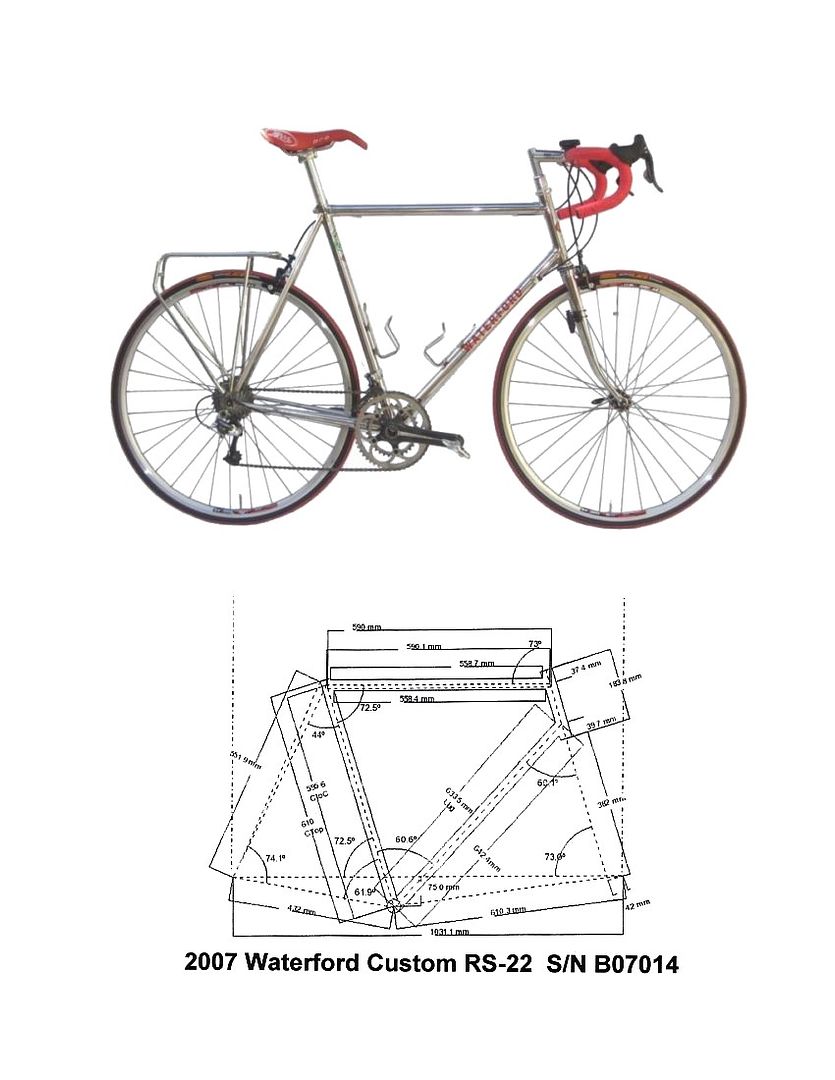
My custom Waterford RS-22 (road-sport geometry) has a 73° head tube angle and 42mm of fork rake, resulting in 59mm of trail. The chainstays are 432mm long, which is a tad longer than most modern frames, but gives me plenty of heel clearance with panniers. The handling is stable but lively, with no surprises.
12-11-14 | 11:36 PM
#18
Senior Member
Joined: Feb 2012
Posts: 19,352
Likes: 5,470
From: Rochester, NY
Bikes: Stewart S&S coupled sport tourer, Stewart Sunday light, Stewart Commuting, Stewart Touring, Co Motion Tandem, Stewart 3-Spd, Stewart Track, Fuji Finest, Mongoose Tomac ATB, GT Bravado ATB, JCP Folder, Stewart 650B ATB
Stan's bike is very close to what I design and build for myself. But I would never call it a tourer. It's funny (actually not really but we have to laugh at tragedy) that what was called a club or stage geometry only a couple of decades ago is branded as a tourer now a days. I remember showing up for one of the first club rides in NC (after having moved there in 2000) with a bike that had sew ups abut because I had a bag bigger then a wedge pack being called a tourer (and the tone of voice was almost insulting). It was obvious to me that the guy didn't really know what he was talking about. Who tours with sew ups? Or a single speed for that mater here in NA? Andy.
12-12-14 | 12:32 AM
#19
Senior Member
Joined: Dec 2010
Posts: 6,682
Likes: 4
From: Above ground, Walnut Creek, Ca
Bikes: 8 ss bikes, 1 5-speed touring bike
Stan's bike is very close to what I design and build for myself. But I would never call it a tourer. It's funny (actually not really but we have to laugh at tragedy) that what was called a club or stage geometry only a couple of decades ago is branded as a tourer now a days. I remember showing up for one of the first club rides in NC (after having moved there in 2000) with a bike that had sew ups abut because I had a bag bigger then a wedge pack being called a tourer (and the tone of voice was almost insulting). It was obvious to me that the guy didn't really know what he was talking about. Who tours with sew ups? Or a single speed for that mater here in NA? Andy.

in the early '80s my first overnight tour was from denver to boulder (not too far). i had sewups and still vividly remember sitting along side of the road with needle and thread (just like it said in the book) trying to sew that damn tire together. until just recently, that one lone experience was enough to make me avoid them. it's been over 30 years now.

but you are right, who in their right mind tour's on tubulars?
Last edited by hueyhoolihan; 12-12-14 at 12:39 AM.
12-12-14 | 02:09 AM
#20
Thread Starter
Senior Curmudgeon
Joined: Jan 2005
Posts: 3,856
Likes: 2
From: Directly above the center of the earth
Bikes: Varies by day
Thanks, [MENTION=38510]Scooper[/MENTION] -
I think my seat tube may be far more steep than yours, but since the manufacturer doesn't post their frame geometry, I don't really know. Back in the day, I brazed my own Reynolds 531 frame with 71.5 degree seat tube and head tube. I wish I still had that one...
As for my Kona Unit, problem solved. I'm turning it into an upright bike with a sprung saddle & sweep-back bars. Fit will be far less critical.
I think my seat tube may be far more steep than yours, but since the manufacturer doesn't post their frame geometry, I don't really know. Back in the day, I brazed my own Reynolds 531 frame with 71.5 degree seat tube and head tube. I wish I still had that one...
As for my Kona Unit, problem solved. I'm turning it into an upright bike with a sprung saddle & sweep-back bars. Fit will be far less critical.
Last edited by FarHorizon; 12-12-14 at 04:10 AM.
12-12-14 | 08:33 AM
#21
Senior Member
Joined: Feb 2012
Posts: 19,352
Likes: 5,470
From: Rochester, NY
Bikes: Stewart S&S coupled sport tourer, Stewart Sunday light, Stewart Commuting, Stewart Touring, Co Motion Tandem, Stewart 3-Spd, Stewart Track, Fuji Finest, Mongoose Tomac ATB, GT Bravado ATB, JCP Folder, Stewart 650B ATB
funny you should mention that.
in the early '80s my first overnight tour was from denver to boulder (not too far). i had sewups and still vividly remember sitting along side of the road with needle and thread (just like it said in the book) trying to sew that damn tire together. until just recently, that one lone experience was enough to make me avoid them. it's been over 30 years now.
but you are right, who in their right mind tour's on tubulars?
in the early '80s my first overnight tour was from denver to boulder (not too far). i had sewups and still vividly remember sitting along side of the road with needle and thread (just like it said in the book) trying to sew that damn tire together. until just recently, that one lone experience was enough to make me avoid them. it's been over 30 years now.
but you are right, who in their right mind tour's on tubulars?
Well, I did too so I speak from experience. Mine (maybe 1977) was going to be a 4 day loop of the Western Finger lakes. While I had no problems with my sew ups I did suffer in the wind and hills with only a 14/28 by 42/52 gear set up. The bike shimmied with it's totally on the rear load. I was so lonely and frustrated (there was some relationship stuff going on, hence my soloness). I cut the ride short. But I learned soooo much about what not to ride when camping touring. Funny how you learn more from your mistakes. Andy.
12-12-14 | 09:11 AM
#22
Decrepit Member
Joined: Aug 2005
Posts: 10,488
Likes: 92
From: Santa Rosa, California
Bikes: Waterford 953 RS-22, several Paramounts
That is so true; for me, the most important lessons have been learned from my mistakes.
12-12-14 | 09:13 AM
#23
Senior Member
Joined: Feb 2012
Posts: 19,352
Likes: 5,470
From: Rochester, NY
Bikes: Stewart S&S coupled sport tourer, Stewart Sunday light, Stewart Commuting, Stewart Touring, Co Motion Tandem, Stewart 3-Spd, Stewart Track, Fuji Finest, Mongoose Tomac ATB, GT Bravado ATB, JCP Folder, Stewart 650B ATB
12-14-14 | 06:49 PM
#24

Senior Member
Joined: Oct 2009
Posts: 644
Likes: 1
From: Willy, VIC
I
My custom Waterford RS-22 (road-sport geometry) has a 73° head tube angle and 42mm of fork rake, resulting in 59mm of trail. The chainstays are 432mm long, which is a tad longer than most modern frames, but gives me plenty of heel clearance with panniers. The handling is stable but lively, with no surprises.
My custom Waterford RS-22 (road-sport geometry) has a 73° head tube angle and 42mm of fork rake, resulting in 59mm of trail. The chainstays are 432mm long, which is a tad longer than most modern frames, but gives me plenty of heel clearance with panniers. The handling is stable but lively, with no surprises.
Your frame has a ratio of 5.6%, seemingly right in the sweet spot for bicycles.
12-14-14 | 08:03 PM
#25
Senior Member
Joined: Feb 2012
Posts: 19,352
Likes: 5,470
From: Rochester, NY
Bikes: Stewart S&S coupled sport tourer, Stewart Sunday light, Stewart Commuting, Stewart Touring, Co Motion Tandem, Stewart 3-Spd, Stewart Track, Fuji Finest, Mongoose Tomac ATB, GT Bravado ATB, JCP Folder, Stewart 650B ATB
Mark- I have only heard of this idea, maybe, once before and haven't yet looked into it. Now I will. Thanks. Andy.