


Correct tyre pressure?
 04-30-20 | 12:38 PM
#26
Senior Member
Joined: Apr 2020
Posts: 53
Likes: 12
From: Lancaster, PA
Bikes: 2020 Specialized Allez

I'm not sure if my frame accommodates 28s. So far I am loving the "zippiness" of the 25's compared to the 2.25" on my 29'er. haha.
 04-30-20 | 12:46 PM
#27

Senior Member

Joined: Aug 2011
Posts: 22,676
Likes: 2,643
From: CID
Bikes: 1991 Bianchi Eros, 1964 Armstrong, 1988 Diamondback Ascent, 1988 Bianchi Premio, 1987 Bianchi Sport SX, 1980s Raleigh mixte (hers), All-City Space Horse (hers)
That said, if you can avoid hitting potholes and other bumps with your full weight in the saddle, you might be able to get away with less pressure. This stuff isn't right or wrong.
04-30-20 | 12:51 PM
#28
Senior Member
Joined: Apr 2020
Posts: 53
Likes: 12
From: Lancaster, PA
Bikes: 2020 Specialized Allez
Both. Since there is less weight on the front of most bikes, it makes sense to use less air in front. So I got 91 psi front and 114 psi rear for your numbers, as well.
That said, if you can avoid hitting potholes and other bumps with your full weight in the saddle, you might be able to get away with less pressure. This stuff isn't right or wrong.
That said, if you can avoid hitting potholes and other bumps with your full weight in the saddle, you might be able to get away with less pressure. This stuff isn't right or wrong.
04-30-20 | 01:21 PM
#29
Senior Member
Joined: Aug 2011
Posts: 22,676
Likes: 2,643
From: CID
Bikes: 1991 Bianchi Eros, 1964 Armstrong, 1988 Diamondback Ascent, 1988 Bianchi Premio, 1987 Bianchi Sport SX, 1980s Raleigh mixte (hers), All-City Space Horse (hers)
Depends on the model, but mine have been between 115 psi and 130 psi or so. There's some wiggle room around those specs, too.
04-30-20 | 01:27 PM
#30

Full Member
Joined: Jan 2015
Posts: 345
Likes: 81
From: Calgary Alberta
Bikes: Many
Full system weight for me on my gravel bike with 40mm tires is prob 10-15lbs less than you, I run 45-50psi on the road, and 30-40psi on gravel depending on conditions. That's tubeless tho, maybe lil extra pressure if you're running tubes. The goal is to find the right pressure for you that feels comfortable and stable, while not low enough to allow for pinch flats (if you're running tubes). Start at maybe 60psi and work your way down and find what works for you.
04-30-20 | 01:55 PM
#31
Senior Member
Joined: Apr 2020
Posts: 53
Likes: 12
From: Lancaster, PA
Bikes: 2020 Specialized Allez
05-01-20 | 06:45 AM
#32

Half way there
Joined: Sep 2015
Posts: 2,967
Likes: 895
From: North Carolina
Bikes: Many, and the list changes frequently
05-01-20 | 10:16 AM
#33
QR-disc must die!!!
Joined: Sep 2018
Posts: 703
Likes: 199
From: Shenandoah Valley, Northern Virginia.
Bikes: '99 Trek 520, '20 Kona Sutra (FOR SALE 48cm), '21 Simon-Bikes mini-velo and a chromoly-framed folding bicycle with drop-bars and V-brakes, that rolls even while folded.
I wanted to to see what optimal pressure for 35mm tires are, but the calculator doesn't offer that tire width. I find it odd that it jumps from 32mm to 37mm, when none of the other tires differ more than 4mm in width from the previous one.
05-01-20 | 12:14 PM
#34

Advanced Slacker

Joined: Feb 2017
Posts: 6,286
Likes: 2,602
Bikes: Soma Fog Cutter, Surly Wednesday, Canfielld Tilt
The reason that it has the sizes it does is that it is based on a study that used those sizes of tires.
05-02-20 | 12:29 AM
#35
Senior Member
Joined: Mar 2018
Posts: 311
Likes: 51
From: Westchester County, NY
Bikes: Trek 3500, Jamis Renegade Escapade
One more calculator with more options to play with: https://silca.cc/pages/sppc-form?__h...a-c25cf17e117f
05-02-20 | 05:06 PM
#36
Senior Member
Joined: Oct 2017
Posts: 1,681
Likes: 799
From: Chapel Hill NC
Bikes: 2000 Litespeed Vortex Chorus 10, 1995 DeBernardi Cromor S/S
One more calculator with more options to play with: https://silca.cc/pages/sppc-form?__h...a-c25cf17e117f
05-03-20 | 05:30 PM
#38


Senior Member

Joined: Apr 2005
Posts: 17,196
Likes: 761
From: Ann Arbor, MI
Bikes: 1980 Masi, 1984 Mondonico, 1984 Trek 610, 1980 Woodrup Giro, 2005 Mondonico Futura Leggera ELOS, 1967 PX10E, 1971 Peugeot UO-8
So I have been reading through these forums, googling, etc, but still not 100% sure how to get this right. How do I get the definitive answer?
Details below.
My weight (fully dressed plus a backpack with some snacks and personal items) approx.: 85-90Kg / 187-198 Lb
Bike weight approx.: 13Kg / 29 Lb
Bike type: Hybrid
Tyres: 700x40c
Details below.
My weight (fully dressed plus a backpack with some snacks and personal items) approx.: 85-90Kg / 187-198 Lb
Bike weight approx.: 13Kg / 29 Lb
Bike type: Hybrid
Tyres: 700x40c
05-04-20 | 11:28 AM
#40
Newbie
Joined: Jan 2016
Posts: 2
Likes: 0
Correct Tire pressure
Every comment on this thread has been much higher pressure than I run. I weigh 165 lbs. Riding gravel on WTB Riddler 700x45mm, tubeless. I run 28 psi front and 34 psi rear. I have not noticed significant increase with rolling resistance on pavement compared with higher pressure and tracks better on gravel. I will drop several psi front and back if course is gnarly. I also have a "gravel" tandem. Co-Motion Java. Combined weight is over 300 lbs. I run about the same pressure on 700x50mm tires (also tubeless), may increase pressure a couple psi if mostly paved course. Once read a comment that if running tubeless, you shouldn't exceed the minimum pressure listed for the tire.
05-04-20 | 06:56 PM
#41
Newbie
Joined: Oct 2012
Posts: 4
Likes: 0
Every comment on this thread has been much higher pressure than I run. I weigh 165 lbs. Riding gravel on WTB Riddler 700x45mm, tubeless. I run 28 psi front and 34 psi rear. I have not noticed significant increase with rolling resistance on pavement compared with higher pressure and tracks better on gravel. I will drop several psi front and back if course is gnarly. I also have a "gravel" tandem. Co-Motion Java. Combined weight is over 300 lbs. I run about the same pressure on 700x50mm tires (also tubeless), may increase pressure a couple psi if mostly paved course. Once read a comment that if running tubeless, you shouldn't exceed the minimum pressure listed for the tire.
Jan Heine proved that tyre pressure generally has no bearing on rolling resistance, when tested with the rider on the bike in normal riding conditions. Since dropping my tyre pressure considerably across the board on all my tyre/wheel combinations, I have not looked back, and I am definitely not slower, IMO faster due to the extra comfort!
Here are other tyres I use, and the pressures I run in them on road surfaces mostly (all set up tubeless).
Schwalbe Pro One 25mm, F/44 R/46 lbs.
Schwalbe Pro One 28mm, F/41 R/43 lbs.
Panaracer Gravel King Slick 32mm, F/37 R/39 lbs.
Compass Switchback Hill 650b 48mm, F/26 R/28 lbs.
Schwalbe G-One Speed 650b 60mm, F/18 R20 lbs.
The way I generally gage tyre pressure for a given tyre/wheel combination is to continually drop pressure until the tyre starts to squirm slightly when cornering, and then add a few lbs until this sensation stops, and that's how I set the tyre pressure for all my setups, again as I mentioned earlier this is similar to what Jan Heine suggests and he has done extensive quality testing with the rider on the bike and also on different surfaces to back up his theories, and just to make it more interesting which might open up a can of worms, I feel equally as fast on my 60mm tyres as I do on my 25mm tyres (no proof), the only time I seem slower is on really steep climbs out of the saddle, and sprinting out of the saddle to catch catch someone in front of me in a race (I guess due to the extra weight), I have had no problem keeping up on flat roads at A grade race speeds on a converted MTB bike frame with drop bars added, at speeds ranging generally from 40-50 klm, and at times even topping at 60-65 klm with a tailwind, and a lot more comfortable and stable as a bonus!
For anyone sceptical I suggest try it first, be open minded, and then make up your mind, I think you'll be pleasantly surprised with your findings!
Last edited by gmgtennis; 05-05-20 at 12:06 AM.
05-05-20 | 06:14 AM
#42
Senior Member
Joined: Jul 2014
Posts: 1,677
Likes: 824
You didn't say what tire you're talking about - they're all different. The PSI range is printed right on the side of the tire, so start there. It has nothing to do with your weight and everything to do with the tires themselves.
Generally, higher pressure gives you less rolling resistance while lower pressure gives you a cushier ride and better grip on some surfaces. Just experiment within the range printed on the side of the tire and you'll be fine.
Generally, higher pressure gives you less rolling resistance while lower pressure gives you a cushier ride and better grip on some surfaces. Just experiment within the range printed on the side of the tire and you'll be fine.
05-05-20 | 08:02 AM
#43
Advanced Slacker
Joined: Feb 2017
Posts: 6,286
Likes: 2,602
Bikes: Soma Fog Cutter, Surly Wednesday, Canfielld Tilt

It abso-freaking-lutely has to do with your weight.
05-05-20 | 08:43 AM
#44
Senior Member
Joined: Jul 2014
Posts: 1,677
Likes: 824
No, it has to do with the specifications for that tire. They don't sell different versions of the same tire, depending on the weight of the rider. And there's no scenario where a rider's weight would override the manufacturer's specifications, printed right there on the side.
05-05-20 | 08:50 AM
#45
Advanced Slacker
Joined: Feb 2017
Posts: 6,286
Likes: 2,602
Bikes: Soma Fog Cutter, Surly Wednesday, Canfielld Tilt
No, it has to do with the specifications for that tire. They don't sell different versions of the same tire, depending on the weight of the rider. And there's no scenario where a rider's weight would override the manufacturer's specifications, printed right there on the side.
Max tire pressure simply tells you whether a given tire can be run at that pressure. If it can't, you need a different (most likely larger) tire. So in that sense, they DO make versions for heavier riders if a model comes in different sizes.
Perhaps we are saying the same thing or I am completely misunderstanding what you are saying.
05-05-20 | 09:00 AM
#46

Senior Member
Joined: Jan 2016
Posts: 2,344
Likes: 320
From: 961' 42.28° N, 83.78° W (A2)
Bikes: Mongoose Selous, Trek DS
One more calculator with more options to play with: https://silca.cc/pages/sppc-form?__h...a-c25cf17e117f
05-05-20 | 09:09 AM
#47
Senior Member
Joined: Jul 2014
Posts: 1,677
Likes: 824
Optimum pressure is primarily determined (in equal parts) by the tire volume and rider weight. (casing construction and personal tastes also play a role but far behind the first two factors). Without knowing either of these, one is shooting in the dark.
Max tire pressure simply tells you whether a given tire can be run at that pressure. If it can't, you need a different (most likely larger) tire. So in that sense, they DO make versions for heavier riders if a model comes in different sizes.
Perhaps we are saying the same thing or I am completely misunderstanding what you are saying.
Max tire pressure simply tells you whether a given tire can be run at that pressure. If it can't, you need a different (most likely larger) tire. So in that sense, they DO make versions for heavier riders if a model comes in different sizes.
Perhaps we are saying the same thing or I am completely misunderstanding what you are saying.
My wife's bike has Kenda Small Block 8s, which are rated for 50-85 PSI. My bike has Maxxis Ikons, rated 30-65 PSI. So when we are going to spend the day on smooth hardpack and want to roll fast, I fill her tires up to 85 PSI, and mine to 65 PSI. Body weight is not a factor - we use what's on the tire.
When we want to ride rougher or looser terrain, we reduce hers to about 55 and mine down to about 40, and that gives us each the best results with the tires we're each riding. Still within the manufacturers specifications, but different because they are different tires.
That's why asking what the best tire pressure is, without knowing exactly what tire we're talking about, is pointless. It depends on the tire.
05-05-20 | 09:32 AM
#48

Senior Member

Joined: Oct 2014
Posts: 14,182
Likes: 5,314
From: Portland, OR
Bikes: (2) ti TiCycles, 2007 w/ triple and 2011 fixed, 1979 Peter Mooney, ~1983 Trek 420 now fixed and ~1973 Raleigh Carlton Competition gravel grinder
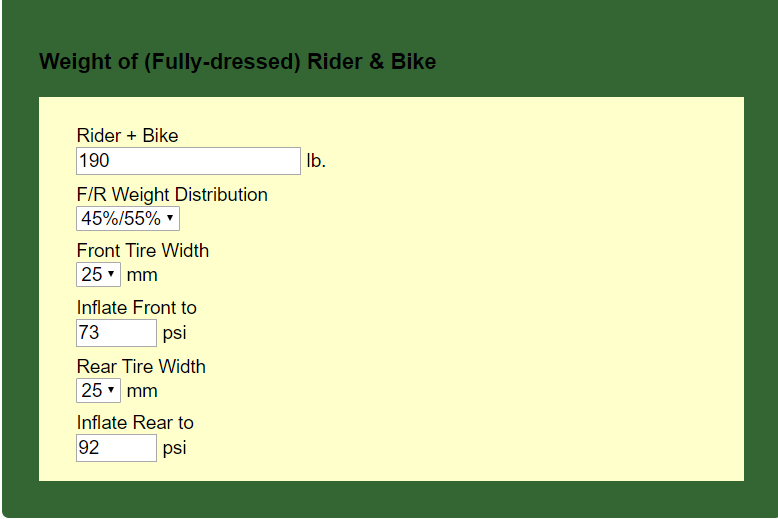
A 190 pound rider slamming into a pothole with all his weight on the front wheel (see my post last page) and only 73 psi in a skinny 25c tire? That's not going to end well. In fact, that might cause conditioning issues months later. Being at 85% of one's best because of a bad crash two months ago is a loss of 15% power. Real. 10% more rolling resistance in the front tire because you had nearly the same pressure up front as the back - well, rolling resistance is rarely more that about 20% of one's total resistance. The front is say half the total rolling resistance. So 1/2 X 20% X 10% increase for the additional pressure = 1% change in the total resistance, Yes, measurable but compared to a crash from loss of control because the front tire blew out or the rim collapsed, peanuts.
Those pretty charts are going to get people hurt. We hit potholes, If we ride long enough, we hit them without doing the proper un-weighting of the wheels and we may hit one one day while braking hard. Front tire pressure could make a very real difference. (If you do choose to ride the low front tire pressures, wear a helmet and shave your legs. Both make the ER experience a lot better and speed recovery.
Ben
05-05-20 | 11:52 AM
#49

Senior Member

Joined: Mar 2011
Posts: 3,891
Likes: 2,291
Maybe we are. My point is illustrated with this example:
My wife's bike has Kenda Small Block 8s, which are rated for 50-85 PSI. My bike has Maxxis Ikons, rated 30-65 PSI. So when we are going to spend the day on smooth hardpack and want to roll fast, I fill her tires up to 85 PSI, and mine to 65 PSI. Body weight is not a factor - we use what's on the tire.
When we want to ride rougher or looser terrain, we reduce hers to about 55 and mine down to about 40, and that gives us each the best results with the tires we're each riding. Still within the manufacturers specifications, but different because they are different tires.
That's why asking what the best tire pressure is, without knowing exactly what tire we're talking about, is pointless. It depends on the tire.
My wife's bike has Kenda Small Block 8s, which are rated for 50-85 PSI. My bike has Maxxis Ikons, rated 30-65 PSI. So when we are going to spend the day on smooth hardpack and want to roll fast, I fill her tires up to 85 PSI, and mine to 65 PSI. Body weight is not a factor - we use what's on the tire.
When we want to ride rougher or looser terrain, we reduce hers to about 55 and mine down to about 40, and that gives us each the best results with the tires we're each riding. Still within the manufacturers specifications, but different because they are different tires.
That's why asking what the best tire pressure is, without knowing exactly what tire we're talking about, is pointless. It depends on the tire.
It is like a car. The tire is designed to carry a max load at the max pressure the tire is rated for, but most cars use a lower pressure for each tire than the max psi the tire is rated for. As an extreme example, the old VW bugs, the ones with the engine on the back, used tires with a max inflation pressure of 35 psi, but, the VW Bug's pressure recommendation in the front, was 16 psi. There was very little weight on in the front of the Bug, so VW recommended 16 psi. That gave you the proper contact patch, the best handling, and best wear for the tire. If you used more, it rode like a buckboard, slid in cornering, the front would easily lock up during braking, and the tires wore in the center of the tread.
Tire inflation has everything to do with the weight the tire has to carry. The inflation range stamped on the tires is simply the minimum psi and maximum psi the tire is designed to be used with, depending on the weight the tire has to support.
05-05-20 | 11:57 AM
#50
Senior Member
Joined: Jul 2014
Posts: 1,677
Likes: 824
Nope, it depends on the weight on the tire. Yes, you can fill the tire to the max, but that is not the way it works optimally. The tire is designed to be able to support weight, using air, how much weight it can handle is dependent upon how much air is in the tire. The tire does not need 85psi to hold up lower weights, and handle the way it is designed to handle. Filling the tire to the max, with a low bike/rider weight, you have a smaller contact patch, which will affect traction for braking and cornering. T the same time, the tire will be hard, and not compliant, it will not be able to conform to small bumps, causing the tire to bounce and lose traction more easily. You most likely will never notice, if you are riding recreationally. On a perfectly smooth road, you probably won't notice any issues, but overall, using a lower psi, one determined by the weight of the rider and bike combined, will give you a better ride, and better efficiency.
It is like a car. The tire is designed to carry a max load at the max pressure the tire is rated for, but most cars use a lower pressure for each tire than the max psi the tire is rated for. As an extreme example, the old VW bugs, the ones with the engine on the back, used tires with a max inflation pressure of 35 psi, but, the VW Bug's pressure recommendation in the front, was 16 psi. There was very little weight on in the front of the Bug, so VW recommended 16 psi. That gave you the proper contact patch, the best handling, and best wear for the tire. If you used more, it rode like a buckboard, slid in cornering, the front would easily lock up during braking, and the tires wore in the center of the tread.
Tire inflation has everything to do with the weight the tire has to carry. The inflation range stamped on the tires is simply the minimum psi and maximum psi the tire is designed to be used with, depending on the weight the tire has to support.
It is like a car. The tire is designed to carry a max load at the max pressure the tire is rated for, but most cars use a lower pressure for each tire than the max psi the tire is rated for. As an extreme example, the old VW bugs, the ones with the engine on the back, used tires with a max inflation pressure of 35 psi, but, the VW Bug's pressure recommendation in the front, was 16 psi. There was very little weight on in the front of the Bug, so VW recommended 16 psi. That gave you the proper contact patch, the best handling, and best wear for the tire. If you used more, it rode like a buckboard, slid in cornering, the front would easily lock up during braking, and the tires wore in the center of the tread.
Tire inflation has everything to do with the weight the tire has to carry. The inflation range stamped on the tires is simply the minimum psi and maximum psi the tire is designed to be used with, depending on the weight the tire has to support.
When talking about bicycle tires, 45 PSI in one tire may handle and perform completely different than 45 PSI in a different tire. That shouldn't be hard to understand either.
Last edited by Jeff Neese; 05-05-20 at 12:05 PM.