


Correct tyre pressure?
 04-30-20 | 06:17 AM
#1
Thread Starter
Junior Member
Joined: Apr 2020
Posts: 13
Likes: 1
Correct tyre pressure?
So I have been reading through these forums, googling, etc, but still not 100% sure how to get this right. How do I get the definitive answer?
Details below.
My weight (fully dressed plus a backpack with some snacks and personal items) approx.: 85-90Kg / 187-198 Lb
Bike weight approx.: 13Kg / 29 Lb
Bike type: Hybrid
Tyres: 700x40c
Details below.
My weight (fully dressed plus a backpack with some snacks and personal items) approx.: 85-90Kg / 187-198 Lb
Bike weight approx.: 13Kg / 29 Lb
Bike type: Hybrid
Tyres: 700x40c
 04-30-20 | 06:35 AM
#2

Senior Member

Joined: Jun 2005
Posts: 2,913
Likes: 991
From: Louisville KY
Bikes: 06 Lemond Reno, 98 GT Timberline
The "correct" pressure is what works for you, kind of. The tire should not be rock solid, or you'll feel every bump, or vibration from a rough road, etc. Don't want it too soft either, or you risk the chance of a "snakebite" or "pinch" flat if you happen to rub tubes and hit an uneven crack in the pavement or a pothole. Tubeless tires can usually be run a bit lower than tires with tubes. To start off, maybe try running 5 lbs less than max in front, 10lbs less than max in back, and go down from there. You'll find what is best for you, your bike, where you ride. May just take a little trial and error.
 04-30-20 | 07:05 AM
#3
Senior Member
Joined: Oct 2018
Posts: 1,437
Likes: 815
From: VA
Bikes: SuperSix Evo | Revolt
Full system weight for me on my gravel bike with 40mm tires is prob 10-15lbs less than you, I run 45-50psi on the road, and 30-40psi on gravel depending on conditions. That's tubeless tho, maybe lil extra pressure if you're running tubes. The goal is to find the right pressure for you that feels comfortable and stable, while not low enough to allow for pinch flats (if you're running tubes). Start at maybe 60psi and work your way down and find what works for you.
04-30-20 | 07:33 AM
#4
Newbie

Joined: Jul 2015
Posts: 16
Likes: 0
From: Albemarle County, VA
Bikes: Lynskey Sportive, Cannondale F1000
04-30-20 | 07:48 AM
#5


I use the IDGAS system. Since I mainly ride on hard roads I look for maximum tire pressure rating on side of tire and pump to that. Works for me
04-30-20 | 07:53 AM
#6
Thread Starter
Junior Member
Joined: Apr 2020
Posts: 13
Likes: 1
Thanks everyone. I was aware that there will be some sort of deviation form the "norm" based on my situation or personal preferences. But just wanted to make sure I get the correct starting point before trialling further instead of poking blind in the dark.
Appreciate everyone's responses.
Appreciate everyone's responses.
 04-30-20 | 08:08 AM
#9
Senior Member
Joined: Apr 2018
Posts: 898
Likes: 337
From: Saulkrasti, Latvia
Bikes: Focus Crater Lake
My figures are pretty much exactly the same, down to the the tire size. I usually run about 50-55 psi, may deviate some 5psi en either direction depending on the expected road conditions (recommended pressure for these tires is 35-65 psi). Although lately I've been going just by feel, pinching the tires with my fingers. That actually tells me more than figures which may vary from gauge to gauge and I have no idea how precise they are.
04-30-20 | 08:15 AM
#10
Thread Starter
Junior Member
Joined: Apr 2020
Posts: 13
Likes: 1
My figures are pretty much exactly the same, down to the the tire size. I usually run about 50-55 psi, may deviate some 5psi en either direction depending on the expected road conditions (recommended pressure for these tires is 35-65 psi). Although lately I've been going just by feel, pinching the tires with my fingers. That actually tells me more than figures which may vary from gauge to gauge and I have no idea how precise they are.
 used that as a kid before I even knew how to use the gauges Thought this time might go a bit more serious, but I agree this method has its pros.
04-30-20 | 08:20 AM
used that as a kid before I even knew how to use the gauges Thought this time might go a bit more serious, but I agree this method has its pros.
04-30-20 | 08:20 AM
#11

I think that the larger 40mm tires don't pinch flat as easily as a 25mm tire. At least, they won't pinch flat on a one inch sized piece of sharp edged gravel on the road, like my 28mm did. I was going 30 mph when I hit it. Slower cruising speeds won't pinch flat on these rocks, since the tire has time to rebound. Slamming a deep pothole could still pinch flat a 40mm, so look out for those!
On 38mm tires, I run 38 psi front and 45 psi rear for rough paved roads. I'm 170 pounds, the bike around 22-23 pounds. These are smooth tread, very flexible tires, built like road tires, so they flex over bumps and still roll fast. A stiffer, more puncture resistant 40mm tire might benefit from higher pressures to lower the rolling resistance.
On 38mm tires, I run 38 psi front and 45 psi rear for rough paved roads. I'm 170 pounds, the bike around 22-23 pounds. These are smooth tread, very flexible tires, built like road tires, so they flex over bumps and still roll fast. A stiffer, more puncture resistant 40mm tire might benefit from higher pressures to lower the rolling resistance.
Last edited by rm -rf; 04-30-20 at 08:24 AM.
04-30-20 | 08:22 AM
#12
Some years ago, I saw a recommendation to squeeze the sidewalls with thumb and index finger, instead of just pressing down on the tread with a thumb. This gives me a better idea of the tire inflation. I've pumped up my various tires, then did the sidewall squeeze to help remember what good pressure feels like.
04-30-20 | 09:27 AM
#13

Old Legs

Joined: Nov 2016
Posts: 1,212
Likes: 33
From: Mass.
Bikes: '80 Strayvaigin, '84 Ciocc Aelle-Shimano 105, '90 Concorde Astore /Campy Triple ,85 Bridgestone 500/Suntour, 2005 Jamis Quest, 2017 Raleigh Merit 1, Raleigh Carbon Clubman
I've been using "Mymavic" app and go from there. Best part, is you can save all your bike profiles in the app and update as necessary .
04-30-20 | 09:32 AM
#14

Senior Member
Joined: Oct 2018
Posts: 808
Likes: 484
From: Thornhill, Canada
Bikes: MEC Origami Folder, QU-AX Uni, United Motocross BMX, Specialized Langster, Giant OCR, Marin Muirwoods, Globe Roll2, VROD:)
I simply inflate to 10psi less than what's stamped on the sidewall of the tire.....then add or minus after a few kms depending on taste of the day.
The important thing is to check the tire pressure every few rides (if not before every ride)......
The important thing is to check the tire pressure every few rides (if not before every ride)......
04-30-20 | 09:45 AM
#15

Advanced Slacker
Joined: Feb 2017
Posts: 6,286
Likes: 2,602
Bikes: Soma Fog Cutter, Surly Wednesday, Canfielld Tilt
Use it.
04-30-20 | 09:58 AM
#16
Senior Member
Joined: Apr 2020
Posts: 53
Likes: 12
From: Lancaster, PA
Bikes: 2020 Specialized Allez
04-30-20 | 10:05 AM
#17

Senior Member


Joined: Jul 2008
Posts: 30,497
Likes: 4,570
From: 25 miles northwest of Boston
Bikes: Bottecchia Sprint, GT Timberline 29r, Marin Muirwoods 29er, Trek FX Alpha 7.0
I would start w max pressure in rear, maybe burp 5-10 lbs out & run the front 10 psi lower & see how it “feels”
04-30-20 | 10:16 AM
#18

Senior Member
Joined: Oct 2014
Posts: 14,180
Likes: 5,312
From: Portland, OR
Bikes: (2) ti TiCycles, 2007 w/ triple and 2011 fixed, 1979 Peter Mooney, ~1983 Trek 420 now fixed and ~1973 Raleigh Carlton Competition gravel grinder
I have never used the sidewall pressure to pump my tires to. In fact I don't even look. I base my pressures on ride feel, need to not pinch flat and grip. With smaller tires, those last two can be a balancing act. The intent of the ride will be the deciding factor. In the days when high quality tires were (nearly) all small, that could be a fine balance and one I had to keep in mind as I rode. Now, I can ride very high quality 28c tires and never have play that balancing act. (I weight 150-155 pounds.)
35s should give the OP the same margin as I get with 28s. 40s are my 32s and have lots of leeway. I'd probably start me ride with 40s at around 42psi so I didn't get hammered. I like the suggestion above for the OP at 50 psi.
I always go 5 psi more in back than in front. The old "rule" from all the experienced racers when I raced back when we still had dinosaurs. Modern theory tell us we should have far less in front since when rolling along, we have 55-60% of our weight in back. But that doesn't reflect that split second when the car taillight comes on right in front of you, you slam on your brakes and simultaneously hit the deep pothole you could not see because of that same car. Now - all your weight is on that front wheel which is slamming into the far pavement edge. Pinch flat, bent rim, maybe blown tire time. And exactly when you full control of your bike! So when I think a pressure, I automatically 2-3 psi more in back and the same less in front.
OP, note the sidewall deflection of your tires, ie "squish" when you achieve a pressure that feels good. And do the pinch (sidewalls, thumb and index (or middle) as suggested above. I actually usually pinch just below the tread, The "pinch gauge" does have some "drift" to it and is not of digital accuracy but the portability and ease of use counts for a lot! (And can be more accurate than a pump gauge!)
Ben
35s should give the OP the same margin as I get with 28s. 40s are my 32s and have lots of leeway. I'd probably start me ride with 40s at around 42psi so I didn't get hammered. I like the suggestion above for the OP at 50 psi.
I always go 5 psi more in back than in front. The old "rule" from all the experienced racers when I raced back when we still had dinosaurs. Modern theory tell us we should have far less in front since when rolling along, we have 55-60% of our weight in back. But that doesn't reflect that split second when the car taillight comes on right in front of you, you slam on your brakes and simultaneously hit the deep pothole you could not see because of that same car. Now - all your weight is on that front wheel which is slamming into the far pavement edge. Pinch flat, bent rim, maybe blown tire time. And exactly when you full control of your bike! So when I think a pressure, I automatically 2-3 psi more in back and the same less in front.
OP, note the sidewall deflection of your tires, ie "squish" when you achieve a pressure that feels good. And do the pinch (sidewalls, thumb and index (or middle) as suggested above. I actually usually pinch just below the tread, The "pinch gauge" does have some "drift" to it and is not of digital accuracy but the portability and ease of use counts for a lot! (And can be more accurate than a pump gauge!)
Ben
04-30-20 | 10:16 AM
#19

Senior Member
Joined: Aug 2011
Posts: 22,676
Likes: 2,643
From: CID
Bikes: 1991 Bianchi Eros, 1964 Armstrong, 1988 Diamondback Ascent, 1988 Bianchi Premio, 1987 Bianchi Sport SX, 1980s Raleigh mixte (hers), All-City Space Horse (hers)
04-30-20 | 11:47 AM
#20

Senior Member
Joined: Mar 2011
Posts: 3,881
Likes: 2,278
04-30-20 | 11:50 AM
#21
Senior Member
Joined: Apr 2020
Posts: 53
Likes: 12
From: Lancaster, PA
Bikes: 2020 Specialized Allez
 04-30-20 | 11:52 AM
#22
Senior Member
Joined: Aug 2011
Posts: 22,676
Likes: 2,643
From: CID
Bikes: 1991 Bianchi Eros, 1964 Armstrong, 1988 Diamondback Ascent, 1988 Bianchi Premio, 1987 Bianchi Sport SX, 1980s Raleigh mixte (hers), All-City Space Horse (hers)
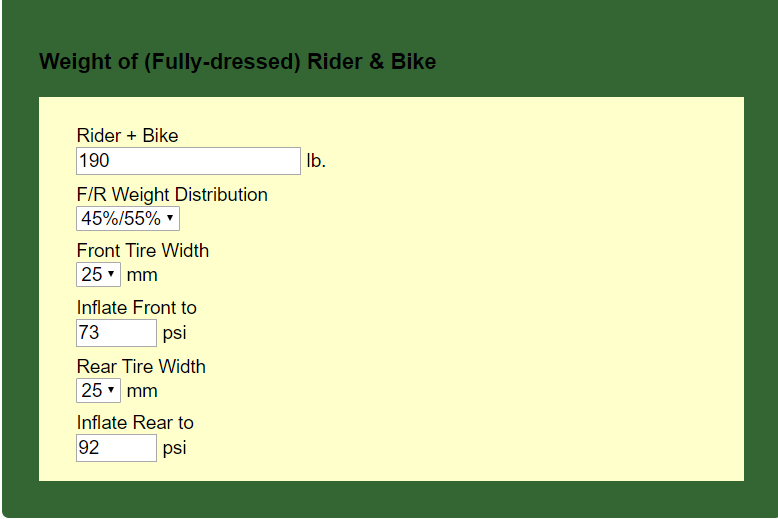
Yep, if you have about the same amount of weight on each wheel. I prefer to use the second calculator on the page anyway, since I assume a 45/55 weight distribution in my bikes, and that works out nicely for me.
ON EDIT: Looks like you figured that out already.
ON EDIT: Looks like you figured that out already.
04-30-20 | 11:56 AM
#23
Senior Member
Joined: Mar 2011
Posts: 3,881
Likes: 2,278
If you look above the first calculator on the page, the one that gave you the 176 psi figure, it say, "Weight measured at wheel." It won't be an equal 50/50 split, the rear will have more weight on it than the front. You will have to account for that.
04-30-20 | 11:57 AM
#24
Senior Member
Joined: Apr 2020
Posts: 53
Likes: 12
From: Lancaster, PA
Bikes: 2020 Specialized Allez
I'm a heavier rider - 230ish - and it suggested 91 psi front and 114 psi rear on the 45/55 chart. That seems extremely high.
The Michelin calculator recommends 102 split between the two, which makes way more sense.
04-30-20 | 12:35 PM
#25
Senior Member
Joined: Aug 2011
Posts: 22,676
Likes: 2,643
From: CID
Bikes: 1991 Bianchi Eros, 1964 Armstrong, 1988 Diamondback Ascent, 1988 Bianchi Premio, 1987 Bianchi Sport SX, 1980s Raleigh mixte (hers), All-City Space Horse (hers)