


Bike tire width

 06-24-21 | 08:38 AM
#2

I like bike
Joined: Feb 2021
Posts: 675
Likes: 289
From: Merry Land USA
Bikes: Roubaix Comp 2020
Here are a couple fairly recent threads on this topic.
Tire width; 28 vs. 30 or 32.
What's the optimal tire width for maximum speed on roads?
https://www.bikeforums.net/road-cycling/1231582-rolling-resistance.html
Tire width; 28 vs. 30 or 32.
What's the optimal tire width for maximum speed on roads?
https://www.bikeforums.net/road-cycling/1231582-rolling-resistance.html
06-24-21 | 10:55 AM
#3
Senior Member
Joined: May 2021
Posts: 219
Likes: 69
If you are asking because you have a road bike, the first step is do do some measuring to find the maximum size tire that can fit in your frame (chainstays, fork). You need at least 3-4 mm clearance, according to the info I got when I put larger tires on my bike.
NB: maximum inflated tire width doesn't necessarily match the published width number... i.e. a '28 mm' tire could inflate to 30 mm or 26, depending on the brand and also the rim width.
NB: maximum inflated tire width doesn't necessarily match the published width number... i.e. a '28 mm' tire could inflate to 30 mm or 26, depending on the brand and also the rim width.
 06-24-21 | 12:05 PM
#4
Clark W. Griswold


Joined: Mar 2014
Posts: 18,400
Likes: 6,728
From: ,location, location
Bikes: Foundry Chilkoot Ti W/Ultegra Di2, Salsa Timberjack Ti, Cinelli Mash Work RandoCross Fun Time Machine, 1x9 XT Parts Hybrid, Co-Motion Cascadia, Specialized Langster, Phil Wood Apple VeloXS Frame (w/DA 7400), R+M Supercharger2 Rohloff, Habanero Ti 26
Vibration given off by narrower tires feels like speed but may not be faster. Go with the widest tire you can fit if a road/cross bike and if a fat bike you are riding not on sand and snow go with the skinniest tire your rim can handle.


 06-24-21 | 12:09 PM
#5
Senior Member


Joined: Aug 2017
Posts: 579
Likes: 80
From: Wisconsin
Bikes: 1973 Schwinn Paramount, 2017 Raleigh Clubman Carbon, 2015 Felt Z75 Disc, 2008 Fuji Cross Comp, 2010 Trek Navigator 1.0, 1974 Raleigh Sports, 1974 Schwinn Le Tour, 2017 Giant Anyroad 2, Surly Cross Check, 2021 Giant Talon 2
Wider tires are more comfortable. Go over the bumps faster.
__________________
check out the Frugal Average Bicyclist
Frugal Average Bicyclist – The goal here is to help you keep cycling on a budget.
check out the Frugal Average Bicyclist
Frugal Average Bicyclist – The goal here is to help you keep cycling on a budget.
06-24-21 | 12:29 PM
#6
Senior Member
Joined: Mar 2019
Posts: 1,606
Likes: 925
All other things being equal, wider tires have similar or less rolling resistance caused by flex in the casing.
All other things being equal, wider tires are a bit heavier than the same tire in a narrower width.
These considerations are generally true when looking at the same model tire in different widths. However, if comparing two tires that are not the same make and model in different widths, often wider tires are the heavier and thicker and stiffer type which roll more slowly, while it is easier to find narrower tires with thin and supple casings which roll better.
Depending on how closely your tire width matches your rim width, a wider tire may have more aerodynamic resistance at high speeds. A big mismatch in rim/tire width (so the tire mounted on the narrow rim has an 'omega' shaped cross section will generally have more aerodynamic resistance than a rim/tire combo that are close to the same width.
A wider tire will almost always be faster on rough or loose surfaces. A wider tire at a lower pressure will glide over surface imperfections, while a higher pressure narrow tire will tend to bounce you and your bike up and down, which is a loss of forward momentum. On soft surfaces a narrow tire will tend to carve a deeper groove while wider tires will be more likely to float on top, which uses less energy.
The great thing about tires is that they are a 'wear item', so you can try a new pair every season or so, or pop new ones on and keep the removed ones as spares or for riding different conditions. I like to take the perspective that riding enough to wear out a set of tires deserves a reward, and I reward myself with a new set of tires!
All other things being equal, wider tires are a bit heavier than the same tire in a narrower width.
These considerations are generally true when looking at the same model tire in different widths. However, if comparing two tires that are not the same make and model in different widths, often wider tires are the heavier and thicker and stiffer type which roll more slowly, while it is easier to find narrower tires with thin and supple casings which roll better.
Depending on how closely your tire width matches your rim width, a wider tire may have more aerodynamic resistance at high speeds. A big mismatch in rim/tire width (so the tire mounted on the narrow rim has an 'omega' shaped cross section will generally have more aerodynamic resistance than a rim/tire combo that are close to the same width.
A wider tire will almost always be faster on rough or loose surfaces. A wider tire at a lower pressure will glide over surface imperfections, while a higher pressure narrow tire will tend to bounce you and your bike up and down, which is a loss of forward momentum. On soft surfaces a narrow tire will tend to carve a deeper groove while wider tires will be more likely to float on top, which uses less energy.
The great thing about tires is that they are a 'wear item', so you can try a new pair every season or so, or pop new ones on and keep the removed ones as spares or for riding different conditions. I like to take the perspective that riding enough to wear out a set of tires deserves a reward, and I reward myself with a new set of tires!


 06-25-21 | 04:54 AM
#10

Senior Member
Joined: May 2021
Posts: 11,620
Likes: 7,017
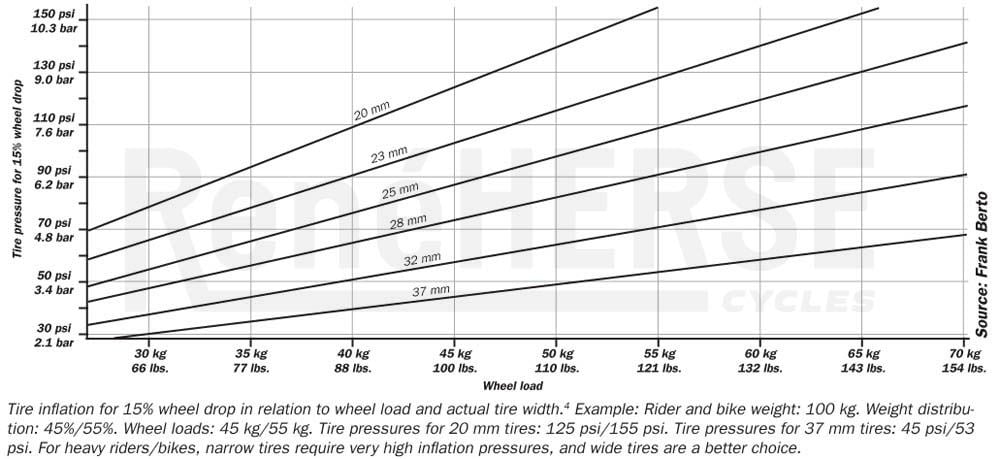
The general trend is clearly toward wider road tyres. 28 mm is now a very common width compared to 23 mm a decade ago. If your roads are rough then 32 mm is a good choice too. Typical pressures are now in the 60-80 psi range with these wider, higher volume tyres.
06-25-21 | 07:23 AM
#12

Senior Member

Joined: Jul 2008
Posts: 30,500
Likes: 4,570
From: 25 miles northwest of Boston
Bikes: Bottecchia Sprint, GT Timberline 29r, Marin Muirwoods 29er, Trek FX Alpha 7.0
fwiw - my road bike has 25mm tires, I weight 225lbs + bike & use approx 100-110 psi rear & 90-100 psi front. by trial & error this work for me for our local roads
06-25-21 | 07:25 AM
#13
Senior Member
Joined: Dec 2010
Posts: 9,690
Likes: 2,610
From: northern Deep South
Bikes: Fuji Touring, Novara Randonee
Many road bikes older than five years are limited as to the size tire they'll take, often maxing out at 25. In that case, ride the widest tire that'll fit. Otherwise, you'll have to try a few and pick your own optimum combination of width, ride, price, and puncture resistance.
06-25-21 | 07:37 AM
#14
Senior Member
Joined: Mar 2019
Posts: 1,606
Likes: 925
The big assumption here is that all other things are equal. Once you start looking carefully, most (not all) tire models start picking up sidewall stiffness as the width increases, usually between 25 and 32 mm wide. That's why tires wider than 25 or so often have higher rolling resistance than narrower tires. The exceptions are usually pricey.
ANyhoo, here is a rolling test of one particular model available in many widths. They even publish stats like sidewall and tread thickness, and the wide tires seem to be very similar, if not made the same as the narrow tires. The widest tire has the lowest RR and the narrowest tire has the highest RR.
https://www.bicyclerollingresistance...000-comparison
 06-25-21 | 07:45 AM
#15

Senior Member
Joined: Sep 2014
Posts: 1,693
Likes: 298
From: Northeastern MA, USA
Bikes: Garmin/Tacx Bike Smart
Pretty funny. Berton's calc page tells me I should be running about 112PSI in the rear and about 91 in the front. This absolutely flies in the face of all those "experts" who claim I should be running pressures much, much lower! I use trial and error to arrive at a comfortable and usable pressure, as always. For my tires and wheels I ended up at 95/100 front/rear. Just because I like the way it feels.
06-25-21 | 07:52 AM
#16

Tragically Ignorant
Joined: Jun 2018
Posts: 15,593
Likes: 9,109
From: New England
Bikes: Serotta Atlanta; 1994 Specialized Allez Pro; Giant OCR A1; SOMA Double Cross Disc; 2022 Allez Elite mit der SRAM
What's fun is you can still find sources on the interwebs referring to 25 mm as "wide" tires.
 06-25-21 | 08:25 AM
#17

Senior Member
Joined: Feb 2015
Posts: 6,006
Likes: 2,286
From: Mission Viejo
Bikes: 1986 Cannondale SR400 (Flat bar commuter), 1988 Cannondale Criterium XTR, 1992 Serotta T-Max, 1995 Trek 970
I think it is safe to say that a wider tire is more comfortable than a narrower tire.
As far as being faster, I think there are other variables that impact speed more than just tire width.
Personally, for a lot on non-competitive riders, I think dollars spent per mile probably has a greater influence on tire selection than getting the fastest tire available.
I should add that flats per ride might have a greater influence than the optimum rolling resistance. Fixing a flat turns the fastest tire into the slowest.
Everything is a compromise.
John
As far as being faster, I think there are other variables that impact speed more than just tire width.
Personally, for a lot on non-competitive riders, I think dollars spent per mile probably has a greater influence on tire selection than getting the fastest tire available.
I should add that flats per ride might have a greater influence than the optimum rolling resistance. Fixing a flat turns the fastest tire into the slowest.
Everything is a compromise.
John
06-25-21 | 09:26 AM
#18

Senior Member

Joined: Feb 2004
Posts: 30,225
Likes: 649
From: St Peters, Missouri
Bikes: Catrike 559 I own some others but they don't get ridden very much.
I think it is safe to say that a wider tire is more comfortable than a narrower tire.
As far as being faster, I think there are other variables that impact speed more than just tire width.
Personally, for a lot on non-competitive riders, I think dollars spent per mile probably has a greater influence on tire selection than getting the fastest tire available.
I should add that flats per ride might have a greater influence than the optimum rolling resistance. Fixing a flat turns the fastest tire into the slowest.
Everything is a compromise.
John
As far as being faster, I think there are other variables that impact speed more than just tire width.
Personally, for a lot on non-competitive riders, I think dollars spent per mile probably has a greater influence on tire selection than getting the fastest tire available.
I should add that flats per ride might have a greater influence than the optimum rolling resistance. Fixing a flat turns the fastest tire into the slowest.
Everything is a compromise.
John
That's what I think too. There's lots more to it than just tire width and air pressure.
__________________
My greatest fear is all of my kids standing around my coffin and talking about "how sensible" dad was.
My greatest fear is all of my kids standing around my coffin and talking about "how sensible" dad was.
 06-25-21 | 11:18 AM
#20
Tragically Ignorant
Joined: Jun 2018
Posts: 15,593
Likes: 9,109
From: New England
Bikes: Serotta Atlanta; 1994 Specialized Allez Pro; Giant OCR A1; SOMA Double Cross Disc; 2022 Allez Elite mit der SRAM
I think it is safe to say that a wider tire is more comfortable than a narrower tire.
As far as being faster, I think there are other variables that impact speed more than just tire width.
Personally, for a lot on non-competitive riders, I think dollars spent per mile probably has a greater influence on tire selection than getting the fastest tire available.
I should add that flats per ride might have a greater influence than the optimum rolling resistance. Fixing a flat turns the fastest tire into the slowest.
Everything is a compromise.
John
As far as being faster, I think there are other variables that impact speed more than just tire width.
Personally, for a lot on non-competitive riders, I think dollars spent per mile probably has a greater influence on tire selection than getting the fastest tire available.
I should add that flats per ride might have a greater influence than the optimum rolling resistance. Fixing a flat turns the fastest tire into the slowest.
Everything is a compromise.
John
I can notice a difference in speed based on the tread of the tire, but based on width is not noticeable at all. The speed differences are so negligible that I agree with you that except for racers, other considerations are generally going to be way more important. I like the way you sliced up the calculations.
I like the Conti GPs (4000 and 5000) because they are smooth (which I prefer) and durable.
06-25-21 | 11:57 AM
#21

Senior Member
Joined: Aug 2009
Posts: 4,303
Likes: 3,732
Pretty funny. Berton's calc page tells me I should be running about 112PSI in the rear and about 91 in the front. This absolutely flies in the face of all those "experts" who claim I should be running pressures much, much lower! I use trial and error to arrive at a comfortable and usable pressure, as always. For my tires and wheels I ended up at 95/100 front/rear. Just because I like the way it feels.
06-25-21 | 12:17 PM
#22
Senior Member
Joined: May 2014
Posts: 2,547
Likes: 660
Bikes: yes
Pretty funny. Berton's calc page tells me I should be running about 112PSI in the rear and about 91 in the front. This absolutely flies in the face of all those "experts" who claim I should be running pressures much, much lower! I use trial and error to arrive at a comfortable and usable pressure, as always. For my tires and wheels I ended up at 95/100 front/rear. Just because I like the way it feels.
 06-25-21 | 12:19 PM
#23
Senior Member
Joined: Sep 2014
Posts: 1,693
Likes: 298
From: Northeastern MA, USA
Bikes: Garmin/Tacx Bike Smart
Lots of variables involved. Wheel type, width, frame material and type, rider weight, etc. I use what works for me and my ride, a 2017 Roubaix that absorbs road shock really well.
06-25-21 | 12:19 PM
#24

Cheerfully low end
Joined: Jun 2020
Posts: 2,229
Likes: 1,298
Otto
06-25-21 | 12:20 PM
#25
Senior Member
Joined: Sep 2014
Posts: 1,693
Likes: 298
From: Northeastern MA, USA
Bikes: Garmin/Tacx Bike Smart
That was my point; there is NO definitive source when it comes to tire pressure. Until everyone is the same weight, riding the same wheels, tires, bikes, and road surfaces. Until then, just use your brain and experience to choose what works for you.