


The physics of bicycles


 03-18-26 | 11:03 PM
#3
Highly Enriched Driftium


Joined: Apr 2017
Posts: 6,832
Likes: 2,214
Didn't watch the video yet.
There was a really good study about 15 years ago IIRC, I may have links to post, that figured this all out. Collaboration between Delft U in the NL and I think Cornell in the USA IIRC. Gyroscopic forces on the wheels help, as well as front trail (caster), however, the study proved those were not essential for stability, stability being, getting the riderless bike rolling at a running pace and letting go, and the bike self-correcting to stay upright, by steering in the direction of falling.
They used a physical model, and developed a parametric(?) computer simulation to predict behavior. The physical model used tiny inline skate or scooter wheels, very low gyroscopic inertia, and, had the same wheels directly above and in tire contact, to rotate backwards, which they said, cancelled the angular momentum of the bottom wheels, so no stability from that. The front wheel pivot was directly beneath wheel center, so no trail or caster. They called this the Two-Mass-Skate model.
And yet, the bike could be made dynamically (rolling) stable, simply via mass distribution. IIRC(?), the stable configuration was the frame center of gravity being made (with weights) forward of the head tube and high. Note, this parallels experience with front block cargo mounts with load on small-wheel bikes like a 349-wheel Brompton. My 406 wheel bike has no front block, though cargo mass on the front fork rack forward of the steering axis, also improves stability, as it causes steering in the falling direction, as well as adding steered mass to slow down the twitchiness of unladen 406 geometry.
I'll see if I have stored links to the study. Quite interesting.
And here it is. There's videos also:
https://bicycle.tudelft.nl/stablebicycle/
EDIT: Fast forwarding thru video in post #1, ah, they reference the Delft study(s), but don't go into them, treating it like a mystery, which it's not at this point.
More info from my own studies: Longer trail makes steering more stable, however, on smaller wheels like my 20"/406 wheel and smaller, you run into limitations; Because the tire fore and aft of axle center, curves up and away from the ground more quickly than a large tire diameter (because smaller tire radius), and the tire contact patch with the ground is resultingly shorter, that limits the length of trail; If you put the steering axis at the ground forward of the contact patch (picture the front fork on Peter Fonda's chopper in Easy Rider), at lower speeds you get "wheel flop", the steering flopping quickly to left or right, not stable on center. Wheel flop makes the bike front settle to a lower height, and a lower potential energy state, so naturally wants to go there, like a ball on top of a hill and wanting to roll into the valley on left or right. As you increase speed, the trail/caster might cancel out the wheel flop. My own 406 bike has relatively low trail so has little inherent steering stability; Others have 406 bikes that are more stable, I think both due to more trail, and longer wheelbase.
There was a really good study about 15 years ago IIRC, I may have links to post, that figured this all out. Collaboration between Delft U in the NL and I think Cornell in the USA IIRC. Gyroscopic forces on the wheels help, as well as front trail (caster), however, the study proved those were not essential for stability, stability being, getting the riderless bike rolling at a running pace and letting go, and the bike self-correcting to stay upright, by steering in the direction of falling.
They used a physical model, and developed a parametric(?) computer simulation to predict behavior. The physical model used tiny inline skate or scooter wheels, very low gyroscopic inertia, and, had the same wheels directly above and in tire contact, to rotate backwards, which they said, cancelled the angular momentum of the bottom wheels, so no stability from that. The front wheel pivot was directly beneath wheel center, so no trail or caster. They called this the Two-Mass-Skate model.
And yet, the bike could be made dynamically (rolling) stable, simply via mass distribution. IIRC(?), the stable configuration was the frame center of gravity being made (with weights) forward of the head tube and high. Note, this parallels experience with front block cargo mounts with load on small-wheel bikes like a 349-wheel Brompton. My 406 wheel bike has no front block, though cargo mass on the front fork rack forward of the steering axis, also improves stability, as it causes steering in the falling direction, as well as adding steered mass to slow down the twitchiness of unladen 406 geometry.
I'll see if I have stored links to the study. Quite interesting.
And here it is. There's videos also:
https://bicycle.tudelft.nl/stablebicycle/
EDIT: Fast forwarding thru video in post #1, ah, they reference the Delft study(s), but don't go into them, treating it like a mystery, which it's not at this point.
More info from my own studies: Longer trail makes steering more stable, however, on smaller wheels like my 20"/406 wheel and smaller, you run into limitations; Because the tire fore and aft of axle center, curves up and away from the ground more quickly than a large tire diameter (because smaller tire radius), and the tire contact patch with the ground is resultingly shorter, that limits the length of trail; If you put the steering axis at the ground forward of the contact patch (picture the front fork on Peter Fonda's chopper in Easy Rider), at lower speeds you get "wheel flop", the steering flopping quickly to left or right, not stable on center. Wheel flop makes the bike front settle to a lower height, and a lower potential energy state, so naturally wants to go there, like a ball on top of a hill and wanting to roll into the valley on left or right. As you increase speed, the trail/caster might cancel out the wheel flop. My own 406 bike has relatively low trail so has little inherent steering stability; Others have 406 bikes that are more stable, I think both due to more trail, and longer wheelbase.
Last edited by Duragrouch; 03-19-26 at 05:22 AM.
03-19-26 | 03:29 AM
#4

Senior Member
Joined: Oct 2022
Posts: 612
Likes: 440
From: UK, New Forest
Bikes: 1948-49 Allin SB Long Term Resto 1948 Raleigh Lenton Clubman Frame Project 1950 Raleigh Clubman Frame Project 1951 Claud Butler New Allrounder Frame Project 1959 Claud Butler European 1977 Motobécane C4 1977 Carlton Clubman 1980 Gitane Sprint
03-19-26 | 03:56 AM
#5
Highly Enriched Driftium
Joined: Apr 2017
Posts: 6,832
Likes: 2,214
03-19-26 | 04:25 AM
#6
Full Member
Joined: Aug 2025
Posts: 205
Likes: 96
03-19-26 | 04:34 AM
#7
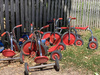

Which surprised me a bit when I first read about the studies he cites. But it should have been obvious. After all, any cyclist can easily keep a bike upright indefinitely while moseying along at or below walking speed, where gyroscopic forces are negligible/nonexistent.
Here's a good article on the topic.
__________________
You are always the same age inside.---Gertrude Stein
My aluminum bikes: Light, strong, cheap, and comfy.
You are always the same age inside.---Gertrude Stein
My aluminum bikes: Light, strong, cheap, and comfy.


 03-19-26 | 04:56 AM
#8
Highly Enriched Driftium
Joined: Apr 2017
Posts: 6,832
Likes: 2,214
Worked for me when I posted, now not. The following link should be a mirror site, different school on the same research team:
https://ruina.tam.cornell.edu/researc...stablebicycle/
https://ruina.tam.cornell.edu/researc...stablebicycle/
Last edited by Duragrouch; 03-19-26 at 05:00 AM.
03-19-26 | 05:00 AM
#9

Happy With My Bikes

Joined: Sep 2020
Posts: 2,791
Likes: 3,305
From: Oklahoma
Bikes: Hi-Ten bike boomers, a Trek Domane and some projects


 03-19-26 | 08:53 AM
#14

Senior Member

Joined: Dec 2004
Posts: 15,396
Likes: 8,314
From: Seattle area
Bikes: Bikes??? Thought this was social media?!?
another issue not worth solving for the typical cyclist --
a scientific solution for a tire's rolling resistance over a mixed surface gravel ride.
a scientific solution for a tire's rolling resistance over a mixed surface gravel ride.
__________________
Vintage, modern, e-road. It is a big cycling universe.
Vintage, modern, e-road. It is a big cycling universe.
03-19-26 | 08:57 AM
#16
Senior Member

Joined: Aug 2009
Posts: 3,153
Likes: 1,665

 03-19-26 | 09:20 AM
#18
Senior Member
Joined: Dec 2004
Posts: 15,396
Likes: 8,314
From: Seattle area
Bikes: Bikes??? Thought this was social media?!?
Physics?!, I'm not a Physician!
__________________
Vintage, modern, e-road. It is a big cycling universe.
Vintage, modern, e-road. It is a big cycling universe.
Last edited by Wildwood; 03-19-26 at 12:39 PM.
03-19-26 | 10:05 AM
#19
03-19-26 | 12:13 PM
#20
climber has-been
Joined: Dec 2004
Posts: 9,162
Likes: 6,051
From: Palo Alto, CA
Bikes: Scott Addict RC Pro & R1, Felt Z1
 03-19-26 | 12:25 PM
#21

Disco Infiltrator


Joined: May 2013
Posts: 15,341
Likes: 3,529
From: Folsom CA
Bikes: Stormchaser, Paramount, Tilt, Samba tandem
we have drone swarm light shows now and people are still posting on the internet "science says bees shouldn't be able to fly"
__________________
Genesis 49:16-17
"Well, well!" said Holmes, impatiently. "A good cyclist does not need a high road. The moor is intersected with paths and the moon is at the full."
Genesis 49:16-17
"Well, well!" said Holmes, impatiently. "A good cyclist does not need a high road. The moor is intersected with paths and the moon is at the full."
03-19-26 | 01:46 PM
#22
Senior Member
Joined: Sep 2007
Posts: 15,293
Likes: 1,771
From: Far beyond the pale horizon.


 03-19-26 | 04:29 PM
#24
Senior Member
Joined: Oct 2023
Posts: 1,713
Likes: 1,020
From: New Jersey
Scientists have concluded that expert cyclists wobble around less than novices. Intuitively, I've always suspected this, but here's validation from an actual scientific study.
The other way to say it (not mentioned in the article) is that any energy that doesn't help make the bike go forward is wasted effort.
The other way to say it (not mentioned in the article) is that any energy that doesn't help make the bike go forward is wasted effort.
03-19-26 | 05:31 PM
#25
Senior Member
Joined: Apr 2010
Posts: 2,963
Likes: 515
From: Elevation 666m Edmonton Canada
Bikes: 2013 Custom SA5w / Rohloff Tourster