


Modern Bicycle Performance
 04-23-26 | 10:26 PM
#26
Gruppetto Bob


Joined: Sep 2020
Posts: 11,416
Likes: 11,640
From: Seattle-ish
Bikes: Orbea Orca, Bianchi Infinito & Campione de Mundo
Do the math: https://silca.cc/blogs/silca/top-10-...3YKcrwjCLMcn-o
Does not include aero bike, enhanced personalized nutrition, scientific training programs and more.
Does not include aero bike, enhanced personalized nutrition, scientific training programs and more.
__________________
“A watt saved is a watt earned” 🚴🏻♂️
 Not a CAT
“A watt saved is a watt earned” 🚴🏻♂️
 04-23-26 | 10:46 PM
#27
Thread Starter
Senior Member

Joined: Mar 2010
Posts: 2,616
Likes: 2,198
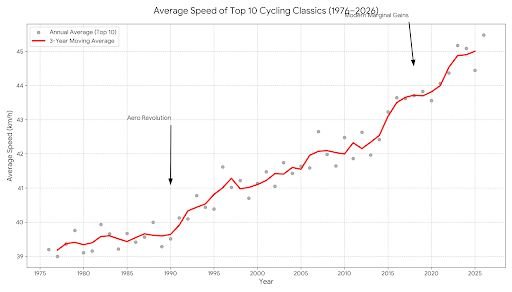
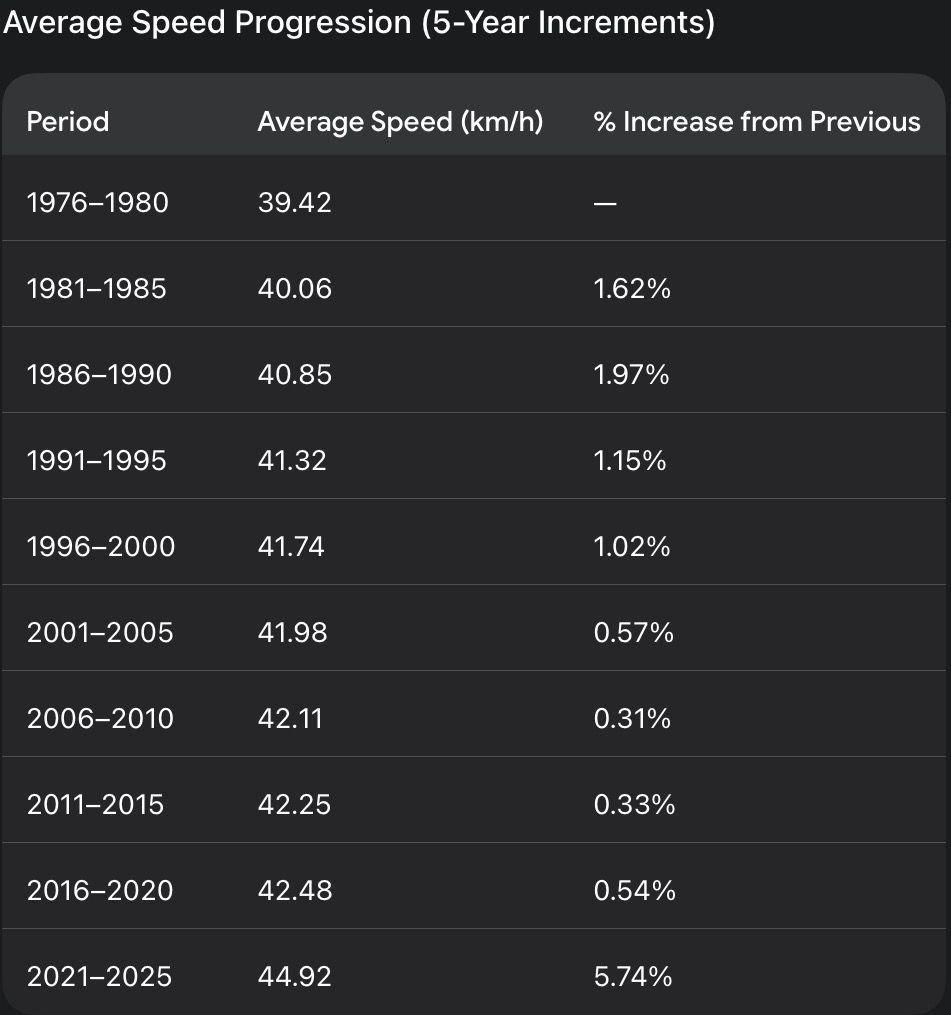
It’s fairly clear that there is an accelerated increase in the average speed of say the top 10 classics races races since the adoption of wider tubeless tires, disc brakes, carbon wheels, aero equipment and carbon frames. I am sure other innovations also play a role including the athletes conditioning, however even the doping era did not have as dramatic effect as the recent surge in technological improvements.
Last edited by Atlas Shrugged; 04-23-26 at 11:16 PM.
 04-24-26 | 12:30 AM
#28

Senior Member

Joined: Jul 2011
Posts: 2,923
Likes: 525
From: Turku, Finland, Europe
Bikes: 2011 Specialized crux comp, 2013 Specialized Rockhopper Pro
I mentioned this as a point of reference. Touring in the traditional sense of huge pannier’s and duffle bags strapped to your bike is mostly dying off replaced with lighter and more streamlined setups. My touring rigs are either a carbon gravel bike for rides 2 weeks or less and a steel adventure bike for 2+ weeks. Both bikes are 2x11 wide ratio gearing, disc brakes, tubeless and carbon wheels. These bikes are quick, good performing either loaded or not. The rack system is either my Tailfin or Tubus, 12L panniers, 6L handlebar bag and optional 4L fork packs, 10L cargo bag.
Triples were better than what we have now. Triples were even better than what can be customized. I've been riding a 2X with 46/30 and 11-46 (an impossible combination without some heavy customization or bar end shifters) for a while now and it's just not as good as my old Deore triple 22/34/44 and 11-36. For riding at my preferred pace that is. Low jumps between gears is better for maintaining steady power.
But the large panniers aren't going anywhere. Thinking that they are is youtube influence. Panniers haven't been the go-to choice of high performance long distance tourers for a long time, but for your average bike tourist on vacation, they still reign supreme. There simply isn't a better way to carry a lot of stuff. And if you want to go out to town in chinos and a button down shirt after a long day's ride, you're gonna need that space. Your average bike tourist is far more likely to ride a flat bar trekking bike with 20l panniers and a rack pack than a carbon drop bar bike with frame bags.
All of this gear is lightweight, fairly streamlined and low profile which makes the riding experience much easier and more enjoyable.
Most importantly much faster allowing to ride at ones preferred pace longer and more comfortably.
Modern gear such as clothing, sleep systems etc. are better and incredibly lightweight. Although slow to change even the touring world is benefiting from the innovations modern technology brings, unfortunately it does come at a cost, this stuff has a tendency to be expensive. Just adding up my onboard electronics, phone, radar taillight, gps watch and bike computer is a crazy number.
But lightweight gear is also fragile. For example one does need to evaluate whether the risk of sleeping pad punctures is worth the decreased weight. Same goes with rain gear, tents, etc.
 04-24-26 | 12:42 AM
#29

Senior Member

Joined: Mar 2018
Posts: 1,950
Likes: 1,922
There hasn't been that much technological improvement, not enough to justify that kind of difference. We've had tubeless, wider tires, disc brakes, carbon wheels and aero frames for a long time now.
Last edited by 50PlusCycling; 04-24-26 at 12:46 AM.
04-24-26 | 01:29 AM
#30
Highly Enriched Driftium
Joined: Apr 2017
Posts: 6,653
Likes: 2,148
Could be doughnuts!!
If there is any question to be questioned - its how does a 19 year old not only win a spring classic, but set the 3rd fastest time in history up the final climb? At grades of 15-20% - it's not really about modern bikes, tires, aero - its about pure power.
19 and coming close to or beating times set by world champions, TDF winners, winningest riders of all time...
They are modifying these kids genetics. We can talk tire pressures all day, or waxed chains... something is different with the riders.
If there is any question to be questioned - its how does a 19 year old not only win a spring classic, but set the 3rd fastest time in history up the final climb? At grades of 15-20% - it's not really about modern bikes, tires, aero - its about pure power.
19 and coming close to or beating times set by world champions, TDF winners, winningest riders of all time...
They are modifying these kids genetics. We can talk tire pressures all day, or waxed chains... something is different with the riders.
So it is not out of the realm of possibility that some gene therapy is going on in bike racing. Tough to detect, and tough to challenge; "Why should someone who won the gene lottery at birth, have that advantage, when the playing field can be leveled?"
04-24-26 | 03:27 AM
#32
Senior Member
Joined: Jul 2011
Posts: 2,923
Likes: 525
From: Turku, Finland, Europe
Bikes: 2011 Specialized crux comp, 2013 Specialized Rockhopper Pro
I just read a story today on NPR about using gene therapy to CURE a rare genetic-based cause of deafness in humans. Not theory, works.
So it is not out of the realm of possibility that some gene therapy is going on in bike racing. Tough to detect, and tough to challenge; "Why should someone who won the gene lottery at birth, have that advantage, when the playing field can be leveled?"
So it is not out of the realm of possibility that some gene therapy is going on in bike racing. Tough to detect, and tough to challenge; "Why should someone who won the gene lottery at birth, have that advantage, when the playing field can be leveled?"
That deafness cure was one gene in one very specific type of cell in one small location inside the ear and the result was an increase in one type of protein. And that wasn't exactly easy.
The human genome has around 3 billion base pairs, and we don't know what most of those do. I'm almost 100% sure we don't know which genes make for good athletes or why. And even if we did, changing them would be extremely risky, because there's so many interactions between all the cell level processes. Change the wrong one and suddenly you're producing prions.
 04-24-26 | 08:49 AM
#33
Senior Member
Joined: Jul 2009
Posts: 8,113
Likes: 11,051
Bikes: Colnago, Van Dessel, Factor, Cervelo, Ritchey
04-24-26 | 09:13 AM
#34

Klaatu..Verata..Necktie?
Joined: May 2007
Posts: 23,552
Likes: 17,030
From: SF Bay Area
Bikes: Litespeed Ultimate, Ultegra; Canyon Endurace, 105; Battaglin MAX, Chorus; Bianchi 928 Veloce; Ritchey Road Logic, Dura Ace; Cannondale R500 RX100; Schwinn Circuit, Sante; Lotus Supreme, Dura Ace
Imagine what Merckx could have done with the much more scientific and rider-specific training that is done today, instead of "Ride Lots".
__________________
"Don't take life so serious-it ain't nohow permanent."
"Everybody's gotta be somewhere." - Eccles
"Don't take life so serious-it ain't nohow permanent."
"Everybody's gotta be somewhere." - Eccles

 04-24-26 | 10:31 AM
#35
Senior Member
Joined: Jan 2023
Posts: 2,387
Likes: 2,095
From: Eastern Shore MD
Bikes: Lemond Zurich/Trek ALR/Giant TCX/Stumpy 15
Pogi, according to the experts, is second to none in lactate processing and tolerance, being dual fuel athlete, has possibly the highest VO2 max in the history of the sport, highest w/kg…
and who was his coach, and what is said coach’s field of expertise? Cellular energy systems and mitochondrial repair. Of which, they are messing about with genetics for other issues.
Even with EPO back in the day, lactate was the limiting factor. They have figured out how to surpass those limits.
04-24-26 | 10:56 AM
#37

The amazing thing is that the coaches with expertise in genetic research also perfected time travel to the past. How else could all those cycling stars have obliterated the competition in their first years of bike racing?
I'm including Greg Lemond, who was known for winning races as a junior in fields that were otherwise all seniors, some of them nationally ranked (e.g., the Tour of Nevada City).
I'm including Greg Lemond, who was known for winning races as a junior in fields that were otherwise all seniors, some of them nationally ranked (e.g., the Tour of Nevada City).
__________________
You are always the same age inside.---Gertrude Stein
My aluminum bikes: Light, strong, cheap, and comfy.
You are always the same age inside.---Gertrude Stein
My aluminum bikes: Light, strong, cheap, and comfy.
 04-24-26 | 12:05 PM
#40
Thread Starter
Senior Member
Joined: Mar 2010
Posts: 2,616
Likes: 2,198
enhanced superior genetics is my guess.
Pogi, according to the experts, is second to none in lactate processing and tolerance, being dual fuel athlete, has possibly the highest VO2 max in the history of the sport, highest w/kg…
and who was his coach, and what is said coach’s field of expertise? Cellular energy systems and mitochondrial repair. Of which, they are messing about with genetics for other issues.
Even with EPO back in the day, lactate was the limiting factor. They have figured out how to surpass those limits.
Pogi, according to the experts, is second to none in lactate processing and tolerance, being dual fuel athlete, has possibly the highest VO2 max in the history of the sport, highest w/kg…
and who was his coach, and what is said coach’s field of expertise? Cellular energy systems and mitochondrial repair. Of which, they are messing about with genetics for other issues.
Even with EPO back in the day, lactate was the limiting factor. They have figured out how to surpass those limits.
Look at the Womens speeds, The women's average of 40.83 km/h is faster than the winning speeds of the following men's races:
2010
Fabian Cancellara
39.33 km/h
2005
Tom Boonen
39.88 km/h
2002
Johan Museeuw
39.24 km/h
1999
Andrea Tafi
40.52 km/h
1992
Gilbert Duclos-Lassalle
41.48 km/h (Slightly Faster)
1981
Bernard Hinault
40.87 km/h (Near Tie)
1977
Roger De Vlaeminck
40.46 km/h
1970
Eddy Merckx
38.90 km/h
04-24-26 | 01:05 PM
#41
Thread Starter
Senior Member
Joined: Mar 2010
Posts: 2,616
Likes: 2,198
There's no denying that newer bike tech has benefited touring, much in the same way it has benefited essentially all other types of riding. Who wouldn't want better brakes or tires or such and such. But newer tech has also made reaching low gear ratios with drop bars a nightmare. I did a quick search and Shimano currently has no off the shelf approved combinations for low gearing. That means either going with SRAM (ew) or mixing and matching, which many bicycle tourists aren't comfortable doing, even if that simply means using an MTB crankset instead of the road/gravel one. And these days the only low gearing drop bar options are 1X, which means massive jumps at the low end and severely restricted high end, both of which make riding at one's own pace a bit of a bummer.
Triples were better than what we have now. Triples were even better than what can be customized. I've been riding a 2X with 46/30 and 11-46 (an impossible combination without some heavy customization or bar end shifters) for a while now and it's just not as good as my old Deore triple 22/34/44 and 11-36. For riding at my preferred pace that is. Low jumps between gears is better for maintaining steady power.
But the large panniers aren't going anywhere. Thinking that they are is youtube influence. Panniers haven't been the go-to choice of high performance long distance tourers for a long time, but for your average bike tourist on vacation, they still reign supreme. There simply isn't a better way to carry a lot of stuff. And if you want to go out to town in chinos and a button down shirt after a long day's ride, you're gonna need that space. Your average bike tourist is far more likely to ride a flat bar trekking bike with 20l panniers and a rack pack than a carbon drop bar bike with frame bags.
Debatable. Depends on how much of a hurry you're in. Also lots of small pouches, frame bags etc. is a hassle to take off compared to a couple of quick lock panniers. Being able to load/unload the bike quickly is a real benefit when using public transport or staying at a hotel that doesn't allow bikes in rooms.
Preferred pace is a power output, not speed. On a bike, it doesn't matter how much weight you're carrying when riding at preferred pace. The only variable is distance covered, which again is something that can be important to some and is of no importance to others. How long one can ride and at what comfort level relates to bike fit and ergonomics, which has nothing to do with weight or aerodynamics.
Modern gear can be lightweight but like you mentioned, that brings the cost up. And the cost does go up exponentially. Some would rather use that cash for the actual trip.
But lightweight gear is also fragile. For example one does need to evaluate whether the risk of sleeping pad punctures is worth the decreased weight. Same goes with rain gear, tents, etc.
Triples were better than what we have now. Triples were even better than what can be customized. I've been riding a 2X with 46/30 and 11-46 (an impossible combination without some heavy customization or bar end shifters) for a while now and it's just not as good as my old Deore triple 22/34/44 and 11-36. For riding at my preferred pace that is. Low jumps between gears is better for maintaining steady power.
But the large panniers aren't going anywhere. Thinking that they are is youtube influence. Panniers haven't been the go-to choice of high performance long distance tourers for a long time, but for your average bike tourist on vacation, they still reign supreme. There simply isn't a better way to carry a lot of stuff. And if you want to go out to town in chinos and a button down shirt after a long day's ride, you're gonna need that space. Your average bike tourist is far more likely to ride a flat bar trekking bike with 20l panniers and a rack pack than a carbon drop bar bike with frame bags.
Debatable. Depends on how much of a hurry you're in. Also lots of small pouches, frame bags etc. is a hassle to take off compared to a couple of quick lock panniers. Being able to load/unload the bike quickly is a real benefit when using public transport or staying at a hotel that doesn't allow bikes in rooms.
Preferred pace is a power output, not speed. On a bike, it doesn't matter how much weight you're carrying when riding at preferred pace. The only variable is distance covered, which again is something that can be important to some and is of no importance to others. How long one can ride and at what comfort level relates to bike fit and ergonomics, which has nothing to do with weight or aerodynamics.
Modern gear can be lightweight but like you mentioned, that brings the cost up. And the cost does go up exponentially. Some would rather use that cash for the actual trip.
But lightweight gear is also fragile. For example one does need to evaluate whether the risk of sleeping pad punctures is worth the decreased weight. Same goes with rain gear, tents, etc.
The huge panniers of the past, no longer necessary, are not a YouTube thing but rather the result of improvements across all aspects of touring gear. Travel clothing has improved substantially, becoming lighter and more compact. I would never pack a pair of cotton chinos anymore; instead, I would pack lightweight alternatives. I can easily get by for months with smaller, streamlined panniers. All my bags are easily removable, unlike the typical frame bags and seat packs used by adventure racers and backcountry riders.
If the bike and system are lighter and more streamlined, everything becomes easier and more enjoyable for most. I agree pace is determined by the rider; however the heavier the setup, the more problematic everything becomes.
Modern gear is more than durable enough for me and other lightweight activities that use the same gear, notably lightweight backpackers. As they say, light, durable, and cheap, pick two, but you can't have all three. Other items, such as replacing maps with digital sources, are huge weight and space savers. Cooking & Sleep systems are very lightweight and compact. But yes, this comes at a cost. Fortunately, bicycle touring has become an activity of more mature and established individuals, the most affluent demographic.
Regardless, traditional touring with bikes fully loaded with huge panniers, duffel bags, and bar bags is becoming increasingly rare, replaced by individuals using much more efficient systems.
04-24-26 | 01:22 PM
#42
Klaatu..Verata..Necktie?
Joined: May 2007
Posts: 23,552
Likes: 17,030
From: SF Bay Area
Bikes: Litespeed Ultimate, Ultegra; Canyon Endurace, 105; Battaglin MAX, Chorus; Bianchi 928 Veloce; Ritchey Road Logic, Dura Ace; Cannondale R500 RX100; Schwinn Circuit, Sante; Lotus Supreme, Dura Ace
04-24-26 | 01:47 PM
#43

I AM AI
Joined: Aug 2013
Posts: 4,285
Likes: 1,160
From: Tucson, AZ
Bikes: 2008 S-Works Roubaix SL, 1979 Raleigh Comp GS, 1978 Schwinn Volare
Power meters, big data, scientific training and nutrition, and human-body-as-machine in that context. Don't underestimate their impact.
__________________
A race bike in any era is a highly personal choice that at its "best" balances the requirements of fit, weight, handling, durability and cost tempered by the willingness to toss it and oneself down the pavement at considerable speed. ~Bandera
A race bike in any era is a highly personal choice that at its "best" balances the requirements of fit, weight, handling, durability and cost tempered by the willingness to toss it and oneself down the pavement at considerable speed. ~Bandera
04-24-26 | 03:14 PM
#44
I presently run a 2x 46-30 and an 11-42 (11-speed) and find the gearing appropriate, and although not approved by Shimano, it is a totally stock GRX system. Shifts well and functions well at both extremes. I agree that it would be nice to have factory-approved wide-range gearing available. However, since I am using lighter, modern gear, the extreme low gearing has not been necessary for me as it was in the past (I am older and less fit now). Most people would not agree with your view that past triples were ideal. . . .
There are those of us who (1) find shifting our triples completely trouble-free (I use Grip-Shift with a friction left shifter on a flat bar, along with bolt-on aero bars for ideal versatility) and (2) appreciate small incremental jumps between gears versus big jumps between chainrings and between cassette cogs.
I'm sure there's some way that 2x or 1x is superior for some people; just curious what that advantage might be.
__________________
You are always the same age inside.---Gertrude Stein
My aluminum bikes: Light, strong, cheap, and comfy.
You are always the same age inside.---Gertrude Stein
My aluminum bikes: Light, strong, cheap, and comfy.
04-24-26 | 04:44 PM
#45
Klaatu..Verata..Necktie?
Joined: May 2007
Posts: 23,552
Likes: 17,030
From: SF Bay Area
Bikes: Litespeed Ultimate, Ultegra; Canyon Endurace, 105; Battaglin MAX, Chorus; Bianchi 928 Veloce; Ritchey Road Logic, Dura Ace; Cannondale R500 RX100; Schwinn Circuit, Sante; Lotus Supreme, Dura Ace
Remind us why past triples were less than ideal?
There are those of us who (1) find shifting our triples completely trouble-free (I use Grip-Shift with a friction left shifter on a flat bar, along with bolt-on aero bars for ideal versatility) and (2) appreciate small incremental jumps between gears versus big jumps between chainrings and between cassette cogs.
I'm sure there's some way that 2x or 1x is superior for some people; just curious what that advantage might be.
There are those of us who (1) find shifting our triples completely trouble-free (I use Grip-Shift with a friction left shifter on a flat bar, along with bolt-on aero bars for ideal versatility) and (2) appreciate small incremental jumps between gears versus big jumps between chainrings and between cassette cogs.
I'm sure there's some way that 2x or 1x is superior for some people; just curious what that advantage might be.
Remind us why past triples were less than ideal?
There are those of us who (1) find shifting our triples completely trouble-free (I use Grip-Shift with a friction left shifter on a flat bar, along with bolt-on aero bars for ideal versatility) and (2) appreciate small incremental jumps between gears versus big jumps between chainrings and between cassette cogs.
I'm sure there's some way that 2x or 1x is superior for some people; just curious what that advantage might be.
There are those of us who (1) find shifting our triples completely trouble-free (I use Grip-Shift with a friction left shifter on a flat bar, along with bolt-on aero bars for ideal versatility) and (2) appreciate small incremental jumps between gears versus big jumps between chainrings and between cassette cogs.
I'm sure there's some way that 2x or 1x is superior for some people; just curious what that advantage might be.


__________________
"Don't take life so serious-it ain't nohow permanent."
"Everybody's gotta be somewhere." - Eccles
"Don't take life so serious-it ain't nohow permanent."
"Everybody's gotta be somewhere." - Eccles
04-24-26 | 05:08 PM
#47
Klaatu..Verata..Necktie?
Joined: May 2007
Posts: 23,552
Likes: 17,030
From: SF Bay Area
Bikes: Litespeed Ultimate, Ultegra; Canyon Endurace, 105; Battaglin MAX, Chorus; Bianchi 928 Veloce; Ritchey Road Logic, Dura Ace; Cannondale R500 RX100; Schwinn Circuit, Sante; Lotus Supreme, Dura Ace
Nope. Not even close to the realm of possibility.
That deafness cure was one gene in one very specific type of cell in one small location inside the ear and the result was an increase in one type of protein. And that wasn't exactly easy.
The human genome has around 3 billion base pairs, and we don't know what most of those do. I'm almost 100% sure we don't know which genes make for good athletes or why. And even if we did, changing them would be extremely risky, because there's so many interactions between all the cell level processes. Change the wrong one and suddenly you're producing prions.
That deafness cure was one gene in one very specific type of cell in one small location inside the ear and the result was an increase in one type of protein. And that wasn't exactly easy.
The human genome has around 3 billion base pairs, and we don't know what most of those do. I'm almost 100% sure we don't know which genes make for good athletes or why. And even if we did, changing them would be extremely risky, because there's so many interactions between all the cell level processes. Change the wrong one and suddenly you're producing prions.
But how would you identify a beneficial mutation? It could be a mutation that reduces the chance of getting a particular cancer, or that prevents you getting hypertension, or that makes you more resistant resistant to cold viruses, or that makes you a better athlete. Nobody's going to go to the doctor because they DON'T get sick, or because they keep winning. So beneficial mutations are out there, but go unidentified. I guarantee you that everyone in the pro peloton has one or more beneficial mutations relative to the general population. It probably isn't the seme genes in everyone - you can get to the same place by different routes.
So, how could we know which gene out of 30,000 should be altered, and how to alter it - which bases to change, and to what?
__________________
"Don't take life so serious-it ain't nohow permanent."
"Everybody's gotta be somewhere." - Eccles
"Don't take life so serious-it ain't nohow permanent."
"Everybody's gotta be somewhere." - Eccles
04-24-26 | 05:26 PM
#48
Senior Member
Joined: Sep 2017
Posts: 10,296
Likes: 14,742
On a different website, years ag, I used to get into arguments with... let's call them "Non-Darwinians", and they would make declarations like "There are no beneficial mutations!" because of course most known mutations are deleterious. We identify deleterious mutations because they do bad thngs that cause people to go to the doctor, where they are investigated and identified
But how would you identify a beneficial mutation? It could be a mutation that reduces the chance of getting a particular cancer, or that prevents you getting hypertension, or that makes you more resistant resistant to cold viruses, or that makes you a better athlete. Nobody's going to go to the doctor because they DON'T get sick, or because they keep winning. So beneficial mutations are out there, but go unidentified. I guarantee you that everyone in the pro peloton has one or more beneficial mutations relative to the general population. It probably isn't the seme genes in everyone - you can get to the same place by different routes.
So, how could we know which gene out of 30,000 should be altered, and how to alter it - which bases to change, and to what?
But how would you identify a beneficial mutation? It could be a mutation that reduces the chance of getting a particular cancer, or that prevents you getting hypertension, or that makes you more resistant resistant to cold viruses, or that makes you a better athlete. Nobody's going to go to the doctor because they DON'T get sick, or because they keep winning. So beneficial mutations are out there, but go unidentified. I guarantee you that everyone in the pro peloton has one or more beneficial mutations relative to the general population. It probably isn't the seme genes in everyone - you can get to the same place by different routes.
So, how could we know which gene out of 30,000 should be altered, and how to alter it - which bases to change, and to what?
__________________
04-24-26 | 06:42 PM
#49

OM boy

Joined: Jul 2005
Posts: 5,309
Likes: 1,299
From: Goleta CA
Bikes: a bunch
Remind us why past triples were less than ideal?
There are those of us who (1) find shifting our triples completely trouble-free (I use Grip-Shift with a friction left shifter on a flat bar, along with bolt-on aero bars for ideal versatility) and (2) appreciate small incremental jumps between gears versus big jumps between chainrings and between cassette cogs.
I'm sure there's some way that 2x or 1x is superior for some people; just curious what that advantage might be.
There are those of us who (1) find shifting our triples completely trouble-free (I use Grip-Shift with a friction left shifter on a flat bar, along with bolt-on aero bars for ideal versatility) and (2) appreciate small incremental jumps between gears versus big jumps between chainrings and between cassette cogs.
I'm sure there's some way that 2x or 1x is superior for some people; just curious what that advantage might be.
Even banging over some rough terrain, I have never shipped a chain.
Now I do also have an older Roubaix with 10 spd triple -52/39/30 paired with a 13-25. Very nice and covers every possible gear combo I could need. And also never ships a chain. One does need to know the best shift points when moving on the chainrings and for many riders they haven't even figured out the best shift points on a 2x...
I love the close gear ratios on the 3x, but that's a left-over from the racing days. The 2 tooth jumps on modern cassettes in the 13-19 range just annoy me... I live in my 16 and 18,and a 14 sometimes is the special sauce.
... as I age further, the 3x seems to find more favor from me...
Ride On
Yuri
04-24-26 | 08:21 PM
#50
Klaatu..Verata..Necktie?
Joined: May 2007
Posts: 23,552
Likes: 17,030
From: SF Bay Area
Bikes: Litespeed Ultimate, Ultegra; Canyon Endurace, 105; Battaglin MAX, Chorus; Bianchi 928 Veloce; Ritchey Road Logic, Dura Ace; Cannondale R500 RX100; Schwinn Circuit, Sante; Lotus Supreme, Dura Ace
As you should.
__________________
"Don't take life so serious-it ain't nohow permanent."
"Everybody's gotta be somewhere." - Eccles
"Don't take life so serious-it ain't nohow permanent."
"Everybody's gotta be somewhere." - Eccles