


Low trail and drops?
 01-02-19 | 12:37 PM
#1
Thread Starter
Full Member
Joined: May 2015
Posts: 396
Likes: 70
From: Oceanside, CA
Bikes: 2017 Lynskey Sportive Disc, 2021 Lynskey Pro29, 1977 Schwinn Super LeTour 12.2
Low trail and drops?
Hopefully this doesn't start a religious war, but what are your thoughts on low-trail geos and drop bars? Is there any general thought about whether lower trail makes things more or less comfortable steering in the drops?
I'm currently not super-confident in the drops in descents. I'm working on that, but I still spend most of my time on the hoods--even when headed downhill, which isn't great for anything (least of all my death-dripping hands). I'm considering a Rawland for my daily commuter, and it's much lower trail (33) than any of my other bikes. Just wondering--if BB height, bar height, stack/reach/etc. are all equal, will the downhill handling be substantially different? And yes, I plan to carry a bit of a front load most days.
Thanks!
Cormac
I'm currently not super-confident in the drops in descents. I'm working on that, but I still spend most of my time on the hoods--even when headed downhill, which isn't great for anything (least of all my death-dripping hands). I'm considering a Rawland for my daily commuter, and it's much lower trail (33) than any of my other bikes. Just wondering--if BB height, bar height, stack/reach/etc. are all equal, will the downhill handling be substantially different? And yes, I plan to carry a bit of a front load most days.
Thanks!
Cormac
Last edited by cormacf; 01-02-19 at 03:52 PM.
 01-03-19 | 09:22 AM
#2


multimodal commuter
Joined: Nov 2006
Posts: 19,811
Likes: 596
From: NJ, NYC, LI
Bikes: 1940s Fothergill, 1959 Allegro Special, 1963? Claud Butler Olympic Sprint, Lambert 'Clubman', 1974 Fuji "the Ace", 1976 Holdsworth 650b conversion rando bike, 1983 Trek 720 tourer, 1984 Counterpoint Opus II, 1993 Basso Gap, 2010 Downtube 8h, and...
I don't seem to be very sensitive to differences in frame geometry. All my bikes seem to handle more or less the same. That is, I don't really notice that one bike steers faster than another. There are differences, though.
The thing that most changes the way a bike handles is where the load sits. A high trail fork becomes unsteady when you put a lot of load on the fork, whereas a low trail fork is more steady with the load on the fork. And I do notice this; if I put a handlebar bag on a bike with high trail, it becomes unsteady. A handlebar bag is important to me, and this is the reason I don't take the bikes with higher trail on long rides.
The two bikes I used for randonneuring in 2018, a modified Holdsworth racer and a Squarebuilt custom, both have low trail geometry. I would say they have very similar geometry. But the Holdsworth has a tendency to shimmy, while the SquareBuilt does not. That is the major difference between the two, and I am at a loss to explain it. The SquareBuilt has fatter tires, which may explain it.
At any rate, in my opinion, there are a lot of factors at play, and it is difficult to establish a relationship between cause and effect. I find low trail geometry to be a good thing in general, but it is not the answer to every problem.
The thing that most changes the way a bike handles is where the load sits. A high trail fork becomes unsteady when you put a lot of load on the fork, whereas a low trail fork is more steady with the load on the fork. And I do notice this; if I put a handlebar bag on a bike with high trail, it becomes unsteady. A handlebar bag is important to me, and this is the reason I don't take the bikes with higher trail on long rides.
The two bikes I used for randonneuring in 2018, a modified Holdsworth racer and a Squarebuilt custom, both have low trail geometry. I would say they have very similar geometry. But the Holdsworth has a tendency to shimmy, while the SquareBuilt does not. That is the major difference between the two, and I am at a loss to explain it. The SquareBuilt has fatter tires, which may explain it.
At any rate, in my opinion, there are a lot of factors at play, and it is difficult to establish a relationship between cause and effect. I find low trail geometry to be a good thing in general, but it is not the answer to every problem.
01-03-19 | 10:28 AM
#3
Randomhead
Joined: Aug 2008
Posts: 25,931
Likes: 4,824
From: Happy Valley, Pennsylvania
I think you will get used to it. I built a low-mid trail frame and it was obviously easier to steer, particularly while climbing. I feel like it made that bike feel livelier. Some people hate low trail, some people really like it. Others like it, but say you need a front load or you will be a hater.
The bike I have that really annoys me has a slack head angle and the standard 45mm rake that all lazy bike designers insist on using. Because of the flop, it is a real handful standing on climbs unless I have been riding it a lot, and even then I regret not building a fork with more rake for it. Doesn't help that it shimmies badly riding no hands.
I'm trying to understand the problem with descending on the hoods. I usually descend on the hoods by choice, because I don't mind a little extra drag. The days when I went into a tuck for any significant descent are over. Your brakes should work fine from the hoods, and if they don't, that is what needs to change.
The bike I have that really annoys me has a slack head angle and the standard 45mm rake that all lazy bike designers insist on using. Because of the flop, it is a real handful standing on climbs unless I have been riding it a lot, and even then I regret not building a fork with more rake for it. Doesn't help that it shimmies badly riding no hands.
I'm trying to understand the problem with descending on the hoods. I usually descend on the hoods by choice, because I don't mind a little extra drag. The days when I went into a tuck for any significant descent are over. Your brakes should work fine from the hoods, and if they don't, that is what needs to change.
Last edited by unterhausen; 01-03-19 at 10:31 AM.
01-04-19 | 04:41 PM
#4

Senior Member
Joined: Jul 2006
Posts: 4,252
Likes: 792
From: On the Hunt
I think low-trail has potential to help but I am of the mind that your issue is more a skill and familiarity issue than anything else. I am regularly alternate a high and low trail bike right now as a I figure out some fit quirks. Descending on pavement is different for each but I can't really conceptualize one being more or less comfortable steering from the drops than the other.
Thinking about your question; if you're having a hard time descending due to being uncomfortable leaning or counter-steering then low-trail will definitely help as it requires much less of both to negotiate descending corners. When I first get on my low trail bike it feels almost like it has a steering wheel that I turn left or right to go around corners, and that's it. Switching to my high-trail bike is like being on a motorcycle; there's some steering interaction but it's much more counter-steer and leaning. High-trail is riding up on the side-tread and putting more side force into the tires than low-trail so I feel less confident descending on loose surfaces or wet surfaces until I acclimate. So I think it is possible it may help you but I would recommend working skills more than relying on geometry.
What are you riding now? What model Rawland are you looking at? The walmart one?
Thinking about your question; if you're having a hard time descending due to being uncomfortable leaning or counter-steering then low-trail will definitely help as it requires much less of both to negotiate descending corners. When I first get on my low trail bike it feels almost like it has a steering wheel that I turn left or right to go around corners, and that's it. Switching to my high-trail bike is like being on a motorcycle; there's some steering interaction but it's much more counter-steer and leaning. High-trail is riding up on the side-tread and putting more side force into the tires than low-trail so I feel less confident descending on loose surfaces or wet surfaces until I acclimate. So I think it is possible it may help you but I would recommend working skills more than relying on geometry.
What are you riding now? What model Rawland are you looking at? The walmart one?
01-04-19 | 07:17 PM
#5
old fart

Joined: Dec 2007
Posts: 387
Likes: 6
From: PA-US
Besides, what is the definition of "substantial"?
During the last year or so, I mostly rode 2 bikes with very closely matched geometry and weight distribution (light front bags on mini-rack), which differ mainly in trail - the A bike has about 64 mm , and the B bike has about 39 mm of trail.
Same roads and mileage. Speaking strictly about downhills, inducing lean (or change in lean) for the A bike takes just a thought, with a very subtle push on the handlebar, while the handlebar of the B bike demands a more pronounced input for the same amounts of lean/lean change.
The downhills I do are all in a tucked mode, hands in the drops, speeds vary between 30 and 65 mph. I have been riding for 52 years and still fail to understand why would someone ride downhill on a dry paved road on the hoods, or with low speed, or with a very firm grip...
It seems to me you need to work on your body and hand position for quite a bit, while riding a bike with a familiar to you geometry, until you learn that your weight is to be borne by your legs, that drops are good, heavy grip is detrimental, and speed is a friend. Then perhaps you would consider low trail.
I appreciate the low trail on a (lightly) front-loaded bike only on the ascends. The rest of the time it is of no benefit. However, where I ride (Appalachia), I am doomed to spend lots of time ascending, hence my low-trail bike....
Last edited by IK_biker; 01-04-19 at 07:18 PM. Reason: t
01-04-19 | 08:05 PM
#6
Randomhead
Joined: Aug 2008
Posts: 25,931
Likes: 4,824
From: Happy Valley, Pennsylvania
I ride with someone that once told us not to chase him, we would catch him later. Sure enough, we caught him walking down a hill. Lots of things can go wrong on a downhill. I'm not in a hurry to get down a hill, it just means starting on climbing the next one that much sooner. This time of year, it means being colder.
01-05-19 | 11:42 AM
#7
Senior Member


Joined: Aug 2010
Posts: 12,688
Likes: 2,094
From: Madison, WI
Bikes: 1961 Ideor, 1966 Perfekt 3 Speed AB Hub, 1994 Bridgestone MB-6, 2006 Airnimal Joey, 2009 Thorn Sherpa, 2013 Thorn Nomad MkII, 2015 VO Pass Hunter, 2017 Lynskey Backroad, 2017 Raleigh Gran Prix, 1980s Bianchi Mixte on a trainer. Others are now gone.
Experience builds confidence.
On hills that are not very tall, I pedal down the hills to try to maintain some momentum to carry me up the other side of the valley. You said nothing about how high the hills are you are riding. On taller hills, I might coast or brake. But if I want to carry any momentum I am building speed while using the drops.
Exception, I had a touring bike with a bad shimmy when loaded, thus I often braked down the hills on it. But I put the frame in the recycle bin so I do not need to worry about a shimmy on that bike any more.
If you are worried about a shimmy developing, practice a few times coasting down a hill with a knee pressed against the top tube, that is a common remedy to lessen the impact of a shimmy. If you practiced it and it starts to shimmy, your brain is more likely to apply that remedy faster without thinking too hard about it.
My only gripe on short trail bikes is that I find it harder to maintain a straight line while turning my head far enough to look behind me to see if any traffic is approaching. Longer trail bikes seem to work better for me to hold a straight line when I look back.
I lost about 15 percent of my body weight about 8 years ago. I find that when I have less girth around the mid section that I am more comfortable in the drops than I used to be years ago, but that is a different topic. Now I probably am using the drops a third of the time for when I am pushing into headwinds, etc.
How low are your drops? Touring bike riders often have the tops of the handlebars set about the same height as the top of the saddle. Racers run much deeper drops. Have you considered raising your bars up higher? I do not know if it would boost confidence, but if it makes you more comfortable it might.
On hills that are not very tall, I pedal down the hills to try to maintain some momentum to carry me up the other side of the valley. You said nothing about how high the hills are you are riding. On taller hills, I might coast or brake. But if I want to carry any momentum I am building speed while using the drops.
Exception, I had a touring bike with a bad shimmy when loaded, thus I often braked down the hills on it. But I put the frame in the recycle bin so I do not need to worry about a shimmy on that bike any more.
If you are worried about a shimmy developing, practice a few times coasting down a hill with a knee pressed against the top tube, that is a common remedy to lessen the impact of a shimmy. If you practiced it and it starts to shimmy, your brain is more likely to apply that remedy faster without thinking too hard about it.
My only gripe on short trail bikes is that I find it harder to maintain a straight line while turning my head far enough to look behind me to see if any traffic is approaching. Longer trail bikes seem to work better for me to hold a straight line when I look back.
I lost about 15 percent of my body weight about 8 years ago. I find that when I have less girth around the mid section that I am more comfortable in the drops than I used to be years ago, but that is a different topic. Now I probably am using the drops a third of the time for when I am pushing into headwinds, etc.
How low are your drops? Touring bike riders often have the tops of the handlebars set about the same height as the top of the saddle. Racers run much deeper drops. Have you considered raising your bars up higher? I do not know if it would boost confidence, but if it makes you more comfortable it might.
01-06-19 | 09:12 PM
#8
Thread Starter
Full Member
Joined: May 2015
Posts: 396
Likes: 70
From: Oceanside, CA
Bikes: 2017 Lynskey Sportive Disc, 2021 Lynskey Pro29, 1977 Schwinn Super LeTour 12.2
I ride a Lynskey Sportive Disc for my longer rides. I'm looking at the xSogn. I'd love a RAVN, but since I already had a MTB and a roadie, justifying the cost for my commuter/beater bike wasn't going to happen. At $1699 at the beginning of last year, the xSogn looked interesting. When they had the issues at Rawland and started blowing out the bike at $899 on Walmart.com, it seemed like kind of an unbeatable deal. I'll need to replace the brakes at some point, and I have a saddle I'll swap on, but that's an awful lot of bike for under a thousand.
I think low-trail has potential to help but I am of the mind that your issue is more a skill and familiarity issue than anything else. I am regularly alternate a high and low trail bike right now as a I figure out some fit quirks. Descending on pavement is different for each but I can't really conceptualize one being more or less comfortable steering from the drops than the other.
Thinking about your question; if you're having a hard time descending due to being uncomfortable leaning or counter-steering then low-trail will definitely help as it requires much less of both to negotiate descending corners. When I first get on my low trail bike it feels almost like it has a steering wheel that I turn left or right to go around corners, and that's it. Switching to my high-trail bike is like being on a motorcycle; there's some steering interaction but it's much more counter-steer and leaning. High-trail is riding up on the side-tread and putting more side force into the tires than low-trail so I feel less confident descending on loose surfaces or wet surfaces until I acclimate. So I think it is possible it may help you but I would recommend working skills more than relying on geometry.
What are you riding now? What model Rawland are you looking at? The walmart one?
Thinking about your question; if you're having a hard time descending due to being uncomfortable leaning or counter-steering then low-trail will definitely help as it requires much less of both to negotiate descending corners. When I first get on my low trail bike it feels almost like it has a steering wheel that I turn left or right to go around corners, and that's it. Switching to my high-trail bike is like being on a motorcycle; there's some steering interaction but it's much more counter-steer and leaning. High-trail is riding up on the side-tread and putting more side force into the tires than low-trail so I feel less confident descending on loose surfaces or wet surfaces until I acclimate. So I think it is possible it may help you but I would recommend working skills more than relying on geometry.
What are you riding now? What model Rawland are you looking at? The walmart one?
01-18-19 | 06:01 PM
#9

Firm but gentle
Joined: Feb 2007
Posts: 690
Likes: 166
From: Oregon
Bikes: Custom Ti Quiring 29Plus, 2005 Litespeed Tuscany, Carver Gnarvester, Soma Pescadero, Jamis Hybrid
If you're not super confident descending in the drops, I would look at frame fit issues before geometry.
02-17-19 | 08:01 PM
#10
Senior Member

Joined: Mar 2018
Posts: 966
Likes: 215
Bikes: 2015 Spec. AWOL Elite,2022 Spec. Diverge, 1984 Trek 620 1985 Trek 620, 1979 Trek 710
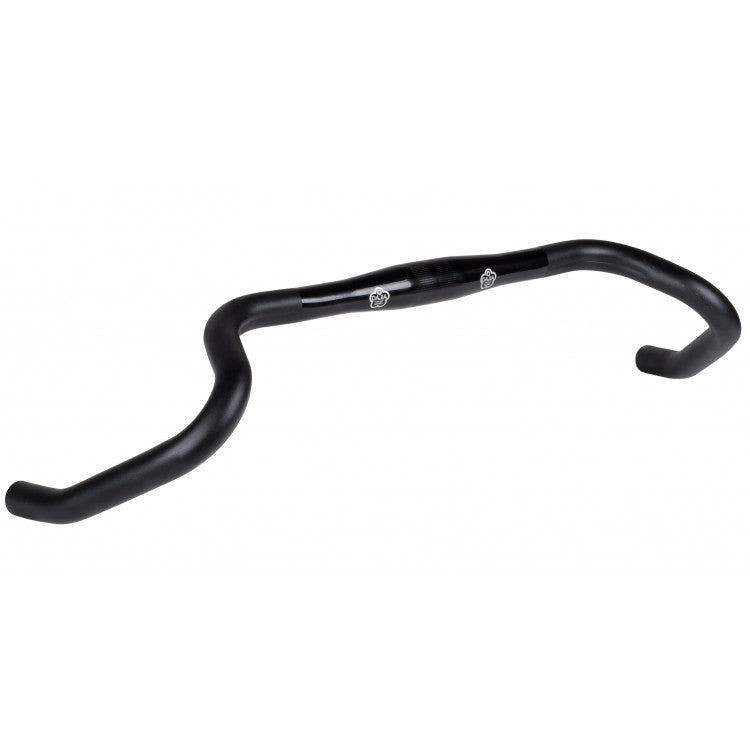
If you want to try some different handlebars I have these on 2 of my bikes - multiple comfortable positions and lots of leverage (because of the flare) - gives a solid sense of control from the drops.
https://velo-orange.com/collections/...-bar-handlebar
$54
https://velo-orange.com/collections/...-bar-handlebar
$54
02-24-19 | 11:13 PM
#11
Thread Starter
Full Member
Joined: May 2015
Posts: 396
Likes: 70
From: Oceanside, CA
Bikes: 2017 Lynskey Sportive Disc, 2021 Lynskey Pro29, 1977 Schwinn Super LeTour 12.2
I wound up getting a fairly traditional-flare bar with long reach (95) and a shallow (124) drop, so I could lengthen things out, while still using the short stem to leave room for a front bag. Just got it together today. Report to follow.

02-26-19 | 10:25 AM
#13
Senior Member
Joined: Mar 2018
Posts: 966
Likes: 215
Bikes: 2015 Spec. AWOL Elite,2022 Spec. Diverge, 1984 Trek 620 1985 Trek 620, 1979 Trek 710
I wound up getting a fairly traditional-flare bar with long reach (95) and a shallow (124) drop, so I could lengthen things out, while still using the short stem to leave room for a front bag. Just got it together today. Report to follow.
Which front rack do you have and did you have to bend the rack struts to line-up with the mid-fork mounts?
02-26-19 | 11:02 AM
#14
Thread Starter
Full Member
Joined: May 2015
Posts: 396
Likes: 70
From: Oceanside, CA
Bikes: 2017 Lynskey Sportive Disc, 2021 Lynskey Pro29, 1977 Schwinn Super LeTour 12.2
Rawland Radioverks rando rack. Same manufacturer as the bike, so it went on pretty smoothly. The only issue, potentially, is that the stays on the bottom poke up a little high, but it hasn't been an issue with my Ozette bag.
03-08-19 | 04:31 AM
#15
Senior Member

Joined: Dec 2013
Posts: 2,084
Likes: 339
One factor not yet specified is bar width. High trail bikes want wider bars, for "leverage" as one poster above puts it. Low trail you don't need or want leverage. It's more about letting the bike go and less about making it respond.
Also want to say the rearward position of saddle is just fine. With a lot of years and a lot of miles behind me I can remember decades when everyone automatically shoved the saddle as far back as it would go. Everyone from the pros to the guy assembling bikes in back of the LBS. Don't recall any breakage. Mine have always been all the way back and no problems ever.
Also want to say the rearward position of saddle is just fine. With a lot of years and a lot of miles behind me I can remember decades when everyone automatically shoved the saddle as far back as it would go. Everyone from the pros to the guy assembling bikes in back of the LBS. Don't recall any breakage. Mine have always been all the way back and no problems ever.
03-08-19 | 07:40 AM
#16
Randomhead
Joined: Aug 2008
Posts: 25,931
Likes: 4,824
From: Happy Valley, Pennsylvania
I suppose everyone's experience is different, but I have seen other riders break saddles twice. Once on a 300k and once on a 1200k. It's not a lot of fun on a 1200k, something permanent needs to be done in that case. On a 300k, I probably would just move the broken rail forward until both parts of the rail are supported. I gave the rider on the 300k a giant wire tie and she used it to keep the front of the saddle down. I'm pretty sure that saddle had steel rails. I think that a setback seatpost is a good idea.
03-08-19 | 10:36 AM
#17

Senior Member
Joined: Aug 2011
Posts: 22,682
Likes: 2,640
From: CID
Bikes: 1991 Bianchi Eros, 1964 Armstrong, 1988 Diamondback Ascent, 1988 Bianchi Premio, 1987 Bianchi Sport SX, 1980s Raleigh mixte (hers), All-City Space Horse (hers)
Given that a lot of riders are going to be using Brooks saddles, I don't get why mass-market steel frame makers use such steep seat tube angles. 73-74° for the xSogn? Why not 72-73°, or even less? If you want a super-forward position, there are no end of straight seatposts and saddles that will easily get you there.
03-08-19 | 01:11 PM
#19
Senior Member
Joined: Aug 2011
Posts: 22,682
Likes: 2,640
From: CID
Bikes: 1991 Bianchi Eros, 1964 Armstrong, 1988 Diamondback Ascent, 1988 Bianchi Premio, 1987 Bianchi Sport SX, 1980s Raleigh mixte (hers), All-City Space Horse (hers)

Even on my average-sized frames, my Brooks is as far back as it can go -- if I ever get a custom frame, it'll have a 72° seat tube.
 03-08-19 | 02:30 PM
#21
Senior Member
Joined: Aug 2011
Posts: 22,682
Likes: 2,640
From: CID
Bikes: 1991 Bianchi Eros, 1964 Armstrong, 1988 Diamondback Ascent, 1988 Bianchi Premio, 1987 Bianchi Sport SX, 1980s Raleigh mixte (hers), All-City Space Horse (hers)
Every so often I'll try that, since it would solve the whole problem. I keep coming back to something between an "Eddy" and "French" fit where the weight is further back, though.

Thread
Thread Starter
Forum
Replies
Last Post
aniki
General Cycling Discussion
9
03-26-19 12:25 PM
Road Fan
Long Distance Competition/Ultracycling, Randonneuring and Endurance Cycling
31
05-18-10 10:58 PM
