


Trek Di2 Pricing
 01-17-19 | 03:22 PM
#1
Thread Starter
Junior Member
Joined: May 2013
Posts: 12
Likes: 0
Trek Di2 Pricing
I'm looking to buy a Madone SLR 7 Disc (Ultegra di2 8070). But it is $1500 higher than the SLR 6 Disc (Ultegra mechanical) with everything spec'ed exactly the same.
The difference is the same when you go from Ultegra mechanical to Di2 in all their high end bikes with everything else spec'ed the same. That just sounds crazy to me since you can buy an entire Ultegra di2 groupset for less than $1700 and around $1400 on Ebay. Canyon only charges $600 premium when you go from mechanical Ultegra to di2.
Am I crazy or is Trek ripping their customers off on electronic groupsets?
The difference is the same when you go from Ultegra mechanical to Di2 in all their high end bikes with everything else spec'ed the same. That just sounds crazy to me since you can buy an entire Ultegra di2 groupset for less than $1700 and around $1400 on Ebay. Canyon only charges $600 premium when you go from mechanical Ultegra to di2.
Am I crazy or is Trek ripping their customers off on electronic groupsets?
 01-17-19 | 04:09 PM
#3
Thread Starter
Junior Member
Joined: May 2013
Posts: 12
Likes: 0
No. I upgraded the SLR 6 to the Aeoplus Pro 5 Disc in the Project One so like I said Everything else is the same. If I don't upgrade the wheels there's a $2000 difference between the two.
01-17-19 | 04:19 PM
#4
Senior Member
Joined: Jul 2018
Posts: 157
Likes: 16
From: Annapolis, MD
Bikes: BMC Teammachine SLR02 Disc, Cannondale CAAD 4
I'm getting ready to buy a BMC Teammachine Di2 bike. The same bike w/ mechanical Ultegra (and cheaper wheels) is $1000 less. Sounds like Trek is charging a bit more.
01-17-19 | 04:40 PM
#5

Senior Member

Joined: Jan 2010
Posts: 39,726
Likes: 9,738
From: TC, MN
Bikes: R3 Disc, Haanjo
Ah. you didn't mention that in the OP.
So don't buy it. Or buy the mech, upgrade the group and sell the take-offs to partially fund the swap.
So don't buy it. Or buy the mech, upgrade the group and sell the take-offs to partially fund the swap.
01-17-19 | 06:37 PM
#6

Advocatus Diaboli

Joined: Feb 2015
Posts: 9,146
Likes: 1,738
From: Wherever I am
Bikes: Merlin Cyrene, Nashbar steel CX
Yeah.. we've had this discussion previously. The gist is that if you want Di2, the manufacturers change a bunch of other stuff of questionable actual value and then add a huge markup; the consumer left wondering what actually changes the price by what it has. It's all marketing.
eg.
https://www.cannondale.com/en/USA/Bi...5-0ae578fa94d3
vs
https://www.cannondale.com/en/USA/Bi...f-8958dca22444
eg.
https://www.cannondale.com/en/USA/Bi...5-0ae578fa94d3
vs
https://www.cannondale.com/en/USA/Bi...f-8958dca22444
01-17-19 | 07:06 PM
#7
Senior Member

Joined: Jul 2007
Posts: 8,625
Likes: 3,541
From: South shore, L.I., NY
Bikes: Trek Emonda SL7, Cannondale Topstone, Miyata City Liner, Specialized Chisel, Specialized Epic Evo
I'm looking to buy a Madone SLR 7 Disc (Ultegra di2 8070). But it is $1500 higher than the SLR 6 Disc (Ultegra mechanical) with everything spec'ed exactly the same.
The difference is the same when you go from Ultegra mechanical to Di2 in all their high end bikes with everything else spec'ed the same. That just sounds crazy to me since you can buy an entire Ultegra di2 groupset for less than $1700 and around $1400 on Ebay. Canyon only charges $600 premium when you go from mechanical Ultegra to di2.
Am I crazy or is Trek ripping their customers off on electronic groupsets?
The difference is the same when you go from Ultegra mechanical to Di2 in all their high end bikes with everything else spec'ed the same. That just sounds crazy to me since you can buy an entire Ultegra di2 groupset for less than $1700 and around $1400 on Ebay. Canyon only charges $600 premium when you go from mechanical Ultegra to di2.
Am I crazy or is Trek ripping their customers off on electronic groupsets?
 01-17-19 | 07:23 PM
#8

I eat carbide.


Joined: Jan 2006
Posts: 21,678
Likes: 1,417
From: Elgin, IL
Bikes: Lots. Chapter2, Van Dessel, Giant, Trek, etc Dealers for BMC, Chapter2
Reflects more about what the different groups pricing levels are to them at OEM.
This is another example of a consumer thought process behavior that always seems to make sense to the consume but leaves the retailer scratching their head.
The short of it: If you want it, buy it. If you don't then don't. I think you'll find inventory and availability issues more with the Di2 options but let's say you don't and you feel you can get the mechanical then buy the Di2 aftermarket and save overall then go for it. It works for you. It works for them. They still sold you a bike.
What it isn't - it's not a window into some sort of nefarious scheme whereby Trek was planning on flossing every customer ever and now you've spoiled it and exposed them for the outrageous corporate drones they are.
Long Examples and discussion:
Pricing. I have written a lot in this forum over the years pertaining to pricing models. One of the worst problems with US retail or businesses in general is that many take the old "cost plus" model of pricing. This is the model that most consumers actually believe is the basis of establishing a retail price. It isn't always and honestly should never be. Prices should be set at the level customers see value at in the market. That natural sweet spot of price to units sold that we all remember from the "guns and butter" graphs in basic Econ. Those models never talked "cost". The reality is if the value in the market for a product is $5 and at that price the seller is selling the amount of units/volume they desire then that's what the price should be. If it costs them $5.01 to manufacture the product then they have a problem. If it costs them $1 then they have a seemingly good position. That's the basics.
Problems with market pricing: when it's taken advantage of in markets with need based in human survival that can't be satisfied through competition. Food, medication, etc. but meh - not my discussion and this is bike parts.
Reality though is that most arrive at their pricing models through a combination of cost plus and market pricing. Example from my business: let's say I have a wheelset and the cost side is such that when I put the margin on it that I need to get in order to survive it results in a weird number - $1404. Market pricing would push me towards making that price $1399. At the same time if it's sitting at $1362..... $1399 looks better and consumer behavior is such that it will be interpreted as the same price to most. Sometimes you win sometimes you lose.
Right now a couple of armchair economists who are actually engineers are pulling their hair out at the idea that pricing isn't simply a set equation for every situation.
What really goes wrong with the situation I described in the last example is that there isn't that incremental "component parity" that was the cause of the initial post. What I mean is that while it is easy to see in the one situation how I could easily round the price to $1399 because it looks better, has a proven psychological effect on shoppers, maximizes market value, etc. it could cause the "component upgrade price" of let's say the hubs to not match at this level in the same way they would at a price point that is roughly half.
Try at an example: Option 1 with brand X component = $1199. Option 2 with brand Y is $1399. Incremental component upgrade cost is $200.
Now let's change something major about the configuration of the product. If it was wheels let's go from carbon to alloy rims. If it's bikes then from a carbon to an alloy frame as an example.
Option 3 with brand X components = $649. Option 4 with Brand Y is $749. Now in this example the incremental component upgrade cost is $100. Same component difference as above. What's changes is the underlying cost structure of the package has roughly halved. Half your cost structure but apply the same markup % to get the same margin % after the sale and you will see this happen. It can be a royal PITA to keep parity in these upgrade pricing differentials AND preserve final pricing structure. Damn near full time job.
In order to preserve parity you have to either undercharge for the upgrade at the high level frame/rim or overcharge for the same upgrade at the lower price point configuration. You have to let your customers and the market be your guide.
In the original post - I am sure its a difference in cost structure for the component upgrade that bears no direct relation to what you are seeing as the retail price for the group through outlets selling off of MSRP. There are so many factors at play when setting pricing on an assembly that the retail price through internet brokers of some of the component parts aftermarket after you've already had the bike on the market is meaningless.
As a result some of this pricing disparity can happen and seem weird to those on the outside.
This is another example of a consumer thought process behavior that always seems to make sense to the consume but leaves the retailer scratching their head.
The short of it: If you want it, buy it. If you don't then don't. I think you'll find inventory and availability issues more with the Di2 options but let's say you don't and you feel you can get the mechanical then buy the Di2 aftermarket and save overall then go for it. It works for you. It works for them. They still sold you a bike.
What it isn't - it's not a window into some sort of nefarious scheme whereby Trek was planning on flossing every customer ever and now you've spoiled it and exposed them for the outrageous corporate drones they are.
Long Examples and discussion:
Pricing. I have written a lot in this forum over the years pertaining to pricing models. One of the worst problems with US retail or businesses in general is that many take the old "cost plus" model of pricing. This is the model that most consumers actually believe is the basis of establishing a retail price. It isn't always and honestly should never be. Prices should be set at the level customers see value at in the market. That natural sweet spot of price to units sold that we all remember from the "guns and butter" graphs in basic Econ. Those models never talked "cost". The reality is if the value in the market for a product is $5 and at that price the seller is selling the amount of units/volume they desire then that's what the price should be. If it costs them $5.01 to manufacture the product then they have a problem. If it costs them $1 then they have a seemingly good position. That's the basics.
Problems with market pricing: when it's taken advantage of in markets with need based in human survival that can't be satisfied through competition. Food, medication, etc. but meh - not my discussion and this is bike parts.
Reality though is that most arrive at their pricing models through a combination of cost plus and market pricing. Example from my business: let's say I have a wheelset and the cost side is such that when I put the margin on it that I need to get in order to survive it results in a weird number - $1404. Market pricing would push me towards making that price $1399. At the same time if it's sitting at $1362..... $1399 looks better and consumer behavior is such that it will be interpreted as the same price to most. Sometimes you win sometimes you lose.
Right now a couple of armchair economists who are actually engineers are pulling their hair out at the idea that pricing isn't simply a set equation for every situation.
What really goes wrong with the situation I described in the last example is that there isn't that incremental "component parity" that was the cause of the initial post. What I mean is that while it is easy to see in the one situation how I could easily round the price to $1399 because it looks better, has a proven psychological effect on shoppers, maximizes market value, etc. it could cause the "component upgrade price" of let's say the hubs to not match at this level in the same way they would at a price point that is roughly half.
Try at an example: Option 1 with brand X component = $1199. Option 2 with brand Y is $1399. Incremental component upgrade cost is $200.
Now let's change something major about the configuration of the product. If it was wheels let's go from carbon to alloy rims. If it's bikes then from a carbon to an alloy frame as an example.
Option 3 with brand X components = $649. Option 4 with Brand Y is $749. Now in this example the incremental component upgrade cost is $100. Same component difference as above. What's changes is the underlying cost structure of the package has roughly halved. Half your cost structure but apply the same markup % to get the same margin % after the sale and you will see this happen. It can be a royal PITA to keep parity in these upgrade pricing differentials AND preserve final pricing structure. Damn near full time job.
In order to preserve parity you have to either undercharge for the upgrade at the high level frame/rim or overcharge for the same upgrade at the lower price point configuration. You have to let your customers and the market be your guide.
In the original post - I am sure its a difference in cost structure for the component upgrade that bears no direct relation to what you are seeing as the retail price for the group through outlets selling off of MSRP. There are so many factors at play when setting pricing on an assembly that the retail price through internet brokers of some of the component parts aftermarket after you've already had the bike on the market is meaningless.
As a result some of this pricing disparity can happen and seem weird to those on the outside.
__________________
PSIMET Wheels, PSIMET Racing, PSIMET Neutral Race Support, and 11 Jackson Coffee
Podcast - YouTube Channel
Video about PSIMET Wheels
Podcast - YouTube Channel
Video about PSIMET Wheels
01-17-19 | 08:04 PM
#9
Advocatus Diaboli
Joined: Feb 2015
Posts: 9,146
Likes: 1,738
From: Wherever I am
Bikes: Merlin Cyrene, Nashbar steel CX
It's interesting.. take another product type like SLR cameras.. offered body alone, or sometimes packaged with 1 or 2 lenses. You get the lens kit, and you pay less than if you bought everything separate. The more you add to a bike, the more the markup is, and the more it costs above buying everything separately yourself.
01-17-19 | 08:19 PM
#10
Thread Starter
Junior Member
Joined: May 2013
Posts: 12
Likes: 0
Yes, odd pricing. My local shop website shows a $1700 difference between an SL6 Disc Di2 and the SL7 Disc Di2. It would be cost effective to purchase the SL6 and the 8070 Di2 7 piece upgrade kit for $1200, than E-Bay the mechanical parts. Better wheels on the SL7 though
Thanks!
01-17-19 | 08:54 PM
#11
Senior Member
Joined: Jul 2007
Posts: 8,625
Likes: 3,541
From: South shore, L.I., NY
Bikes: Trek Emonda SL7, Cannondale Topstone, Miyata City Liner, Specialized Chisel, Specialized Epic Evo
If you are in NYC they are a block from the Wantagh LIRR station. Good shop, good people.
And note the Di2 upgrade price is from Texas Cyclesport.
01-17-19 | 09:03 PM
#12
Thread Starter
Junior Member
Joined: May 2013
Posts: 12
Likes: 0
Thanks! I googled the 7 piece kit and saw it on Texas Cyclesport. The problem is it's difficult to know the cable length and type of cables needed. I might have to talk to the bike shop and see if they can help in ordering the upgrade kit.
01-17-19 | 09:05 PM
#13


Senior Member
Joined: Jun 2004
Posts: 3,164
Likes: 578
From: Torrance, CA
Bikes: Homebuilt steel
Same with cars; buy the higher trim model and get some nifty features but pay a bunch more. I worked for an auto OEM and our profit soared when people bought the high trim packages.
01-18-19 | 06:41 AM
#16
Advocatus Diaboli
Joined: Feb 2015
Posts: 9,146
Likes: 1,738
From: Wherever I am
Bikes: Merlin Cyrene, Nashbar steel CX
Curious on this... didn't they also need to clear out the mech versions for the new model year? Or just random situation that all the mech had already sold out? Or they discounted heavily the Di2 but not the mech?
01-18-19 | 10:11 AM
#18
Thread Starter
Junior Member
Joined: May 2013
Posts: 12
Likes: 0
Anyone got any sort of discount for 2019 Madone SLR?
01-18-19 | 11:03 AM
#19
Senior Member
Joined: Jul 2007
Posts: 8,625
Likes: 3,541
From: South shore, L.I., NY
Bikes: Trek Emonda SL7, Cannondale Topstone, Miyata City Liner, Specialized Chisel, Specialized Epic Evo
As well price an upgrade at the shop. You will likely need a shop to get the b-bracket pulled so as to run cables, then reinstalled. As well maybe help with hydro brake install
01-18-19 | 11:05 AM
#20

Voice of the Industry
Joined: May 2007
Posts: 12,572
Likes: 8
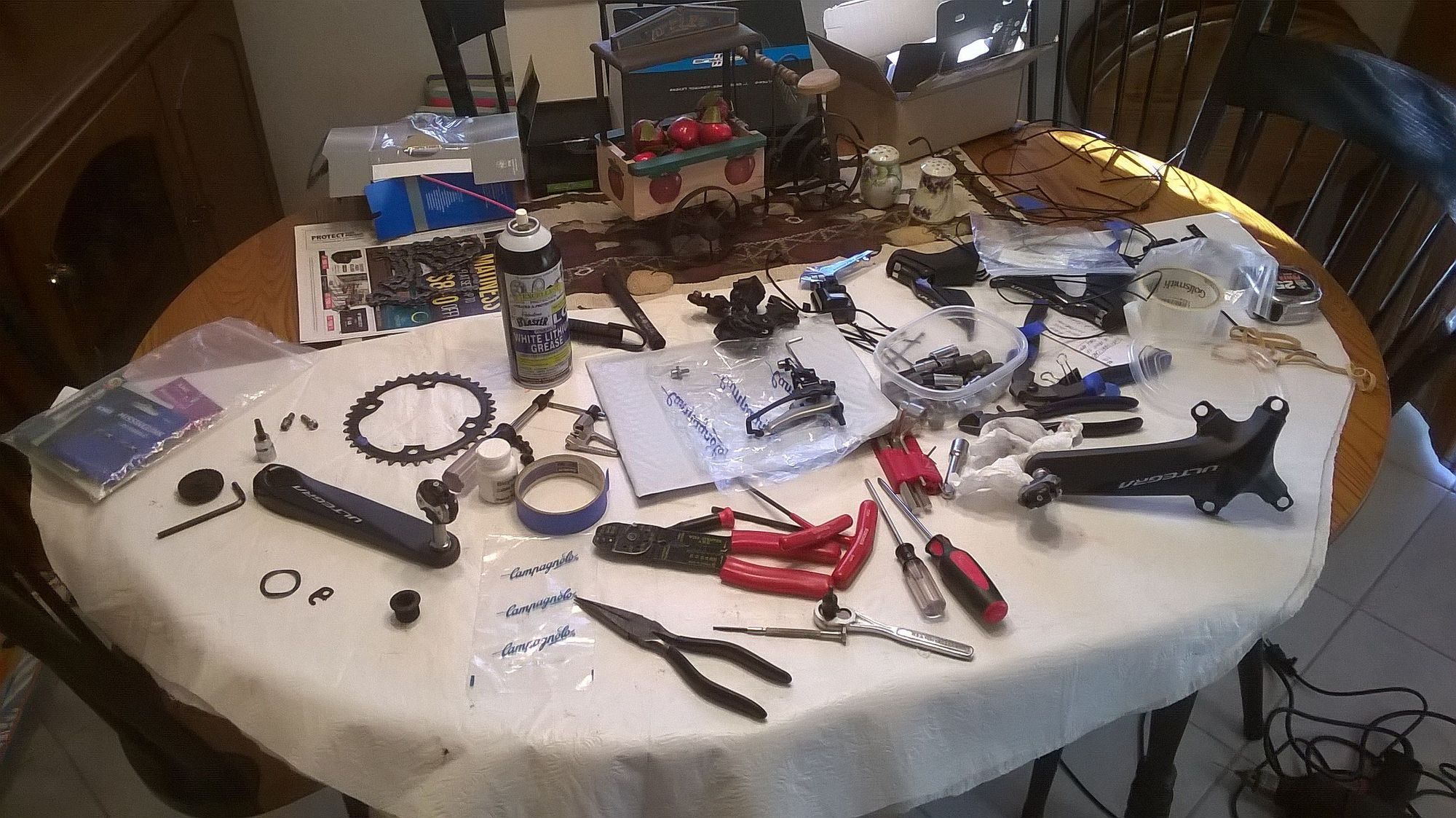
$8K is superbike territory. You can build an uber high end bike for that amount of cheddar.
Wheels of your choosing with custom hubs. Madone frame because you want one...but lots of other great frames out there too.
Saddle of choice. Handlebar of choice. Everything down to bar tape.
But maybe you don't know that stuff. I hope you have your sizing nailed.
PS: the table of an insufferable bike guy (me) converting between Di2 and Campy mechanical. Won't tell you which direction I went.

Last edited by Campag4life; 01-18-19 at 11:19 AM.
01-18-19 | 01:10 PM
#22

Senior Member
Joined: Mar 2010
Posts: 23,208
Likes: 10,653
From: Seattle, WA
I bet there's still some previous generation out on the floor feeling lonely.
01-18-19 | 03:47 PM
#23
Senior Member
Joined: Aug 2014
Posts: 2,433
Likes: 413
The mech was discounted too. I didn't know that yet and had budgeted for the mech version. I walked in asking to test ride it, and they offered Di2 for a hair more. I hadn't used it yet but had only heard great things. So I opted for more bike instead of less money.
I bet there's still some previous generation out on the floor feeling lonely.
I bet there's still some previous generation out on the floor feeling lonely.
01-18-19 | 04:12 PM
#24
Senior Member
Joined: Sep 2014
Posts: 595
Likes: 125
From: Southern California
Bikes: Bianchi Oltre XR4 Celeste, De Rosa SK Pininfarina, Giant TCR SL, Giant Revolt Advanced Revolt 0 Gravel Bike, Trek Madone SLR, Cervelo R5 Disk
I'm looking to buy a Madone SLR 7 Disc (Ultegra di2 8070). But it is $1500 higher than the SLR 6 Disc (Ultegra mechanical) with everything spec'ed exactly the same.
The difference is the same when you go from Ultegra mechanical to Di2 in all their high end bikes with everything else spec'ed the same. That just sounds crazy to me since you can buy an entire Ultegra di2 groupset for less than $1700 and around $1400 on Ebay. Canyon only charges $600 premium when you go from mechanical Ultegra to di2.
Am I crazy or is Trek ripping their customers off on electronic groupsets?
The difference is the same when you go from Ultegra mechanical to Di2 in all their high end bikes with everything else spec'ed the same. That just sounds crazy to me since you can buy an entire Ultegra di2 groupset for less than $1700 and around $1400 on Ebay. Canyon only charges $600 premium when you go from mechanical Ultegra to di2.
Am I crazy or is Trek ripping their customers off on electronic groupsets?
Having said that, I saved close to $3K building my Madone with Dura Ace 9150, Bontrager XXX-6 wheels, and aero two piece cockpit.

Thread
Thread Starter
Forum
Replies
Last Post
hunkim
Bicycle Mechanics
0
02-27-15 05:07 PM
