


Truth about clipless pedals.
 07-09-13 | 11:35 AM
#226

Tour De French Fries
Joined: Apr 2012
Posts: 1,251
Likes: 2
From: Salt Lake City
Bikes: 2010 Cervelo R3 SL & 2013 Airborne Goblin
This is what i notice too. If i start cramping i will pull more probably almost 70(push)/30(pull) ratio w/o having to sacrifice speed while giving my muscles a reprieve.
Last edited by Elduderino2412; 07-09-13 at 11:39 AM.
 07-09-13 | 11:40 AM
#227

Senior Member

Joined: Jul 2002
Posts: 40,863
Likes: 3,115
From: Sacramento, California, USA
Bikes: Specialized Tarmac, Canyon Exceed, Specialized Transition, Ellsworth Roots, Ridley Excalibur
Thanks for the reminder about CX. Particularly SSCX, where there are many short stretches where it absolutely would be impossible to turn the pedals over without pulling on the upstroke. In fact, my avatar picture
<=============
was taken at a race last fall on an old golf course, which made great use out of the old sand traps. That absolutely required an upstroke pull.
<=============
was taken at a race last fall on an old golf course, which made great use out of the old sand traps. That absolutely required an upstroke pull.
Last edited by caloso; 07-09-13 at 12:53 PM.
07-09-13 | 11:58 AM
#228


At this point, all I can say is "wait until pedal-based power meters are commercialized." Granted, most people on BF will not run their own studies with rigorous protocols. But at least you will be able to see what actually happens when you are standing on a climb.
07-09-13 | 12:09 PM
#229

Descends like a rock
Joined: Oct 2010
Posts: 4,034
Likes: 16
From: Fort Worth, TX
Bikes: Scott Foil, Surly Pacer
Most of the sites I went to required a log in. I found one that let me in temporarily, but when I went back, it asked me to log in. As fun as this has been, I'm not paying to look this stuff up. In fact, even if it was free, I don't care enough either. 
07-09-13 | 12:51 PM
#230
Senior Member
Joined: May 2011
Posts: 1,421
Likes: 1
From: NoVA
Bikes: Specialized Allez Sport
How is it possible that someone could post nearly 6,000 times on a bicycle forum and never encounter a steep hill on a bicycle? I ride on hills that are steep enough that my body weight won't produce enough force to keep the crank turning in low gear (more frequent on mountain biking trails than on the road, but it occurs in both places). What would be the right thing to do there? Roll back down the hill, or apply some additional force by levering against the handlebars and pulling in both directions (up and down) on the crank?
07-09-13 | 02:27 PM
#231
Yay, I seem to have found a public copy of the Korff paper. Have at it. 
https://img2.tapuz.co.il/forums/1_168859045.pdf
At the risk of oversimplifying, the key diagram is this one, drumroll please....
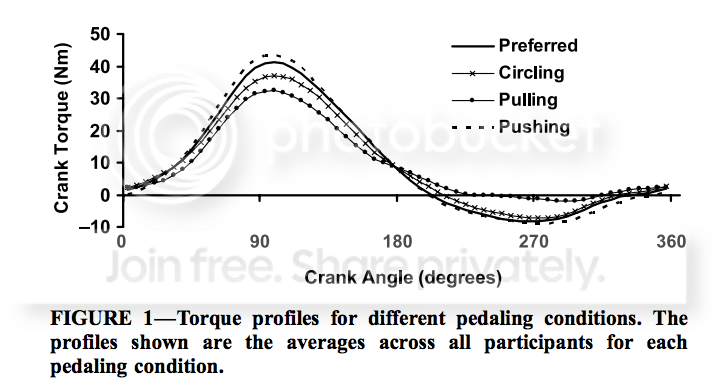
This was (as noted) a steady-state effort at 200W.
What you will hopefully notice is:
• You don't supply constant torque during a pedal stroke.
• Intentionally pulling on the upstroke reduces the power output on the downstroke.
• Even when pulling up hard on the upstroke, the rider still barely produces positive torque on the upstroke.
• The general shape of the graph ought to look familiar by now.
The power advantage is that intentionally pulling on the upstroke lifts the leg more successfully. Thus, the other leg doesn't waste as much power on the downstroke, because it doesn't have to do as much work lifting the leg.
This, I suspect, is the type of evidence that leads Pruitt to say "no one supplies power on the upstroke, including top track sprinters @ 130rpm."
https://img2.tapuz.co.il/forums/1_168859045.pdf
At the risk of oversimplifying, the key diagram is this one, drumroll please....
This was (as noted) a steady-state effort at 200W.
What you will hopefully notice is:
• You don't supply constant torque during a pedal stroke.
• Intentionally pulling on the upstroke reduces the power output on the downstroke.
• Even when pulling up hard on the upstroke, the rider still barely produces positive torque on the upstroke.
• The general shape of the graph ought to look familiar by now.
The power advantage is that intentionally pulling on the upstroke lifts the leg more successfully. Thus, the other leg doesn't waste as much power on the downstroke, because it doesn't have to do as much work lifting the leg.
This, I suspect, is the type of evidence that leads Pruitt to say "no one supplies power on the upstroke, including top track sprinters @ 130rpm."
07-09-13 | 02:34 PM
#233
Senior Member
Joined: May 2002
Posts: 10,123
Likes: 4
From: Near Portland, OR
Bikes: Three road bikes. Two track bikes.
[MENTION=37529]Bacciagalupe[/MENTION]
I think you are missing the point. Yes, at 130rpm, when I am track sprinting, I am not supplying much upstroke if any. In fact, there is not much torque at all at 130rpm. On the other hand, when I am accelerating from walking pace to 40mph, yes, I am pulling on my pedals. So much so that I don't trust clipless to stay clipped and I rely on an aluminum slotted cleat and two leather and plastic laminated straps pulled so tight my toes go numb.
The power advantage is I can push with my quads and glutes while simultaneously pulling with my hamstrings and avoid pulling my hands off my bars.
People keep talking about acceleration and torque production and you keep pushing graphs about steady state on us. Just what are you trying to accomplish with this?
I think you are missing the point. Yes, at 130rpm, when I am track sprinting, I am not supplying much upstroke if any. In fact, there is not much torque at all at 130rpm. On the other hand, when I am accelerating from walking pace to 40mph, yes, I am pulling on my pedals. So much so that I don't trust clipless to stay clipped and I rely on an aluminum slotted cleat and two leather and plastic laminated straps pulled so tight my toes go numb.
The power advantage is I can push with my quads and glutes while simultaneously pulling with my hamstrings and avoid pulling my hands off my bars.
People keep talking about acceleration and torque production and you keep pushing graphs about steady state on us. Just what are you trying to accomplish with this?
__________________
Cat 2 Track, Cat 3 Road.
"If you’re new enough [to racing] that you would ask such question, then i would hazard a guess that if you just made up a workout that sounded hard to do, and did it, you’d probably get faster." --the tiniest sprinter
Cat 2 Track, Cat 3 Road.
"If you’re new enough [to racing] that you would ask such question, then i would hazard a guess that if you just made up a workout that sounded hard to do, and did it, you’d probably get faster." --the tiniest sprinter
Last edited by Brian Ratliff; 07-09-13 at 02:39 PM.
07-09-13 | 02:42 PM
#234
Senior Member


Joined: Jun 2008
Posts: 9,201
Likes: 289
From: Vancouver, BC
Yay, I seem to have found a public copy of the Korff paper. Have at it.
https://img2.tapuz.co.il/forums/1_168859045.pdf
At the risk of oversimplifying, the key diagram is this one, drumroll please....
This was (as noted) a steady-state effort at 200W.
What you will hopefully notice is:
• You don't supply constant torque during a pedal stroke.
• Intentionally pulling on the upstroke reduces the power output on the downstroke.
• Even when pulling up hard on the upstroke, the rider still barely produces positive torque on the upstroke.
• The general shape of the graph ought to look familiar by now.
The power advantage is that intentionally pulling on the upstroke lifts the leg more successfully. Thus, the other leg doesn't waste as much power on the downstroke, because it doesn't have to do as much work lifting the leg.
This, I suspect, is the type of evidence that leads Pruitt to say "no one supplies power on the upstroke, including top track sprinters @ 130rpm."
https://img2.tapuz.co.il/forums/1_168859045.pdf
At the risk of oversimplifying, the key diagram is this one, drumroll please....
This was (as noted) a steady-state effort at 200W.
What you will hopefully notice is:
• You don't supply constant torque during a pedal stroke.
• Intentionally pulling on the upstroke reduces the power output on the downstroke.
• Even when pulling up hard on the upstroke, the rider still barely produces positive torque on the upstroke.
• The general shape of the graph ought to look familiar by now.
The power advantage is that intentionally pulling on the upstroke lifts the leg more successfully. Thus, the other leg doesn't waste as much power on the downstroke, because it doesn't have to do as much work lifting the leg.
This, I suspect, is the type of evidence that leads Pruitt to say "no one supplies power on the upstroke, including top track sprinters @ 130rpm."
Unfortunately, I've not been able to find any studies showing sprint power with independent pedal measurements. There are numerous studies using an SRM sampling up to 200Hz but it always shows the combined left&right torque power. Interestingly though they do find that sprinters are putting out ~300W when the pedals are at 180 degrees (i.e. vertical). I suspect that would be difficult to do on clipless without risk of slipping off the pedals.
I'm not sure if I've heard a good answer to why track sprinters use clipless and straps. Seems unnecessary if they aren't pulling up with any force.
07-09-13 | 02:48 PM
#235
Senior Member
Joined: May 2002
Posts: 10,123
Likes: 4
From: Near Portland, OR
Bikes: Three road bikes. Two track bikes.
Also, 200W is small beans. I'm curious what 500+W looks like.
__________________
Cat 2 Track, Cat 3 Road.
"If you’re new enough [to racing] that you would ask such question, then i would hazard a guess that if you just made up a workout that sounded hard to do, and did it, you’d probably get faster." --the tiniest sprinter
Cat 2 Track, Cat 3 Road.
"If you’re new enough [to racing] that you would ask such question, then i would hazard a guess that if you just made up a workout that sounded hard to do, and did it, you’d probably get faster." --the tiniest sprinter
07-09-13 | 02:49 PM
#236
Edmund Burke, who trained Olympic cyclists, wrote several books on cycling techniques, and competed several times in the Leadville 100 and did the 24 Hours of Moab, was an "inexperienced academic?"
You are committing the primary amateur sin of extrapolating data outside the context of the study. The data in the study addresses only the parameters tested in the study. There are many different types of pedal strokes a cyclist might use....
And yes, it is possible that something different could happen when you're anaerobic, or if you've spent 6 months adapting to that particular pedal style. If someone actually runs a study like that, we can use that to update our beliefs. Until then, I see no real reason to believe that it's going to result in a drastic difference in the results.
Your body is a sensor, if you care to pay attention.
You don't get to throw around data like it's Christmas then claim a conclusion built on an unsupported extrapolation.
I am specifically pointing out that even with foot retention, you are not providing power to the drivetrain on the upstroke.
I don't feel bad about speculating that many cyclists may not need foot retention, nor does any speculation on that point alter the truth of anything I've said here.
You have heard plenty of contrary data.
I'm happy to read objective evidence that supports any position. But so far, I am the only person linking to any objective evidence here.
07-09-13 | 02:55 PM
#237

I'm doing it wrong.
Joined: Jun 2009
Posts: 4,875
Likes: 2,814
Bikes: Rivendell Appaloosa, Rivendell Frank Jones Sr., Trek Fuel EX9, Kona Jake the Snake CR, Niner Sir9
07-09-13 | 03:04 PM
#238
Descends like a rock
Joined: Oct 2010
Posts: 4,034
Likes: 16
From: Fort Worth, TX
Bikes: Scott Foil, Surly Pacer
Its not evidence when its out of the scope of the discussion. I haven't seen anyone say they disagree with these studies. I certainly don't. I'm saying they don't address the question about hard, burst sprinting and steep climbing. These scenarios are the main reason I use clipless - that and the comfort and convenience of not having to deal with keeping your feet secured.
07-09-13 | 03:10 PM
#239
• Every single graph I've seen, including vector data when standing, indicates that no one actually applies power to the drivetrain on the upstroke. This includes data collected from a variety of average wattages, cadences, inclines, body positions and pedaling styles.
• No one has provided any data based on sprinting which shows otherwise.
• No one has bothered to explain, based on objective data, why sprinting would be so vastly different that it radically changes the apparent biomechanics of the legs.
• Experts in the field like Pruitt and Burke, who do work with a variety of pros from a variety of disciplines, and most certainly have seen sprinters in action, indicate that even those riders don't add power to the drivetrain on the upstroke.
• The claims that "clipless lets you pull on the upstroke" are not limited to discussions of sprinting. (They might be for specific people, but most people who discuss clipless still believe the old wives tale version.)
Also, perhaps you can clarify what would be so radically different about sprinting that would justify ignoring all of the data collected to date?
Unfortunately, I've not been able to find any studies showing sprint power with independent pedal measurements. There are numerous studies using an SRM sampling up to 200Hz but it always shows the combined left&right torque power.
One of these years, pedal-based power meters will be commercially available. Although I'd be skeptical of what Joe Cyclist produces without any rigid protocols, that type of data might still show something useful.
Interestingly though they do find that sprinters are putting out ~300W when the pedals are at 180 degrees (i.e. vertical). I suspect that would be difficult to do on clipless without risk of slipping off the pedals.
I'm not sure if I've heard a good answer to why track sprinters use clipless and straps. Seems unnecessary if they aren't pulling up with any force.
07-09-13 | 03:14 PM
#241

The Weird Beard
Joined: May 2005
Posts: 8,554
Likes: 3
From: COS
I'm curious to know what the end of this thread looks like. I am hoping it is not a mushroom cloud. I'd climb in here and agree with some of both sides, but learned long ago that intense threads only make the big vein in my forehead more prominent.
All I know is that if I pedal hard enough, 1.21 Gigawatts is still out of reach.
All I know is that if I pedal hard enough, 1.21 Gigawatts is still out of reach.
07-09-13 | 03:18 PM
#242

Senior Member
Joined: Aug 2011
Posts: 3,141
Likes: 84
Bacciagalupe, you are bringing data about oranges to an argument about apples. Seriously, I am an arts and letters wimp, but I have enough time in science and research methods classes to know this. You are making yourself look foolish. Live to fight another day.
07-09-13 | 03:23 PM
#243
Senior Member
Joined: Jun 2008
Posts: 9,201
Likes: 289
From: Vancouver, BC
The reason you are getting pushback on the sprinting or hard uphill effort is that most riders who have done those efforts feel themselves pulling up. For me, this is particularly noticeable on a certain hill that gets steeper towards the top. My cadence will slow to 60 or so and during this period I am pulling up hard. At high cadence, even out of the saddle, I suspect you are correct that there isn't much power being applied on the upstroke. I've also pulled out of my pedals when my cleats are worn.
That said, I believe the original premise was that riding clipless did not provide more power. I think that is incorrect as there is plenty of power being applied at the top and bottom of the pedal stroke which would be difficult to achieve with platform pedals.
07-09-13 | 03:37 PM
#244

Prefers Cicero
Joined: Jul 2005
Posts: 12,860
Likes: 146
From: Toronto
Bikes: 1984 Trek 520; 2007 Bike Friday NWT; misc others
I think the weakest part of the circle is around the "10 o'clock" postion where the vector point back at a tangent.Your foot is barely interacting with the pedal here, and in fact the pedal is dragging your foot along. And in post 183, the vectors show no interaction between foot and pedal at the top of the circle- they just happen to be moving in the same direction. When I have switched from cleat to flat pedals, that is where my foot tends to drift off the pedal, for the first day or so until I adapt. Not at "8 o'clock" or "9 o'clock" where you think I'd be pulling up and leaving the pedal behind.
Last edited by cooker; 07-09-13 at 03:48 PM.
07-09-13 | 03:40 PM
#245
Senior Member
Joined: May 2002
Posts: 10,123
Likes: 4
From: Near Portland, OR
Bikes: Three road bikes. Two track bikes.


__________________
Cat 2 Track, Cat 3 Road.
"If you’re new enough [to racing] that you would ask such question, then i would hazard a guess that if you just made up a workout that sounded hard to do, and did it, you’d probably get faster." --the tiniest sprinter
Cat 2 Track, Cat 3 Road.
"If you’re new enough [to racing] that you would ask such question, then i would hazard a guess that if you just made up a workout that sounded hard to do, and did it, you’d probably get faster." --the tiniest sprinter
07-09-13 | 03:41 PM
#246
Senior Member
Joined: May 2002
Posts: 10,123
Likes: 4
From: Near Portland, OR
Bikes: Three road bikes. Two track bikes.
So Andy Pruitt, founder of the Boulder Center for Sports Medicine, an Olympic trainer, who works on the Specialized BG gear, who has worked with pro teams like Saxo Bank, who has worked with thousands of cyclists, is an "inexperienced academic?"
Edmund Burke, who trained Olympic cyclists, wrote several books on cycling techniques, and competed several times in the Leadville 100 and did the 24 Hours of Moab, was an "inexperienced academic?"
Edmund Burke, who trained Olympic cyclists, wrote several books on cycling techniques, and competed several times in the Leadville 100 and did the 24 Hours of Moab, was an "inexperienced academic?"
You're advocating anecdotes over objective evidence, and I'm the one making the "primary amateur sin?" Sweet.
And yes, it is possible that something different could happen when you're anaerobic, or if you've spent 6 months adapting to that particular pedal style. If someone actually runs a study like that, we can use that to update our beliefs. Until then, I see no real reason to believe that it's going to result in a drastic difference in the results.
And yes, it is possible that something different could happen when you're anaerobic, or if you've spent 6 months adapting to that particular pedal style. If someone actually runs a study like that, we can use that to update our beliefs. Until then, I see no real reason to believe that it's going to result in a drastic difference in the results.
Feet do not have built-in strain gauges.
Yet again, I'm not making an anti-clipless argument. I'm not saying clipless is bad, or reduces performance, or will tangle you up in a crash, or will curve your spine.
I am specifically pointing out that even with foot retention, you are not providing power to the drivetrain on the upstroke.
I don't feel bad about speculating that many cyclists may not need foot retention, nor does any speculation on that point alter the truth of anything I've said here.
Make as many speculations as you wish. Everyone's entitled their opinion about cost/benefits. What you are not entitled to is coloring your argument as objective fact when you are forced to disclaim up front that you are extrapolating.
No, I really haven't. All I've seen are anecdotes, and misinterpretations of one study.
I'm happy to read objective evidence that supports any position. But so far, I am the only person linking to any objective evidence here.
__________________
Cat 2 Track, Cat 3 Road.
"If you’re new enough [to racing] that you would ask such question, then i would hazard a guess that if you just made up a workout that sounded hard to do, and did it, you’d probably get faster." --the tiniest sprinter
Cat 2 Track, Cat 3 Road.
"If you’re new enough [to racing] that you would ask such question, then i would hazard a guess that if you just made up a workout that sounded hard to do, and did it, you’d probably get faster." --the tiniest sprinter
07-09-13 | 03:43 PM
#247
Senior Member
Joined: Jul 2011
Posts: 693
Likes: 0
From: Ogden, Utah
Bikes: CAAD 10, Cervelo P2 SL, Focus RG-700, Quintana Roo #101
You've keep on making these statements but in reality, what you don't realize is, control IS power.
If your feet can't stay on the pedal or even slip a little, you are changing your power output.
It'd be nice if you could understand a FBD, but realize that having the net force vector point in a downward direction (or with a component) isn't solely indicating that upstroking is not applying additional force in comparison to having platforms.
Also, what happens in a 1200 Watt sprint? None of your data even indicates over 600 Watts.
If your feet can't stay on the pedal or even slip a little, you are changing your power output.
It'd be nice if you could understand a FBD, but realize that having the net force vector point in a downward direction (or with a component) isn't solely indicating that upstroking is not applying additional force in comparison to having platforms.
Also, what happens in a 1200 Watt sprint? None of your data even indicates over 600 Watts.
Last edited by justkeepedaling; 07-09-13 at 03:48 PM.


 07-09-13 | 03:53 PM
#249
Senior Member
Joined: May 2002
Posts: 10,123
Likes: 4
From: Near Portland, OR
Bikes: Three road bikes. Two track bikes.
You do strike me as the type who never accelerates hard. Might that be coloring your analysis? Have you ever tried to push a big gear without foot retention? Do an experiment: find a 10%+ grade driveway, maybe 10 feet long. Put your bike in the big ring. Try to get up it without foot retention. Report back.
__________________
Cat 2 Track, Cat 3 Road.
"If you’re new enough [to racing] that you would ask such question, then i would hazard a guess that if you just made up a workout that sounded hard to do, and did it, you’d probably get faster." --the tiniest sprinter
Cat 2 Track, Cat 3 Road.
"If you’re new enough [to racing] that you would ask such question, then i would hazard a guess that if you just made up a workout that sounded hard to do, and did it, you’d probably get faster." --the tiniest sprinter
07-09-13 | 03:57 PM
#250
The reason you are getting pushback on the sprinting or hard uphill effort is that most riders who have done those efforts feel themselves pulling up.
Here's one example of how the steady-state data is relevant to your claim. In post #231 , you're looking at a graph of riders who were instructed to intentionally pull up on the pedals. In doing so, they did reduce the negative forces on the upstroke, but still did not go into positive territory.
Now, if you intentionally pull up for 6 minutes, are you never going to feel like you're putting power to the drivetrain? If you hadn't seen the data first, what would you expect?
Can you really determine, just by feel, how many newtons of force you generate on the upstroke?
And again, when you're standing, you're slamming lots of power to the drivetrain on the downstroke -- and, apparently, also weighing down the pedal on the upstroke, and at no point contributing significant forces to the drivetrain on the upstroke. Why isn't that observation relevant to what happens in a sprint or a climb?
That said, I believe the original premise was that riding clipless did not provide more power. I think that is incorrect as there is plenty of power being applied at the top and bottom of the pedal stroke which would be difficult to achieve with platform pedals.
I'm still open to hearing why sprinting would be different. I'm just not seeing it from a biomechanical perspective, and am (obviously) very skeptical of subjective impressions.
I don't think we'll get a real answer until something like the Garmin Vector is out and in use for awhile -- and assuming the software will let users view instantaneous or non-averaged data.