


pedaling efficiency of clipless vs platform tested
 01-06-15 | 05:47 PM
#76
Senior Member

Joined: Jul 2008
Posts: 6,431
Likes: 44
From: Minneapolis, MN
Just foot retention by itself could be enough reason for professional racers to wear clipless.
 01-06-15 | 06:24 PM
#77

just another gosling

Joined: Feb 2007
Posts: 20,555
Likes: 2,667
From: Everett, WA
Bikes: CoMo Speedster 2003, Trek 5200, CAAD 9, Fred 2004
That just proves that there is a belief that there is some advantage somewhere for some reason. Road racers spend craploads of money on lightweight wheels, but it's not a financially sound investment for anyone who's not racing. The difference between $1,000 wheels and $10,000 wheels is worth it for Tour De France riders, but not at all for most people.
Just foot retention by itself could be enough reason for professional racers to wear clipless.
Just foot retention by itself could be enough reason for professional racers to wear clipless.
It's not about the money. It's about getting up the hill faster, even for slowpokes like me. It's totally worth it if you have it.
01-06-15 | 06:56 PM
#78

Administrator

Joined: Feb 2005
Posts: 13,651
Likes: 2,695
From: Delaware shore
Bikes: Cervelo C5, Guru Photon, Waterford, Specialized CX
Exactly. Bicycling isn't about financial investments unless maybe for commuting for some. Bicycling is about fun, sport, adventure, and excitement. If things like lightweight aero wheels, light clipless pedals, aero helmets, etc., increase the fun and you can afford it, good!
01-06-15 | 08:31 PM
#79

Senior Member


Joined: Oct 2014
Posts: 14,159
Likes: 5,285
From: Portland, OR
Bikes: (2) ti TiCycles, 2007 w/ triple and 2011 fixed, 1979 Peter Mooney, ~1983 Trek 420 now fixed and ~1973 Raleigh Carlton Competition gravel grinder
This is funny! Kids in Europe have been racing bikes to go pro and get out of the life as a peasant, the existence of their families for generations, just like inner city kids in this country look to go pro basketball. They are coached by ex-racers who have done the same. This has been going on for more than a century. And long ago, they figured out that a direct connection to the pedal was necessary. Look at the racing photos of the 1890s. You will see cleats and straps pulled tight.
Remember this was before generations of cycling tradition. Also keep in mind the brightest minds on the planet had their sights on bikes. This was before auto, aero and computers. They were building world class drive shaft bikes then. World records were set on them. If platform pedals were faster, they would have switched to them in a flash.
Ben
Remember this was before generations of cycling tradition. Also keep in mind the brightest minds on the planet had their sights on bikes. This was before auto, aero and computers. They were building world class drive shaft bikes then. World records were set on them. If platform pedals were faster, they would have switched to them in a flash.
Ben

 01-06-15 | 10:36 PM
#81

Senior Member


Joined: Nov 2014
Posts: 27,576
Likes: 5,454
From: Eugene, Oregon, USA
Or, perhaps use the old slotted cleats without toeclips to at least help keep the feet from falling off the pedals.
I'm convinced that at lower cadences, a person benefits significantly by pulling up. At higher cadences, one may not. So, the more spinning, the less vital pulling up is. This is in part because at lower cadences, one is running close to the maximum downward force one can generate with 100% of one's weight.
Has racing changed so that people spend more time in the saddle at higher cadences, and less time standing at lower cadences, especially on hills? In that case, it may well be true that for the average ride, flats is just as good.
Now, what about those few minutes that one is hitting 100% of the maximum power output? Perhaps a short but hard hillclimb? Sprint? Those may be the moments where there is a benefit of using every muscle possible in the body, arms, legs, torso, extensors and flexors, pulling, pushing. Squeeze every ounce of aerobic and anaerobic energy out of the body that is possible. The person that looses the sprint, looses the race.
Now, for the every day rider, I don't know.
I've been using toeclips since I was about 10 yrs old. I pass people in flats, and get passed by people in flats. One thing is that I'm never in a steady state. Accelerating after a stop light. A few rolling hills, sometimes skip pedalling. Lots of mini accelerations when a little extra power is nice. And, for me, those power boosts come from the upstroke. Efficient or not, the upstroke is where I inject that little extra power into my routine.
01-06-15 | 10:39 PM
#82


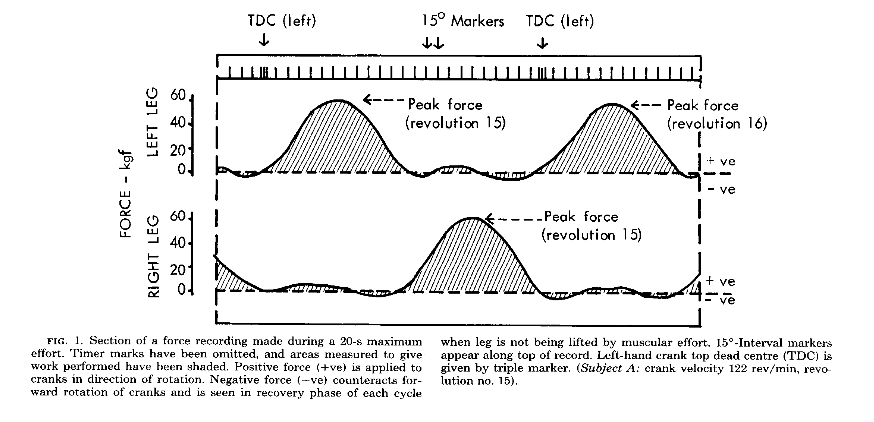

I believe this is the 2nd study I've seen which specifically shows how intentionally pulling up reduces peak power, and still doesn't really get the upstroke into positive territory.
Up and across the bottom and top are all real numbers, less than the downstroke, but quite real.
No one, including top pros, and including track cyclists, are actually applying more than a token amount of power directly to the drivetrain on the upstroke. (cf Book excerpt: The biomechanics of pedaling, from Andy Pruitt?s Complete Medical Guide for Cyclists - VeloNews.com)
Pedaling in circles is good technique, but it's not because that actually applies force to the drivetrain. What you're doing on the upstroke is lifting your leg. For a 175-pound male, a single leg may weigh 10 pounds, and it's gotta get back up to the 12:00 position somehow. Instead of expending some of the force from the downstroke to lift the leg, you're using your leg muscles to lift it.
Foot retention helps, but not because it gets more power to the pedal. Retention lets you maintain contact, have better control of the pedal stroke, and keep your foot in the right spot for your fit.
If you look at the first chart (which is Fig 1 from the study the OP discussed), you'll see that the pros lose less power on the upstroke than the amateurs. And no, you really can't know this is going on without using pedal-based power meters that give you a full graph of independent left- and right-leg power.
01-06-15 | 11:05 PM
#83
Senior Member
Joined: Jun 2008
Posts: 9,201
Likes: 289
From: Vancouver, BC
No one, including top pros, and including track cyclists, are actually applying more than a token amount of power directly to the drivetrain on the upstroke. (cf Book excerpt: The biomechanics of pedaling, from Andy Pruitt?s Complete Medical Guide for Cyclists - VeloNews.com)
01-06-15 | 11:10 PM
#84
Senior Member
Joined: Jun 2008
Posts: 9,201
Likes: 289
From: Vancouver, BC
Yes, but you know what? Any "up power" you're generating on the upstroke is likely be neutralized by taking that same amount of power away from the downstroke on the other side. In other words, it's a ero net-sum "gain". In fact, you might even be losing something in the mix, because I've seen studies (probably posted on this forum- where else?  ) which say that pulling on the upstroke is very power-inefficient.
) which say that pulling on the upstroke is very power-inefficient.
01-07-15 | 01:41 AM
#85
Senior Member
Joined: Nov 2014
Posts: 27,576
Likes: 5,454
From: Eugene, Oregon, USA
I went ahead and marked up the second chart you posted.
Maximum effort, 122 RPM for 20 seconds. That is pretty fast.
And, what do you know. Pushing down with a peak of about 60 kilos force (132 lbs), and pulling up with a peak of about 5 kilos force (11 lbs), or about 8.3% However, it may well be significantly more than that as one can also consider the unloading power (weight of the leg), if he is standing, or close to standing, then that added off-side weight can be more or less added to the on-side weight. Less so if he is sitting, but there may be some reciprocal force even while sitting.
The power stroke is also generating power over just over 50% of the stroke which isn't bad.
Anyway, tell a sprinter that you have a suggestion of increasing their power by about 10%, and do you think they'll ignore you?
How many fancy Titanium parts is that worth?
01-07-15 | 10:07 AM
#86

Old Fart
Joined: Dec 2014
Posts: 3,348
Likes: 3
From: Bumpkinsville
Bikes: '97 Klein Quantum '16 Gravity Knockout
True- but again, it's a zero-net-sum gain, because all they are doing is reducing the resistence of the downstroke pedal; so any gains they make on the upstroke are just making other side's pedal easier to push down on- more force on the upstroke- but less force on the corresponding downstroke. If this weren't so, there'd be a ton of evidence showing substantially performance with clipless. But there is not- and the above is why. It's just simple physics.
01-07-15 | 10:18 AM
#87
Old Fart
Joined: Dec 2014
Posts: 3,348
Likes: 3
From: Bumpkinsville
Bikes: '97 Klein Quantum '16 Gravity Knockout
End of story; no further discussion needed. THAT is the simple truth.
Any other ideas have just been formulated from cycle industry marketing campaigns. (Why they can't just tout the real benefits of clipless to push their product, instead of having to invent lies about upstroke power and all, I don't know- but I guess the idea of increased power sells cycling products like big boobs on the cover sell secks magazines....)
01-07-15 | 10:35 AM
#88
Senior Member
Joined: Jun 2008
Posts: 9,201
Likes: 289
From: Vancouver, BC
True- but again, it's a zero-net-sum gain, because all they are doing is reducing the resistence of the downstroke pedal; so any gains they make on the upstroke are just making other side's pedal easier to push down on- more force on the upstroke- but less force on the corresponding downstroke. If this weren't so, there'd be a ton of evidence showing substantially performance with clipless. But there is not- and the above is why. It's just simple physics.
There is a ton of evidence that pulling up on the pedals allows for extra power during sprinting, it just hasn't been published (at least I've never seen any published papers).
For reference take a look at how track sprinters lock themselves into their pedals. They use a combination of clips and straps over top. That's not because they're pushing down harder on the pedals
01-07-15 | 11:52 AM
#90
just another gosling
Joined: Feb 2007
Posts: 20,555
Likes: 2,667
From: Everett, WA
Bikes: CoMo Speedster 2003, Trek 5200, CAAD 9, Fred 2004
I think you need to review your physics. By pulling up you increase the torque applied to the crankset. During a sprint you are applying as much force as possible on the downstroke. Any force you can apply on the upstroke is additive and will increase the torque.
There is a ton of evidence that pulling up on the pedals allows for extra power during sprinting, it just hasn't been published (at least I've never seen any published papers).
For reference take a look at how track sprinters lock themselves into their pedals. They use a combination of clips and straps over top. That's not because they're pushing down harder on the pedals
There is a ton of evidence that pulling up on the pedals allows for extra power during sprinting, it just hasn't been published (at least I've never seen any published papers).
For reference take a look at how track sprinters lock themselves into their pedals. They use a combination of clips and straps over top. That's not because they're pushing down harder on the pedals
It would be very interesting to do some hill sprints with pedal-based PMs and try different techniques and cadences. Love to see the results.
I only gave it everything I had on a hill sprint when I had a guy who was staying with me, so I only know what worked for me. The critical thing of course is to be in the right gear because it's impossible to shift. What would drop that guy was to pull up on the pedals like I was trying to rip them off the crank. No 10% BS. So it's definitely more power that way. The more up force you can apply, the more down force you can apply. Your legs are stronger than your arms.
I wonder if track sprinters every snap their pedal shafts. I have a couple friends who've done that with no good result unless you count a tidy lawsuit.
Other than short hard efforts, it's a heck of a lot easier on the legs if one can spread out the loads over more muscles. Lower load per muscle cross section area equals lower oxidative flux equals more endurance.
01-07-15 | 01:29 PM
#91

Old fart
Joined: Nov 2004
Posts: 26,347
Likes: 5,251
From: Appleton WI
Bikes: Several, mostly not name brands.
Prior to clipless pedals, professional riders used toeclips and slotted cleats, which provide just as secure foot retention as clipless. The advantage of clipless is is not more secure foot retention (just look at current track riders who use clipless pedals supplemented by straps) but rather ease of entry and exit.
01-07-15 | 11:13 PM
#92
Senior Member
Joined: Jul 2008
Posts: 6,431
Likes: 44
From: Minneapolis, MN
Prior to clipless pedals, professional riders used toeclips and slotted cleats, which provide just as secure foot retention as clipless. The advantage of clipless is is not more secure foot retention (just look at current track riders who use clipless pedals supplemented by straps) but rather ease of entry and exit.
In the sentence you quoted, I was comparing clipless vs no-foot-retention.
01-08-15 | 08:49 AM
#94
Administrator
Joined: Feb 2005
Posts: 13,651
Likes: 2,695
From: Delaware shore
Bikes: Cervelo C5, Guru Photon, Waterford, Specialized CX
Many riders also need float which you don't have with toe clips. They need some movement but with structure or limited control. One more reason for cliples at least for some.
01-08-15 | 10:26 AM
#95
Old fart
Joined: Nov 2004
Posts: 26,347
Likes: 5,251
From: Appleton WI
Bikes: Several, mostly not name brands.
Back in the day, we'd file the cleat slot into an elongated hourglass shape to get some float.
01-08-15 | 12:44 PM
#96
Senior Member
Joined: Nov 2014
Posts: 27,576
Likes: 5,454
From: Eugene, Oregon, USA
Say a rider weighs 180 lbs (82 kilos), then that more or less limits the downward force that one can apply to the pedals by simply standing to the 180 lbs, 82 kilos. The only way to increase force is to pull up with the arms and legs.
So one adds whatever downward pressure one can generate with the arms, say an additional 20 lbs.
Plus double the upward pressure one gets with one's legs, say an additional 40 lbs.
That gives one the equivalent of about 180+20+(2*40) = 280 lbs of downward force on the pedals (127 kilos). Not too bad, and potentially over a 50% increase in power over simply standing on flats. Say one can do it at 50 RPM. But, it comes at a HUGE PHYSICAL COST and makes a rider tired very quickly.
Now, the sprinter above was generating about 60 kilos downward force + 5 kilos upward = 65 kilos total force (143 lbs) on the pedals at 120 RPM. This effort also wouldn't be easy either, and was only held for 20 seconds in the study (all I have is the chart, and the link to the original paper wasn't posted).
One can probably just multiply the numbers together to get an estimate of who is putting more power to the rear wheel.
(280 lbs)*(50 rpm) = 14000
(143 lbs)*(120 rpm) = 17160
Now, this isn't a true power estimate which depends on the crank length, and power through the entire stroke, not just the peak force, but just looking at the numbers, the spinner may well win over the masher. And, with the estimated forces above, the only way the masher may be able to effectively increase power may be to drop down in the gears and spin faster. Doing so, however, may decrease the force function. That, or figure out how to pull up harder, but there is a limit, and as some people have pointed out, one naturally has difficulty pulling up with significant force.
And, of course, there are some BIG ESTIMATES in the calculations.
No doubt one could calculate the peak power standing, and the peak power spinning, as well as how much power can be maintained over a period of time, say 1 minute, 10 minutes, or 30 minutes.
From my experience, it seems that watts power may be the limiting factor. Say one rides a 10 MPH hill either mashing or spinning, one still gets to the top at about 10 MPH. That is actually an easy enough test one can do with a $10 speedo and no fancy equipment.
Anyway, pulling up certainly isn't impossible as there are many riders that do it, especially on standing hill climbs. The big question is whether or not it is more or less efficient (for all riders).
01-08-15 | 01:08 PM
#97
Senior Member
Joined: Jun 2013
Posts: 3,047
Likes: 302
From: location location
Bikes: MBK Super Mirage 1991, CAAD10, Yuba Mundo Lux, and a Cannondale Criterium Single Speed
Mó don't think there's any doubt that, all other things being equal, if a cyclist has a straight either/or could option between stand and mash pulling up, or sit and spin, the latter is the more efficient use of energy. Where the pull-up is beneficial is when your gearing bottoms out and you need the extra power to get through this steep gradient to the leveling off point.
01-08-15 | 01:14 PM
#98
Old Fart
Joined: Dec 2014
Posts: 3,348
Likes: 3
From: Bumpkinsville
Bikes: '97 Klein Quantum '16 Gravity Knockout
Mó don't think there's any doubt that, all other things being equal, if a cyclist has a straight either/or could option between stand and mash pulling up, or sit and spin, the latter is the more efficient use of energy. Where the pull-up is beneficial is when your gearing bottoms out and you need the extra power to get through this steep gradient to the leveling off point.
01-08-15 | 01:23 PM
#99

Senior Member
Joined: Jul 2014
Posts: 290
Likes: 0
From: Southeast Michigan
Bikes: 2012 Specialized Tarmac Apex Mid Compact, 2013 Specialized Sirrus Elite, 2007 Giant Boulder se
Even though I don't get any more power using clipless pedals, I do notice more power on hills and at speed/sprints because I have more security. I always have the feeling of my feet slipping out with platform pedals and just overalls inconvienence with the strap pedals
01-08-15 | 01:35 PM
#100
Old Fart
Joined: Dec 2014
Posts: 3,348
Likes: 3
From: Bumpkinsville
Bikes: '97 Klein Quantum '16 Gravity Knockout
I think you need to review your physics. By pulling up you increase the torque applied to the crankset. During a sprint you are applying as much force as possible on the downstroke. Any force you can apply on the upstroke is additive and will increase the torque.
There is a ton of evidence that pulling up on the pedals allows for extra power during sprinting, it just hasn't been published (at least I've never seen any published papers).
For reference take a look at how track sprinters lock themselves into their pedals. They use a combination of clips and straps over top. That's not because they're pushing down harder on the pedals
There is a ton of evidence that pulling up on the pedals allows for extra power during sprinting, it just hasn't been published (at least I've never seen any published papers).
For reference take a look at how track sprinters lock themselves into their pedals. They use a combination of clips and straps over top. That's not because they're pushing down harder on the pedals
Uh-oh....anyone else catching this? He's "one of them"!!!!!
And were these unpublished studies conducted on a grassy knoll in Texas??? (C'mon, spill it! We won't tell)