


??s about front ring sizes / #teeth
 01-07-11 | 05:23 PM
#1

Thread Starter
Senior Member
Joined: Jul 2010
Posts: 274
Likes: 0
From: Fritch, Tx
Bikes: Felt F80, Trek 730, Raleigh M40
??s about front ring sizes / #teeth
I live in area where I ride some pretty serious hills for about 80% of my mileage. I have a 2005 Felt F80 that I bought used last spring and feel that I need to look at some re-gearing options to make these hills more manageable. What I am contmeplating is finding a way to drop the size of the smallest front ring down about two teeth while leaving the middle and large ring the same. My question is this: (since this is my first bike of this caliber), is it possible to change out just the small ring or does one have to change the entire ring-set (or crank set) to accomplish this goal?
thanks in advance
thanks in advance
 01-07-11 | 05:29 PM
#2

Senior Member
Joined: Jun 2007
Posts: 12,257
Likes: 5
From: A Coffin Called Earth. or Toronto, ON
Bikes: Bianchi, Miyata, Dahon, Rossin
yes, it's possible to change out just the small ring.
If it's stock , it should be a 74BCD 30T chainring and getting a 74BCD 28T shouldn't be all that hard.
The alternative, and a bit easier, is to get a 12-27 rear 9sp cassette, as the stock cassette should be 12-25.
This is your bike, correct?
https://www.bikepedia.com/quickbike/B...=F80&Type=bike
If it's stock , it should be a 74BCD 30T chainring and getting a 74BCD 28T shouldn't be all that hard.
The alternative, and a bit easier, is to get a 12-27 rear 9sp cassette, as the stock cassette should be 12-25.
This is your bike, correct?
https://www.bikepedia.com/quickbike/B...=F80&Type=bike
__________________
Food for thought: if you aren't dead by 2050, you and your entire family will be within a few years from starvation. Now that is a cruel gift to leave for your offspring. ;)
https://sanfrancisco.ibtimes.com/arti...ger-photos.htm
Food for thought: if you aren't dead by 2050, you and your entire family will be within a few years from starvation. Now that is a cruel gift to leave for your offspring. ;)
https://sanfrancisco.ibtimes.com/arti...ger-photos.htm
01-07-11 | 06:14 PM
#3
Thread Starter
Senior Member
Joined: Jul 2010
Posts: 274
Likes: 0
From: Fritch, Tx
Bikes: Felt F80, Trek 730, Raleigh M40
ok, bear with me now; I haven't done serious wrench turning on a bicycle since I worked on my '71 Raliegh Grand Prix many years ago. You're saying it is easier to change out the rear cassette than just the one ring in front? I am also on a bit of a budget, so what would be the most economical providing I am doing all the labor myself?
I can see that the rear casstte you suggested would keep my top-end gearing the same while changing one? two? three? in the lower range? It probably wouldn't hurt to have more choices if the three largest in the rear were just one or two teeth taller while the other six remained the same. Or even 2 more on two then 1 more on the next two and the rest ramining the same as now. How many combinations are actually available on rear clusters and are they affordable on a tight budget?
There is a guy I work with who builds his own bikes from various components he orders. Maybe I should check with him to see if he can help with the changes you have suggested.
OH! and yes the link you provided is the bike I have.
I can see that the rear casstte you suggested would keep my top-end gearing the same while changing one? two? three? in the lower range? It probably wouldn't hurt to have more choices if the three largest in the rear were just one or two teeth taller while the other six remained the same. Or even 2 more on two then 1 more on the next two and the rest ramining the same as now. How many combinations are actually available on rear clusters and are they affordable on a tight budget?
There is a guy I work with who builds his own bikes from various components he orders. Maybe I should check with him to see if he can help with the changes you have suggested.
OH! and yes the link you provided is the bike I have.
01-07-11 | 06:21 PM
#4
Senior Member
Joined: Jun 2007
Posts: 12,257
Likes: 5
From: A Coffin Called Earth. or Toronto, ON
Bikes: Bianchi, Miyata, Dahon, Rossin
if you're doing everything on your own, then the chainring option should be cheaper.
It is just that changing the smallest ring requires the crank to be removed and put back on again, and that's easier to screw up than a cassette swap.
$25 for cassette, $10 for lockring tool, $20 for chainwhip
vs.
$10 for 28T chainring, $20 for crank extractor
most likely you already have the hex keys that fit the crank bolts.
It is just that changing the smallest ring requires the crank to be removed and put back on again, and that's easier to screw up than a cassette swap.
$25 for cassette, $10 for lockring tool, $20 for chainwhip
vs.
$10 for 28T chainring, $20 for crank extractor
most likely you already have the hex keys that fit the crank bolts.
__________________
Food for thought: if you aren't dead by 2050, you and your entire family will be within a few years from starvation. Now that is a cruel gift to leave for your offspring. ;)
https://sanfrancisco.ibtimes.com/arti...ger-photos.htm
Food for thought: if you aren't dead by 2050, you and your entire family will be within a few years from starvation. Now that is a cruel gift to leave for your offspring. ;)
https://sanfrancisco.ibtimes.com/arti...ger-photos.htm
01-07-11 | 06:51 PM
#5
Thread Starter
Senior Member
Joined: Jul 2010
Posts: 274
Likes: 0
From: Fritch, Tx
Bikes: Felt F80, Trek 730, Raleigh M40
Yeah, I suspect have ample tooling from working on my own motorcycles for the past 10 years. I'll start looking into those tools you mentioned that I don't have. I figure with as many bikes as I now have plus my wife's and grandkids' bikes, I can justify some of the special tools needed to maintain them all.
thanks
thanks
01-07-11 | 08:49 PM
#7
Senior Member
Joined: Aug 2005
Posts: 33,657
Likes: 1,119
From: Pittsburgh, PA
Bikes: '96 Litespeed Catalyst, '05 Litespeed Firenze, '06 Litespeed Tuscany, '20 Surly Midnight Special, All are 3x10. It is hilly around here!
If you don't want to buy the crank extractor, your bike shop may make the change for you at reasonable cost if you buy the new granny ring from them.
01-07-11 | 10:13 PM
#8
Senior Member
Joined: Jun 2010
Posts: 7,579
Likes: 6
From: Pearland, Texas
Bikes: Cannondale, Trek, Raleigh, Santana
crusintx, Your friend would likely have the tools needed to remove either the crank arm or the cassette. Find out from him what other tools you'll need for the whole fleet.
The difference between the 12-25 and 12-27 9S cassettes are the lower two gears, 23T to 24T and 25T to 27T. That keeps the most commonly used middle gears the same. If you're going to replace the inner chainring I'd suggest the 26T with your present cassette. You might need to shorten the chain. Because there's so much redundancy between the two cassettes an inner chainring swap makes sense to me.
Brad
The difference between the 12-25 and 12-27 9S cassettes are the lower two gears, 23T to 24T and 25T to 27T. That keeps the most commonly used middle gears the same. If you're going to replace the inner chainring I'd suggest the 26T with your present cassette. You might need to shorten the chain. Because there's so much redundancy between the two cassettes an inner chainring swap makes sense to me.
Brad
01-08-11 | 02:57 AM
#9

Constant tinkerer
Joined: May 2010
Posts: 8,040
Likes: 156
From: Madison, WI
This is incorrect. Changing only the inner chainring, the large/large combination will still be the same, and so the chain must remain the same length. You might get excessive droop in the small/small combination, but you should never use it anyway so it's not an issue.
I agree that changing the chainring to a 26 would be the way to go. You'll use the same cassette, so you'll still have the closer ratios. Plus, 26/25 is lower than 30/28 (if you decided to swap on a 12-28 cassette.)
I agree that changing the chainring to a 26 would be the way to go. You'll use the same cassette, so you'll still have the closer ratios. Plus, 26/25 is lower than 30/28 (if you decided to swap on a 12-28 cassette.)
01-08-11 | 07:07 AM
#11
Thread Starter
Senior Member
Joined: Jul 2010
Posts: 274
Likes: 0
From: Fritch, Tx
Bikes: Felt F80, Trek 730, Raleigh M40
great bunch of responses guys; thanks.
For those of you who have tried the swap to a smaller front chain-ring, is there any difficulty in shifting either up or down to/from the middle ring? I'm sort of leaning that way but want to be cautious that I don't create more problems than it's worth if it is difficult for the shifter to make the larger jump and cause me to interrupt my rhythm; especially when going uphill.
For those of you who have tried the swap to a smaller front chain-ring, is there any difficulty in shifting either up or down to/from the middle ring? I'm sort of leaning that way but want to be cautious that I don't create more problems than it's worth if it is difficult for the shifter to make the larger jump and cause me to interrupt my rhythm; especially when going uphill.
01-08-11 | 07:53 AM
#12
Senior Member
Joined: Jun 2010
Posts: 7,579
Likes: 6
From: Pearland, Texas
Bikes: Cannondale, Trek, Raleigh, Santana
crusintx, Shifting problems with the chainrings generally occur when shifting to a larger chainring rather than downshifting. Chainrub with the middle chainring may happen if using the smaller cassette gears and the granny, but you're likely not in those gears when facing a climb anyhow.
It's generally better to anticipate when to use the granny. By this I mean go to the granny and upshift the rear a couple of gears and then downshift the rear as needed.
Brad
It's generally better to anticipate when to use the granny. By this I mean go to the granny and upshift the rear a couple of gears and then downshift the rear as needed.
Brad
01-08-11 | 08:09 AM
#13
Senior Member
Joined: Sep 2008
Posts: 7,296
Likes: 577
From: Loveland, CO
Bikes: Cervelo Rouvida x 2
I normally use the small/small also, but this is a oddball case, where the RD's wrap capacity might be exceeded. The chain length should then be set with the big/big plus 1 inch method. If the chain hangs loose in the two smallest cogs, that's OK because they should never be used. What that means is the RD's wrap capacity has been exceeded. When this happens, you should not shorten the chain to maintain tension in combinations that are not used.
01-08-11 | 08:54 AM
#14

Have bike, will travel
Joined: Feb 2006
Posts: 12,286
Likes: 317
From: Lake Geneva, WI
Bikes: Ridley Helium SLX, Canyon Endurance SL, De Rosa Professional, Eddy Merckx Corsa Extra, Schwinn Paramount (1 painted, 1 chrome), Peugeot PX10, Serotta Nova X, Simoncini Cyclocross Special, Raleigh Roker, Pedal Force CG2 and CX2
great bunch of responses guys; thanks.
For those of you who have tried the swap to a smaller front chain-ring, is there any difficulty in shifting either up or down to/from the middle ring? I'm sort of leaning that way but want to be cautious that I don't create more problems than it's worth if it is difficult for the shifter to make the larger jump and cause me to interrupt my rhythm; especially when going uphill.
For those of you who have tried the swap to a smaller front chain-ring, is there any difficulty in shifting either up or down to/from the middle ring? I'm sort of leaning that way but want to be cautious that I don't create more problems than it's worth if it is difficult for the shifter to make the larger jump and cause me to interrupt my rhythm; especially when going uphill.
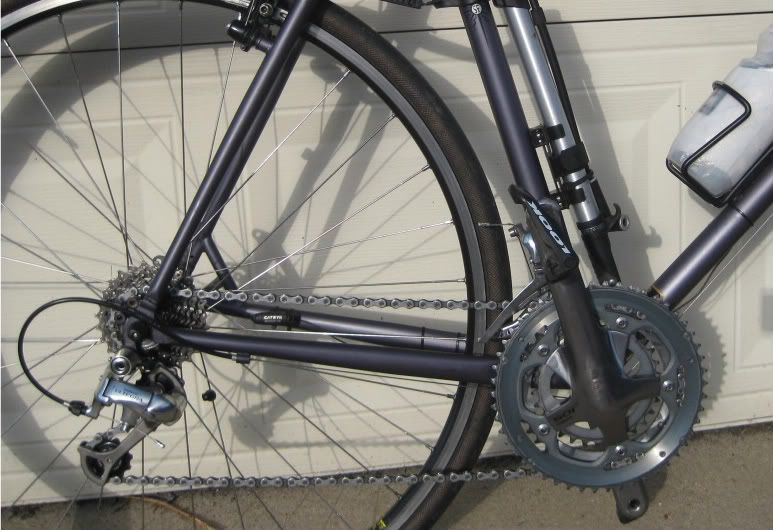
I'm using a 105 triple crankset (50, 39 & 30t) with a 105 FD & Brifter. It has been flawless. I installed a 26t granny gear, and started to drop the chain to the inside. The shape of the FD is engineered for the 50-11=39 and the 39-9=30 relationship between the chainring sizes. The small 26t granny gear creates a larger drop for the chain to travel. I'm going to install a "Dogs Tooth" chain guide to help the chain find the small chainring every time.
The chain wrap required equals the chain wrap capacity of the RD, you chould have no trouble using the small-small combination without any slack in the chain. I don't recommend you cross-chain by using the small-small combination while riding, but the system will operate best when all the slack is gone from the small-small combination. This allows you to "fail-safe" your drivetrain and use every gear without the chain going slack.
See this explanation from Sheldon Brown: https://www.sheldonbrown.com/gloss_ca-g.html#capacity
"The "capacity" of a particular derailer model is the largest range of sprocket sizes it can handle:
For front derailers, when the derailer is mounted high enough to clear the largest chainwheel, there is a certain minimum size that you need for the smallest ring so that the chain won't be dragging over the bottom of the front cage. Different front derailers have different capacities depending on how tall their cages are. It is expressed in a number of teeth, which is the difference between the largest and smallest chainwheel. For instance, a 50/39/30 crank set would call for a front derailer with a minimum 20 tooth (50-30) capacity.
Front derailers are also designed to be used with a certain size for the largest chain ring. The curvature of the outer cage plate is matched to this size. If you use a different-sized big ring, capacity may be reduced. If the big ring is substantially larger than the derailer is designed for, shifting precision will suffer. If the big ring is much smaller than the derailer is designed for, it may shift OK, but you are likely to have to "trim" the front derailer as you shift the rear derailer to the extremes.
A front derailer for triple chainrings also may need to have an inner cage plate adapted to the size difference between the outer and middle chainrings. If this difference ism ore than a few teeth, the inner cage plate must be deep from top to bottom, so it can push the chain from small chainwheel to the middle one without overshifting it onto the large one. The cage plate also may have a special shape, intended to improve this shift.
For rear derailers, the capacity relates to the amount of chain slack the derailer can take up, and is equal to the front range (24 in the example) plus the rear range. Thus, if you have a 50/39/26 crank set, and a 12-25 (13 tooth difference) cluster, the total capacity required would theoretically be 37 teeth (24 front difference + 13 rear difference).
Manufacturers specify this fairly conservatively. They must do so, because they have to assume that some of their derailers will be sold to incompetent cyclists, who will abuse their drive trains by using the smallest chainwheel with the smaller rear sprockets.Competent riders can considerably exceed the official rated capacity, since they will not misuse the granny ring by running it with the smaller rear sprockets, so it doesn't matter if the chain hangs slack in those gears.
Rear derailers are also commonly designed for a particular maximum size of rear sprocket. If you exceed this size by too much, the jockey pulley may rub against the sprocket when using the lowest gear.
Rated maximum rear sprocket size, however, is also commonly much lower than what actually works. For instance, Shimano's models designated as "road" derailers are generally listed for a "maximum" sprocket of 27 teeth...because 27 teeth is the largest size that they make in a designated "road" cassette. However, in almost all cases, these derailers, even the short-cage models, will handle rear sprockets as large as 30 teeth in practice. (This somewhat depends on the design of the frame's derailer hanger, so once in a while you will find a particular installation where you can't use a 30, but I've never seen one where a 28 wouldn't work.)
I'll also mention that many folks seem to be a bit mystified and intimidated by derailers. They're actually quite inexpensive and easy to replace, so it is foolish to allow the limitations of a particular derailer to keep you from having the gearing appropriate to your riding style/needs".
Last edited by Barrettscv; 01-08-11 at 09:42 AM.
01-08-11 | 09:02 AM
#15
Senior Member
Joined: Jun 2010
Posts: 7,579
Likes: 6
From: Pearland, Texas
Bikes: Cannondale, Trek, Raleigh, Santana
DaveSSS, I agree that a small-small usage shouldn't be used, but having a cross chaining princess daughter (nuff said there. ) the amount of RD wrapability needs testing, which I took for granted, but shouldn't have, as more damage can be done if the big-big is selected and the chain is too short than if the chain is too long and there's tension/guide wheel interferance.
Brad
) the amount of RD wrapability needs testing, which I took for granted, but shouldn't have, as more damage can be done if the big-big is selected and the chain is too short than if the chain is too long and there's tension/guide wheel interferance.Brad
01-08-11 | 09:19 AM
#16
Senior Member
Joined: Aug 2005
Posts: 33,657
Likes: 1,119
From: Pittsburgh, PA
Bikes: '96 Litespeed Catalyst, '05 Litespeed Firenze, '06 Litespeed Tuscany, '20 Surly Midnight Special, All are 3x10. It is hilly around here!
No. See DaveSSS's posting for the reasoning. In this case the derailleur's chain wrap will have been exceeded and a chain short enough to allow small-small will not accomidate big-big. That could lead to severe mechanical damage if big-big is used even inadvertently.
Agree fully. A Deda Dog Fang, N-Gear's Jump Stop or a Third Eye Chain Watcher should be fitted for the reason you give. I recommend one of these for any triple set-up and particularly when the stock granny chainring has been changed for a smaller one. Very cheap insurance.
Agree fully. A Deda Dog Fang, N-Gear's Jump Stop or a Third Eye Chain Watcher should be fitted for the reason you give. I recommend one of these for any triple set-up and particularly when the stock granny chainring has been changed for a smaller one. Very cheap insurance.
01-08-11 | 09:24 AM
#17
Have bike, will travel
Joined: Feb 2006
Posts: 12,286
Likes: 317
From: Lake Geneva, WI
Bikes: Ridley Helium SLX, Canyon Endurance SL, De Rosa Professional, Eddy Merckx Corsa Extra, Schwinn Paramount (1 painted, 1 chrome), Peugeot PX10, Serotta Nova X, Simoncini Cyclocross Special, Raleigh Roker, Pedal Force CG2 and CX2
[QUOTE=HillRider;12046584]No. See DaveSSS's posting for the reasoning. In this case the derailleur's chain wrap will have been exceeded and a chain short enough to allow small-small will not accomidate big-big. That could lead to severe mechanical damage if big-big is used even inadvertently.
[QUOTE]
Do the math, he is not exceeding the chain wrap capacity.
I'm running a 12-27 cassette & a 50, 39 & 26t Crankset without any slack on the small-small combination. The Big-Big combination does not cause any problems or damage. I reduced the problem with chain drop by keeping tension on the chain while on the granny gear.
[QUOTE]
Do the math, he is not exceeding the chain wrap capacity.
I'm running a 12-27 cassette & a 50, 39 & 26t Crankset without any slack on the small-small combination. The Big-Big combination does not cause any problems or damage. I reduced the problem with chain drop by keeping tension on the chain while on the granny gear.
Last edited by Barrettscv; 01-08-11 at 09:28 AM.
01-08-11 | 09:42 AM
#18
Senior Member
Joined: Aug 2005
Posts: 33,657
Likes: 1,119
From: Pittsburgh, PA
Bikes: '96 Litespeed Catalyst, '05 Litespeed Firenze, '06 Litespeed Tuscany, '20 Surly Midnight Special, All are 3x10. It is hilly around here!
Do the math, he is not exceeding the chain wrap capacity.
I'm running a 12-27 cassette & a 50, 39 & 26t Crankset without any slack on the small-small combination. The Big-Big combination does not cause any problems or damage. I reduced the problem with chain drop by keeping tension on the chain while on the granny gear.
I'm running a 12-27 cassette & a 50, 39 & 26t Crankset without any slack on the small-small combination. The Big-Big combination does not cause any problems or damage. I reduced the problem with chain drop by keeping tension on the chain while on the granny gear.
I don't know what the OP's crank configuration is but big-big+1" is never a mistake unless you change the cassette for a larger one without adjusting it.
01-08-11 | 09:46 AM
#19
Have bike, will travel
Joined: Feb 2006
Posts: 12,286
Likes: 317
From: Lake Geneva, WI
Bikes: Ridley Helium SLX, Canyon Endurance SL, De Rosa Professional, Eddy Merckx Corsa Extra, Schwinn Paramount (1 painted, 1 chrome), Peugeot PX10, Serotta Nova X, Simoncini Cyclocross Special, Raleigh Roker, Pedal Force CG2 and CX2
DaveSSS, I agree that a small-small usage shouldn't be used, but having a cross chaining princess daughter (nuff said there. ) the amount of RD wrapability needs testing, which I took for granted, but shouldn't have, as more damage can be done if the big-big is selected and the chain is too short than if the chain is too long and there's tension/guide wheel interferance.
Brad
) the amount of RD wrapability needs testing, which I took for granted, but shouldn't have, as more damage can be done if the big-big is selected and the chain is too short than if the chain is too long and there's tension/guide wheel interferance.Brad
Michael
01-08-11 | 09:55 AM
#20
Have bike, will travel
Joined: Feb 2006
Posts: 12,286
Likes: 317
From: Lake Geneva, WI
Bikes: Ridley Helium SLX, Canyon Endurance SL, De Rosa Professional, Eddy Merckx Corsa Extra, Schwinn Paramount (1 painted, 1 chrome), Peugeot PX10, Serotta Nova X, Simoncini Cyclocross Special, Raleigh Roker, Pedal Force CG2 and CX2
I'm assuming that the OP has the 53, 42, 30t OE crankset and a 12-25 cassette as stated. Installing a 26t granny gear will require a chain wrap range of 40, the 39t chainwrap range of the Shimano GS RD has a safety factor. He is right at the upper range of the RD chain wrap capacity.
I first assumed that he had a 50t big chainring, so my first calculation is off. However he should still shorten the chain using the Big-Big +1 as you suggested. I would be suprised if he had slack on the small-small combo after resizing.
Michael
Last edited by Barrettscv; 01-08-11 at 10:45 AM.
01-08-11 | 10:49 AM
#21
Senior Member
Joined: Sep 2008
Posts: 7,296
Likes: 577
From: Loveland, CO
Bikes: Cervelo Rouvida x 2
A little known fact is that a RD must always have 3T of excess wrap capacity to account for differences in the chainstay length. For any given combination, there is a perfect chainstay length that would require exactly 53, 54 , 55 .... inches of chain. If the chainstay length is any longer, you might only need 1/4 inch of extra chain (1T), but you have to add a whole inch (4T), just to get that little bit of extra length.
To figure out that perfect length, you can use the rigorous chain length formula, found at the Park Tool website.
To figure out that perfect length, you can use the rigorous chain length formula, found at the Park Tool website.
Last edited by DaveSSS; 01-08-11 at 11:10 AM.
01-08-11 | 11:58 AM
#22
Thread Starter
Senior Member
Joined: Jul 2010
Posts: 274
Likes: 0
From: Fritch, Tx
Bikes: Felt F80, Trek 730, Raleigh M40
man!! you guys are talking way above my head on all this. But, from what I can gather at this point; it should be safe to change the 'granny' ring down from 30T to 28T or 26T without worry about chain length priovided I don't get much past the center on the rear cluster. I bought this bike used (Felt F80) but am pretty sure it has the OEM chain-rings and rear cassette. That said; I should note that I am not likely to ever go past the middle of the rear cluster while on the granny ring up front. I've found in the first year of ownership and 1100 miles, that there is generally enough overlap of ratios to jump to the middle ring in front once I've reached the middle cog in the rear.
Now; I did have some problems with losing the chain to the inside last summer a few times while heading into a hill. I generally try to get onto the granny ring several seconds before starting uphill. I resolved that with some fine tuning of cable tension and deralleur stops. But if going to a smaller granny will exacerbate that problem, I probably need to know what "A Deda Dog Fang, N-Gear's Jump Stop or a Third Eye Chain Watcher" is to help with the dropping issue. I'm out to increase my total miles this year and want to make it as fun as possible without worrying about losing the chain every other ride and without struggling to get up hills because the gearing is a bit tall for my old legs.
thanks again for all the input; this is great!
Now; I did have some problems with losing the chain to the inside last summer a few times while heading into a hill. I generally try to get onto the granny ring several seconds before starting uphill. I resolved that with some fine tuning of cable tension and deralleur stops. But if going to a smaller granny will exacerbate that problem, I probably need to know what "A Deda Dog Fang, N-Gear's Jump Stop or a Third Eye Chain Watcher" is to help with the dropping issue. I'm out to increase my total miles this year and want to make it as fun as possible without worrying about losing the chain every other ride and without struggling to get up hills because the gearing is a bit tall for my old legs.
thanks again for all the input; this is great!
01-08-11 | 01:42 PM
#23
Thread Starter
Senior Member
Joined: Jul 2010
Posts: 274
Likes: 0
From: Fritch, Tx
Bikes: Felt F80, Trek 730, Raleigh M40
just a quick update note: I've had a chance to count the teeth on the granny gear and it is in fact 30. My thinking is that while my hills are pretty tough this early in the year and I was doing sort of OK on them last fall at the peak of my training (until I had rotator cuff surgery) I now just need a little bit of extra low end power and that a 28T might be the ideal solution to avoid too many other adjustments & parts. I'm hoping my level of conditioning as the season wears on will allow that change to be sufficient so as to not need anything further.
Part of my in house and work conditioning includes some pretty steep stairs at work where I have to climb three flights several times a day while at home I do lunges and hip flexors two or three mornings a week.
Part of my in house and work conditioning includes some pretty steep stairs at work where I have to climb three flights several times a day while at home I do lunges and hip flexors two or three mornings a week.
01-08-11 | 01:49 PM
#24
Banned
Joined: Jun 2010
Posts: 43,586
Likes: 1,380
From: NW,Oregon Coast
Bikes: 8
I run a Campag 'race' triple 135 bcd big rings 50, 40.. 74bcd granny I put a 24 on it .
Square taper BB on those..
You can't make tooth count smaller than bcd, TA gets closer than anyone ..
33t -110, 41t -144, as examples..
STI stuff has preset throws expects early chain pickup..
Square taper BB on those..
You can't make tooth count smaller than bcd, TA gets closer than anyone ..
33t -110, 41t -144, as examples..
STI stuff has preset throws expects early chain pickup..
Last edited by fietsbob; 01-08-11 at 01:58 PM.
01-08-11 | 02:24 PM
#25
Thread Starter
Senior Member
Joined: Jul 2010
Posts: 274
Likes: 0
From: Fritch, Tx
Bikes: Felt F80, Trek 730, Raleigh M40
I run a Campag 'race' triple 135 bcd big rings 50, 40.. 74bcd granny I put a 24 on it .
Square taper BB on those..
You can't make tooth count smaller than bcd, TA gets closer than anyone ..
33t -110, 41t -144, as examples..
STI stuff has preset throws expects early chain pickup..
Square taper BB on those..
You can't make tooth count smaller than bcd, TA gets closer than anyone ..
33t -110, 41t -144, as examples..
STI stuff has preset throws expects early chain pickup..
I'm not a racer nor do I plan to be at age 56; I'm just shooting for a little more low end torque to climb hills without having to spend half the cost of the bike.