


Front End Flexy - Fork Recommendations, etc...
 12-17-08 | 02:39 PM
#1
Thread Starter
Tandem Mountain Climber
Joined: Mar 2007
Posts: 4,104
Likes: 3
From: San Mateo, CA
Bikes: Calfee Tandem, Litespeed Gravel, SuperSix Evo HM, Larry vs. Harry Bullitt (e-cargo)
Front End Flexy - Fork Recommendations, etc...
Hi everyone.
We have a heavily upgraded 1990 Santana Arriva that I would like to improve further by reducing the flex in the front end.
Right now it has the OEM Columbus/Santana steel fork. The front end is flexy during standing climbing and heavy braking. I'm worried the thing is becoming fatigued.
We are pretty hard on this bike. We descend fast, and climb steep stuff all the time (like every ride).
Unfortunately we are limited by the head tube, which uses a 1" steerer.
I don't care if it uses a caliper or a canti. I would like it to be lighter and stiffer than what I have.
Here's the models I am looking at thus far:
Alpha Q CX - Cross Fork (full carbon, 520g - which means it's light but not crazy light, and nice price at the moment)
I know that they made a tandem version of this fork for Burley at one point
https://www.truetemper.com/performance_tubing/cx.asp
https://www.universalcycles.com/shopp...s.php?id=10001
Wound Up Tandem Fork (steel steerer, 900g or so, kind of pricey)
https://www.woundupcomposites.com/tandem_fork.html
Anyone have any input??
Pics of our tandem:
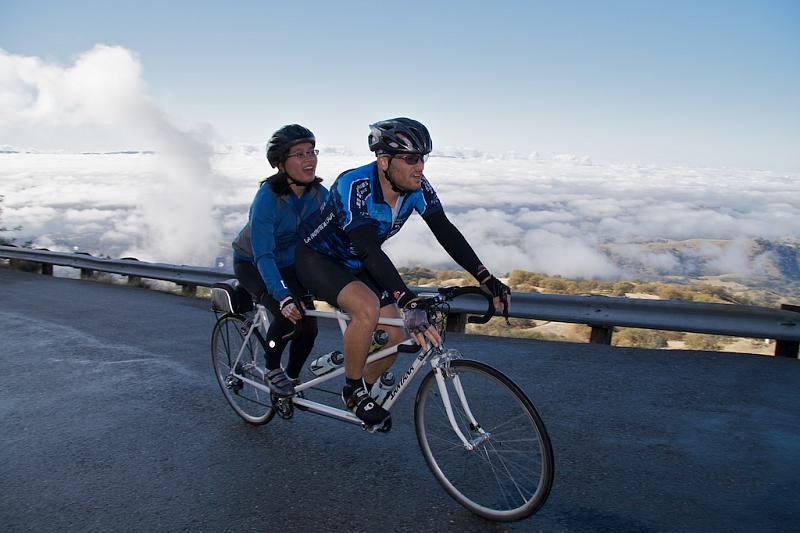

We have a heavily upgraded 1990 Santana Arriva that I would like to improve further by reducing the flex in the front end.
Right now it has the OEM Columbus/Santana steel fork. The front end is flexy during standing climbing and heavy braking. I'm worried the thing is becoming fatigued.
We are pretty hard on this bike. We descend fast, and climb steep stuff all the time (like every ride).
Unfortunately we are limited by the head tube, which uses a 1" steerer.
I don't care if it uses a caliper or a canti. I would like it to be lighter and stiffer than what I have.
Here's the models I am looking at thus far:
Alpha Q CX - Cross Fork (full carbon, 520g - which means it's light but not crazy light, and nice price at the moment)
I know that they made a tandem version of this fork for Burley at one point
https://www.truetemper.com/performance_tubing/cx.asp
https://www.universalcycles.com/shopp...s.php?id=10001
Wound Up Tandem Fork (steel steerer, 900g or so, kind of pricey)
https://www.woundupcomposites.com/tandem_fork.html
Anyone have any input??
Pics of our tandem:
Last edited by uspspro; 12-17-08 at 02:47 PM.
 12-17-08 | 03:45 PM
#2
DisMember

Joined: Feb 2002
Posts: 183
Likes: 0
From: Washington DC & Clermont FL
Bikes: Waterford RS22 Gearie, Waterford RS22 Fixte, Rivendell Rambouillet, Trek Madone5.5, Santana Beyond, GT Zaskar
That is a good looking bike, have you asked Santana about upgrading the fork?
12-17-08 | 03:48 PM
#3


pan y agua
Joined: Aug 2005
Posts: 31,812
Likes: 1,233
From: Jacksonville
Bikes: Willier Zero 7; Merlin Extralight; Calfee Dragonfly tandem, Calfee Adventure tandem; Cervelo P2; Motebecane Ti Fly 29er; Motebecanne Phantom Cross; Schwinn Paramount Track bike
Personally, I would't put a fork with a 1" carbon steerer on a tandem.
A fair number of people think 1" carbon steerers aren't appropriate for even a single bike. I think that's being overly cautious, but on a tandem, I think you're tempting fate.
A fair number of people think 1" carbon steerers aren't appropriate for even a single bike. I think that's being overly cautious, but on a tandem, I think you're tempting fate.
12-17-08 | 03:55 PM
#4
Senior Member
Joined: Dec 2005
Posts: 563
Likes: 0
From: London, UK
Bikes: Trek T200 plus enough others to fill a large shed
If I recall correctly the 1 1/8" Alpha Q cyclocross fork is tested to the same standards as their tandem fork. You should email their tech guys (response within 24h) to check same applies for 1".
Regarding fatigue I think it's unlikely that there's an issue. What you're feeling could be the difference between your carbon forked bike and a steel forked bike. Steel forks do flex and IMHO are no worse for it. I used to find the flex useful to gauge how hard I was braking as it helps avoid locking the wheel.
I find when I ride my non a-headset bikes the front end feels flexy. IMHO most of the flex comes from the spindly alloy stem rather than the fork, particularly when twisting the bars, so an aheadset system will help here.
I'm not sure upgrading the fork alone would be such a good idea. If you're not happy with a Steel Santana fork, where would you draw the line? Perhaps a better solution since you like tandeming would be to update the whole bike or frame and forks? Yes that does cost more but probably you would be happier in the end.
Regarding fatigue I think it's unlikely that there's an issue. What you're feeling could be the difference between your carbon forked bike and a steel forked bike. Steel forks do flex and IMHO are no worse for it. I used to find the flex useful to gauge how hard I was braking as it helps avoid locking the wheel.
I find when I ride my non a-headset bikes the front end feels flexy. IMHO most of the flex comes from the spindly alloy stem rather than the fork, particularly when twisting the bars, so an aheadset system will help here.
I'm not sure upgrading the fork alone would be such a good idea. If you're not happy with a Steel Santana fork, where would you draw the line? Perhaps a better solution since you like tandeming would be to update the whole bike or frame and forks? Yes that does cost more but probably you would be happier in the end.
12-17-08 | 04:12 PM
#5

Suggestions:
1. Contact Santana to get an assessment based on the history of that year/model tandem and fork durability. My guess it, the fork's fine... Santana has always built it's frames and forks to endure a whole lot more punishment than folks of your size can dish out: think 450 lb teams, folks doing loaded tours and triplets.
2. If after Santana has reassured you that there were not systemic weaknesses in that year / model of fork you still want a fork that's stiffer, ask the folks at Santana what they recommend. They may have an inside track on 1" forks that are well-suited for your tandem. Be mindful of the cost relative to the fair market value of your current tandem (See #4, below).
3. If neither of those things trip-your-trigger, consider having someone like Steve Rex or Dennis Bushnell at R&E Cycles make a custom steel fork for your tandem. They can tailor it to your weight and set the rake to the stock Santana spec (55mm) or adjust it to suit your riding style, i.e., knock it down to something less than 55mm of rake such as Co-Motion's gold standard of 50mm or something even more racy; however, I wouldn't go much beyond 50mm for that year / model frame. Cost would most certainly be less than a tandem-specific carbon model and while it probably won't be as light as a carbon fork, it will most likely be plenty stiff and something less than 900 grams given your team weight.
4. If that doesn't scratch your itch, perhaps it's really time to start looking for a new used tandem or perhaps even a new frame/fork given the amount of money that you'll end up sinking into the old tandem. Y'all seem to ride the wheels off of that thing based on Pete's blog and tandems have come a long way since that one was built. You could probably cover more than 1/2 the cost of a new tandem by selling your old one... but only after you have the new to you tandem so that you can trade out any chi-chi parts you'd like to keep, e.g., the Campy stuff and daVinci cranks, etc.). Seriously, if you two are hooked on tandems and riding that thing aggressively in challenging terrain and have an inclination towards doing time trials or other major challenges, the acquisition of a contemporary frame will be money well spent. Probably a good time to do some cost modelling of those different options.
1. Contact Santana to get an assessment based on the history of that year/model tandem and fork durability. My guess it, the fork's fine... Santana has always built it's frames and forks to endure a whole lot more punishment than folks of your size can dish out: think 450 lb teams, folks doing loaded tours and triplets.
2. If after Santana has reassured you that there were not systemic weaknesses in that year / model of fork you still want a fork that's stiffer, ask the folks at Santana what they recommend. They may have an inside track on 1" forks that are well-suited for your tandem. Be mindful of the cost relative to the fair market value of your current tandem (See #4, below).
3. If neither of those things trip-your-trigger, consider having someone like Steve Rex or Dennis Bushnell at R&E Cycles make a custom steel fork for your tandem. They can tailor it to your weight and set the rake to the stock Santana spec (55mm) or adjust it to suit your riding style, i.e., knock it down to something less than 55mm of rake such as Co-Motion's gold standard of 50mm or something even more racy; however, I wouldn't go much beyond 50mm for that year / model frame. Cost would most certainly be less than a tandem-specific carbon model and while it probably won't be as light as a carbon fork, it will most likely be plenty stiff and something less than 900 grams given your team weight.
4. If that doesn't scratch your itch, perhaps it's really time to start looking for a new used tandem or perhaps even a new frame/fork given the amount of money that you'll end up sinking into the old tandem. Y'all seem to ride the wheels off of that thing based on Pete's blog and tandems have come a long way since that one was built. You could probably cover more than 1/2 the cost of a new tandem by selling your old one... but only after you have the new to you tandem so that you can trade out any chi-chi parts you'd like to keep, e.g., the Campy stuff and daVinci cranks, etc.). Seriously, if you two are hooked on tandems and riding that thing aggressively in challenging terrain and have an inclination towards doing time trials or other major challenges, the acquisition of a contemporary frame will be money well spent. Probably a good time to do some cost modelling of those different options.
Last edited by TandemGeek; 12-17-08 at 04:17 PM.
12-17-08 | 04:38 PM
#6
Thread Starter
Tandem Mountain Climber
Joined: Mar 2007
Posts: 4,104
Likes: 3
From: San Mateo, CA
Bikes: Calfee Tandem, Litespeed Gravel, SuperSix Evo HM, Larry vs. Harry Bullitt (e-cargo)
Suggestions:
1. Contact Santana to get an assessment based on the history of that year/model tandem and fork durability. My guess it, the fork's fine... Santana has always built it's frames and forks to endure a whole lot more punishment than folks of your size can dish out: think 450 lb teams, folks doing loaded tours and triplets.
2. If after Santana has reassured you that there were not systemic weaknesses in that year / model of fork you still want a fork that's stiffer, ask the folks at Santana what they recommend. They may have an inside track on 1" forks that are well-suited for your tandem. Be mindful of the cost relative to the fair market value of your current tandem (See #4, below).
3. If neither of those things trip-your-trigger, consider having someone like Steve Rex or Dennis Bushnell at R&E Cycles make a custom steel fork for your tandem. They can tailor it to your weight and set the rake to the stock Santana spec (55mm) or adjust it to suit your riding style, i.e., knock it down to something less than 55mm of rake such as Co-Motion's gold standard of 50mm or something even more racy; however, I wouldn't go much beyond 50mm for that year / model frame. Cost would most certainly be less than a tandem-specific carbon model and while it probably won't be as light as a carbon fork, it will most likely be plenty stiff and something less than 900 grams given your team weight.
4. If that doesn't scratch your itch, perhaps it's really time to start looking for a new used tandem or perhaps even a new frame/fork given the amount of money that you'll end up sinking into the old tandem. Y'all seem to ride the wheels off of that thing based on Pete's blog and tandems have come a long way since that one was built. You could probably cover more than 1/2 the cost of a new tandem by selling your old one... but only after you have the new to you tandem so that you can trade out any chi-chi parts you'd like to keep, e.g., the Campy stuff and daVinci cranks, etc.). Seriously, if you two are hooked on tandems and riding that thing aggressively in challenging terrain and have an inclination towards doing time trials or other major challenges, the acquisition of a contemporary frame will be money well spent. Probably a good time to do some cost modelling of those different options.
1. Contact Santana to get an assessment based on the history of that year/model tandem and fork durability. My guess it, the fork's fine... Santana has always built it's frames and forks to endure a whole lot more punishment than folks of your size can dish out: think 450 lb teams, folks doing loaded tours and triplets.
2. If after Santana has reassured you that there were not systemic weaknesses in that year / model of fork you still want a fork that's stiffer, ask the folks at Santana what they recommend. They may have an inside track on 1" forks that are well-suited for your tandem. Be mindful of the cost relative to the fair market value of your current tandem (See #4, below).
3. If neither of those things trip-your-trigger, consider having someone like Steve Rex or Dennis Bushnell at R&E Cycles make a custom steel fork for your tandem. They can tailor it to your weight and set the rake to the stock Santana spec (55mm) or adjust it to suit your riding style, i.e., knock it down to something less than 55mm of rake such as Co-Motion's gold standard of 50mm or something even more racy; however, I wouldn't go much beyond 50mm for that year / model frame. Cost would most certainly be less than a tandem-specific carbon model and while it probably won't be as light as a carbon fork, it will most likely be plenty stiff and something less than 900 grams given your team weight.
4. If that doesn't scratch your itch, perhaps it's really time to start looking for a new used tandem or perhaps even a new frame/fork given the amount of money that you'll end up sinking into the old tandem. Y'all seem to ride the wheels off of that thing based on Pete's blog and tandems have come a long way since that one was built. You could probably cover more than 1/2 the cost of a new tandem by selling your old one... but only after you have the new to you tandem so that you can trade out any chi-chi parts you'd like to keep, e.g., the Campy stuff and daVinci cranks, etc.). Seriously, if you two are hooked on tandems and riding that thing aggressively in challenging terrain and have an inclination towards doing time trials or other major challenges, the acquisition of a contemporary frame will be money well spent. Probably a good time to do some cost modelling of those different options.
*** I actually contacted Steve Rex about building us a fork, and he said he was not able to buy a suitable 1" steerer tube.
 I will try Dennis to find out what he has to say.
*** Alpha Q got back to me and said:
"No, the 1” cx is not meant for tandem riding.
Sorry
The 1 1/8” cx fork is actually stronger than the tandem, but the 1” is not for tandem."
*** In the long term, looking at just dollars and cents. Buying this fork makes no sense because we will eventually get a new frameset. However.... when I say eventually, I mean probably a couple years from now (unfortunately). Another thing is sentimental attachment (especially with the stoker). I think even when we get a new tandem, she wouldn't let me sell the thing


*** So with that last statement, spending the money on a fork is OK with me. It will enable us to enjoy a better performing tandem for a couple years, while we are waiting for our purchase of a new frameset. I would recoup some of my costs by selling it later on (after switching the old tandem back to stock). The bottom line is: we can't afford a new tandem, but we want to enjoy riding the heck out of this thing in the mean time.
I don't know, maybe the Wound up is the ticket. I will call R+E and Santana though and listen to what they have to say.
Thanks again!
12-17-08 | 04:50 PM
#7
The same thing happened when I moved her from the '98 C'dale MT3000 to our first Ventana: no way are we selling that tandem until I try this full-suspension thing. First ride... she was hooked and no trip to the Chiropractor after the ride: Love = comfort and confidence-inspiring handling.
Relative to the Wound-Up and any other fork options other than a 55mm Santana-spec fork, please ask Steve, Bill or whoever you talk to at Santana how that 90's model frame's handling would be affected by changing the rake to something like a 45mm Wound-Up. Santana like Co-Motion, optimizes their frames to work with their respective steering geometries. You can really mess up the 'balance' that builders work so hard to achieve by changing something as significant as the fork's rake.
12-17-08 | 05:29 PM
#8
Thread Starter
Tandem Mountain Climber
Joined: Mar 2007
Posts: 4,104
Likes: 3
From: San Mateo, CA
Bikes: Calfee Tandem, Litespeed Gravel, SuperSix Evo HM, Larry vs. Harry Bullitt (e-cargo)
Don't be so sure. Debbie was very attached to our first road tandem but became even more attached to the next one which introduced her to a proper fit and, well, she promptly fell in love all over again. She was really apprehensive about the newest road tandem because, well, there was just no way it could be as comfortable for her as our nearly 10-year old beloved road tandem: yeah, that lasted about 5 miles. Love = comfort and confidence-inspiring handling.
The same thing happened when I moved her from the '98 C'dale MT3000 to our first Ventana: no way are we selling that tandem until I try this full-suspension thing. First ride... she was hooked and no trip to the Chiropractor after the ride: Love = comfort and confidence-inspiring handling.
Relative to the Wound-Up and any other fork options other than a 55mm Santana-spec fork, please ask Steve, Bill or whoever you talk to at Santana how that 90's model frame's handling would be affected by changing the rake to something like a 45mm Wound-Up. Santana like Co-Motion, optimizes their frames to work with their respective steering geometries. You can really mess up the 'balance' that builders work so hard to achieve by changing something as significant as the fork's rake.
The same thing happened when I moved her from the '98 C'dale MT3000 to our first Ventana: no way are we selling that tandem until I try this full-suspension thing. First ride... she was hooked and no trip to the Chiropractor after the ride: Love = comfort and confidence-inspiring handling.
Relative to the Wound-Up and any other fork options other than a 55mm Santana-spec fork, please ask Steve, Bill or whoever you talk to at Santana how that 90's model frame's handling would be affected by changing the rake to something like a 45mm Wound-Up. Santana like Co-Motion, optimizes their frames to work with their respective steering geometries. You can really mess up the 'balance' that builders work so hard to achieve by changing something as significant as the fork's rake.

Don't know if that's worth it
12-18-08 | 06:13 PM
#9
Thread Starter
Tandem Mountain Climber
Joined: Mar 2007
Posts: 4,104
Likes: 3
From: San Mateo, CA
Bikes: Calfee Tandem, Litespeed Gravel, SuperSix Evo HM, Larry vs. Harry Bullitt (e-cargo)
Relative to the Wound-Up and any other fork options other than a 55mm Santana-spec fork, please ask Steve, Bill or whoever you talk to at Santana how that 90's model frame's handling would be affected by changing the rake to something like a 45mm Wound-Up. Santana like Co-Motion, optimizes their frames to work with their respective steering geometries. You can really mess up the 'balance' that builders work so hard to achieve by changing something as significant as the fork's rake.
My solo bike has around 55-56 mm of trail, for reference.
Would the tandem become more twitchy? Will it actually become better at speed but just a little more sketchy at low speed??
Any ideas?
12-18-08 | 07:03 PM
#10
Anyway, as for the handling, rather than rehashing let me pull from something I posted back in '05 quoting myself from an article I wrote for Recumbent & Tandem Rider Magazine a bunch of years ago:
-------------------
Originally Posted by K&M
One problem, as you can see from reading this thread, is that people have a tendency to get things backwards and say the opposite of what they mean when discussing trail.
Originally Posted by Me in RTR #16
As for how short (conservative) or long (aggressive) fork trail feels, that's often times where the terminology and expectations can also create confusion. Based on my experience, the following is how I like to sum up how conservative and aggressive fork trail affect the steering and handling of tandems:
Conservative fork trail on a tandem (under 2") favors low speed maneuverability by providing lighter steering effort and faster steering responsiveness to handlebar inputs. Many teams will describe this as being "more stable" because, at least at slow speeds, it "feels" that way. Tandems with conservative fork trail take less effort and attention to steer in a straight line at slower speed and are resistant to inadvertent movements by the stoker, aka (stoker induced steering). However, conservative trail tandems also tend to understeer in aggressive or high speed cornering maneuvers which is not always desirable.
Aggressive fork trail on a tandem (more than 2") favors high speed cruising and aggressive cornering. This is because of their inherently greater straight line stability and smooth responsiveness to leaning inputs, noting that at speeds above 15 -20 mph all directional changes on two-wheeled cycles are accomplished through leaning the bike in the direction of the turn and countersteering with the handlebars. Many teams will describe tandems that handle well at speed as being "more stable" because, at least at higher speeds and for aggressive cornering, it "feels" that way. However, at slower speeds, steering tends to be heavier and less responsive which is often described as being twitchy. Moreover, for teams with stokers that are exceptionally tall, or who tend to move around along or "rock" when they ride, a tandem with long fork trail can make steering control a laborious task that can also be undesirable.
Conservative fork trail on a tandem (under 2") favors low speed maneuverability by providing lighter steering effort and faster steering responsiveness to handlebar inputs. Many teams will describe this as being "more stable" because, at least at slow speeds, it "feels" that way. Tandems with conservative fork trail take less effort and attention to steer in a straight line at slower speed and are resistant to inadvertent movements by the stoker, aka (stoker induced steering). However, conservative trail tandems also tend to understeer in aggressive or high speed cornering maneuvers which is not always desirable.
Aggressive fork trail on a tandem (more than 2") favors high speed cruising and aggressive cornering. This is because of their inherently greater straight line stability and smooth responsiveness to leaning inputs, noting that at speeds above 15 -20 mph all directional changes on two-wheeled cycles are accomplished through leaning the bike in the direction of the turn and countersteering with the handlebars. Many teams will describe tandems that handle well at speed as being "more stable" because, at least at higher speeds and for aggressive cornering, it "feels" that way. However, at slower speeds, steering tends to be heavier and less responsive which is often described as being twitchy. Moreover, for teams with stokers that are exceptionally tall, or who tend to move around along or "rock" when they ride, a tandem with long fork trail can make steering control a laborious task that can also be undesirable.
Originally Posted by Me in RTR #16
[after looking at steering geometry numbers for solo bikes]... you might logically conclude that high performance steering should be assigned to the tandems with shorter trail numbers instead of the longer ones since the racing bikes in Table 1 have the shortest trail numbers. Unfortunately, while tandems with short trail benefit from the more neutral handling in some performance areas, the long wheelbase and significantly higher gross weight of a tandem creates a point of diminishing returns for more aggressive riders. The long trail tandems, on the other hand, trade off that low speed maneuverability and neutral steering for better responsiveness in those more aggressive riding situations. So, in some respects, expectations about how changes in fork trail "should" effect the handling on solo bicycles can't be extrapolated into how fork trail actually affects the handling on a tandem.
Last edited by TandemGeek; 12-18-08 at 07:10 PM.
12-19-08 | 11:08 AM
#11
Thread Starter
Tandem Mountain Climber
Joined: Mar 2007
Posts: 4,104
Likes: 3
From: San Mateo, CA
Bikes: Calfee Tandem, Litespeed Gravel, SuperSix Evo HM, Larry vs. Harry Bullitt (e-cargo)
Are the head tube angles the same for the Co-motions and Santana's?
Santana has no old geometry specs available
If the HT angles are the same, then wouldn't the handling would be similar to all those few year old Co-motions spec'd with Wound-up forks?
I gave a rough measure for the axle-to-crown on the current fork, and it seems to be just shy of 390mm.
Santana has no old geometry specs available
If the HT angles are the same, then wouldn't the handling would be similar to all those few year old Co-motions spec'd with Wound-up forks?
I gave a rough measure for the axle-to-crown on the current fork, and it seems to be just shy of 390mm.
12-19-08 | 11:43 AM
#12
For the most part, yes... along with 73* seat tubes. There was a time when Co-Motion was using 72.5 head tubes on its smallest models and 74 degree head tubes on its largest models of the tri-lateral Java & Double Espresso tandem models in the late 90's and I'm not exactly sure what they used on the models that pre-date the Speedster. But I'm pretty sure Santana has been using 73* for a pretty long time.
They've never been all that forthcoming with those numbers because, frankly, in talking with Bill it really shouldn't matter to the average consumer and, well, I tend to agree. Again, a frame designer / builder balances tubing selection and geometries to achieve the ride characteristics they are shooting for. Therefore, it's very hard to make too many assumptions about how different bikes will handle by simply comparing things like geometry numbers. They're really red herrings in many respects because, as already suggested, you can't make a Santana "feel" like a Co-Motion by simply sticking a 50mm or 45mm fork on it anymore than a Co-Motion will feel like a Santana if you stick a 55mm fork on it.
However, just to indulge your curiousity a little bit, you can find a write up on the '96 Santana Sovereign at the Tandem & Family Cycling Magazine's website at the following link, along with a few others where geometry is usually provided: https://www.tandemmag.com/roadtest/
See above. Again, the steering geometry has to play nice with the frame. While you can pretty well assume what will happen to the steering characteristics by changing fork rake, what you can't really account for is how the whole package will handle once all is said and done and how well you'll like that.
Again, it's pretty easy to find teams riding tandems that aren't a good fit for their riding styles. Things to look for are teams on Co-Motions or other tandems with short rake / long steering trail who can't hold a straight line to save their lives, particularly when climbing. If you ride their wheel for a while you can actually watch the front wheel and the captain's arms twitch with each pedal stroke. Conversely, you'll find folks who ride stock Santana, Burley, Trek (pre-carbon fork models) tandems that will characterize the handling of their tandems as being "like a truck".
That sounds like it's in the ball park. I want to say that it was 395mm for Santana but can't be sure off-hand. Most tandems seem to fall into the 390mm to 400mm range, except for the ones that are sporting True Temper Alpha Q forks with their 374mm (or is it now 376mm?) axle-to-crown dimension.
They've never been all that forthcoming with those numbers because, frankly, in talking with Bill it really shouldn't matter to the average consumer and, well, I tend to agree. Again, a frame designer / builder balances tubing selection and geometries to achieve the ride characteristics they are shooting for. Therefore, it's very hard to make too many assumptions about how different bikes will handle by simply comparing things like geometry numbers. They're really red herrings in many respects because, as already suggested, you can't make a Santana "feel" like a Co-Motion by simply sticking a 50mm or 45mm fork on it anymore than a Co-Motion will feel like a Santana if you stick a 55mm fork on it.
However, just to indulge your curiousity a little bit, you can find a write up on the '96 Santana Sovereign at the Tandem & Family Cycling Magazine's website at the following link, along with a few others where geometry is usually provided: https://www.tandemmag.com/roadtest/
Again, it's pretty easy to find teams riding tandems that aren't a good fit for their riding styles. Things to look for are teams on Co-Motions or other tandems with short rake / long steering trail who can't hold a straight line to save their lives, particularly when climbing. If you ride their wheel for a while you can actually watch the front wheel and the captain's arms twitch with each pedal stroke. Conversely, you'll find folks who ride stock Santana, Burley, Trek (pre-carbon fork models) tandems that will characterize the handling of their tandems as being "like a truck".
That sounds like it's in the ball park. I want to say that it was 395mm for Santana but can't be sure off-hand. Most tandems seem to fall into the 390mm to 400mm range, except for the ones that are sporting True Temper Alpha Q forks with their 374mm (or is it now 376mm?) axle-to-crown dimension.
12-19-08 | 12:15 PM
#13
Thread Starter
Tandem Mountain Climber
Joined: Mar 2007
Posts: 4,104
Likes: 3
From: San Mateo, CA
Bikes: Calfee Tandem, Litespeed Gravel, SuperSix Evo HM, Larry vs. Harry Bullitt (e-cargo)
I seem to remember TandemRacer fitted a HT spacer at the bottom when he ran the Alpha on their Lightspeed.
But that's really a tangent off the original dilemma.
Anyway, regarding my comparison of my Santana to a Co-motion (w/ Wound-Up). My purpose for comparison isn't to say that they will feel all that similar, but more so to say that switching to a 45mm rake fork with a similar A-to-C length will not make the specs fall outside of generally accepted values.
12-19-08 | 02:05 PM
#14

just another gosling


Joined: Feb 2007
Posts: 20,555
Likes: 2,667
From: Everett, WA
Bikes: CoMo Speedster 2003, Trek 5200, CAAD 9, Fred 2004
Just trying to learn a little more here . . .
We ride with one tandem team which, when out of the saddle, moves the front wheel back and forth a couple of inches every stroke, constantly making little S curves. I can't imagine why, but then we don't ride their bike.
Before I was into tandems, I remember coming up on one on a long pass climb. Out of the saddle, their front and rear wheels were moving out of alignment by a couple of degrees, the frame was flexing so badly. Didn't look at the logo when I went by, too bad. Again, I can't imagine why.
Our CoMo with Wound Up is perfect for us. We have the 1-1/8" threadless. When we're standing nicely, it goes in a straight line without much handlebar loading. My ideal is to time the movement so that I apply the least possible force to the bars. Which is not what I do when I'm trying to apply a lot of power on a single, but is the same as I do during a long standing rest period on a pass climb. In the first case, would fork flex be much of an issue? Seated, we both pedal pretty decent circles, so there's no bike movement at all. OTOH, we're not as strong as the usps team. I do notice that my singles seem twitchy after doing a lot of tandem riding. Again, I don't know why. Maybe the tandem just needs more effort in steering input because of the weight?
I read TGs rake and trail discussion in RTR when I was researching before our purchase. I must confess that I still don't know enough for it to be particularly enlightening. With our bike, I can easily do a U-turn on a narrow 2-lane country road, but I cannot manage it on a 12' bike path, which I can easily do on a single. Handling at all speeds seems fine to me, better than anything else we've ridden, but my experience is limited to only three tandems, the CoMo, an older C'dale, and an older Davidson.
A new tandem team now owns the steel-forked Davidson. The captain is very strong, one of the strongest riders I know, and the stoker is a double for the usps stoker. They like the bike and ride it in a straight line, often using 53X19 on the climbs, but they never stand. OTOH, they never stand on their singles, either.
We ride with one tandem team which, when out of the saddle, moves the front wheel back and forth a couple of inches every stroke, constantly making little S curves. I can't imagine why, but then we don't ride their bike.
Before I was into tandems, I remember coming up on one on a long pass climb. Out of the saddle, their front and rear wheels were moving out of alignment by a couple of degrees, the frame was flexing so badly. Didn't look at the logo when I went by, too bad. Again, I can't imagine why.
Our CoMo with Wound Up is perfect for us. We have the 1-1/8" threadless. When we're standing nicely, it goes in a straight line without much handlebar loading. My ideal is to time the movement so that I apply the least possible force to the bars. Which is not what I do when I'm trying to apply a lot of power on a single, but is the same as I do during a long standing rest period on a pass climb. In the first case, would fork flex be much of an issue? Seated, we both pedal pretty decent circles, so there's no bike movement at all. OTOH, we're not as strong as the usps team. I do notice that my singles seem twitchy after doing a lot of tandem riding. Again, I don't know why. Maybe the tandem just needs more effort in steering input because of the weight?
I read TGs rake and trail discussion in RTR when I was researching before our purchase. I must confess that I still don't know enough for it to be particularly enlightening. With our bike, I can easily do a U-turn on a narrow 2-lane country road, but I cannot manage it on a 12' bike path, which I can easily do on a single. Handling at all speeds seems fine to me, better than anything else we've ridden, but my experience is limited to only three tandems, the CoMo, an older C'dale, and an older Davidson.
A new tandem team now owns the steel-forked Davidson. The captain is very strong, one of the strongest riders I know, and the stoker is a double for the usps stoker. They like the bike and ride it in a straight line, often using 53X19 on the climbs, but they never stand. OTOH, they never stand on their singles, either.
12-19-08 | 04:54 PM
#15
Our Calfee is definitely designed around the Alpha Q and I confirmed with the folks at Co-Motion that they design their Supremo, Robusta and other 'race' tandems around the Alpha Q forks, whereas the Speedster, Roadster, etc... are designed around their chromoly & the Wound-Up carbon forks. As to what aspect of the frame is altered, it would appear to be dimensions about the head tube as the bottom bracket heights are standardized across their entire road bike range.
Actually, TandemRacer rode their Litespeed without the spacer for the vast majority of the time they had that fork on the bike. It was shortly before their AME-built Alpha Q fork started to develop cracks (about 20k very hard miles or so?) that a friend up in Asheville, NC, machined a custom spacer for their tandem and Alpha Q fork. Once he realized the Alpha Q had reached the end of its service life TR contacted the new owners of the Alpha Q, True Temper, with regard to a replacement. While they had a great replacement program / price, they didn't have any tandem forks of the correct spec in stock at the time so they ended up switching over to a Wound-Up fork which, I believe, TR found to be much more to his liking anyway.
12-19-08 | 05:11 PM
#16
With our bike, I can easily do a U-turn on a narrow 2-lane country road, but I cannot manage it on a 12' bike path, which I can easily do on a single. Handling at all speeds seems fine to me, better than anything else we've ridden, but my experience is limited to only three tandems, the CoMo, an older C'dale, and an older Davidson.
Again, about the only time there is any point in discussing steering geometry is when someone is contemplating a change like USPSPRO is, where the stock geometry is being altered and/or for anyone who finds their tandem's handling to be less than desirable for any reason. My RTR article was really trying to frame the problem that most folks encounter when they have a discussion about bicycle handling and terms like stability while also trying generalize the two prevailing philosophies on how a tandem should be designed, i.e., Co-Motion vs Santana and the various adherents as well as those who use a different approach, e.g., Bilenky again being VERY conservative with their geometries and Erickson being way out in front at the other extreme.... but noting both are still "in the box" that USPSPRO mentioned earlier.
Last edited by TandemGeek; 12-19-08 at 05:18 PM.
12-19-08 | 09:20 PM
#17

Ride it like you stole it
Joined: Nov 2005
Posts: 4,996
Likes: 21
From: Union County, NC
Bikes: 2012 Cannondale EVO Ultegra Di2, Pedal Force Aeroblade, Rue Tandem
TG, I am working on a theory about tandem handling and it relates to why some prefer Santana over Co-Motion. I really believe it has to do with background. Recreational riders, tourists, Sunday afternoon cruisers all seem to prefer the Santana bike that steers like the Titanic. Fast club riders, triathletes, former racers may prefer the C0-Motion bike that handles like a personal watercraft.
I haven't thought this completely through yet, just kind of thinking out loud.
But as I and others have said, it only takes a few miles to get used to any of the differences so that they become unnoticeable while you are riding.
I haven't thought this completely through yet, just kind of thinking out loud.
But as I and others have said, it only takes a few miles to get used to any of the differences so that they become unnoticeable while you are riding.
__________________
"Never use your face as a brake pad" - Jake Watson
The Reloutionaries @ Shapeways
"Never use your face as a brake pad" - Jake Watson
The Reloutionaries @ Shapeways
12-19-08 | 11:21 PM
#18

SWS: Small Wheel Syndrome
Joined: Aug 2006
Posts: 728
Likes: 0
From: Palo Alto
Bikes: Bike Friday Pocket Rocket/PedalForce RS2/Specialized Rock Hopper Xtracycle/Periscope Hammerhead
USPSPRO,
You should borrow our Periscope Hammerhead on Cañada for a quick feel to see the difference in rake,trail,etc. You can also take some of those side roads and test climbing. Going from a Santana to a Co-Mo might be an eye-opener. I really prefer the handling on the Co-Mo (IMHO), although riding a 20" wheeled bike 90% of the time might influence that opinion.
You should borrow our Periscope Hammerhead on Cañada for a quick feel to see the difference in rake,trail,etc. You can also take some of those side roads and test climbing. Going from a Santana to a Co-Mo might be an eye-opener. I really prefer the handling on the Co-Mo (IMHO), although riding a 20" wheeled bike 90% of the time might influence that opinion.
12-20-08 | 07:06 AM
#19
TG, I am working on a theory about tandem handling and it relates to why some prefer Santana over Co-Motion. I really believe it has to do with background. Recreational riders, tourists, Sunday afternoon cruisers all seem to prefer the Santana bike that steers like the Titanic. Fast club riders, triathletes, former racers may prefer the C0-Motion bike that handles like a personal watercraft.
I haven't thought this completely through yet, just kind of thinking out loud.
But as I and others have said, it only takes a few miles to get used to any of the differences so that they become unnoticeable while you are riding.
I haven't thought this completely through yet, just kind of thinking out loud.
But as I and others have said, it only takes a few miles to get used to any of the differences so that they become unnoticeable while you are riding.
The same was true for Santana who has earned and enjoyed tremendous brand-name recognition since reshaping the US tandem market back in the late 70's and early 80's. Again, up and until that time if you wanted a well-designed tandem you either had a custom Paramount made or you looked to the UK and Europe for a good tandem. Santana's clear market leadership position has traditionally made it the top shelf brand for all types of riders, so even today you're just as likely to see state time trial champs or a Cat 2 racer riding a Santana as you are tourists or recreational riders. Moreover, even though Co-Motion and more recently Calfee and a few other boutique tandem builders has established a reputation for building tandems that "ride like single bikes" Santana's tandems are still some of the most comfortable and forgiving tandems that you can find so they're hardly a non-player and, depending on a buyer's dealer options and/or what their friends are riding, an elite cyclist could easily elect to ride a Santana.
Again, there really aren't any 'bad' tandems out on the market once you get into the premium quality brands. They're simply a little bit different. Some folks will take notice of the difference and have a preference for certain handling characteristics vs. another, whereas others won't. If someone who rides a Co-Motion finds that their back and shoulders are fatigued after a long day in the saddle then they might want to borrow a Santana or even a Bilenky for a long ride to see if that might be better. Conversely, if someone who rides aggressively just can't find their comfort zone on a Santana they might want to try a Co-Motion, Calfee or other brand of tandem that uses more steering trail to see if they can detect a difference.
Again, unless you've ridden a lot of these different tandems under similar conditions with the same stoker and know what to look for this stuff can be meaningless. However, there are in fact differences and sometimes it helps to know why and what they are so that folks can make informed decisions when those differences become a factor.
12-20-08 | 09:57 AM
#20
Ride it like you stole it
Joined: Nov 2005
Posts: 4,996
Likes: 21
From: Union County, NC
Bikes: 2012 Cannondale EVO Ultegra Di2, Pedal Force Aeroblade, Rue Tandem
Not saying one tandem is worse than any other, but my bias does show in my posting. I do not enjoy the slumbering ride provided by limited experience on our 'Dale, similar large fork offset to Santana. I am sure not nearly as comfortable. I do think that suggesting that someone whose back or arms ache after riding a Co-Motion or similar might benefit from a switch to Santana or similar oversimplifies the situation. Comfort is more about fit than geometry. Once up to speed a bike that fits will allow the rider to be more relaxed, releasing the 'death grip' and not suffer from soreness often misassociated (is this really a word) with bike geometry. I do not find myself constantly fidgeting with steering input, but then I am used to bikes with more trail, I do not feel like my arms or back have received more of a workout than the rest of my body after a tandem ride.
Notwithstanding market penetration, do you even think for a minute that geometry bias has anything to do with familiarity, age, bike handling skills, etc?
I am still just thinking out loud here and have no basis in fact other than limited personal experience, that is why I am asking.
Notwithstanding market penetration, do you even think for a minute that geometry bias has anything to do with familiarity, age, bike handling skills, etc?
I am still just thinking out loud here and have no basis in fact other than limited personal experience, that is why I am asking.
__________________
"Never use your face as a brake pad" - Jake Watson
The Reloutionaries @ Shapeways
"Never use your face as a brake pad" - Jake Watson
The Reloutionaries @ Shapeways
Last edited by WheresWaldo; 12-20-08 at 09:58 AM. Reason: corrected spelling
12-20-08 | 10:47 AM
#21
That said, the reason I introduce stoker size is that the stoker's height, weight and riding style will usually do more to alter how a tandem handles and feels moreso than anything you can do by changing a fork. Small kids can do handstands on the back of a tandem and still not create as much 'work' for the captain with regard to keeping the bike going in a straight line than a 6' stoker who likes to peek around the captain's head. The more trail you add to that scenario the more dramatic the effect and the more 'work' the captain must do to keep the thing going in a straight line.
Also, getting back to the OPs conundrum, you can also screw up the handling of a tandem by selecting a fork that's just not stiff enough for your preferences. Alpha Q forks, for example, have a noticeable amount of deflection... far more than any of the other tandem-rated carbon forks. That additional deflection makes our tandems handle differently than they would with a stiffer fork with same or different rake. It was somewhat unsettling at first back '02 when we made the change from our lightweight (850g) custom steel fork to the 500g Alpha Q, but since we're a lightweight team and I float around in the 160-170lb range over the course of a year, the deflection is acceptable. Again, nothing's simple and you can add all kinds of things into the equation to make it even more complex.
Nothing wrong with that and all I'm sharing are my observations and opinions and purposely try to keep it simple. Again, the best way to figure out if any of this matters is to ride different tandems back to back under similar circumstances that mean something to you. If you'll never have a 200 lb stoker on the back of a tandem, then you'll never need to worry about how much more or less suitable a Co-Motion or a Santana might be, in much the same way that the strength and durability of a rear wheel may ever become an issue.
Last edited by TandemGeek; 12-20-08 at 11:05 AM.
12-20-08 | 12:29 PM
#22
Ride it like you stole it
Joined: Nov 2005
Posts: 4,996
Likes: 21
From: Union County, NC
Bikes: 2012 Cannondale EVO Ultegra Di2, Pedal Force Aeroblade, Rue Tandem
Good, love the insight. My stoker is 145 pounds and very smooth. for many months before we even had our tandem she was riding rollers and is much more competent at it than I am. Also working with a coach smoothed out her pedaling stroke and she delivers power much more evenly than I do. But we are a 345 pound team. I rarely notice her moving around back there until I make some smart comment about workload or some such nonsense. We prefer the handling we got when swapping forks. The 'Dale fatty is a very stiff fork and offers little trail the Winwood not so stiff and a lot more trail after the first few jittery miles everything smoothed out and we did not even notice the handling because it was so much the same as our single bikes. Now that I just wrote the last couple of sentences, I think it I should have said I was the one who preferred this type of geometry. I am not really sure my stoker cares oone way or another.
With regard to my comment on geometry preference, you indirectly answered it. I was totally ignoring availability. You tend to ride what is available in your area. So if an LBS is heavily invested in Santana, you ride and become familiar wih Santana, same for Co-Motion, etc. Without having something to compare to you 'settle' (not the best word but the one that sprang to mind first) for whatever is available in your area. It certainly isn't like single bikes. In our area, and I am just up I85 from your area, you would be hardpressed to find more than one or two tandems in stock in the entire area. The Charlotte metro area is over 1M people. The test ride type of comparison is very difficult to do here (I am not a fan of test rides for other reasons I will not delve into here). You have to rely on past experience whether that be tandem or single to understand what to expect.
I took no offense nor did it occur to me that you were being a smart-ass. Remeber I mostly post in Road Cycling and if you don't have a tough skin, or simply take no notice of anything considered offensive you certainly wouldn't last long in that particular forum.
With regard to my comment on geometry preference, you indirectly answered it. I was totally ignoring availability. You tend to ride what is available in your area. So if an LBS is heavily invested in Santana, you ride and become familiar wih Santana, same for Co-Motion, etc. Without having something to compare to you 'settle' (not the best word but the one that sprang to mind first) for whatever is available in your area. It certainly isn't like single bikes. In our area, and I am just up I85 from your area, you would be hardpressed to find more than one or two tandems in stock in the entire area. The Charlotte metro area is over 1M people. The test ride type of comparison is very difficult to do here (I am not a fan of test rides for other reasons I will not delve into here). You have to rely on past experience whether that be tandem or single to understand what to expect.
I took no offense nor did it occur to me that you were being a smart-ass. Remeber I mostly post in Road Cycling and if you don't have a tough skin, or simply take no notice of anything considered offensive you certainly wouldn't last long in that particular forum.
__________________
"Never use your face as a brake pad" - Jake Watson
The Reloutionaries @ Shapeways
"Never use your face as a brake pad" - Jake Watson
The Reloutionaries @ Shapeways
12-20-08 | 08:53 PM
#23
All three tandems most likely used a 73° head tube, with most likely a 55mm rake fork / 48mm of steering trail on the Davidson (same as Santana), perhaps a 53mm rake fork / 51mm of steering trail on the Cannondale depending when it was made, and a 45mm rake fork / 58mm of steering trail on the Co-Motion.
12-20-08 | 09:39 PM
#24
just another gosling
Joined: Feb 2007
Posts: 20,555
Likes: 2,667
From: Everett, WA
Bikes: CoMo Speedster 2003, Trek 5200, CAAD 9, Fred 2004
Again, about the only time there is any point in discussing steering geometry is when someone is contemplating a change like USPSPRO is, where the stock geometry is being altered and/or for anyone who finds their tandem's handling to be less than desirable for any reason.
https://www.bikeforums.net/tandem-cycling/294295-primera-vs-speedster-vs-roadster.html
I guess I never said how all that worked out. Our first two tandem tests were on borrowed C'dale and Davidson. We rode each several times, probably a total of 100 miles each. No problems, but we didn't feel like we could make either bike really "go." Then we had a disastrous test ride on a Co-Mo Primera, described in somewhat mellow terms in the post referenced above. Much mellower terms than what we really felt during the test, not wanting to rank too much on someone's pet bike, but we barely got out of the parking lot without crashing into someone or something. We had trouble staying in a 3' imaginary bike lane on the climbs.
We did not go back for a second test. Our ride had been a good 15 miles over varied terrain, and we felt we had a good feel for the bike. Instead, we had faith and bought our used Speedster with Wound-up fork, sight unseen. We rode this bike perfectly from the first pedal stroke. No instability, no stoker steer, no feeling of frame flex, etc. Not a subtle difference. From what TG says in these two threads, the Wound-up with its slightly greater trail should have disposed the bike to increased stoker steer, low speed handling issues, etc. But it was the opposite. Something about the Primera's handling was stimulating my stoker to try to compensate. Whatever that was, it does not exist on our Speedster.
The only thing I can think of is that the Primera's steer tube was not cut down to no spacers on the headset, like our Speedster. Rather, about 3" of spacers were under the stem and maybe the steer tube was flexing like crazy. The dealer said they always left them like that until sold, to accomodate buyer preferences. Or maybe the stock fork is not nearly as stiff as the Wound-up, which gets back to the OP's question. Though TG seems to be saying the opposite. And kudos to TG for presenting a consistent story through all these threads.
12-21-08 | 08:52 AM
#25
From what TG says in these two threads, the Wound-up with its slightly greater trail should have disposed the bike to increased stoker steer, low speed handling issues, etc. But it was the opposite. Something about the Primera's handling was stimulating my stoker to try to compensate. Whatever that was, it does not exist on our Speedster.
If anyone happened to follow our Calfee journal, they may recall when we took delivery of our much anticipated Calfee our high expectations for it's handling and comfort were not met during the early rides with the '08 Rolf wheelset. Like yourself, I was somewhat charitable in my commentary as the handling was downright awful and I couldn't be I'd just spent a small fortune for a tandem that handled worse than a $900 whippy steel import, to wit:
The steering will take a bit of getting used to, which says more about just how much steering trail was used on our Ericksons than anything else. Although it's hard to imagine a tandem with what is essentially the same steering trail as a Co-Motion Supremo or Robusta running an Alpha Q fork feeling sluggish, that's how the Calfee initially felt compared to our Ericksons. Instead of thinking "turn left" like I do on the Erickson which then immediately dives into a corner, the Calfee needed a bit more engagement on my part.
It wasn't until I finally fitted different wheels that the true colors of the frame geometry showed through. It's experiences like that and what I've seen and heard from other teams that makes me sometimes question if folks have the right tandems and/or have their tandems dialed in.
Anyway, getting back to your experience... just coming up the learning curve riding tandems normally goes a very long way towards 'improving' the handling of most subsequent rides by a given team. Some of what you describe on the Primera test ride sounds very much like what I've heard from others who took their very first tandem test ride on a Co-Motion or one of our Erickson tandems. However, subsequent rides on the same or different tandems were usually more successful.
It's possible that your Speedster experience after making the purchase was so successful because of the Primera learning experience and the collective experience you gained as a tandem team coupled with perhaps a better set-up on the Speedster and the ownership / commitment factor that comes along with the purchase of a tandem. Again, expectations and that pride of ownership sometimes have a powerful and positive influence. In the airplane business there's an old saying that's probably not unique to aircraft that goes: good-looking airplane fly good, whereas ugly ones fly ugly. I wanted our Calfee to be so good that I kidded myself into making those first few hundred miles seem better than they really were because that good looking and mega-costly tandem rode ugly, real ugly. Thank goodness we had the resources and experience to pursue a fix and solve the mystery.
Bottom Line: It's not that hard to discuss the mechanics of steering geometry but theory and what 'should be' are meaningless when personal experience and the realities of all the other factors that influence handling come into play.