


Choping some risers


 08-08-07 | 01:59 PM
#29
Agent of Entropy
Joined: Jul 2007
Posts: 41
Likes: 0
From: Jersey, the green part
OUCH!
I hope you weren't in a full-on sprint when that puppy went.......................
As for the OP's query: I now have a pretty simple and effective method for trimming bars/tubing;
(NOTE: While this is a very delicate operation, requiring precision, it is NOT for the faint of heart.)
1) Lay the bars in question on a sturdy plank (short piece of 2x6 or railroad tie).
2) Take careful aim with axe or splitting maul
3) Whack IT! (you now have a nice pinch through the tube)
4) Clamp one end of now-pinched bar in bench vise and grab other end with channel-lock type pliers.
5) Rapidly bend bar back and forth 'till it fatigues and snaps at pinch point.
6) Now use ball-peen hammer, sidewalk, and file, to re-round pinched end of bar.
simple enough, huh? Well, at least it beats my old method...........holding the bar across a railroad rail and waiting for a train.
Last edited by freeradical; 08-08-07 at 05:57 PM.
08-10-07 | 01:11 AM
#30

Senior Member

Joined: Nov 2003
Posts: 610
Likes: 0
From: Home of the Homeless
Bikes: Rustbuckets, the lot of them.
Sort of. Flaring happens when the cutting wheel displaces the metal as it cuts through, unlike a saw, which removes metal chip by chip, about the width of the saw teeth. Pipe cutters don't remove metal, simply deform it with a hard, thin, circular rolling knife-like blade. I find a file (or grinder or belt sander or deburring tool) is usually necessary to fix the sharp edge left by a pipe cutter, which is on the inside of the tubing when using a pipe cutter. Some materials will actually flare out a bit, aluminum may be more prone to this IME. I think it may have to do with the softness and the thickness of the tube wall which affects this. Steel (and copper, FWIW) tends to end up with a slightly smaller O.D. at the cut area, with perhaps a much smaller flare. In any event, a file or powered tool will take care of it.
08-10-07 | 12:47 PM
#31

Senior Member
Joined: Aug 2007
Posts: 315
Likes: 0
From: Boston (Coolidge Corner in Brookline)
Sort of. Flaring happens when the cutting wheel displaces the metal as it cuts through, unlike a saw, which removes metal chip by chip, about the width of the saw teeth. Pipe cutters don't remove metal, simply deform it with a hard, thin, circular rolling knife-like blade. I find a file (or grinder or belt sander or deburring tool) is usually necessary to fix the sharp edge left by a pipe cutter, which is on the inside of the tubing when using a pipe cutter. Some materials will actually flare out a bit, aluminum may be more prone to this IME. I think it may have to do with the softness and the thickness of the tube wall which affects this. Steel (and copper, FWIW) tends to end up with a slightly smaller O.D. at the cut area, with perhaps a much smaller flare. In any event, a file or powered tool will take care of it.
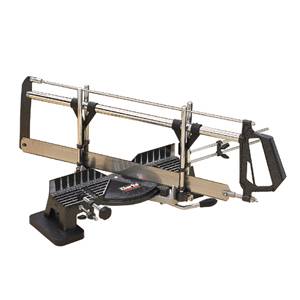
Hack saws without a guide can work fine, but only if you are good with a saw. Personally, when ever I use a handsaw freehand my cuts are always crooked. The RIGHT way to do it is to use a guide that clamps onto the bar. The saw blade is in this guide and your cut will be perpendicular to the pipe. A mitre saw also works very well if you can clamp the pipe in place somehow.
 08-10-07 | 01:14 PM
#32

BFSSFG old timer
Joined: Apr 2001
Posts: 1,912
Likes: 1
From: Fredrock
 08-10-07 | 01:15 PM
#33

:jarckass:
Joined: Aug 2006
Posts: 6,562
Likes: 1
From: Nashville
 Otherwise youre ****ed.
Obviously, I was referring to a freehand cut.
08-10-07 | 01:22 PM
#34
BFSSFG old timer
Joined: Apr 2001
Posts: 1,912
Likes: 1
From: Fredrock
I've done freehand (wrap tape around the steerer) and used a hose clamp for a guide on many forks, you just need to take it slow. I've also broken a few pipe cutting wheels on steel forks (hence the hacksaw job). And I sure wouldn't want to try to cut a threaded fork with a pipe cutter. That said, pipe cutters are handy tools for the right job.
08-10-07 | 01:36 PM
#36
BFSSFG old timer
Joined: Apr 2001
Posts: 1,912
Likes: 1
From: Fredrock
1) Freehand with the tape as a visual guide
2) Cut using a hose clamp as a guide (although if you've ever done this, it's still sort of freehand 'cause it's easy to go off course
)
08-10-07 | 01:55 PM
#38
BFSSFG old timer
Joined: Apr 2001
Posts: 1,912
Likes: 1
From: Fredrock


