


Gatorskin vs Randonneur
 01-23-10 | 05:21 PM
#76

thread derailleur
Joined: May 2008
Posts: 1,095
Likes: 1
From: beyond Thunderdome
Bikes: 82 Bianchi ECO Pista, Pake, Kilo TT, some *** bmx i found underneath an old house
How would you back-pedal on a fixed-gear without first skidding? Correct me if I'm wrong, but isn't the "loss of traction" with a "longer stopping distance" by means of "back pedaling" equate to a type of skidding anyhow?
How about a video? If this is a new way to stop I'm sure the forums, including myself, would very much enjoy seeing some new techniques on the fixed.
How about a video? If this is a new way to stop I'm sure the forums, including myself, would very much enjoy seeing some new techniques on the fixed.
 01-23-10 | 05:26 PM
#77

Hella Raw
Joined: Jul 2009
Posts: 820
Likes: 0
From: San Francisco, CA
are you guys serious? are you both unable to slow your bikes down without skidding? you are aware that back pedaling refers to resistance pedaling as well, right? y'know, where if you pedal slower, your bike rolls more slowly? if you do this enough, you will back pedal your bike to a stop. contrary to what all the action sport videos say, it is possible to modulate your speed on a fixed gear bike without skidding.
01-23-10 | 05:26 PM
#78
Senior Member
Joined: Jun 2009
Posts: 319
Likes: 0
We're talking about a quick stop while moving/spinning fast (20mph+?). I can slow down my bike perfectly fine back pedaling. I'm around 70 GI so I can even back pedal down some hills like Tomo mentioned. I think everyone that rides a fixed gear knows you can modulate speed with your pedaling...
01-23-10 | 09:28 PM
#79

Riding Engineer
Joined: Jan 2008
Posts: 835
Likes: 0
From: Tokyo
Bikes: Kiyo Kiyo Kiyo
That is actually a very good idea. We ought to start a poll, but we should have more "competitors" after all looks like a lot of people use other stuff too. I don't know enough tires to make a poll thread though. Anyone up to it?
01-23-10 | 09:33 PM
#80

King of the Hipsters
Joined: Jan 2005
Posts: 2,128
Likes: 2
From: Bend, Oregon
Bikes: Realm Cycles Custom
Just so we all use the same terms, let's use the following applet for determining gear inches:
https://software.bareknucklebrigade.c...it.applet.html
From my experience, when riding at or below 72 gear inches, a young and athletic rider of normal to light body mass can more efficiently stop a fixed gear bike with resistance pedaling than with skidding.
Above 72 gear inches, a rider needs exceptional athletic ability or exceptional skill in order to ride without a brake and without skidding or skipping.
I presently ride at 61 gear inches, and I consider 63 gear inches the all-around gear ratio.
I have ridden long commutes in the past at up to 82 gear inches with a front brake.
I went down to 61 gear inches in order to keep riding during chemotherapy, and to my surprise, my spin rapidly improved until I found myself getting around town just as fast at 61 gear inches as I had at 72-82 gear inches.
I also noticed that my acceleration and my control increased DRAMATICALLY, and I found myself using my front brake less and less.
I learned that in order to brake with resistance pedaling, it helps to have the correct saddle height.
Correct saddle height for any kind of riding means low enough so that one can fully lower the heel with a 15 degree bend in the knee.
With the saddle this low, correctly low, one can lower his heel, make himself light in the saddle, and begin the resistance before the pedal gets to bottom dead center.
With practice, one learns how much to resist the rising rear pedal so that one maximizes braking action without getting pushed up by the pedal.
One also learns different forward and aft positions on the saddle for different situations; and, on occasion, one can add to the resistance by pulling up on the descending forward pedal (although, when accompanied by a forward position on the bike, this will result in skidding).
Additionally, one learns to not ride "ballistically."
To some riders, not riding ballistically might mean riding slower, but I find that my times between destinations remain the same, which means my average speed must remain the same.
When I first started riding fixed gear, about five years ago, I could not imagine anyone riding without a brake.
However, even before my chemotherapy, and while still riding at 72 gear inches and above, I found that I would, every now and then, get to a destination without having used my brake.
I then started examining those situations in which I did use my brake with the thought of discovering principles or patterns relevant to using or not using my brake.
The second year, I actually made an effort to not use my front brake, and this meant that on those occasions when I would put myself in a situation that required a rapid stop, I would do my best to stop by back pedaling, or resistance pedaling.
Most often, when I had to stop in a hurry I would inadvertently skid, which I considered a failure of sorts.
Over time, I developed sufficient coordination so that I could take the resistance right to the edge of skidding without skidding, and I would stop faster than if I skidded.
I need to emphasize that below 72 gear inches, this does not involve strength, but, rather, timing, coordination, and reflection.
Every time I had to make a major effort to stop, I would examine the WHY of the situation, sometimes turning around and riding through the situation again in order to analyze it.
Eventually, I found that I could actually stop more quickly and with less effort by back pedaling, and partly because I could begin my resistance at any point in the spin; whereas, with skidding, I had to wait for the right pedal position (for a non-ambidextrous skidder, this could mean almost an entire spin cycle).
One spin cycle at 61 gear inches corresponds to 5.4 meters, or almost 18 feet, before one even starts to skid.
The typical fixed gear rider on a factory bike rides at 78 gear inches (48 X 16), and at 78 gear inches the bike travels 6.3 meters, or 24 feet, before beginning the skid.
With back pedaling, though, I can begin to resist the pedals at any point in the spin, which can give me as much as a 24 foot advantage in stopping over a rider who depends on skidding in order to stop.
So, not only can I stop as quickly or more quickly by back pedaling, I can in many situations also begin the braking effort earlier than can a rider who only skids.
Gear down to 72 gear inches or below (I recommend 63 gear inches, or 46 X 19), learn to back pedal and save your tires for riding.
https://software.bareknucklebrigade.c...it.applet.html
From my experience, when riding at or below 72 gear inches, a young and athletic rider of normal to light body mass can more efficiently stop a fixed gear bike with resistance pedaling than with skidding.
Above 72 gear inches, a rider needs exceptional athletic ability or exceptional skill in order to ride without a brake and without skidding or skipping.
I presently ride at 61 gear inches, and I consider 63 gear inches the all-around gear ratio.
I have ridden long commutes in the past at up to 82 gear inches with a front brake.
I went down to 61 gear inches in order to keep riding during chemotherapy, and to my surprise, my spin rapidly improved until I found myself getting around town just as fast at 61 gear inches as I had at 72-82 gear inches.
I also noticed that my acceleration and my control increased DRAMATICALLY, and I found myself using my front brake less and less.
I learned that in order to brake with resistance pedaling, it helps to have the correct saddle height.
Correct saddle height for any kind of riding means low enough so that one can fully lower the heel with a 15 degree bend in the knee.
With the saddle this low, correctly low, one can lower his heel, make himself light in the saddle, and begin the resistance before the pedal gets to bottom dead center.
With practice, one learns how much to resist the rising rear pedal so that one maximizes braking action without getting pushed up by the pedal.
One also learns different forward and aft positions on the saddle for different situations; and, on occasion, one can add to the resistance by pulling up on the descending forward pedal (although, when accompanied by a forward position on the bike, this will result in skidding).
Additionally, one learns to not ride "ballistically."
To some riders, not riding ballistically might mean riding slower, but I find that my times between destinations remain the same, which means my average speed must remain the same.
When I first started riding fixed gear, about five years ago, I could not imagine anyone riding without a brake.
However, even before my chemotherapy, and while still riding at 72 gear inches and above, I found that I would, every now and then, get to a destination without having used my brake.
I then started examining those situations in which I did use my brake with the thought of discovering principles or patterns relevant to using or not using my brake.
The second year, I actually made an effort to not use my front brake, and this meant that on those occasions when I would put myself in a situation that required a rapid stop, I would do my best to stop by back pedaling, or resistance pedaling.
Most often, when I had to stop in a hurry I would inadvertently skid, which I considered a failure of sorts.
Over time, I developed sufficient coordination so that I could take the resistance right to the edge of skidding without skidding, and I would stop faster than if I skidded.
I need to emphasize that below 72 gear inches, this does not involve strength, but, rather, timing, coordination, and reflection.
Every time I had to make a major effort to stop, I would examine the WHY of the situation, sometimes turning around and riding through the situation again in order to analyze it.
Eventually, I found that I could actually stop more quickly and with less effort by back pedaling, and partly because I could begin my resistance at any point in the spin; whereas, with skidding, I had to wait for the right pedal position (for a non-ambidextrous skidder, this could mean almost an entire spin cycle).
One spin cycle at 61 gear inches corresponds to 5.4 meters, or almost 18 feet, before one even starts to skid.
The typical fixed gear rider on a factory bike rides at 78 gear inches (48 X 16), and at 78 gear inches the bike travels 6.3 meters, or 24 feet, before beginning the skid.
With back pedaling, though, I can begin to resist the pedals at any point in the spin, which can give me as much as a 24 foot advantage in stopping over a rider who depends on skidding in order to stop.
So, not only can I stop as quickly or more quickly by back pedaling, I can in many situations also begin the braking effort earlier than can a rider who only skids.
Gear down to 72 gear inches or below (I recommend 63 gear inches, or 46 X 19), learn to back pedal and save your tires for riding.
 01-24-10 | 07:46 PM
#82
Senior Member
Joined: Jun 2009
Posts: 319
Likes: 0
Interesting reply Ken. I guess I just don't have the timing/coordination to backpedal to a stop (quickly) while spinning fast. If my feet are spinning fast it's just more natural to lock my feet. I personally like skidding though, especially down hills. The couple extra tires a year isn't a big deal for me.
01-24-10 | 07:51 PM
#83
Hella Raw
Joined: Jul 2009
Posts: 820
Likes: 0
From: San Francisco, CA
Interesting reply Ken. I guess I just don't have the timing/coordination to backpedal to a stop (quickly) while spinning fast. If my feet are spinning fast it's just more natural to lock my feet. I personally like skidding though, especially down hills. The couple extra tires a year isn't a big deal for me.
 01-24-10 | 07:57 PM
#84
Riding Engineer
Joined: Jan 2008
Posts: 835
Likes: 0
From: Tokyo
Bikes: Kiyo Kiyo Kiyo
Oh don't be a guy with "a glass half empty". Be a guy with "a glass half full".
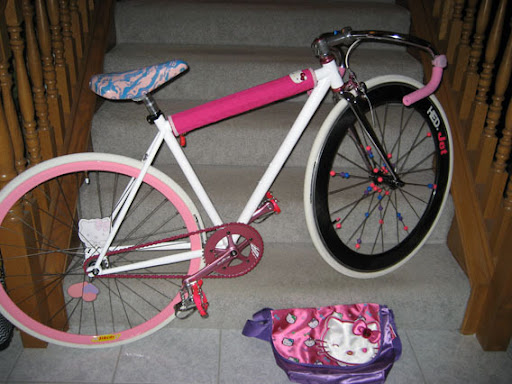
It means you can swap and use brand-new tires every few weeks. It gives you a good excuse to swap colors and stuff. Who knows, you look better with pink tires.
It means you can swap and use brand-new tires every few weeks. It gives you a good excuse to swap colors and stuff. Who knows, you look better with pink tires.


 03-24-10 | 01:52 AM
#91

Senior Member
Joined: Dec 2009
Posts: 215
Likes: 0
From: San Diego, CA
03-24-10 | 08:38 AM
#92
Spin Meister
Joined: May 2008
Posts: 2,658
Likes: 74
From: California, USA
Bikes: Trek Émonda, 1961 Follis (French) road bike (I'm the original owner), a fixie, a mountain bike, etc.
"specialized armadillo's are great for flat protection but ride like rocks"
I have to disagree with stryper on this one - I don't think the armadillos are that bad a ride - at least not the elite's I've tried. Their rated under 300 grams.
I have to disagree with stryper on this one - I don't think the armadillos are that bad a ride - at least not the elite's I've tried. Their rated under 300 grams.
__________________
This post is a natural product. Slight variations in spelling and grammar enhance its individual character and beauty and are in no way to be considered flaws or defects.
This post is a natural product. Slight variations in spelling and grammar enhance its individual character and beauty and are in no way to be considered flaws or defects.
03-24-10 | 08:50 AM
#93

Senior Member
Joined: Aug 2007
Posts: 1,092
Likes: 0
From: where the mild things roam
+1 to pretty much most of what ken said.
this is my fifth year on fixed and i've tried everything for stopping from resisting 80gis to skipping 59 and back. currently, my model is 67gi with resistance as my primary method with some skipping thrown in for fun (admit it: it's fun) -- and to take some pressure off my aging knees -- and a front brake for those "yikes!" moments (and those moments get increasingly rare -- the last one was july).
lower gi is, of course, the key. with practice, you can get your spin ramped up enough that 67 or even lower doesn't put too big a dent in your speed and the payoff in control makes it worth it.
this is my fifth year on fixed and i've tried everything for stopping from resisting 80gis to skipping 59 and back. currently, my model is 67gi with resistance as my primary method with some skipping thrown in for fun (admit it: it's fun) -- and to take some pressure off my aging knees -- and a front brake for those "yikes!" moments (and those moments get increasingly rare -- the last one was july).
lower gi is, of course, the key. with practice, you can get your spin ramped up enough that 67 or even lower doesn't put too big a dent in your speed and the payoff in control makes it worth it.
03-24-10 | 04:18 PM
#94
"I love lamp"

Joined: May 2004
Posts: 427
Likes: 0
From: Dirty Jersey
Bikes: 06 Fuji Track with upgrades, 06 Redline Flight Monocog, 01 Trek XO1, 2003 Cervelo P3, 2006 Bianchi San Jose monstercross
I like gatorskins the best, although I currently run a gatorskin on the back only. I have a 28 on the rear of my everyday wheels and a 23 on my dura ace wheels. I will run a nice conti up front like a 4000 or a 4 seasons. I have used the Refuse, the Rando and the TServ in the past. I didn't care for the ride of the TServs, took them off after like 100 miles. I run the rando's on my san jose but am not a big fan as they feel sluggish and vague. The refuse are ok, I run them on my trek xo1 with my rain wheels.
03-25-10 | 08:09 AM
#97

Senior Member
Joined: Jun 2009
Posts: 1,047
Likes: 1
From: Dallas, TX
Bikes: Panasonic NJS Keirin x2, Level Professional, Bianchi CUSS, GT Pulse
Soooo smooth man. The randos are a little boxy right from the get go, and the Ribmo is much rounder, if that makes since. There's less rolling resistance, but the sidewalls roll nearly all the way to the bead, so it skids real well if you're a whipper. I will say the compound is much softer than a Randonneur though, so it'll pick up little pieces of road debris.
The 28c barely fits my stays w a 44t; if I moved up on my chainring it wouldn't work. But this is on my Panasonic, so the stays are super narrow anyway. They make a 25c, but I like the 28 bc my streets blow and it offers alot of additional cushioning. Overall, I'd say it's much more "robust" than the Randonneur; we'll see how long it lasts. I'm using a foldable for weight savings.
The 28c barely fits my stays w a 44t; if I moved up on my chainring it wouldn't work. But this is on my Panasonic, so the stays are super narrow anyway. They make a 25c, but I like the 28 bc my streets blow and it offers alot of additional cushioning. Overall, I'd say it's much more "robust" than the Randonneur; we'll see how long it lasts. I'm using a foldable for weight savings.
