


Modifying fork to accept low-rider rack - need to be specific to a rack type?
 09-03-19 | 03:16 PM
#1


Modifying fork to accept low-rider rack - need to be specific to a rack type?
I'm getting a fork modified with some braze-ons (to take a rando-bag rack, post-mounted centerpull brakes, and low-rider rack).
In this thread I am asking about locations for low-rider braze-ons. For maximum compatibility, it looks like I need:
a) an eyelet in front of the dropout (my fork already has fender-stay eyelet behind the dropout)
b) a mid-fork eyelet (I'll probably have this on the middle of the blade or the back, so it doesn't interfere with the mid-fork eyelet to support a handlebar bag randonneur rack)
There are numerous low-rider rack designs; are most designs sensitive to precise relative locations of the two mounting points, or is there a fair bit of adjustment so the fork-based mounting points can have some variability and racks will still work? My fork has a bit more offset than typical steel forks.
I have one other question. I appreciate the suspension that steel fork blades can provide on a rim-brake bike (disc brake requires the fork blades be more rigid). I'd guess that most low rider racks make the ride more rigid by connecting the dropout to the middle of the fork blade area. Are there any low-rider designs that allow the end of the fork blades to flex more?
In this thread I am asking about locations for low-rider braze-ons. For maximum compatibility, it looks like I need:
a) an eyelet in front of the dropout (my fork already has fender-stay eyelet behind the dropout)
b) a mid-fork eyelet (I'll probably have this on the middle of the blade or the back, so it doesn't interfere with the mid-fork eyelet to support a handlebar bag randonneur rack)
There are numerous low-rider rack designs; are most designs sensitive to precise relative locations of the two mounting points, or is there a fair bit of adjustment so the fork-based mounting points can have some variability and racks will still work? My fork has a bit more offset than typical steel forks.
I have one other question. I appreciate the suspension that steel fork blades can provide on a rim-brake bike (disc brake requires the fork blades be more rigid). I'd guess that most low rider racks make the ride more rigid by connecting the dropout to the middle of the fork blade area. Are there any low-rider designs that allow the end of the fork blades to flex more?
Last edited by TallRider; 09-03-19 at 03:22 PM.
 09-03-19 | 03:24 PM
#2

The dropped

Joined: Oct 2018
Posts: 2,182
Likes: 1,055
From: Columbus, OH
Bikes: Pake C'Mute Touring/Commuter Build, 1989 Kona Cinder Cone, 1995 Trek 5200, 1973 Raleigh Super Course FG, 1969 Raleigh Superbe, 1986 Miyata Nine : 1960/61 Montgomery Ward Hawthorne "thrift" 3 speed, by Hercules (sold), 1966 Schwinn Deluxe Racer (sold)
I'm not sure this is something you need to specify to your frame builder. Many forks, threaded and threadless, come with such braze ons without knowledge of which rack can be bolted on there.
Many racks and lowriders are also adjustable for different fork configurations. Tubus racks are the easiest example, but Surly and Blackburn also sell racks. You must like this fork to pay to alter it.
Many racks and lowriders are also adjustable for different fork configurations. Tubus racks are the easiest example, but Surly and Blackburn also sell racks. You must like this fork to pay to alter it.
09-03-19 | 03:27 PM
#3
The dropped
Joined: Oct 2018
Posts: 2,182
Likes: 1,055
From: Columbus, OH
Bikes: Pake C'Mute Touring/Commuter Build, 1989 Kona Cinder Cone, 1995 Trek 5200, 1973 Raleigh Super Course FG, 1969 Raleigh Superbe, 1986 Miyata Nine : 1960/61 Montgomery Ward Hawthorne "thrift" 3 speed, by Hercules (sold), 1966 Schwinn Deluxe Racer (sold)
I have one other question. I appreciate the suspension that steel fork blades can provide on a rim-brake bike (disc brake requires the fork blades be more rigid). I'd guess that most low rider racks make the ride more rigid by connecting the dropout to the middle of the fork blade area. Are there any low-rider designs that allow the end of the fork blades to flex more?
 09-03-19 | 04:07 PM
#4
I'm not sure this is something you need to specify to your frame builder. Many forks, threaded and threadless, come with such braze ons without knowledge of which rack can be bolted on there.
Many racks and lowriders are also adjustable for different fork configurations. Tubus racks are the easiest example, but Surly and Blackburn also sell racks. You must like this fork to pay to alter it.
Many racks and lowriders are also adjustable for different fork configurations. Tubus racks are the easiest example, but Surly and Blackburn also sell racks. You must like this fork to pay to alter it.
I wanted a low-trail bike for riding with front loads - mainly a handlebar bag, but also at times with low-rider panniers. This is already fairly low-trail (and the framebuilder might increase the rake/offset just a bit), and the frame fits me very well and hasn't seen many miles despite its age. It's harder to find 1" threaded forks to fit this frame. (I'm getting some modifications on the frame as well, and weighed doing this vs buying a new frame/fork, and decided to go this route)
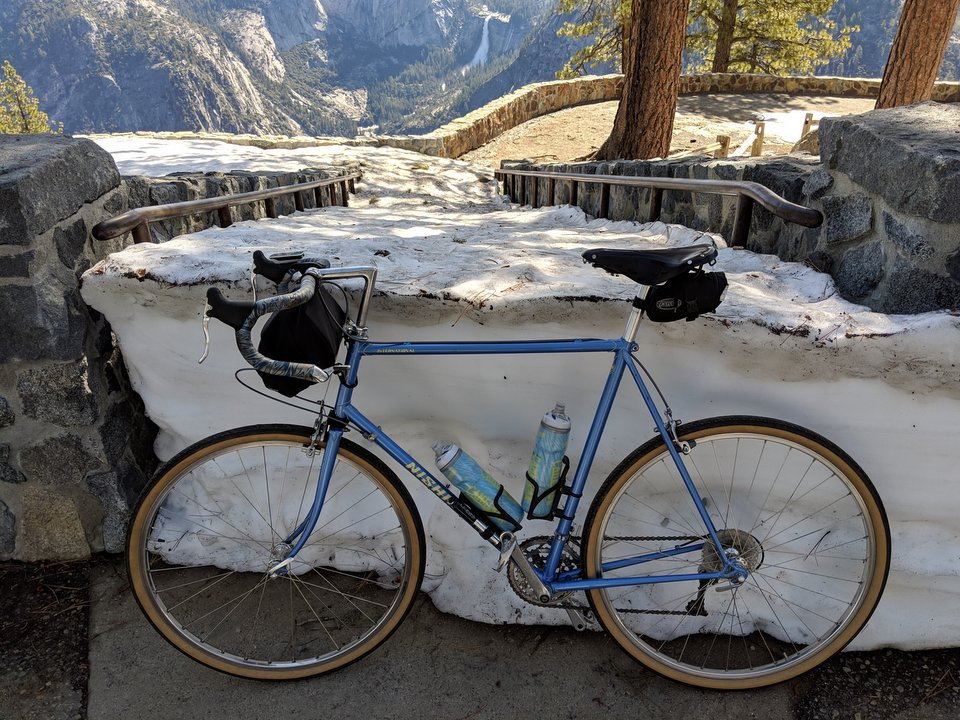
Here's a picture of the frame in its pre-modified incarnation.
Good point; when I put the low-riders on I'll have front load that will probably more than offset any increase in stiffness of the fork blades.
 09-03-19 | 08:52 PM
#5

Senior Member

Joined: Feb 2004
Posts: 3,814
Likes: 434
From: Thailand..........currently Nakhon Ricefield, moving to the beach soon.
Bikes: inferior steel....alas....noodly aluminium assploded
a competent frame builder should know what's needed, but if you're concerned, safest and simplest thing would be to include the low-rider when you deliver the frame and fork.

 (OMG wow!)
09-03-19 | 09:29 PM
(OMG wow!)
09-03-19 | 09:29 PM
#7
I live near Yosemite, and this year I was the first cyclist to Glacier Point when they opened the road to cyclists (a day or two before they open to motor traffic, as they still have some things to fix on the road after the snow has been plowed). I had to do the ride really early because I had a graduation ceremony to attend in early afternoon.
09-03-19 | 09:45 PM
#8

Senior Member


Joined: Oct 2014
Posts: 14,160
Likes: 5,286
From: Portland, OR
Bikes: (2) ti TiCycles, 2007 w/ triple and 2011 fixed, 1979 Peter Mooney, ~1983 Trek 420 now fixed and ~1973 Raleigh Carlton Competition gravel grinder
Thanks for the feedback; I figured front low-rider racks are fairly flexible and/or standardized, but it's good to have confirmation.
I wanted a low-trail bike for riding with front loads - mainly a handlebar bag, but also at times with low-rider panniers. This is already fairly low-trail (and the framebuilder might increase the rake/offset just a bit), and the frame fits me very well and hasn't seen many miles despite its age. It's harder to find 1" threaded forks to fit this frame. (I'm getting some modifications on the frame as well, and weighed doing this vs buying a new frame/fork, and decided to go this route)
Here's a picture of the frame in its pre-modified incarnation.
Good point; when I put the low-riders on I'll have front load that will probably more than offset any increase in stiffness of the fork blades.
I wanted a low-trail bike for riding with front loads - mainly a handlebar bag, but also at times with low-rider panniers. This is already fairly low-trail (and the framebuilder might increase the rake/offset just a bit), and the frame fits me very well and hasn't seen many miles despite its age. It's harder to find 1" threaded forks to fit this frame. (I'm getting some modifications on the frame as well, and weighed doing this vs buying a new frame/fork, and decided to go this route)
Here's a picture of the frame in its pre-modified incarnation.
Good point; when I put the low-riders on I'll have front load that will probably more than offset any increase in stiffness of the fork blades.
I love LowRiders and their competition because the ride and handling of the bike change so little between light and loaded. But one thing to keep in mind - since the racks and bags are not sprung weight, they are subject to far more road shock than you see. Be mindful or you will be breaking delicate baggage and bruising fruits and vegetables. Also your front wheel sees far more abuse. A stronger rim is a smart move.
Ben
 09-04-19 | 11:15 AM
#9
No, that doesn't happen. LowRiders direct weight straight to the front hub, completely bypassing the suspension effects provided by the frame. I suppose the rack stiffens the fork but I have never noticed that effect. My stiffest rack (a Jandd) is on my most flexy fork. It is still my most flexy fork. I used to take my racks on and off.. Never noticed a difference.
I love LowRiders and their competition because the ride and handling of the bike change so little between light and loaded. But one thing to keep in mind - since the racks and bags are not sprung weight, they are subject to far more road shock than you see. Be mindful or you will be breaking delicate baggage and bruising fruits and vegetables. Also your front wheel sees far more abuse. A stronger rim is a smart move.
I love LowRiders and their competition because the ride and handling of the bike change so little between light and loaded. But one thing to keep in mind - since the racks and bags are not sprung weight, they are subject to far more road shock than you see. Be mindful or you will be breaking delicate baggage and bruising fruits and vegetables. Also your front wheel sees far more abuse. A stronger rim is a smart move.
I appreciate the note about front lowrider racks getting whatever motion/impact/vibration the front hub does. I'll be running at least 32mm tires here, possibly larger, but will have a wheel set up to take some abuse (likely Sun CR18 with 32 spokes, and I'll go with 36 spokes if I end up with heavier front loads).
09-04-19 | 02:07 PM
#10
Senior Member
Joined: Oct 2014
Posts: 14,160
Likes: 5,286
From: Portland, OR
Bikes: (2) ti TiCycles, 2007 w/ triple and 2011 fixed, 1979 Peter Mooney, ~1983 Trek 420 now fixed and ~1973 Raleigh Carlton Competition gravel grinder
Yeah, I was just thinking that a low-rider rack, since it crosses the curved (and most flexy) part of a fork, might stiffen it somewhat. But it sounds like not much, if at all.
I appreciate the note about front lowrider racks getting whatever motion/impact/vibration the front hub does. I'll be running at least 32mm tires here, possibly larger, but will have a wheel set up to take some abuse (likely Sun CR18 with 32 spokes, and I'll go with 36 spokes if I end up with heavier front loads).
I appreciate the note about front lowrider racks getting whatever motion/impact/vibration the front hub does. I'll be running at least 32mm tires here, possibly larger, but will have a wheel set up to take some abuse (likely Sun CR18 with 32 spokes, and I'll go with 36 spokes if I end up with heavier front loads).
Ben
09-04-19 | 04:05 PM
#11
Senior Member
Joined: Apr 2006
Posts: 720
Likes: 19
From: Tucson, AZ
Bikes: Road, mountain and track bikes and tandems.
I am a frame builder/ bike tourist; The low rider rack attaches to the rear (behind the fork) mount, the fender mounts to the front, or not at all if you use a (slide -on) clip on fender.
The standard placement for the low rider rack is between six and six and one half inches ( have put on quite a few at 6.25 inches) from the center of the rear rack mount and the center of the fork blade.
I am glad to see you are still touring. Last time that I saw one of your posts, you were in central America, breaking rack bolts like pretzels and thinking of heading for Europe.
The standard placement for the low rider rack is between six and six and one half inches ( have put on quite a few at 6.25 inches) from the center of the rear rack mount and the center of the fork blade.
I am glad to see you are still touring. Last time that I saw one of your posts, you were in central America, breaking rack bolts like pretzels and thinking of heading for Europe.
09-04-19 | 04:13 PM
#12
Senior Member
Joined: Apr 2006
Posts: 720
Likes: 19
From: Tucson, AZ
Bikes: Road, mountain and track bikes and tandems.
I forgot to mention that since your new "project" bike will likely get new paint, I noticed that the Nishiki has horizontal drop outs. The disadvantage being that there is the likely hood of pulling the rear wheel over from hard up hill cranking. That can be remedied by having little tabs on the front of the drop outs, stopping the wheel from pulling over. Sort of like the little tabs that you see on forks.

Thread
Thread Starter
Forum
Replies
Last Post
wrk101
Classic & Vintage
5
04-11-14 05:37 AM
Uosdwis R Dewoh
Bicycle Mechanics
10
02-24-11 11:30 PM
