


Thoughts on double vs triple
 02-07-13 | 03:10 PM
#1
Thread Starter
Senior Member
Joined: Feb 2005
Posts: 56
Likes: 0
Thoughts on double vs triple
I'm currently in the preliminary stages of building a touring bike. My thoughts for the drive train include a Shimano XT 10 speed setup. The LBS guy advised that I should go with a double as with this setup the ratios are the same as a triple if one gets the rear cogs right. I haven't done the math and wonder if this is true? Any advice would be helpful.
Thanks
Thanks
 02-07-13 | 03:42 PM
#2
Senior Member
Joined: May 2009
Posts: 358
Likes: 0
Use Sheldon Brown's gear calculator to see for yourself. Plug in the appropriate chainwheel and freewheel values and you'll have your answer.
I prefer to use it in gear inches mode, since that's the way I've always talked about gearing. For reference, my dedicated touring bike is 18" to 101", which is a bit lower than most "off the shelf" touring bikes and way lower than you can get with any normal double setup. I use a 48-36-22 triple in the front and a 13-34 custom freewheel in the back.
I prefer to use it in gear inches mode, since that's the way I've always talked about gearing. For reference, my dedicated touring bike is 18" to 101", which is a bit lower than most "off the shelf" touring bikes and way lower than you can get with any normal double setup. I use a 48-36-22 triple in the front and a 13-34 custom freewheel in the back.
02-07-13 | 03:49 PM
#4

The Recumbent Quant

Joined: Jan 2012
Posts: 3,094
Likes: 8
From: Fairfield, CT
Bikes: 2012 Cruzbike Sofrider, 2013 Cruzigami Mantis, 2016 Folding CruziTandem
First, it's hard to get the same range on a double that you can get on a triple. Second, when trying to get close to the same range on a double that you have on a triple, your gears are going to be bigger jumps (which some people don't mind, but I really do).
Some people tour on single speed bicycles and like them. There aren't really any (real) disadvantages to them. If it were me, I'd get a triple.
Some people tour on single speed bicycles and like them. There aren't really any (real) disadvantages to them. If it were me, I'd get a triple.
02-07-13 | 03:51 PM
#5

Mad bike riding scientist


Joined: Nov 2004
Posts: 29,141
Likes: 6,201
From: Denver, CO
Bikes: Some silver ones, a red one, a black and orange one, and a few titanium ones
I'm currently in the preliminary stages of building a touring bike. My thoughts for the drive train include a Shimano XT 10 speed setup. The LBS guy advised that I should go with a double as with this setup the ratios are the same as a triple if one gets the rear cogs right. I haven't done the math and wonder if this is true? Any advice would be helpful.
Thanks
Thanks
The website will let you compare the ratios side-by-side. If you use the mountain bike numbers, you can quickly see that the trekking crank has a wider range and, in my opinion, a more useful range. The compact mountain crank has some large holes that would require constant double shifts to try to get to the range that you may want or need. The road compact double has the same holes with a higher high but the low end isn't as good. With the triple, you have more intermediate choices which come in handy while riding all day.
You can always change the chainwheels but I doubt that you would want to pair a 48 tooth outer with a 24 tooth inner...use the calculator...it would have a good high and an okay low but the jumps would be huge. On the other hand, you could change the inner ring on the trekking set to a 22 (or even a 20) and have a great range.
__________________
Stuart Black
Dreamin' of Bemidji Down the Mississippi (in part)
Plan Epsilon Around Lake Michigan in the era of Covid
Gold Fever Three days of dirt in Colorado
Pokin' around the Poconos A cold ride around Lake Erie
Dinosaurs in Colorado A mountain bike guide to the Purgatory Canyon dinosaur trackway
Solo Without Pie. The search for pie in the Midwest.
Picking the Scablands. Washington and Oregon, 2005. Pie and spiders on the Columbia River!
Stuart Black
Dreamin' of Bemidji Down the Mississippi (in part)
Plan Epsilon Around Lake Michigan in the era of Covid
Gold Fever Three days of dirt in Colorado
Pokin' around the Poconos A cold ride around Lake Erie
Dinosaurs in Colorado A mountain bike guide to the Purgatory Canyon dinosaur trackway
Solo Without Pie. The search for pie in the Midwest.
Picking the Scablands. Washington and Oregon, 2005. Pie and spiders on the Columbia River!
02-07-13 | 03:55 PM
#6

Senior Member
Joined: Dec 2007
Posts: 895
Likes: 10
From: columbus, ohio
Bikes: Soma Saga, 1980 Schwinn Voyageur 11.8, New Albion Privateer
Much obviously depends on the terrain you'll be in. If in hilly or mountainous you would be best served by a mountain triple front crank (at least 46-36-26)and a wide range rear cassette. Personally, I'd opt for an eight speed for the simple reason that an eight speed chain is stronger and cheaper than a ten speed (eight speed cassettes are cheaper too). Also, most touring bikes are set up with triples. Further, look on Sheldon Brown's website https://www.sheldonbrown.com/ for article on gear ratios to answer your questions.
02-07-13 | 04:00 PM
#7

The Rabbi
Joined: Apr 2004
Posts: 5,123
Likes: 3
It entirely depends on your crank and cassette selection. Since you're running an XT group, you have a very wide range of cassettes to choose from. Your crank, if a double, will likely be the 40/28t model, vs. a triple which is 42/32/24t. I wouldn't worry much about losing your top end. Loaded, you're not going to be winding it out much on the flats, and downhill you're likely coasting anyway. Now, for the low end, you're losing a bit since your low gear will be a 28t instead of a 24t. However, depending on your cassette selection, this can be all but voided. If you run a 12-32 on the triple, you'll get about 95% of the same gear ratios by running a 11-34 with the double, for example.
02-07-13 | 04:16 PM
#8
Senior Member
Joined: May 2009
Posts: 358
Likes: 0
One more thing.
You mentioned an XT group, which is a MTB group. If that includes a MTB crank, it commits you to MTB shifters unless you friction shift the front or do something creative. This is no problem if it's what you want. Otherwise, it's another thing to consider.
You mentioned an XT group, which is a MTB group. If that includes a MTB crank, it commits you to MTB shifters unless you friction shift the front or do something creative. This is no problem if it's what you want. Otherwise, it's another thing to consider.
02-07-13 | 04:20 PM
#9

Senior Member
Joined: Jul 2008
Posts: 866
Likes: 0
From: Atlanta
Bikes: LHT
2 questions:
1.) what benefit would you get out of running a double crank (price? simplicity? weight?) and is that a reasonable benefit(s)
2.) why would they make triple cranks if there was no reason to run them instead of a double?
less gears with the same range = a larger space between gears
1.) what benefit would you get out of running a double crank (price? simplicity? weight?) and is that a reasonable benefit(s)
2.) why would they make triple cranks if there was no reason to run them instead of a double?
less gears with the same range = a larger space between gears
02-07-13 | 04:26 PM
#10
Senior Member
Joined: Jul 2008
Posts: 866
Likes: 0
From: Atlanta
Bikes: LHT
One more thing.
You mentioned an XT group, which is a MTB group. If that includes a MTB crank, it commits you to MTB shifters unless you friction shift the front or do something creative. This is no problem if it's what you want. Otherwise, it's another thing to consider.
You mentioned an XT group, which is a MTB group. If that includes a MTB crank, it commits you to MTB shifters unless you friction shift the front or do something creative. This is no problem if it's what you want. Otherwise, it's another thing to consider.
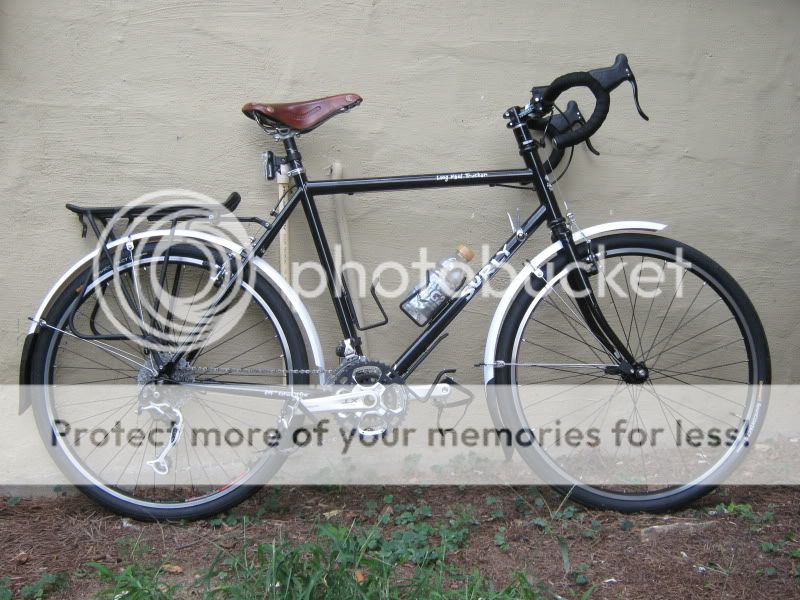 ahh, you mean like this ; )
I like my setup, but I must admit, for commuting this setup feels like that sweet spot is between the 3rd and 2nd chainrings so I constantly ride in the faster cogs in the 2nd chainring or middle cogs with the 3rd. Loaded it feels great. This is only a 9 speed cog.
02-07-13 | 04:48 PM
#11
Banned
Joined: Jun 2010
Posts: 43,586
Likes: 1,380
From: NW,Oregon Coast
Bikes: 8
NEITHER Get an IGH
Now 15 years ago I toured on a 50,40,24 triple, 13-34 rear,
but now the Rohloff does things so Much Better.
my Brompton has a 2 speed IG cank 54t, '21.6' (as it's a 2,5 reduction gear)
AW3 is used twice, as if a 6 speed ,
Rohloff does that too, with a 7 speed x2, but all in the same case.
in the 80's my AYH trip leader initiation , a fellow brought his TA double 50 28. 13-28 rear from UK,
.. it worked.
Last edited by fietsbob; 02-07-13 at 05:06 PM.
02-07-13 | 04:55 PM
#12

Senior Member
Joined: Mar 2004
Posts: 677
Likes: 3
From: Grants Pass, Oregon
Bikes: Hard Rock Sport, Peugeot Triathlon, Schwinn Paramount Series 7
What kind of touring are you thinking of doing? A compact double could be fine for ultralight touring, credit card touring, etc., or if you're young and a strong rider.
I have a compact double on my road bike, and it's fine for that. But I'd never run that on my touring bike. I don't ride light, and I'm not young. Loaded, the touring bike weighs about four and a half times more than the road bike and climbing hills is hard enough already. Even with a 36T cassette I could only get the gear inches down to about 24 with the compact double (50/34) and then would have to deal with big jumps between gears. Smallest chainring on the touring bike is 24T and even with just a 28T cassette it gets me down to 22 gear inches and gives me a lot more choices in the middle. To each his own, but for myself a triple works best for loaded touring.
I have a compact double on my road bike, and it's fine for that. But I'd never run that on my touring bike. I don't ride light, and I'm not young. Loaded, the touring bike weighs about four and a half times more than the road bike and climbing hills is hard enough already. Even with a 36T cassette I could only get the gear inches down to about 24 with the compact double (50/34) and then would have to deal with big jumps between gears. Smallest chainring on the touring bike is 24T and even with just a 28T cassette it gets me down to 22 gear inches and gives me a lot more choices in the middle. To each his own, but for myself a triple works best for loaded touring.
Last edited by simplygib; 02-07-13 at 05:02 PM.
02-07-13 | 05:13 PM
#13
Banned
Joined: Jun 2010
Posts: 43,586
Likes: 1,380
From: NW,Oregon Coast
Bikes: 8
Seeing a SRAM 11x1 MTB drivetrain, in the catalog, a odd double could result
since the high added to a normal 9 gear set is 10 on one side , and a 42 after the 34
so 50:10, and a 34 :42 might be possible , just be sitting down when asking; How Much?
since the high added to a normal 9 gear set is 10 on one side , and a 42 after the 34
so 50:10, and a 34 :42 might be possible , just be sitting down when asking; How Much?
02-07-13 | 08:22 PM
#14
Senior Member
Joined: Oct 2005
Posts: 3,670
Likes: 43
Bikes: Rivendell Quickbeam, Rivendell Rambouillet, Rivendell Atlantis, Circle A town bike, De Rosa Neo Primato, Cervelo RS, Specialized Diverge
I've never seen the need for high gearing on a touring bike and you should design your gearing give the gear inches you ride most of the time with the least amount of chain angle. I far prefer to ride a double than a triple and I've found that gearing becomes less and less of a concern the more you tour. I currently tour on a 50/34 with an 12/25 cassette and love it. Go with a double.
02-07-13 | 08:28 PM
#15

Senior Member
Joined: May 2008
Posts: 9,102
Likes: 6,009
From: Zang's Spur, CO
02-07-13 | 08:58 PM
#16
Senior Member

Joined: Jul 2010
Posts: 13,905
Likes: 1,241
From: Montreal Canada
Nuns assessment works great for his setup, a light bike, a very light load. His view on the range of gear inches is very realistic, but again, depends on the load and the terrain.
For me the kicker is what sort of load do you think you will be carrying, but even then I am very much a fan of triples. FDs shift perfectly well with triples, and the angle of the chain is always going to be better, guys in stores dont give a hoot often about cross chaining and such, and also will tell you that you need to change your chain every 1500km or whatever--and I may be an old sourpuss but usually folks who give out gearing advice in stores havent toured with lots of weight in hilly terrain.
Plus in my experience most of the time we are in the middle chainring, so it reduces the amount of chainring shifting one does. I too like tighter jumps between cogs, and a triple will help with that as you can put a tighter cassette on and still have the triple range of gearing from up front. In fact, tighter jumps and closer jumps between chainrings is even more important when you have 30, 40, 50 lbs of crap on a bike as it is much harder on the knees and legs with bigger jumps between shifts.
my take on ideal cranks for a touring bike--for most touring situations and the bike being used lightly or unloaded, 46/36/26 works great.
A mountain crank 44/32/22 can also work great if you are fully loaded and or will be in really mountainous terrain--people poo-poo this gearing but the reality of heavy touring is that you will most often be riding from 10-25kph, and a mtn crank works fine and can give you lower gearing below 20 gear inches easily for really steep hills.
Give us an idea of what touring you have done, with what sort of weight and in what sort of terrain. As mentioned, this will really give a better idea of what sort of situation you will be touring in the future--is it a 20lb bike with 15lbs of stuff riding in Florida, or a 35lb bike with 50lbs of stuff in the Alps or the Appalachians.
ps, 8 speed stuff is cheap, 9 speed stuff is now nothing special so reasonably priced, 10 speed stuff much more expensive (chains, cassettes) so perhaps look into the prices between 9 and 10 stuff. Also to consider that 10 speed stuff would be harder to find parts depending on where you are planning to tour. I only know 7, 8 and 9 speed stuff for longevity so can't speak for 10.
Id go with 9, just because its still got slightly closer gearing jumps than the equivelent 8, but has been around now for so long that finding parts as mentioned is easier and cheaper (again, not an issue if in N American, Europe) and seems to me to be the good balance of cost/performance.
For me the kicker is what sort of load do you think you will be carrying, but even then I am very much a fan of triples. FDs shift perfectly well with triples, and the angle of the chain is always going to be better, guys in stores dont give a hoot often about cross chaining and such, and also will tell you that you need to change your chain every 1500km or whatever--and I may be an old sourpuss but usually folks who give out gearing advice in stores havent toured with lots of weight in hilly terrain.
Plus in my experience most of the time we are in the middle chainring, so it reduces the amount of chainring shifting one does. I too like tighter jumps between cogs, and a triple will help with that as you can put a tighter cassette on and still have the triple range of gearing from up front. In fact, tighter jumps and closer jumps between chainrings is even more important when you have 30, 40, 50 lbs of crap on a bike as it is much harder on the knees and legs with bigger jumps between shifts.
my take on ideal cranks for a touring bike--for most touring situations and the bike being used lightly or unloaded, 46/36/26 works great.
A mountain crank 44/32/22 can also work great if you are fully loaded and or will be in really mountainous terrain--people poo-poo this gearing but the reality of heavy touring is that you will most often be riding from 10-25kph, and a mtn crank works fine and can give you lower gearing below 20 gear inches easily for really steep hills.
Give us an idea of what touring you have done, with what sort of weight and in what sort of terrain. As mentioned, this will really give a better idea of what sort of situation you will be touring in the future--is it a 20lb bike with 15lbs of stuff riding in Florida, or a 35lb bike with 50lbs of stuff in the Alps or the Appalachians.
ps, 8 speed stuff is cheap, 9 speed stuff is now nothing special so reasonably priced, 10 speed stuff much more expensive (chains, cassettes) so perhaps look into the prices between 9 and 10 stuff. Also to consider that 10 speed stuff would be harder to find parts depending on where you are planning to tour. I only know 7, 8 and 9 speed stuff for longevity so can't speak for 10.
Id go with 9, just because its still got slightly closer gearing jumps than the equivelent 8, but has been around now for so long that finding parts as mentioned is easier and cheaper (again, not an issue if in N American, Europe) and seems to me to be the good balance of cost/performance.
Last edited by djb; 02-07-13 at 09:04 PM.
02-07-13 | 09:47 PM
#17
weirdo
Joined: Jan 2008
Posts: 1,962
Likes: 5
From: Reno, NV
2 is heading towards being a moot point because the number of triples available seem to be shrinking rapidly since about two years ago. No, not in danger of extinction, but definitely no longer in fashion, even on mtbs, where they ruled the roost for years.
My 11-28 8 speed is pretty much an 11-36 10 speed without the biggest two sprockets, isn`t it? Is the combined weight of those 32t and 36t sprockets a lot lighter than the 24t ring and extra five ring bolts I have on my crank? Is the 2 X 10 drivetrain less expensive than 3 X 7,8,9? Will it last a lot longer than 7, 8 or 9? If any of those are "yes", then I guess there`s the answer.
Last edited by rodar y rodar; 02-07-13 at 09:55 PM.
02-07-13 | 10:18 PM
#18
Senior Member
Joined: May 2009
Posts: 358
Likes: 0
Not necessarily. This FD lets Shimano road shifters work like a charm with a mtb crank: https://store.interlocracing.com/alfrde.html
02-07-13 | 10:22 PM
#19

Senior Member
Joined: Aug 2012
Posts: 527
Likes: 0
From: Houston
Bikes: 2012 Surly LHT / 2024 Surly Karate Monkey / Surly Grappler
The easy way to do the math is to use gear inches. Crankset / cog * tire size so
a 50/34 with 11-34 your lowest gear on a 26" wheel would be 26
26/36/46 with 11-34 would be almost 20
a 50/34 with 11-34 your lowest gear on a 26" wheel would be 26
26/36/46 with 11-34 would be almost 20
02-07-13 | 10:37 PM
#20
Senior Member
Joined: Jul 2010
Posts: 13,905
Likes: 1,241
From: Montreal Canada
as you say, triples are seen less now and thats the line I get from bike store salesguys.
for me, gear is just gear, a tool, if it works fine then Im not opposed to "new stuff" just because its new.
-for me, I"ve always been someone who doesnt cross chain, simply from a "mechanical sympathy" angle, and I keep my drivetrain clean and I figure that these two things mean my drivetrains last longer, and my shifting and such will be smoother and nicer feeling over time due to less wear. For this reason the idea of a double means that there will always be more crosschaining, so life will be harder on a chain and therefore teeth over time, hence the need to change out stuff more often.
Am I wrong here? I can see that on an unloaded bike, its easier to push through a tougher gear, easy to stand and push till you can upshift etc, so maybe a double is less of an issue. I still see it just from common sense that there will be lots of times that the 50 will be too high and the 34 too low--now maybe Im looking at all of this too much from a triple pt of view, ie that a double doesnt crosschain physically as much as a triple, so perhaps my concerns are too much--?? I dunno.
throw in 10 speed chains (or 11) being narrower so therefore perhaps having more longevity issues--again, I dont know from only having 7,8 and 9 experience. I think it is fair to say that 9 speed stuff is still a lot cheaper than 10--but I will admit that in the big scheme of things (like compared to car repairs we have to do) replacing bike parts doesnt happen all that often, not in my case anyway--my drivetrains, brake pads, rims, last a good long time due to all the various factors (keeping stuff clean, Im a low hp rider, I dont drag my brakes all the way down hills etc)
so who knows, maybe its not just that bike companies want to sell more chains and cassettes etc, but that doubles work well compared to triples?
I do know that I dont like chain noise, so keeping a chain straighter is a natural reaction for me, so I cant see how that would change, especially if you dont keep your drivetrain clean, the chain is always going to be crosschained more with a double (Im thinking touring and regular day in day out riding here, not a roadie who keeps his bike super clean all the time)
for me, the added weight is not an issue (again, especially not with a bike with bags on it) and as I mentioned before, my experience with both mtn bike fd and road ones like the Tiagra FD show they are pretty simple to setup properly (Ive installed and or replaced cables on both) and the trim features of the Tiagra fd works perfectly fine, just as its shifting does.
re jumps between shifts, I realize that my 8 speed 11-28 has the same jumps more or less as a 9 speed 11-32 (with the 32 tacked on) so a 10 speed could have similar jumps and still have a nice wide range--but this doesnt change the crosschain issue and or how long the stuff lasts (or availability depending on where you are)--but again, concerning the wear and longevity issue, I just dont know how in real life 10 compares to 9 compares to 8.....
thoughts?
for me, gear is just gear, a tool, if it works fine then Im not opposed to "new stuff" just because its new.
-for me, I"ve always been someone who doesnt cross chain, simply from a "mechanical sympathy" angle, and I keep my drivetrain clean and I figure that these two things mean my drivetrains last longer, and my shifting and such will be smoother and nicer feeling over time due to less wear. For this reason the idea of a double means that there will always be more crosschaining, so life will be harder on a chain and therefore teeth over time, hence the need to change out stuff more often.
Am I wrong here? I can see that on an unloaded bike, its easier to push through a tougher gear, easy to stand and push till you can upshift etc, so maybe a double is less of an issue. I still see it just from common sense that there will be lots of times that the 50 will be too high and the 34 too low--now maybe Im looking at all of this too much from a triple pt of view, ie that a double doesnt crosschain physically as much as a triple, so perhaps my concerns are too much--?? I dunno.
throw in 10 speed chains (or 11) being narrower so therefore perhaps having more longevity issues--again, I dont know from only having 7,8 and 9 experience. I think it is fair to say that 9 speed stuff is still a lot cheaper than 10--but I will admit that in the big scheme of things (like compared to car repairs we have to do) replacing bike parts doesnt happen all that often, not in my case anyway--my drivetrains, brake pads, rims, last a good long time due to all the various factors (keeping stuff clean, Im a low hp rider, I dont drag my brakes all the way down hills etc)
so who knows, maybe its not just that bike companies want to sell more chains and cassettes etc, but that doubles work well compared to triples?
I do know that I dont like chain noise, so keeping a chain straighter is a natural reaction for me, so I cant see how that would change, especially if you dont keep your drivetrain clean, the chain is always going to be crosschained more with a double (Im thinking touring and regular day in day out riding here, not a roadie who keeps his bike super clean all the time)
for me, the added weight is not an issue (again, especially not with a bike with bags on it) and as I mentioned before, my experience with both mtn bike fd and road ones like the Tiagra FD show they are pretty simple to setup properly (Ive installed and or replaced cables on both) and the trim features of the Tiagra fd works perfectly fine, just as its shifting does.
re jumps between shifts, I realize that my 8 speed 11-28 has the same jumps more or less as a 9 speed 11-32 (with the 32 tacked on) so a 10 speed could have similar jumps and still have a nice wide range--but this doesnt change the crosschain issue and or how long the stuff lasts (or availability depending on where you are)--but again, concerning the wear and longevity issue, I just dont know how in real life 10 compares to 9 compares to 8.....
thoughts?
02-07-13 | 11:23 PM
#21
Senior Member
Joined: Jun 2010
Posts: 7,579
Likes: 6
From: Pearland, Texas
Bikes: Cannondale, Trek, Raleigh, Santana
jisho, There's no reason that a double crankset wouldn't be ideal for you, but it wouldn't be ideal for me. I've found that a triple can be more flexable WRT varied terrain and can allow for more closely spaced cassette sprockets, which I prefer. For a loaded tourer a gearing range of 20-100 GIs is most often suggested and I find that good advice.
Brad
Brad
02-08-13 | 12:34 AM
#22

Likes to Ride Far
Joined: May 2007
Posts: 2,354
Likes: 15
From: Switzerland
Bikes: road+, gravel, commuter/tourer, tandem, e-cargo, folder
Definitely consider the spacing (tooth differences) between the rear cogs as well as the total range of gears.
If the terrain is not extremely hilly, then you'll likely find yourself using just 2 or 3 gears in the middle to lower end of the range for up to 50% of the time (any time the gradient is close to level) - if those gears are spread wide apart then you might often end up between two of them, either pedalling with a cadence slightly too low or slightly too high.
I once made the mistake of using a SRAM 11-28 10-speed road cassette for a few days of touring. I spent a huge amount of time in between the 19 and 22 tooth cogs (a 16% difference), not finding a happy cadence. Now I won't tolerate anything more than a 13% difference between cog sizes (largest / smallest), and preferably less.
So, estimate your cruising speed (about 20 kph / 13 mph) and your preferred cadence (80 rpm for many people, 90 rpm for me) and figure out what gear ratios you'll likely need most, and look at the spacing between those to choose your cassette. Also, don't go with a double crank that leaves you in either the big-big cogs or small-small combinations, because then you'll end up needing to shift on the front way too often (this is a big problem with road compact doubles). Once you've got your cruising gears sorted out, then figure out how big of a range of gears you need to choose the inner and outer rings.
If the terrain is not extremely hilly, then you'll likely find yourself using just 2 or 3 gears in the middle to lower end of the range for up to 50% of the time (any time the gradient is close to level) - if those gears are spread wide apart then you might often end up between two of them, either pedalling with a cadence slightly too low or slightly too high.
I once made the mistake of using a SRAM 11-28 10-speed road cassette for a few days of touring. I spent a huge amount of time in between the 19 and 22 tooth cogs (a 16% difference), not finding a happy cadence. Now I won't tolerate anything more than a 13% difference between cog sizes (largest / smallest), and preferably less.
So, estimate your cruising speed (about 20 kph / 13 mph) and your preferred cadence (80 rpm for many people, 90 rpm for me) and figure out what gear ratios you'll likely need most, and look at the spacing between those to choose your cassette. Also, don't go with a double crank that leaves you in either the big-big cogs or small-small combinations, because then you'll end up needing to shift on the front way too often (this is a big problem with road compact doubles). Once you've got your cruising gears sorted out, then figure out how big of a range of gears you need to choose the inner and outer rings.
02-08-13 | 12:34 AM
#23

Senior Member
Joined: Mar 2009
Posts: 6,628
Likes: 1,055
From: Oregon
Originally Posted by xyzzy834
One more thing.
You mentioned an XT group, which is a MTB group. If that includes a MTB crank, it commits you to MTB shifters unless you friction shift the front or do something creative. This is no problem if it's what you want. Otherwise, it's another thing to consider
One more thing.
You mentioned an XT group, which is a MTB group. If that includes a MTB crank, it commits you to MTB shifters unless you friction shift the front or do something creative. This is no problem if it's what you want. Otherwise, it's another thing to consider
LHT set up with a 44/32/22, 11-34 cassette and STI shifters.

My wife's Co-Motion Touring bike with the same set up.

My Bianchi Volpe with the same setup.

Last edited by Doug64; 02-08-13 at 12:37 AM.
02-08-13 | 12:51 AM
#24
Senior Member
Joined: Sep 2008
Posts: 5,300
Likes: 115
I'm currently in the preliminary stages of building a touring bike. My thoughts for the drive train include a Shimano XT 10 speed setup. The LBS guy advised that I should go with a double as with this setup the ratios are the same as a triple if one gets the rear cogs right. I haven't done the math and wonder if this is true? Any advice would be helpful.
Thanks
Thanks
https://www.sheldonbrown.com/gears/
Last edited by LeeG; 02-08-13 at 01:02 AM.
02-08-13 | 07:04 AM
#25

Senior Member
Joined: Jul 2011
Posts: 1,141
Likes: 5
From: Erie Penna.
You ask the same questions I had about gearing and all the above is good sound logic based around each person’s needs and abilities. For what it’s worth here is the logic I used.
After riding doubles and triples and experiencing the wider cassettes I was drawn to the triple because with the center ring in the center it gave me full use of all the cassette.
The question was for me do I want a close spaced cassette because I love the ability of fine tuning as mentioned above or do I want a wide spaced cassette that lets me stay on the center ring more.
The question was more compounded as I wanted to ride the bike loaded but also recreationally and as a commuter and I found my ideal range between the two was a couple of gear inches different.
When I looked at closer spacing on the cassette you lose the larger cogs and that causes you to need a very small granny gear for touring.
I found for me a 42t center ring with a 12-36 cassette covered all my needs except loaded climbing or steep unloaded climbing. I found a 30t granny was just a little too big for me a 26t was really nice and a 24t was amazing for climbing with lots of load.
At that point my answer to your question was I need two rings only but I can’t get them on any double crank spaced like I want with the big ring lined up in the center and a granny as small as I wanted. But a double on a triple crank was really nice. I thought about taking my big ring off all together and rode around for a year with a 52t big ring I never used. I thought about a smaller overall setup so I could use the big ring and tried a 44-32-22 mtn crank and liked the little granny ring and loved the way the 44t ring worked with the 3 smallest cogs (straight chain line) and absolutely hated the 32t center ring because I had to make that front shift part way thru my range. I just felt I was always thinking about where I was with the shifting.
That gave me the idea to try something like maybe having two rings nearly the same size or even the same size as the center and large ring. With playing with the numbers I found 45,42 with my cassette gave me a perfect third ring and half step shifting and the straight chain line on those small cogs. I now have filled in the wide spaces in the 12-36 cassette only when I need them with a simple shift.
So my answer to your question is like Nun said a double will do the job if you can get the rings you need on ether a double or a triple crank and stay away from cross chaining too much and make your big ring work with the whole cassette to give you an almost full range minus the granny range of gears. Or in my case a triple because it gave me everything I wanted in terms of spacing and minimal front shifting and a range of gear that cover both touring loaded and road riding unloaded. No one sells a bike remotely setup like mine and I have a big box of parts getting to where I wanted to be, but the final result is everything I wanted.
After riding doubles and triples and experiencing the wider cassettes I was drawn to the triple because with the center ring in the center it gave me full use of all the cassette.
The question was for me do I want a close spaced cassette because I love the ability of fine tuning as mentioned above or do I want a wide spaced cassette that lets me stay on the center ring more.
The question was more compounded as I wanted to ride the bike loaded but also recreationally and as a commuter and I found my ideal range between the two was a couple of gear inches different.
When I looked at closer spacing on the cassette you lose the larger cogs and that causes you to need a very small granny gear for touring.
I found for me a 42t center ring with a 12-36 cassette covered all my needs except loaded climbing or steep unloaded climbing. I found a 30t granny was just a little too big for me a 26t was really nice and a 24t was amazing for climbing with lots of load.
At that point my answer to your question was I need two rings only but I can’t get them on any double crank spaced like I want with the big ring lined up in the center and a granny as small as I wanted. But a double on a triple crank was really nice. I thought about taking my big ring off all together and rode around for a year with a 52t big ring I never used. I thought about a smaller overall setup so I could use the big ring and tried a 44-32-22 mtn crank and liked the little granny ring and loved the way the 44t ring worked with the 3 smallest cogs (straight chain line) and absolutely hated the 32t center ring because I had to make that front shift part way thru my range. I just felt I was always thinking about where I was with the shifting.
That gave me the idea to try something like maybe having two rings nearly the same size or even the same size as the center and large ring. With playing with the numbers I found 45,42 with my cassette gave me a perfect third ring and half step shifting and the straight chain line on those small cogs. I now have filled in the wide spaces in the 12-36 cassette only when I need them with a simple shift.
So my answer to your question is like Nun said a double will do the job if you can get the rings you need on ether a double or a triple crank and stay away from cross chaining too much and make your big ring work with the whole cassette to give you an almost full range minus the granny range of gears. Or in my case a triple because it gave me everything I wanted in terms of spacing and minimal front shifting and a range of gear that cover both touring loaded and road riding unloaded. No one sells a bike remotely setup like mine and I have a big box of parts getting to where I wanted to be, but the final result is everything I wanted.
Last edited by bud16415; 02-08-13 at 07:19 AM.