


Fogged Goggles
 12-30-14 | 08:24 AM
#1

Thread Starter
Senior Member
Joined: Feb 2006
Posts: 99
Likes: 0
From: Rochester, MN
Fogged Goggles
When the temps dip below zero (like they did this morning), I like to wear a pair of Scott snowboard/ski goggles. The issue I'm having is with fog inside the goggles. My head-wrap setup is a neck gaiter from collarbone to over my nose/ears and a thin Nike ACG winter running cap. Goggles on top. Helmet. No matter where I breathe from (nose or mouth), my goggles fog over and I have to take them off. This typically happens within a mile. Am I layering wrong? Do I need different goggles? Mine are entry-level, so I doubt they're the best option. Here's what I have:

 12-30-14 | 08:37 AM
#2

Senior Member
Joined: May 2010
Posts: 1,822
Likes: 4
From: St.Paul, MN
Googles suck.
The goggles probably have venting along the top and bottom. This is probably covered with foam. Rip that foam off. Now you want to get set up to maximize air movement.
First, make sure your hot air is not leaving your gaiter and going into your goggles. You need it to go down and out the bottom or get some other escape route. At the top make sure that your helmet is not blocking the top vents.
Other than that, goggles suck. I prefer glasses and frostbite.
ETA: I use Cat Crap also. This stuff works for a while but eventually the fog that the crap prevents turns to condensation and then you have a real mess.
The goggles probably have venting along the top and bottom. This is probably covered with foam. Rip that foam off. Now you want to get set up to maximize air movement.
First, make sure your hot air is not leaving your gaiter and going into your goggles. You need it to go down and out the bottom or get some other escape route. At the top make sure that your helmet is not blocking the top vents.
Other than that, goggles suck. I prefer glasses and frostbite.
ETA: I use Cat Crap also. This stuff works for a while but eventually the fog that the crap prevents turns to condensation and then you have a real mess.
12-30-14 | 08:48 AM
#4
Senior Member
Joined: May 2010
Posts: 1,822
Likes: 4
From: St.Paul, MN
My glasses fog when I stop. My rule is nothing over my eyes in the winter. Sometimes my eyelashes get icy, that can be annoying. Salt in the eye hurts also.
Of course, the nothing over the face rule falls apart when it is super-cold.
This is literally what I do when the temps are below zero (like they are today!) - I start the commute with goggles and have my glasses in an accessible case. I ride like this until the goggles fog up. Usually 15 or twenty minutes. During this time my entire face is covered. When that falls apart I pull the googles up on my helmet and ride with glasses. After about 30 minutes I find myself looking over the top of my glasses, which are fogged up. I do this for about 15 minutes and by that time I am at work!
Of course, the nothing over the face rule falls apart when it is super-cold.
This is literally what I do when the temps are below zero (like they are today!) - I start the commute with goggles and have my glasses in an accessible case. I ride like this until the goggles fog up. Usually 15 or twenty minutes. During this time my entire face is covered. When that falls apart I pull the googles up on my helmet and ride with glasses. After about 30 minutes I find myself looking over the top of my glasses, which are fogged up. I do this for about 15 minutes and by that time I am at work!
12-30-14 | 10:20 AM
#5
Thread Starter
Senior Member
Joined: Feb 2006
Posts: 99
Likes: 0
From: Rochester, MN
My glasses fog when I stop. My rule is nothing over my eyes in the winter. Sometimes my eyelashes get icy, that can be annoying. Salt in the eye hurts also.
Of course, the nothing over the face rule falls apart when it is super-cold.
This is literally what I do when the temps are below zero (like they are today!) - I start the commute with goggles and have my glasses in an accessible case. I ride like this until the goggles fog up. Usually 15 or twenty minutes. During this time my entire face is covered. When that falls apart I pull the googles up on my helmet and ride with glasses. After about 30 minutes I find myself looking over the top of my glasses, which are fogged up. I do this for about 15 minutes and by that time I am at work!
Of course, the nothing over the face rule falls apart when it is super-cold.
This is literally what I do when the temps are below zero (like they are today!) - I start the commute with goggles and have my glasses in an accessible case. I ride like this until the goggles fog up. Usually 15 or twenty minutes. During this time my entire face is covered. When that falls apart I pull the googles up on my helmet and ride with glasses. After about 30 minutes I find myself looking over the top of my glasses, which are fogged up. I do this for about 15 minutes and by that time I am at work!
12-30-14 | 02:02 PM
#6

Senior Member
Joined: May 2008
Posts: 7,381
Likes: 219
When the temps dip below zero (like they did this morning), I like to wear a pair of Scott snowboard/ski goggles. The issue I'm having is with fog inside the goggles. … No matter where I breathe from (nose or mouth), my goggles fog over and I have to take them off. This typically happens within a mile. Am I layering wrong? Do I need different goggles? …
Googles suck.
The goggles probably have venting along the top and bottom. This is probably covered with foam. Rip that foam off. Now you want to get set up to maximize air movement…
Other than that, goggles suck. I prefer glasses and frostbite.
ETA: I use Cat Crap also. This stuff works for a while but eventually the fog that the crap prevents turns to condensation and then you have a real mess.
The goggles probably have venting along the top and bottom. This is probably covered with foam. Rip that foam off. Now you want to get set up to maximize air movement…
Other than that, goggles suck. I prefer glasses and frostbite.
ETA: I use Cat Crap also. This stuff works for a while but eventually the fog that the crap prevents turns to condensation and then you have a real mess.
12-30-14 | 02:18 PM
#7

Senior Member
Joined: Aug 2011
Posts: 570
Likes: 1
From: Columbia county, NY
+1
Googles suck.
The goggles probably have venting along the top and bottom. This is probably covered with foam. Rip that foam off. Now you want to get set up to maximize air movement.
First, make sure your hot air is not leaving your gaiter and going into your goggles. You need it to go down and out the bottom or get some other escape route. At the top make sure that your helmet is not blocking the top vents.
Other than that, goggles suck. I prefer glasses and frostbite.
ETA: I use Cat Crap also. This stuff works for a while but eventually the fog that the crap prevents turns to condensation and then you have a real mess.
The goggles probably have venting along the top and bottom. This is probably covered with foam. Rip that foam off. Now you want to get set up to maximize air movement.
First, make sure your hot air is not leaving your gaiter and going into your goggles. You need it to go down and out the bottom or get some other escape route. At the top make sure that your helmet is not blocking the top vents.
Other than that, goggles suck. I prefer glasses and frostbite.
ETA: I use Cat Crap also. This stuff works for a while but eventually the fog that the crap prevents turns to condensation and then you have a real mess.
12-30-14 | 03:26 PM
#8
Full Member
Joined: May 2009
Posts: 359
Likes: 0
From: Wisconsin
Bikes: Salsa Fargo, One-One Inbred 29er, Blue Norcross
I disagree that goggles suck. Poorly managed temperature and condensation coupled with goggles sucks. Same with glasses in the cold. I wear goggles in the cold-Madison, so maybe not as severe as the Twin Cities, but close- and very rarely have fogging issues unless I mismanage my temperature.
IMHO, nothing should directly cover your mouth. Cut a hole in your neck gaiter. Wear a ear band over your nose. If you are breathing into the gaiter, that warm, moist air needs to go somewhere, and the path of least resistance is likely up instead of through the fabric. Change the path of least resistance.
The other issue is temperature management. While I never get fogging from my breath as my neck gaiter stays below my mouth, I occasionally fog up my goggles from my face sweating. This means I overdressed or should have layered down after warming up. Don't wear too much on your head/neck. I don't wear a neck gaiter until it is well below 0F (unless it is pretty windy), because I start sweating.
If you work on these two issues, I think your problems should be largely mitigated unless you sweat more than me, which is possible, but unlikely.
IMHO, nothing should directly cover your mouth. Cut a hole in your neck gaiter. Wear a ear band over your nose. If you are breathing into the gaiter, that warm, moist air needs to go somewhere, and the path of least resistance is likely up instead of through the fabric. Change the path of least resistance.
The other issue is temperature management. While I never get fogging from my breath as my neck gaiter stays below my mouth, I occasionally fog up my goggles from my face sweating. This means I overdressed or should have layered down after warming up. Don't wear too much on your head/neck. I don't wear a neck gaiter until it is well below 0F (unless it is pretty windy), because I start sweating.
If you work on these two issues, I think your problems should be largely mitigated unless you sweat more than me, which is possible, but unlikely.
12-30-14 | 04:25 PM
#9
Senior Member
Joined: Jun 2013
Posts: 878
Likes: 139
I too disagree. I've worn goggles for years and never had a problem with them fogging up. (Down to -15F.) The key is vent holes. My pair (an old Forest Fire Fighters.) has about 15+ holes in it. If you don't want the goggles to fog up the solution is easy, drill baby, drill. No need for Cat Crap or anything else. The vent holes will take care of everything.
12-30-14 | 05:59 PM
#10

vespertine member
Joined: Jul 2013
Posts: 2,473
Likes: 223
From: Land of Angora, Turkey
Bikes: Yes
It's the annual fogged goggles thread!
Like others, my solution involves a way of keeping the hot air (I have a lot of it) from getting into the goggles from the bottom. I made a homemade wool face mask with the top portion sewn really thick; this seems to serve as a vapor barrier, keeping the warm air from reaching the goggles.
One of my favorite solutions is in this thread: https://www.bikeforums.net/winter-cyc...free-last.html
I seem to recall seeing that some companies are now selling pre-made devices of this kind...
Like others, my solution involves a way of keeping the hot air (I have a lot of it) from getting into the goggles from the bottom. I made a homemade wool face mask with the top portion sewn really thick; this seems to serve as a vapor barrier, keeping the warm air from reaching the goggles.
One of my favorite solutions is in this thread: https://www.bikeforums.net/winter-cyc...free-last.html
I seem to recall seeing that some companies are now selling pre-made devices of this kind...
12-30-14 | 06:55 PM
#11
Senior Member
Joined: May 2008
Posts: 7,381
Likes: 219
Googles suck…
…Rip that foam off. Now you want to get set up to maximize air movement.
I use Cat Crap also. This stuff works for a while but eventually the fog that the crap prevents turns to condensation and then you have a real mess.
…Rip that foam off. Now you want to get set up to maximize air movement.
I use Cat Crap also. This stuff works for a while but eventually the fog that the crap prevents turns to condensation and then you have a real mess.
I disagree that goggles suck. Poorly managed temperature and condensation coupled with goggles sucks. Same with glasses in the cold…IMHO, nothing should directly cover your mouth... If you are breathing into the gaiter, that warm, moist air needs to go somewhere, and the path of least resistance is likely up instead of through the fabric….I occasionally fog up my goggles from my face sweating...
I too disagree...The key is vent holes. My pair (an old Forest Fire Fighters.) has about 15+ holes in it…No need for Cat Crap or anything else. The vent holes will take care of everything.
Here’s my perennial post on the subject.
- Sealed goggles, i.e. like typical ski goggles with a foam seal, sometimes also with double-paned lenses, or even blower fans, to keep out exhaled moisture. The problem with these are IMO, they are made mostly for downhill skiing or snowmobiling, where the traveling speeds are much higher, but the physical exertion and the burden of exhaled moist air is less. A high rate of ventilation is produced by the onrushing air to remove trapped moist air inside the goggles via small gaps in the seal. However, we cyclists are breathing hard with a limited rate of oncoming air to ventilate.
I don’t think any ski googles can be made to completely exclude moist air, unless you breathe away from them. And once moist air is trapped inside the goggles, it will fog up.
- Widely ventilated glasses, like industrial safety glasses ("goggles") as described by me, or as altered goggles as described by Bat56, or Colorado Kid. The lenses serve as a windscreen, and the wide gaps provide a large area for ventilation.
It's the annual fogged goggles thread!...
Here we go again. I perennially post about my winter eyewear for my 14 mile [one-way] year-round commute, from about 35° down to as low as 0°. I must wear my prescription eyeglasses, and fogging is one of the worst dangers of winter riding. I am entirely satisfied with my system:
…for eye protection is a pair of simple, wide, plastic industrial goggles that I suspend from my cycling cap using Velcro around the nosepiece. The glasses sit very comfortably on my face securely in place even though my ears are covered. The earpieces then provide a secure mount for my eyeglass-mounted Take-a-Look mirror. The goggles allow sufficient room for my prescription eyeglasses, and are widely ventilated to carry away the exhaled moisture preventing fogging…


This morning (12/14/13) I did my 14 mile commute at 11° F with no fogging problems. After about one mile I was comfortable with lowering my face mask below my lower lip. When going fast on windswept downhill runs of about a few hundred yards, I raised my face mask to below my nose. The warm, moist exhaled air kept my exposed nose and cheeks warm, and the onrushing air dissipated the moisture before it could fog up the goggles. With a slightly forced exhalation, I could even warm my eyebrows, with no fogging.
I realize now that my goggles and face mask are actually an integrated system of heating and ventilation that keeps my face warm and my vision unencumbered by fogging. The windscreen of the goggles is so effective in keeping my eyes warm that my eyelids actually perspired because my central core body was so warm, and my eyes never got cold, even on those fast windswept downhill runs...
This morning (12/14/13) I did my 14 mile commute at 11° F with no fogging problems. After about one mile I was comfortable with lowering my face mask below my lower lip. When going fast on windswept downhill runs of about a few hundred yards, I raised my face mask to below my nose. The warm, moist exhaled air kept my exposed nose and cheeks warm, and the onrushing air dissipated the moisture before it could fog up the goggles. With a slightly forced exhalation, I could even warm my eyebrows, with no fogging.
I realize now that my goggles and face mask are actually an integrated system of heating and ventilation that keeps my face warm and my vision unencumbered by fogging. The windscreen of the goggles is so effective in keeping my eyes warm that my eyelids actually perspired because my central core body was so warm, and my eyes never got cold, even on those fast windswept downhill runs...
Last edited by Jim from Boston; 12-30-14 at 10:42 PM.
12-30-14 | 07:21 PM
#12
Senior Member
Joined: May 2008
Posts: 7,381
Likes: 219
...Like others, my solution involves a way of keeping the hot air (I have a lot of it) from getting into the goggles from the bottom. I made a homemade wool face mask with the top portion sewn really thick; this seems to serve as a vapor barrier, keeping the warm air from reaching the goggles.
One of my favorite solutions is in this thread: https://www.bikeforums.net/winter-cyc...free-last.html
I seem to recall seeing that some companies are now selling pre-made devices of this kind
One of my favorite solutions is in this thread: https://www.bikeforums.net/winter-cyc...free-last.html
I seem to recall seeing that some companies are now selling pre-made devices of this kind
Last year was my first year cycling through the winter and at very low temperatures I constantly struggled with problem of fogging glasses. This year I'm using a combination of a neoprene mask and a half-mask respirator and so far I've been able to ride at -32C with zero fogging. On the first test runs, on the coldest days, I experienced a slight fogging of my glasses inside my goggles but the dishwashing soap trick has taken care of that. It is such a relief to not have to worry about losing visibility during my commute.
I have posted more details here if anyone is interested.
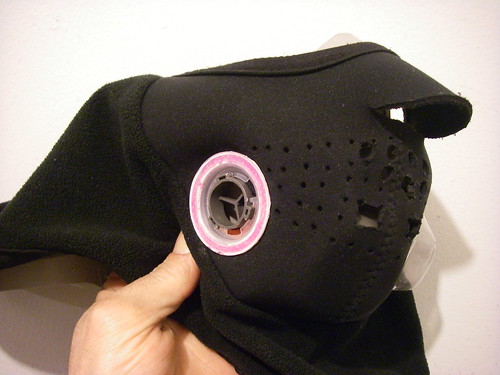
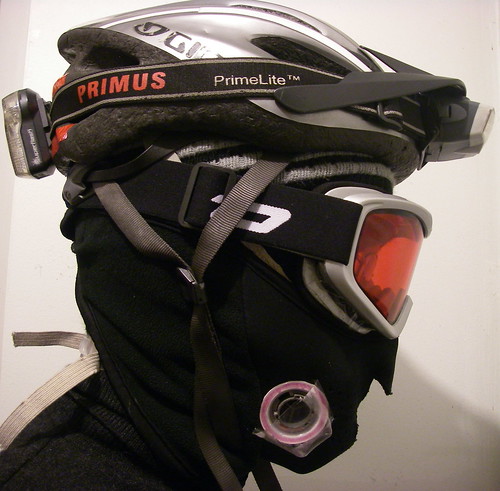
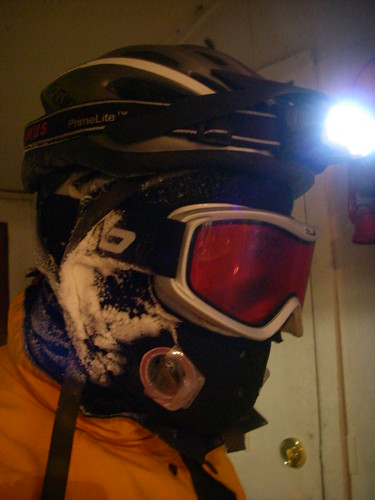
I have posted more details here if anyone is interested.
Wow, that's a pretty elegant solution and thanks for the detailed description. I post frequently about my system using open, well-ventilated safety goggles with a wide windscreen suspended over my prescription eyeglasses. It works pretty well down to the single digits Farenheit, but likely would not be adequate at those temps in Alberta...How far do you ride under those extreme conditions?
I haven't found the respirator necessary until the temperature gets below -20C. I think the safety glasses method would likely work fine for me above that. My daily commute is 11km each way and in the winter it takes 45 to 60 minutes depending on conditions.
Thanks for the reply. Your -20ºC and 11 km are: -4ºF and 6.8 miles; my 0ºF (lowest temp with safety glasses) and 14 miles are: -17ºC and 22.5 km.
I have often posted that for any evaluation of winter gear, the poster should specify temperature and distance (as a function of time).
One post once suggested that a "cold" ride is one where the water bottle freezes solid; a function of temperature and time. For my 14 miles that occurs at about 15ºF or less (-9.4ºC).
I have often posted that for any evaluation of winter gear, the poster should specify temperature and distance (as a function of time).
One post once suggested that a "cold" ride is one where the water bottle freezes solid; a function of temperature and time. For my 14 miles that occurs at about 15ºF or less (-9.4ºC).
Last edited by Jim from Boston; 12-30-14 at 10:43 PM.
01-04-15 | 04:30 PM
#13
Senior Member
Joined: May 2010
Posts: 1,822
Likes: 4
From: St.Paul, MN
The one thing I agree with in all of this is temperature management. I definitely agree that if body, face, and head are cool - googles won't fog. When I ride I get hot. Slowing down mitigates this, but I don't want to slow down so I take the foggy goggles off.
Tomorrow the forecast is -10F (not including that bogus wind chill). I will have my goggles on and keep them on.
Tomorrow the forecast is -10F (not including that bogus wind chill). I will have my goggles on and keep them on.
01-04-15 | 10:00 PM
#14
Banned.
Joined: Jun 2009
Posts: 964
Likes: 2
I pretty much ride without anything on my eyes, havent had much of a problem. It looks like this winter will remain kinda mild. Wednesday it will get down to -2 with a high of 10 then it will get warmer into the weekend back up to 28 on Sunday. I rode yesterday in the rain and snow mix, nothing on my eyes
01-06-15 | 08:12 PM
#15

Senior Member
Joined: Jun 2005
Posts: 848
Likes: 0
From: Minneapolis MN USA
Bikes: Trek 4300
It's the annual fogged goggles thread!
Like others, my solution involves a way of keeping the hot air (I have a lot of it) from getting into the goggles from the bottom. I made a homemade wool face mask with the top portion sewn really thick; this seems to serve as a vapor barrier, keeping the warm air from reaching the goggles.
One of my favorite solutions is in this thread: https://www.bikeforums.net/winter-cyc...free-last.html
I seem to recall seeing that some companies are now selling pre-made devices of this kind...
Like others, my solution involves a way of keeping the hot air (I have a lot of it) from getting into the goggles from the bottom. I made a homemade wool face mask with the top portion sewn really thick; this seems to serve as a vapor barrier, keeping the warm air from reaching the goggles.
One of my favorite solutions is in this thread: https://www.bikeforums.net/winter-cyc...free-last.html
I seem to recall seeing that some companies are now selling pre-made devices of this kind...
01-06-15 | 08:33 PM
#16

Senior Member
Joined: Jul 2010
Posts: 972
Likes: 2
From: South Central PA
Bikes: Cannondale Slate 105 and T2 tandem, 2008 Scott Addict R4, Raleigh SC drop bar tandem
You can smear a little dish soap onto the inside of the lens. As long as they stay dry, it will prevent the fogging.
01-06-15 | 09:16 PM
#17
Senior Member

Joined: Sep 2010
Posts: 1,575
Likes: 223
From: Canada
Bikes: 2009 Trek 520
My last few rides have been between -20C and -30C. In my recent experience one of the biggest factors for fogged glasses and goggles is an overheated forehead (since I've been using a respirator to eliminate exhaled breath as a cause). The goggle friendly ski helmet I use although containing many vent holes still isn't ventilated enough, so its easy for my head to overheat. Particularly in fresh snow where my exertion levels have been very high.
01-06-15 | 09:19 PM
#18

Senior Member
Joined: Nov 2014
Posts: 631
Likes: 355
From: Eastern Iowa
Bikes: 2014 Trek Allant drop bar conversion, modified Schwinn MTN commuter, 2015 Trek 520, Soma ES, Salsa Journeyman, 1980 Trek 414
I use similar goggles in sub zero temps and have no fogging issues. I have a balaclava with goggles over the top, and helmet over both. Stay toasty warm, and have no fogging. My balaclava has a small opening under my nostrils and a lighter fabric in front of my mouth, but is not overly fancy....it does breath pretty well, however, as I can see my breath getting out there pretty good when stopped.
01-06-15 | 10:32 PM
#19
Senior Member
Joined: Dec 2005
Posts: 1,655
Likes: 0
When the temps dip below zero (like they did this morning), I like to wear a pair of Scott snowboard/ski goggles. The issue I'm having is with fog inside the goggles. My head-wrap setup is a neck gaiter from collarbone to over my nose/ears and a thin Nike ACG winter running cap. Goggles on top. Helmet. No matter where I breathe from (nose or mouth), my goggles fog over and I have to take them off. This typically happens within a mile. Am I layering wrong? Do I need different goggles? Mine are entry-level, so I doubt they're the best option. Here's what I have:
Try this and see if it works. Take an old pair of glasses (best if they have large lenses) and remove the folding ear braces or whatever they are called, so you have only the lenses in the front frame. Put this inside your goggles to act as a prescription insert. If you don't have to wear glasses just don't do this.
Wear the neck gaiter over your chin but with your mouth and nose exposed so you are not breathing into the gaiter. The foam on the goggle will keep the top of your nose warm and you will be able to take some cold on your mouth and upper lip as long as your head and body is warm and it is not too cold. You should be good down to -5F or so. Don't remove the foam around the outside of the goggles because if you do and your riding in the snow it will go inside your goggles and they will get fogged up no matter what else yo have done. The most important thing you have to remember is to keep your breath from going into your glasses or goggles.
If you are really hot goggles may fog up when you stop and there is no air moving around them. They will unfog in a few minutes of riding.
If you have to keep your nose and mouth covered you are going to have greater problems keeping you glasses or goggles unfogged.
Search the forums. Some guys have used neoprene face masks with the mouth area cut open and some kind of a respirator on to redirect breath with good success.
Last edited by Hezz; 01-06-15 at 10:38 PM.


