


Fork Stuck in Frame
 01-01-17 | 04:34 PM
#1
Thread Starter
Newbie
Joined: Jan 2017
Posts: 2
Likes: 0
From: Newcastle Upon Tyne, UK
Bikes: Specialized Stumpjumper '02 HT
Fork Stuck in Frame
Fork: Rockshox reba sl
Frame: Specialized Stumpjumper '02 M4 HT
Headset: Hope (unsure of model can provide pictures if necessary)
I am trying to remove my fork, I have removed everything from the top cap down to the compression ring but the fork stays firmly attached. The fork moves side to side slightly but will not move at all up or down in order to remove it. I have tried hitting the top of the steerer tube with a mallet as hard as i felt comfortable and still nothing.
The fork/headset hasn't been removed since at least 2009.
Am I missing something here? Not hitting it hard enough perhaps?
Thank you for any help and sorry if I've missed out any details.
Frame: Specialized Stumpjumper '02 M4 HT
Headset: Hope (unsure of model can provide pictures if necessary)
I am trying to remove my fork, I have removed everything from the top cap down to the compression ring but the fork stays firmly attached. The fork moves side to side slightly but will not move at all up or down in order to remove it. I have tried hitting the top of the steerer tube with a mallet as hard as i felt comfortable and still nothing.
The fork/headset hasn't been removed since at least 2009.
Am I missing something here? Not hitting it hard enough perhaps?
Thank you for any help and sorry if I've missed out any details.
 01-01-17 | 05:15 PM
#2

Bikes are okay, I guess.


Joined: Jan 2015
Posts: 8,005
Likes: 3,770
From: Richmond, Virginia
Bikes: Waterford Paramount Touring, Raleigh Sports 3-speeds in M23 & L23, Schwinn Cimarron oddball build, Marin Palisades Trail dropbar conversion, Nishiki Cresta GT, Jeunet mixte
Depending on the threadless headset there may be a wedge ring pressed down into a groove on the inside diameter of the top race between it and the steerer. See if you can use a pick of some sort to pry it up, making it easier to remove and the fork should drop out when it is no longer retained by the pressure of that ring. A hard enough whack should move it regardless.
It's the centering sleeve in this photo but yours might be different.
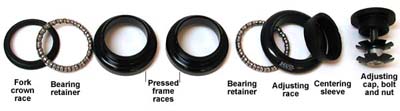
It's the centering sleeve in this photo but yours might be different.
Last edited by thumpism; 01-01-17 at 05:20 PM.
01-01-17 | 06:25 PM
#4

Senior Member
Joined: Feb 2012
Posts: 19,344
Likes: 5,461
From: Rochester, NY
Bikes: Stewart S&S coupled sport tourer, Stewart Sunday light, Stewart Commuting, Stewart Touring, Co Motion Tandem, Stewart 3-Spd, Stewart Track, Fuji Finest, Mongoose Tomac ATB, GT Bravado ATB, JCP Folder, Stewart 650B ATB
It sounds like the centering sleeve/compression ring has been removed so the chance of rust developing between the upper headset cup and the steerer is strong, especially if one is steel and the other is AL. Penetrating oil placed on the exposed top section of the steerer might drip down and soften the corrosion/bond. More shock is the next step, and shock is sometimes more the issue then force is.
At some point the decision of what is more important to save comes into play. Is the fork worth more to you then the headset? Either can be destructively removed (grinding/slitting). Andy.
At some point the decision of what is more important to save comes into play. Is the fork worth more to you then the headset? Either can be destructively removed (grinding/slitting). Andy.
01-01-17 | 06:57 PM
#5
Thread Starter
Newbie
Joined: Jan 2017
Posts: 2
Likes: 0
From: Newcastle Upon Tyne, UK
Bikes: Specialized Stumpjumper '02 HT
Thanks for the replies. I've had a few more attempts at removing it with no luck so i'll continue to apply WD40 to see if rust/corrosion is the issue.
Just to clarify the centering sleeve and compression ring have been removed, at the top end the steerer tube is able to move around by about 1mm but of course does not slide up/down at all. At the bottom end the steerer wiggles around slightly but is restricted by the bearing/bottom cup. I suspect it may be correct that the steerer has become bonded to the bottom cup/bearing.
More suggestions are very welcome.
Thanks again.
Just to clarify the centering sleeve and compression ring have been removed, at the top end the steerer tube is able to move around by about 1mm but of course does not slide up/down at all. At the bottom end the steerer wiggles around slightly but is restricted by the bearing/bottom cup. I suspect it may be correct that the steerer has become bonded to the bottom cup/bearing.
More suggestions are very welcome.
Thanks again.
01-01-17 | 08:10 PM
#6
Senior Member
Joined: Feb 2012
Posts: 19,344
Likes: 5,461
From: Rochester, NY
Bikes: Stewart S&S coupled sport tourer, Stewart Sunday light, Stewart Commuting, Stewart Touring, Co Motion Tandem, Stewart 3-Spd, Stewart Track, Fuji Finest, Mongoose Tomac ATB, GT Bravado ATB, JCP Folder, Stewart 650B ATB
A few comments- The bonding of the steerer and the headset parts is at the upper stack, not the lower one (or I'll eat my hat). WD40 is a poor penetrant. Koil, ATF, PB Blaster all are far better. But just having a penrtrant get past the corrosion does not remove the mechanical clamping of the plug (understand that most corrosion is a larger molecule, rust adds dimension to the surface). Hence the suggestion of shock to break the structure of the corrosion. Since the fork has some free play within the bearing perhaps a downward impact to the upper cup is in order. Place a tireless wheel in the fork (do not just place the drop outs on the floor!) and a length of solid pipe over the steerer that also contacts the upper cup then whack away. Andy
01-01-17 | 08:23 PM
#7

Senior Member
Joined: Nov 2010
Posts: 22,994
Likes: 10,496
From: Sacramento, CA
Bikes: old ones
...the frame itself needs to be firm in the stand, with the clamp of the stand close to the head tube to minimize flexing in the frame as you pound on the steerer. Block of scrap wood and a bigger hammer.
01-01-17 | 09:00 PM
#8

Freshman Member
Joined: Mar 2014
Posts: 5,864
Likes: 4,152
From: City of Angels
Bikes: A few too many
Hi,
I am not sure what you mean by compression ring is everything off of the top of the tube (threaded end) and it will still not come out?
If you do not want to damage the fork threads do not hit it without the top nut in place....leave it on when "tapping" it as mentioned in the above post be sure the frame is secure when tapping other wise you are not getting the force necessary to remove the fork.
2 other things that might help:
1 Turn the bike over and put a block into the top of the fork near the ST with the bike secure give it some "taps" to see if this will provide upper movement and help dislodge the fork.
2. Put more PB into the cavity and wait for a while....if all else fails you know the answer.
Good Luck , Ben
I am not sure what you mean by compression ring is everything off of the top of the tube (threaded end) and it will still not come out?
If you do not want to damage the fork threads do not hit it without the top nut in place....leave it on when "tapping" it as mentioned in the above post be sure the frame is secure when tapping other wise you are not getting the force necessary to remove the fork.
2 other things that might help:
1 Turn the bike over and put a block into the top of the fork near the ST with the bike secure give it some "taps" to see if this will provide upper movement and help dislodge the fork.
2. Put more PB into the cavity and wait for a while....if all else fails you know the answer.
Good Luck , Ben
__________________
"EVERY PERSON IS GUILTY OF ALL THE GOOD THEY DID NOT DO"
Voltaire
Voice recognition may sometimes create odd spelling and grammatical errors
"EVERY PERSON IS GUILTY OF ALL THE GOOD THEY DID NOT DO"
Voltaire
Voice recognition may sometimes create odd spelling and grammatical errors
01-01-17 | 09:46 PM
#9
Senior Member
Joined: Feb 2012
Posts: 19,344
Likes: 5,461
From: Rochester, NY
Bikes: Stewart S&S coupled sport tourer, Stewart Sunday light, Stewart Commuting, Stewart Touring, Co Motion Tandem, Stewart 3-Spd, Stewart Track, Fuji Finest, Mongoose Tomac ATB, GT Bravado ATB, JCP Folder, Stewart 650B ATB
Hi,
I am not sure what you mean by compression ring is everything off of the top of the tube (threaded end) and it will still not come out?
If you do not want to damage the fork threads do not hit it without the top nut in place....leave it on when "tapping" it as mentioned in the above post be sure the frame is secure when tapping other wise you are not getting the force necessary to remove the fork.
2 other things that might help:
1 Turn the bike over and put a block into the top of the fork near the ST with the bike secure give it some "taps" to see if this will provide upper movement and help dislodge the fork.
2. Put more PB into the cavity and wait for a while....if all else fails you know the answer.
Good Luck , Ben
I am not sure what you mean by compression ring is everything off of the top of the tube (threaded end) and it will still not come out?
If you do not want to damage the fork threads do not hit it without the top nut in place....leave it on when "tapping" it as mentioned in the above post be sure the frame is secure when tapping other wise you are not getting the force necessary to remove the fork.
2 other things that might help:
1 Turn the bike over and put a block into the top of the fork near the ST with the bike secure give it some "taps" to see if this will provide upper movement and help dislodge the fork.
2. Put more PB into the cavity and wait for a while....if all else fails you know the answer.
Good Luck , Ben
The fork is a threadless one. The chance of steerer damage from impact strikes has been covered. Andy
01-01-17 | 10:25 PM
#10
Freshman Member
Joined: Mar 2014
Posts: 5,864
Likes: 4,152
From: City of Angels
Bikes: A few too many
Regards, Ben
__________________
"EVERY PERSON IS GUILTY OF ALL THE GOOD THEY DID NOT DO"
Voltaire
Voice recognition may sometimes create odd spelling and grammatical errors
"EVERY PERSON IS GUILTY OF ALL THE GOOD THEY DID NOT DO"
Voltaire
Voice recognition may sometimes create odd spelling and grammatical errors
Last edited by xiaoman1; 01-01-17 at 10:29 PM.
01-02-17 | 06:15 AM
#11

Senior Member
Joined: Aug 2016
Posts: 1,642
Likes: 5
From: Brisbane Aust
Bikes: Giant ToughRoad Giant talon
You have to be careful with the paintwork though, I don't use the stand, I don't find them rigid enough. I rest the frame across the arm of a solid old lounge chair with the head and forks extended over the edge. It's padded but firm enough to allow the transmission of the force.
01-02-17 | 08:00 AM
#12


You have to be careful with the paintwork though, I don't use the stand, I don't find them rigid enough. I rest the frame across the arm of a solid old lounge chair with the head and forks extended over the edge. It's padded but firm enough to allow the transmission of the force.
01-02-17 | 09:32 AM
#13
Mechanic/Tourist
Joined: Apr 2007
Posts: 7,522
Likes: 12
From: Syracuse, NY
Bikes: 2008 Novara Randonee - love it. Previous bikes:Motobecane Mirage, 1972 Moto Grand Jubilee (my fave), Jackson Rake 16, 1983 C'dale ST500.
That made no sense at all. If you balance the bike by the nose of the saddle much of the force will go into rocking the frame around the fulcrum you have created. A "rigid structure" will not significantly absorb the force of a blow to something secured by it. It's more likely to reflect it back.
01-02-17 | 12:39 PM
#14
That made no sense at all. If you balance the bike by the nose of the saddle much of the force will go into rocking the frame around the fulcrum you have created. A "rigid structure" will not significantly absorb the force of a blow to something secured by it. It's more likely to reflect it back.
01-02-17 | 01:34 PM
#15
Senior Member
Joined: Feb 2012
Posts: 19,344
Likes: 5,461
From: Rochester, NY
Bikes: Stewart S&S coupled sport tourer, Stewart Sunday light, Stewart Commuting, Stewart Touring, Co Motion Tandem, Stewart 3-Spd, Stewart Track, Fuji Finest, Mongoose Tomac ATB, GT Bravado ATB, JCP Folder, Stewart 650B ATB
"That made no sense at all. If you balance the bike by the nose of the saddle much of the force will go into rocking the frame around the fulcrum you have created. A "rigid structure" will not significantly absorb the force of a blow to something secured by it. It's more likely to reflect it back." cny-bikeman
"Attempting to secure the frame in a rigid structure is one approach. Veteran mechanics know that the rigid structure with which the bike is secured is likely to absorb much of the force of impact. Often, the best approach is to suspend the bike---e.g., by balancing the bike by the nose of the saddle on top of a work stand clamp---to ensure that little of the force is absorbed by the rigid structure and that almost all of the force goes where you want it to." Trakhak
No repair stand is what I would call a "rigid structure". Even the Park PRS series have a fair amount of bike movement when the bike is impacted. So I view the above points to be shades of gray. But the main reason to hold the bike in a repair stand is to allow for far better impact control and to lessen the after impact secondary damage possibilities. It's easier to pin point your chisel ot drift punch on a bike that's not moving as you place the tip of the tool on it. Also the bike swinging about after the whack can cause issues. if you must hang the bike from the saddle at least strap the seat to the jaw arm so the bike won't slip off and fall on your foot (Very important if the wheels are off the bike. Ever seen a toe nail punctured by a chain ring? I have). Andy.
"Attempting to secure the frame in a rigid structure is one approach. Veteran mechanics know that the rigid structure with which the bike is secured is likely to absorb much of the force of impact. Often, the best approach is to suspend the bike---e.g., by balancing the bike by the nose of the saddle on top of a work stand clamp---to ensure that little of the force is absorbed by the rigid structure and that almost all of the force goes where you want it to." Trakhak
No repair stand is what I would call a "rigid structure". Even the Park PRS series have a fair amount of bike movement when the bike is impacted. So I view the above points to be shades of gray. But the main reason to hold the bike in a repair stand is to allow for far better impact control and to lessen the after impact secondary damage possibilities. It's easier to pin point your chisel ot drift punch on a bike that's not moving as you place the tip of the tool on it. Also the bike swinging about after the whack can cause issues. if you must hang the bike from the saddle at least strap the seat to the jaw arm so the bike won't slip off and fall on your foot (Very important if the wheels are off the bike. Ever seen a toe nail punctured by a chain ring? I have). Andy.
01-03-17 | 06:02 PM
#16
Mechanic/Tourist
Joined: Apr 2007
Posts: 7,522
Likes: 12
From: Syracuse, NY
Bikes: 2008 Novara Randonee - love it. Previous bikes:Motobecane Mirage, 1972 Moto Grand Jubilee (my fave), Jackson Rake 16, 1983 C'dale ST500.
It's not obvious because it's illogical. I'm hardly a new mechanic, and am very comfortable with creative, out of the box solutions.
Last edited by cny-bikeman; 01-04-17 at 07:11 AM.

Thread
Thread Starter
Forum
Replies
Last Post
fodio
Bicycle Mechanics
3
02-17-14 06:27 AM
lineinthewater
Bicycle Mechanics
17
12-12-12 04:08 PM


