


Question about ball bearing grade vs. hardness.
 03-17-17 | 04:23 PM
#1

Thread Starter
Procrastinateur supreme

Joined: Sep 2006
Posts: 1,216
Likes: 3
From: Franko barada nikto
Bikes: Enough bikes...for today!
Question about ball bearing grade vs. hardness.
I have and service my own vintage bikes. With them, there are few things more disappointing than disassembling a cup-and-cone to find the cone or BB spindle race pitted up.  This usually means that the metal is worn below the hardened layer so one can't mill it and have it last. Doesn't happen often, but when it does I have to go find a rare C&V part. Usually, the bearings look OK, though I always trash them when servicing the part. Presume I know how to set up the adjustment correctly. I hope I do.
Wisdom was/is that you always use Grade 25 bearings over Grade 100 because they are rounder. However, I notice that the Grade 25 are a lot harder. Thus, if you get contamination/malajustment/overload, wouldn't the harder but more accurate ball tend to pit the softer cone? And for older cup-and-cone adjustments, isn't 0.0005" tolerance (Grade 100) really as accurate as you can get anyway?
My thought is that the softer balls will be likely do less damage to the cups/cones than the harder Grade 25s. Below is a list of three different 1/4" balls. Note that the alloys are different in each, too. But the Grade 100 ones all are Rockwell C25 to 39, where the Grade 25 is C58 to 65.
Discuss? You can mention your views on alloy type too, if you have metallurgical knowledge.
Dia. 1/4"
Alloy302
Rockwell C 25 to 39
Grade 100
+/-0.0005"
•
Dia.1/4"
Alloy 316
Rockwell C 25 to 39
Grade 100
+/-0.0005"
•
Dia. 1/4"
Alloy 440C
RockwellC 58 to 65
Grade25
+/-0.0001"
This usually means that the metal is worn below the hardened layer so one can't mill it and have it last. Doesn't happen often, but when it does I have to go find a rare C&V part. Usually, the bearings look OK, though I always trash them when servicing the part. Presume I know how to set up the adjustment correctly. I hope I do. Wisdom was/is that you always use Grade 25 bearings over Grade 100 because they are rounder. However, I notice that the Grade 25 are a lot harder. Thus, if you get contamination/malajustment/overload, wouldn't the harder but more accurate ball tend to pit the softer cone? And for older cup-and-cone adjustments, isn't 0.0005" tolerance (Grade 100) really as accurate as you can get anyway?
My thought is that the softer balls will be likely do less damage to the cups/cones than the harder Grade 25s. Below is a list of three different 1/4" balls. Note that the alloys are different in each, too. But the Grade 100 ones all are Rockwell C25 to 39, where the Grade 25 is C58 to 65.
Discuss? You can mention your views on alloy type too, if you have metallurgical knowledge.
Dia. 1/4"
Alloy302
Rockwell C 25 to 39
Grade 100
+/-0.0005"
•
Dia.1/4"
Alloy 316
Rockwell C 25 to 39
Grade 100
+/-0.0005"
•
Dia. 1/4"
Alloy 440C
RockwellC 58 to 65
Grade25
+/-0.0001"
 03-17-17 | 05:07 PM
#2
Senior Member
Joined: Aug 2005
Posts: 33,657
Likes: 1,119
From: Pittsburgh, PA
Bikes: '96 Litespeed Catalyst, '05 Litespeed Firenze, '06 Litespeed Tuscany, '20 Surly Midnight Special, All are 3x10. It is hilly around here!
Those bearing balls you list are all various grades of stainless steel and their hardness has nothing to do with their sphericity grade. Type 304 and 316 stainless steel are "austenitic" stainless steels and cannot be heat treated effectively. Type 440 stainless steel is a "tool steel" stainless and can be heat treated to high hardness so it's greater hardness is due to it's composition, not because it's "rounder".
If you compare standard carbon or "chrome steel" steel bearing balls you will find little hardness differences between roundness grades.
If you compare standard carbon or "chrome steel" steel bearing balls you will find little hardness differences between roundness grades.
03-17-17 | 05:19 PM
#3
Full Member
Joined: Dec 2016
Posts: 379
Likes: 64
From: tennessee
Bikes: '13 Specialized Elite, KHS 223, '94 Trek 2120, 92 Raleigh technium, '87 Centurion LeMans, '86 Centurion IronMan, 2019 Canyon Endurace Al
Cranky-
I'm no expert, but with forty years experience diagnosing, repairing/replacing bearings on pumps, motors, fans, etc, I've learned a few things.
I agree with your feelings about the probable damage from the difference in bearing grades, but I feel it is likely a very small amount. 99% of bearing failures are from one or both of two things: Heat and contamination. I don't think heat (except from sloppy torch work) enters the picture for bikes. Either grade of bearing ball will be damaged or cause damage when any dirt or grit- even dust- enters the picture.
Which is why I toss old bearings. They may be perfect, but I don't think I can keep the entire job 100% clean on reassembly.
As soon as the 2017 Beater Bike Challenge is over later this month I'm going to experiment and try what I've been reading about on BF lately and convert my Zephyr zombie to a sealed cartridge setup.
I'm no expert, but with forty years experience diagnosing, repairing/replacing bearings on pumps, motors, fans, etc, I've learned a few things.
I agree with your feelings about the probable damage from the difference in bearing grades, but I feel it is likely a very small amount. 99% of bearing failures are from one or both of two things: Heat and contamination. I don't think heat (except from sloppy torch work) enters the picture for bikes. Either grade of bearing ball will be damaged or cause damage when any dirt or grit- even dust- enters the picture.
Which is why I toss old bearings. They may be perfect, but I don't think I can keep the entire job 100% clean on reassembly.
As soon as the 2017 Beater Bike Challenge is over later this month I'm going to experiment and try what I've been reading about on BF lately and convert my Zephyr zombie to a sealed cartridge setup.
03-17-17 | 07:56 PM
#4

Senior Member


Joined: Feb 2012
Posts: 19,373
Likes: 5,516
From: Rochester, NY
Bikes: Stewart S&S coupled sport tourer, Stewart Sunday light, Stewart Commuting, Stewart Touring, Co Motion Tandem, Stewart 3-Spd, Stewart Track, Fuji Finest, Mongoose Tomac ATB, GT Bravado ATB, JCP Folder, Stewart 650B ATB
While I agree with grayEZrider's views on some of the failure modes of bike bearings I'll add that bearing alignment and initial preload are two also common causes of early failure. Andy
03-19-17 | 08:26 AM
#5
Thread Starter
Procrastinateur supreme
Joined: Sep 2006
Posts: 1,216
Likes: 3
From: Franko barada nikto
Bikes: Enough bikes...for today!
Those bearing balls you list are all various grades of stainless steel and their hardness has nothing to do with their sphericity grade. Type 304 and 316 stainless steel are "austenitic" stainless steels and cannot be heat treated effectively. Type 440 stainless steel is a "tool steel" stainless and can be heat treated to high hardness so it's greater hardness is due to it's composition, not because it's "rounder".
If you compare standard carbon or "chrome steel" steel bearing balls you will find little hardness differences between roundness grades.
If you compare standard carbon or "chrome steel" steel bearing balls you will find little hardness differences between roundness grades.
Since the older cup-and-cone machines weren't built to today's standards of accuracy, and since one adjusts the bearings more-or-less by feel as per the many descriptions of proper adjustment to avoid preload, would a more round gr.25 tend to have you adjust the wheel closer and therefore less tolerant of contaminaton or misalignment?
And if the more accurately round grade 25 cited above also is harder, would the properly adjusted hub or BB then be more prone to damage of the cup/cones because the balls are harder than the cups or cones?
03-19-17 | 08:40 AM
#6
Senior Member
Joined: Apr 2009
Posts: 39,897
Likes: 3,865
From: New Rochelle, NY
Bikes: too many bikes from 1967 10s (5x2)Frejus to a Sumitomo Ti/Chorus aluminum 10s (10x2), plus one non-susp mtn bike I use as my commuter
The grading system in discussing is purely about dimensional tolerance, and has nothing to do with hardness. That would be related to the balls material specs. So you pick a type of ball in the grade you need.
In any case, ball wear is rarely an issue, race wear is, especially for the shorter inner race. Higher grade balls are preferable because they're better matched in size, and therefore spread loads more equally, keeping the peak loadseason lower as they roll on the races.
In any case, ball wear is rarely an issue, race wear is, especially for the shorter inner race. Higher grade balls are preferable because they're better matched in size, and therefore spread loads more equally, keeping the peak loadseason lower as they roll on the races.
__________________
FB
Chain-L site
An ounce of diagnosis is worth a pound of cure.
Just because I'm tired of arguing, doesn't mean you're right.
“One accurate measurement is worth a thousand expert opinions” - Adm Grace Murray Hopper - USN
WARNING, I'm from New York. Thin skinned people should maintain safe distance.
FB
Chain-L site
An ounce of diagnosis is worth a pound of cure.
Just because I'm tired of arguing, doesn't mean you're right.
“One accurate measurement is worth a thousand expert opinions” - Adm Grace Murray Hopper - USN
WARNING, I'm from New York. Thin skinned people should maintain safe distance.
03-19-17 | 08:47 AM
#7
Senior Member
Joined: Aug 2005
Posts: 33,657
Likes: 1,119
From: Pittsburgh, PA
Bikes: '96 Litespeed Catalyst, '05 Litespeed Firenze, '06 Litespeed Tuscany, '20 Surly Midnight Special, All are 3x10. It is hilly around here!
First those stainless steel bearing balls are considered specialty items and you won't find them anywhere but from industrial supply dealers such as McMaster-Carr or Grainger. Bike shops won't have them. They will carry the far more common chrome steel bearing balls which are more than good enough.
Second, the roundness difference between Gr 100 and Grade 25 balls is measured in 10,000th of an inch and the "closeness" difference between them in proper adjusted bearings is infinitesimal and will allow no difference in leaving a gap for contamination. You are agonizing over minutia.
What the better bearing balls will do is allow a slightly smoother bearing adjustment if you are sensitive to detect it and they will not wear out your races or cones any faster than lower quality ones. Remember, bicycles are very low demand service for bearings. The loads, rotational speeds and temperature range are trivial compared to many industrial demands
Second, the roundness difference between Gr 100 and Grade 25 balls is measured in 10,000th of an inch and the "closeness" difference between them in proper adjusted bearings is infinitesimal and will allow no difference in leaving a gap for contamination. You are agonizing over minutia.
What the better bearing balls will do is allow a slightly smoother bearing adjustment if you are sensitive to detect it and they will not wear out your races or cones any faster than lower quality ones. Remember, bicycles are very low demand service for bearings. The loads, rotational speeds and temperature range are trivial compared to many industrial demands
03-19-17 | 04:27 PM
#8
Senior Member
Joined: Feb 2009
Posts: 6,660
Likes: 177
I understand that hardness and sphericity are distinct qualities. And that austenitic structure is destroyed by heat treatment. I guess that you can get the 304 or 316 balls in Gr.25, but I don't see them commonly. When you go to the LBS and ask for grade 25 balls, they don't tell you the hardness.
Since the older cup-and-cone machines weren't built to today's standards of accuracy, and since one adjusts the bearings more-or-less by feel as per the many descriptions of proper adjustment to avoid preload, would a more round gr.25 tend to have you adjust the wheel closer and therefore less tolerant of contaminaton or misalignment?
And if the more accurately round grade 25 cited above also is harder, would the properly adjusted hub or BB then be more prone to damage of the cup/cones because the balls are harder than the cups or cones?
Since the older cup-and-cone machines weren't built to today's standards of accuracy, and since one adjusts the bearings more-or-less by feel as per the many descriptions of proper adjustment to avoid preload, would a more round gr.25 tend to have you adjust the wheel closer and therefore less tolerant of contaminaton or misalignment?
And if the more accurately round grade 25 cited above also is harder, would the properly adjusted hub or BB then be more prone to damage of the cup/cones because the balls are harder than the cups or cones?
If you are avoiding preload when you adjust your cup and cone bearings you are setting them up to fail!
Wheel Bearing adjustment by Jobst Brandt
Bottom Bracket Bearing adjustment by Jobst Brandt
03-20-17 | 07:18 AM
#10

Old Legs

Joined: Nov 2016
Posts: 1,212
Likes: 33
From: Mass.
Bikes: '80 Strayvaigin, '84 Ciocc Aelle-Shimano 105, '90 Concorde Astore /Campy Triple ,85 Bridgestone 500/Suntour, 2005 Jamis Quest, 2017 Raleigh Merit 1, Raleigh Carbon Clubman
Hello Andy. Could you elaborate on this, specially "preload" . Thank you. KB
03-20-17 | 07:51 AM
#11
Senior Member
Joined: Feb 2012
Posts: 19,373
Likes: 5,516
From: Rochester, NY
Bikes: Stewart S&S coupled sport tourer, Stewart Sunday light, Stewart Commuting, Stewart Touring, Co Motion Tandem, Stewart 3-Spd, Stewart Track, Fuji Finest, Mongoose Tomac ATB, GT Bravado ATB, JCP Folder, Stewart 650B ATB
The way I understand typical cup and cone "wear" failures in bearings is from rolling surface pitting/erosion caused by the work hardening of the surfaces and then the flaking off of the brittle surface. As the rolling element (the ball or roller) runs over the cup/cone surface a tiny amount of compression then spring back happens at the surface. In time this surface layers work hardens and becomes less flexible/more brittle. In time this results in layers cracking off of the surface, a pit has formed.
By setting the preload very high one has this process start with greater rolling element pressure, shortening the number of cycles before pitting happens. The common evidence of this is with cheap wheels and their often very high bearing preload "out of the box". Shops see the cup cracking around the wear track and completely breaking down into two pieces. Why does the cup crack where it does? Because of it's having been hardened there by the constant deforming a too tight bearing creates.
Too little pre load (the bearing is "loose") and this work hardening only happens when the rolling element is in contact with the surface. In theory this means a loose bearing lasts longer. In practice I see this to be the case. One does have to understand the cause of a loose bearing adjustment though. There are loose bearing causes that are from a failure already in process (see the racked cup example). Andy.
By setting the preload very high one has this process start with greater rolling element pressure, shortening the number of cycles before pitting happens. The common evidence of this is with cheap wheels and their often very high bearing preload "out of the box". Shops see the cup cracking around the wear track and completely breaking down into two pieces. Why does the cup crack where it does? Because of it's having been hardened there by the constant deforming a too tight bearing creates.
Too little pre load (the bearing is "loose") and this work hardening only happens when the rolling element is in contact with the surface. In theory this means a loose bearing lasts longer. In practice I see this to be the case. One does have to understand the cause of a loose bearing adjustment though. There are loose bearing causes that are from a failure already in process (see the racked cup example). Andy.
03-20-17 | 08:34 AM
#12

Generally bewildered
Joined: Aug 2015
Posts: 3,038
Likes: 344
From: Eastern PA, USA
Bikes: 2014 Trek Domane 6.9, 1999 LeMond Zurich, 1978 Schwinn Superior
Generally you adjust preload for zero play and stiffness, and to achieve low bearing wear, and considering the amount of friction.
Agree mostly with Andy. Precision machine tools use, for the most part, angular contact bearings (or tapered roller bearings, which are heavier duty but have more drag). Several reasons for A/C bearings. First, the bearing handles both axial and radial loads very well. Second, because A/C bearing construction does not require a spacer between the balls, the balls are more densely spaced and give you better support in the same space. Third, you can get pretty much zero slop and high stiffness by adjusting the cup and cone to the proper preload. This is a mama/papa/baby bear issue as Andrew points out. Too tight, and you have very little slop but high wear. Too little, and you have slop - the spindle is not held precisely on axis. This dissapates energy. On a bike, this means that the $5000 you spent on a stiff carbon frame is, to some extent, wasted! Proper preload gives you better system stiffness. With preload just right, you have good system stiffness, long life, and low bearing drag. One other thing about A/C bearings: if there is minimal wear, you can adjust the cup and cone for it. As any of us know who have adjusted the old cup and cone bearings in our wheels.
Deep groove, or radial ball bearings are not designed for axial thrust. They can handle some, but not as much as an A/C bearing. Preloading on a radial bearing must be lower (less force) than with an A/C bearing. To some extent, when you preload a radial bearing you are kind of changing it to an A/C bearing, but with a contact angle of less than a degree or so, compared to 15 degrees for nominal A/C bearings. But radial bearings are designed with very little slop in the unloaded state, and for the normal case (your front wheel, for example) most of the load you see is radial anyway. Bottom line: you need less preload with radial bearings.
One other failure mode for bearings is observed when someone installs the (for example) outer race into a frame by pounding on the inner race with a hammer, or by using a press with high force. This actually causes the balls to make indentations in the races. It's called "Brinnelling", and is undesireable(!) but fortunately completely avoidable.
Some info on preload from SKF is below, but a figure from them shows that bearing life is enhanced with a little bit of preload. at the cost of a little bit more friction. What is not shown here is how much more stiff the system is with proper preload.
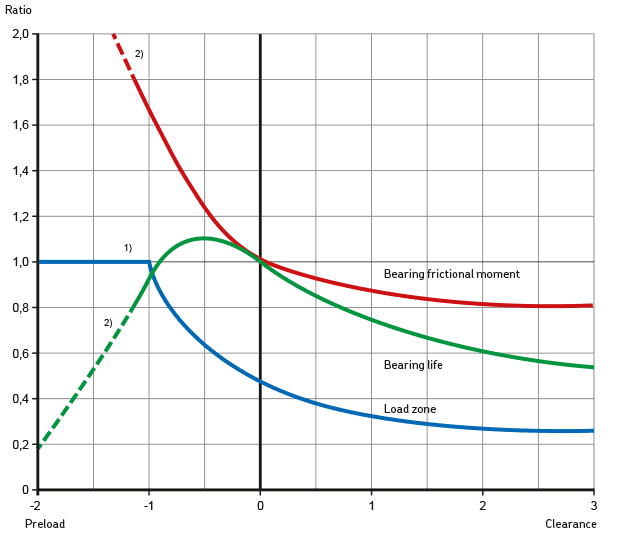
Effects of bearing preload
Agree mostly with Andy. Precision machine tools use, for the most part, angular contact bearings (or tapered roller bearings, which are heavier duty but have more drag). Several reasons for A/C bearings. First, the bearing handles both axial and radial loads very well. Second, because A/C bearing construction does not require a spacer between the balls, the balls are more densely spaced and give you better support in the same space. Third, you can get pretty much zero slop and high stiffness by adjusting the cup and cone to the proper preload. This is a mama/papa/baby bear issue as Andrew points out. Too tight, and you have very little slop but high wear. Too little, and you have slop - the spindle is not held precisely on axis. This dissapates energy. On a bike, this means that the $5000 you spent on a stiff carbon frame is, to some extent, wasted! Proper preload gives you better system stiffness. With preload just right, you have good system stiffness, long life, and low bearing drag. One other thing about A/C bearings: if there is minimal wear, you can adjust the cup and cone for it. As any of us know who have adjusted the old cup and cone bearings in our wheels.
Deep groove, or radial ball bearings are not designed for axial thrust. They can handle some, but not as much as an A/C bearing. Preloading on a radial bearing must be lower (less force) than with an A/C bearing. To some extent, when you preload a radial bearing you are kind of changing it to an A/C bearing, but with a contact angle of less than a degree or so, compared to 15 degrees for nominal A/C bearings. But radial bearings are designed with very little slop in the unloaded state, and for the normal case (your front wheel, for example) most of the load you see is radial anyway. Bottom line: you need less preload with radial bearings.
One other failure mode for bearings is observed when someone installs the (for example) outer race into a frame by pounding on the inner race with a hammer, or by using a press with high force. This actually causes the balls to make indentations in the races. It's called "Brinnelling", and is undesireable(!) but fortunately completely avoidable.
Some info on preload from SKF is below, but a figure from them shows that bearing life is enhanced with a little bit of preload. at the cost of a little bit more friction. What is not shown here is how much more stiff the system is with proper preload.
Effects of bearing preload
Last edited by WizardOfBoz; 03-20-17 at 08:41 AM.
03-20-17 | 09:25 AM
#13
Old Legs
Joined: Nov 2016
Posts: 1,212
Likes: 33
From: Mass.
Bikes: '80 Strayvaigin, '84 Ciocc Aelle-Shimano 105, '90 Concorde Astore /Campy Triple ,85 Bridgestone 500/Suntour, 2005 Jamis Quest, 2017 Raleigh Merit 1, Raleigh Carbon Clubman
Well, I must be doing it right (per Sheldon Brown's method), the last 40 years. Never had any premature failures. But, again, I replace all my bearings every year or 2 years, depending on how much each bike got ridden , how much. Thanks for the info guys. KB
03-20-17 | 09:58 AM
#14
Senior Member
Joined: Feb 2009
Posts: 6,660
Likes: 177
I quit replacing the bearings after reading that as long as they still have their finish they can be reused. I know that they are cheap, but I hate to waste material.
03-20-17 | 10:28 AM
#15
Old Legs
Joined: Nov 2016
Posts: 1,212
Likes: 33
From: Mass.
Bikes: '80 Strayvaigin, '84 Ciocc Aelle-Shimano 105, '90 Concorde Astore /Campy Triple ,85 Bridgestone 500/Suntour, 2005 Jamis Quest, 2017 Raleigh Merit 1, Raleigh Carbon Clubman
I just did some major maintenance this past winter and beginning to wonder how often to even perform this lube work .KB
03-20-17 | 11:45 AM
#16
Senior Member
Joined: Aug 2005
Posts: 33,657
Likes: 1,119
From: Pittsburgh, PA
Bikes: '96 Litespeed Catalyst, '05 Litespeed Firenze, '06 Litespeed Tuscany, '20 Surly Midnight Special, All are 3x10. It is hilly around here!
I ride two "good" bikes only on paved roads and almost always in good weather and they average about 4,000 miles/year each. They are given a major overhaul and bearing maintenance about every 18 to 24 months.
My "rain bike" sees much harsher conditions of frequent rain, salted roads, and limestone Rail-Trail use a far greater proportion of it's time and it gets overhauled about once a year to 16 months or about every 2,000 miles.
03-20-17 | 11:54 AM
#17
Old Legs
Joined: Nov 2016
Posts: 1,212
Likes: 33
From: Mass.
Bikes: '80 Strayvaigin, '84 Ciocc Aelle-Shimano 105, '90 Concorde Astore /Campy Triple ,85 Bridgestone 500/Suntour, 2005 Jamis Quest, 2017 Raleigh Merit 1, Raleigh Carbon Clubman
How far do you ride every year? What weather conditions do you ride in? How dusty or dirty are your roads. Do you even ride only on paved roads as apart from Rail-Trails, gravel roads, etc.? All of these factor into how often maintenance should be done.
I ride two "good" bikes only on paved roads and almost always in good weather and they average about 4,000 miles/year each. They are given a major overhaul and bearing maintenance about every 18 to 24 months.
My "rain bike" sees much harsher conditions of frequent rain, salted roads, and limestone Rail-Trail use a far greater proportion of it's time and it gets overhauled about once a year to 16 months or about every 2,000 miles.
I ride two "good" bikes only on paved roads and almost always in good weather and they average about 4,000 miles/year each. They are given a major overhaul and bearing maintenance about every 18 to 24 months.
My "rain bike" sees much harsher conditions of frequent rain, salted roads, and limestone Rail-Trail use a far greater proportion of it's time and it gets overhauled about once a year to 16 months or about every 2,000 miles.
So, I think I will back off to every 2 years on 3 bikes and my Huffy touring maybe 3 years. It doesn't get ridden much, this year I plan a 100 mile camping trip, to celebrate my 70th Birthday. KB
03-20-17 | 05:45 PM
#18
Senior Member
Joined: Aug 2005
Posts: 33,657
Likes: 1,119
From: Pittsburgh, PA
Bikes: '96 Litespeed Catalyst, '05 Litespeed Firenze, '06 Litespeed Tuscany, '20 Surly Midnight Special, All are 3x10. It is hilly around here!
I recently acquired a '85 Bridgestone 500, single owner. That bike had not been grease since leaving the factory. The grease was like glue, that stuck my fingers together, trying to get the bearing out of every where. One of my bikes went 5 years, no lube and the grease looked and felt new.
For the mileage and conditions you describe every two or three years should be fine. Use plenty of good quality grease and rest easy.
03-21-17 | 05:22 AM
#19
Old Legs
Joined: Nov 2016
Posts: 1,212
Likes: 33
From: Mass.
Bikes: '80 Strayvaigin, '84 Ciocc Aelle-Shimano 105, '90 Concorde Astore /Campy Triple ,85 Bridgestone 500/Suntour, 2005 Jamis Quest, 2017 Raleigh Merit 1, Raleigh Carbon Clubman
Thanks, I've been using White Lithium Grease, from my local hardware store, for the last 2 decades. How about the headset ? Maybe longer than 2-3 years ? KB
03-21-17 | 05:32 AM
#20

Mostly harmless ™
Joined: Nov 2010
Posts: 4,463
Likes: 244
From: Novi Sad
Bikes: Heavy, with friction shifters
Just a speculation, thought:
I know that knives with low hardness steel (in HRC) are hard to sharpen perfectly.
Might be similar with bearing balls. The finer the grade, the more hardness might be required to enable bearings to be machined to that specification.
Softer balls are more easily damaged themselves - then damaging cups and cones more easily.
Too hard balls will also be more likely to damage cups and cones.
So I guess it's best to go with some middle value.
I know that knives with low hardness steel (in HRC) are hard to sharpen perfectly.
Might be similar with bearing balls. The finer the grade, the more hardness might be required to enable bearings to be machined to that specification.
Softer balls are more easily damaged themselves - then damaging cups and cones more easily.
Too hard balls will also be more likely to damage cups and cones.
So I guess it's best to go with some middle value.
03-21-17 | 06:28 AM
#21
Senior Member
Joined: Aug 2005
Posts: 33,657
Likes: 1,119
From: Pittsburgh, PA
Bikes: '96 Litespeed Catalyst, '05 Litespeed Firenze, '06 Litespeed Tuscany, '20 Surly Midnight Special, All are 3x10. It is hilly around here!
Chrome steel and tool steel ball bearings have similar hardness which is unrelated to grade. Those low hardness 304 and 316 stainless steel balls the OP referenced are specialty items used only for their corrosion resistance. The low hardness is an unavoidable function of the steel's composition and, again, has nothing to do with grade.

Thread
Thread Starter
Forum
Replies
Last Post
Brocephus
Bicycle Mechanics
8
08-25-18 10:56 AM
