


Rim failure - need help identifying causes
 09-09-18 | 06:57 AM
#1
Thread Starter
Senior Member
Joined: Apr 2018
Posts: 898
Likes: 337
From: Saulkrasti, Latvia
Bikes: Focus Crater Lake
Rim failure - need help identifying causes
So after attending a concert on Friday night, I came back to my bike locked outside the club, unlocked it, got on it, and immediately heard a clanging noise after doing a few meters. It was pretty clear a spoke was broken and was banging against the frame. The reality turned out to be somewhat different - the clanging noise was indeed a spoke banging against the frame, but it was not broken; instead it was ripped clean out of the rim together with the spoke head, destroying the rim in the process. Since the rim is double-walled, it was still rideable, so I could get home allright. Inspecting the rim afterwards in better lighting, I found several other faults - one where the rim was about to split open as well, and some 6 or 7 other spoke holes with cracks around them. It is possible that some of those happened while riding on the damaged rim - it's highly likely that the second worst damage went from mere cracks to the point of just before splitting open during the ride, but I suspect the cracks have been around earlier.
Now, it doesn't matter as much if the damage comes from someone kicking the bike while locked outside the club - which, while unlikely, is possible; but in either event I would expect the spokes to break before the rim. Seems that the rim itself is of poor quality. I weigh around 95 kg, the bike itself around 14, I haven't done any jumps on it apart from the occasional hop off the curb, and haven't hit it hard against any obstacles. The rim has done around 5000 km at this point. These come as stock for the Focus Crater Lake, and are manufactured by Schürmann, Germany, as is indicated on the rim.
What do you think?
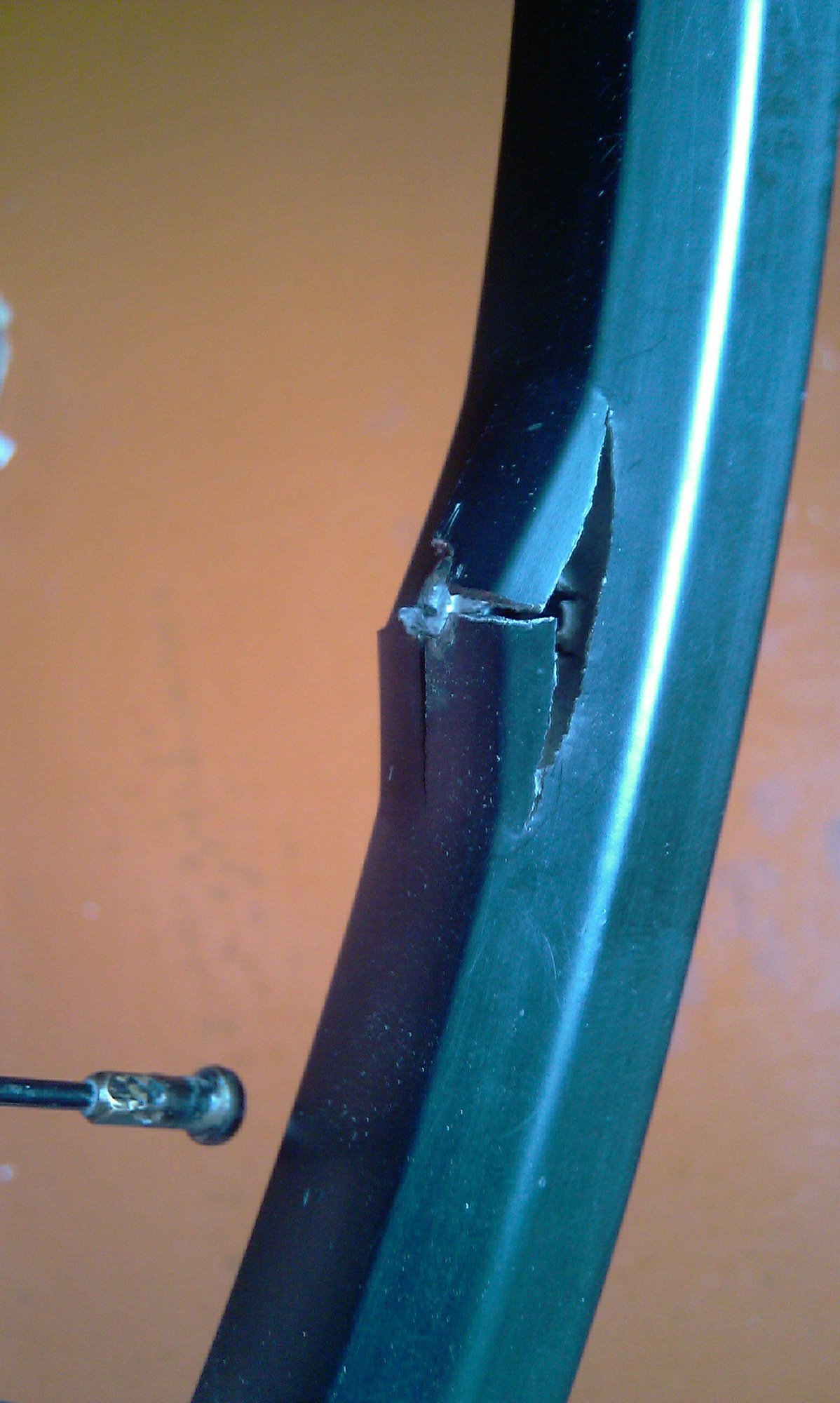
The worst bit of damage. note that there aren't any dents on the rim, and the spoke is intact
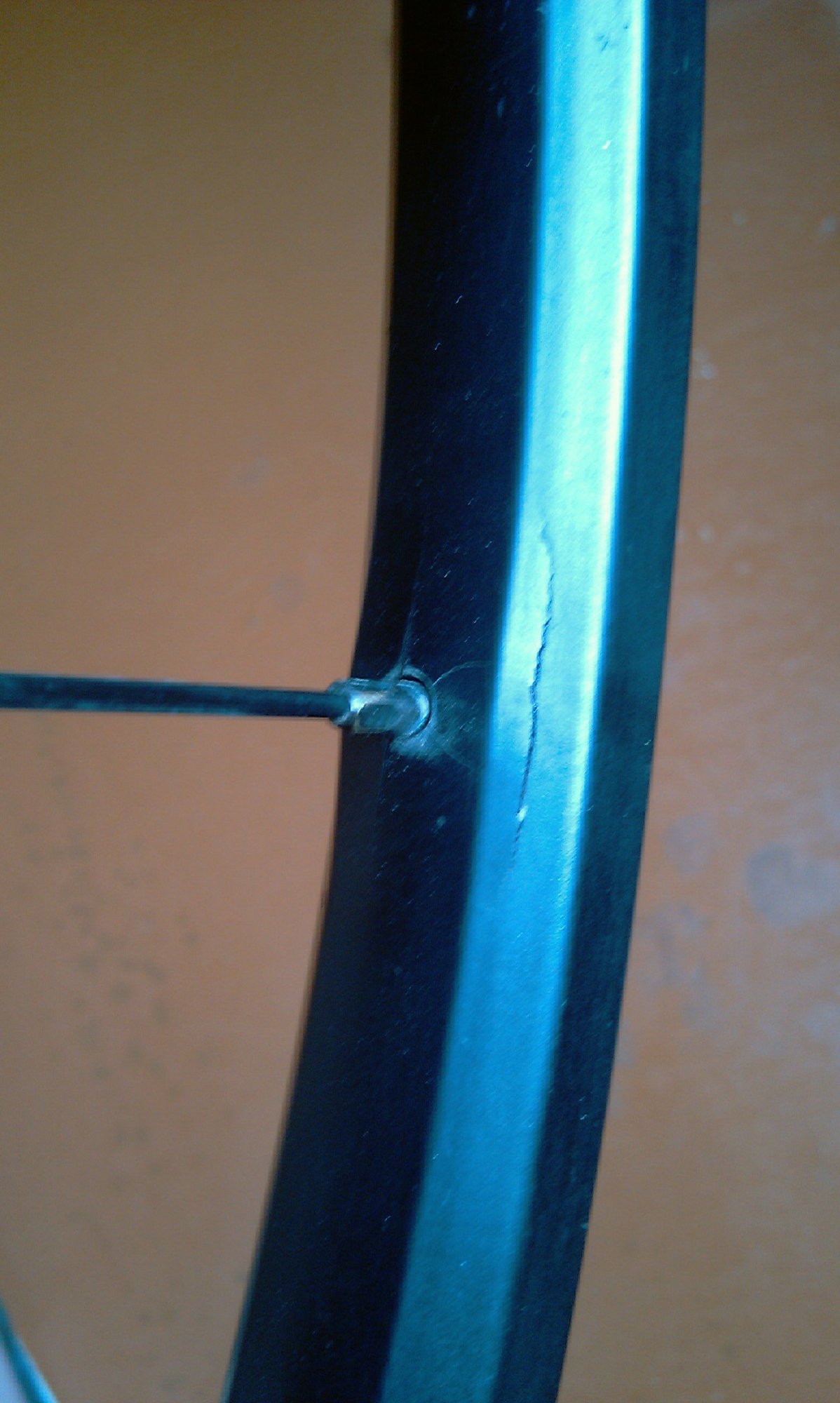
This one seems to be ready to split open at any moment
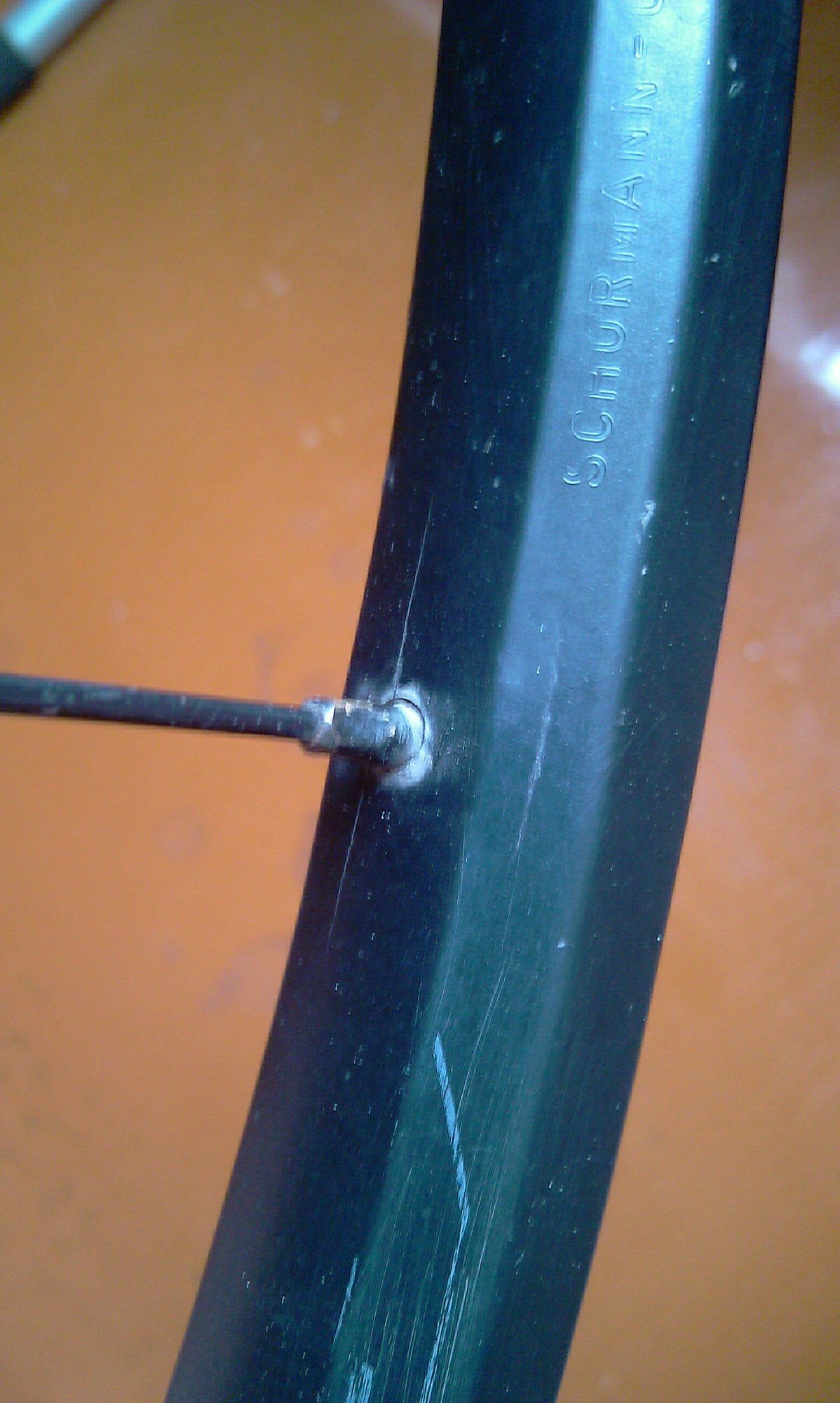
Cracks around the spoke hole
Now, it doesn't matter as much if the damage comes from someone kicking the bike while locked outside the club - which, while unlikely, is possible; but in either event I would expect the spokes to break before the rim. Seems that the rim itself is of poor quality. I weigh around 95 kg, the bike itself around 14, I haven't done any jumps on it apart from the occasional hop off the curb, and haven't hit it hard against any obstacles. The rim has done around 5000 km at this point. These come as stock for the Focus Crater Lake, and are manufactured by Schürmann, Germany, as is indicated on the rim.
What do you think?
The worst bit of damage. note that there aren't any dents on the rim, and the spoke is intact
This one seems to be ready to split open at any moment
Cracks around the spoke hole
 09-09-18 | 07:06 AM
#3
Senior Member
Joined: Aug 2005
Posts: 33,657
Likes: 1,119
From: Pittsburgh, PA
Bikes: '96 Litespeed Catalyst, '05 Litespeed Firenze, '06 Litespeed Tuscany, '20 Surly Midnight Special, All are 3x10. It is hilly around here!
That rim cracked from fatigue, not from anybody "kicking it". That major spoke failure was just the first of many that would have followed it in the very near future. With only 5000 Km, even at your weight, it appears the rim material was brittle, possibly from improper heat treatment or a poor choice of alloy.

 09-09-18 | 07:08 AM
#5

Senior Member


Joined: Feb 2012
Posts: 19,381
Likes: 5,527
From: Rochester, NY
Bikes: Stewart S&S coupled sport tourer, Stewart Sunday light, Stewart Commuting, Stewart Touring, Co Motion Tandem, Stewart 3-Spd, Stewart Track, Fuji Finest, Mongoose Tomac ATB, GT Bravado ATB, JCP Folder, Stewart 650B ATB
This type of rim failure is pretty common, especially with the lightweight rims/reduced spoke counts and the higher spoke tensions that are more popular these days. It's called fatigue. AL is a poor material to repeatedly bend, note the lack of AL springs in the real world. Yet our community (bikes) has adapted AL as the rim material of choice for the masses. Rim spoke hole areas get flexed with each wheel revolution and each pedal stroke. (With some very lightweight rims one can see the sidewalls bulge outwards a tad at each spoke, the stress that a tight spoke places on the rim deforms the rim slightly).
The cures is to replace the rim or wheel. Choosing a stronger/heavier rim, perhaps with spoke hole eyelets, and more spokes will help avoid this in the future. But all AL rims have this failure in their possible future. Andy
I'll add that hub/disk brakes place an additional stress cycle on the spokes and therefore the rim spoke holes. Expect more spoke/rim issues with disk brakes.
The cures is to replace the rim or wheel. Choosing a stronger/heavier rim, perhaps with spoke hole eyelets, and more spokes will help avoid this in the future. But all AL rims have this failure in their possible future. Andy
I'll add that hub/disk brakes place an additional stress cycle on the spokes and therefore the rim spoke holes. Expect more spoke/rim issues with disk brakes.
__________________
AndrewRStewart
AndrewRStewart
09-09-18 | 07:09 AM
#6
Senior Member
Joined: Mar 2017
Posts: 1,923
Likes: 233
From: Madison, WI
Bikes: Giant Toughroad SLR1 and Motobecane Sturgis NX
uneven spoke tension and those are the spokes that had to hold the entire load. Those spokes likely also are overstressed, but not broken yet.
you basically need new rim and spokes. Obviously with even spoke tension this time.
And don't do anything with less than 32 spokes and don't choose the "lightest rim you can find".
you basically need new rim and spokes. Obviously with even spoke tension this time.
And don't do anything with less than 32 spokes and don't choose the "lightest rim you can find".
09-09-18 | 07:23 AM
#7
Thread Starter
Senior Member
Joined: Apr 2018
Posts: 898
Likes: 337
From: Saulkrasti, Latvia
Bikes: Focus Crater Lake
Yeah, so that's more or less what I thought. Yes, I have disc brakes, 32 spokes. The rim has not been warped severely, but has been trued a couple times (had 2-3mm side to side wobble). Oh and all of the cracked spoke holes are with the drive side spokes (rear wheel), so it must be weak rim + overtensioned spoke issue. I'm getting a new rim tomorrow and hopefully it gets properly installed.
09-09-18 | 08:37 AM
#8
Mechanic/Tourist
Joined: Apr 2007
Posts: 7,522
Likes: 12
From: Syracuse, NY
Bikes: 2008 Novara Randonee - love it. Previous bikes:Motobecane Mirage, 1972 Moto Grand Jubilee (my fave), Jackson Rake 16, 1983 C'dale ST500.
The underlying reason is the type of rim/wheel construction that is currently popular. Failures of this type were extremely rare before the last 10-15 years. Low spoke counts, the higher required tension per spoke, greater dish, and the unhealthy focus on saving grams all combine to make such an occurrence much more likely. Yes, uneven tension, harsh conditions, etc. provide additive factors, but are relatively minor, as is aluminum rims.
 09-09-18 | 10:16 AM
#10

Generally bewildered
Joined: Aug 2015
Posts: 3,038
Likes: 344
From: Eastern PA, USA
Bikes: 2014 Trek Domane 6.9, 1999 LeMond Zurich, 1978 Schwinn Superior
My guess is that aggiegrads and Andrew are correct: fatigue failure.
Stuff responds to stress (force per area, for example in 1000s of pounds per square inch) in several ways.
1) acute elastic deformation. Below a certain stress level the part bends when stress is applied but returns to original form when stress is removed. All bicycle parts should be designed with strong enough materials and enough metal so that normal stress is in this elastic range.
2) acute plastic deformation. Above a certain "yield" stress, the part bends and does not return to original form. Ideally, bike parts won't be subject to this stress but good design could use stress in this region to absorb shock. Car manufacturers design cars to crumple (plastically deform) in a predictable way to absorb energy in crashes. Not sure if bike mfrs design bikes to take advantage of plastic deformation in crashes.
3) acute tensile fracture. At an "ultimate" stress above yield stress, the material has stretched all it can, and it breaks completely. There is no way a properly designed bike part should see ultimate stress in normal use. If you are careening down the Col du Manse at 50 mph and hit a wall or pothole, you might break your form blades off. That would be tensile fracture.
Given that the forces on bicycle parts are pretty much known, and stress is force per area, bike design is simple, right? We just design the part with enough "meat" (metal or CF area) to lower the stress to below yield stress. Not that simple. There is a third threshold which is called fatigue point, or fatigue stress. It is less then yield stress. A part will fail after many cycles of stress that is greater than the fatigue point,. This is fatigue failure. Fatigue in common metals is very well characterized. The higher the stress above the fatigue point, the fewer cycles required to fail. So if a mfr pares down the amt of material in (for example) a rim, the stress the metal in the rim sees is higher and it fails in fewer cycles. Or, if a rim is over-tensioned, the stress level is higher and you see fatigue
So, after 5000km, your wheels have been subjected to about 2.2 million revolutions. Each revolution is a stress cycle. It's pretty clear from your pics and discussion that your failure mode was fatigue. If you had inspected your rims a week ago, I'd bet you would have seen small fatigue cracks near many of the nipples. It may be that these rims were under-built (not enough metal or poor design geometry, with normal cycling forces cause higher than desirable stress). Or the spokes may have been over-tensioned. Higher force, hence higher stress, on the rims. Alternately, if you are a Clydesdale, the forces and stress the bike sees are higher than design (not poking fun of anyone: I weigh 245# myself). If you used the bike to commute every day over very rough roads, that increases the stress and could facilitate failure.
BTW, designing for fatigue strength is the main reason why aluminum bikes aren't much lighter. Aluminum has a much lower fatigue point than steel and you need to add more meat to get adequate fatigue strength.
If 5000km life is good for you, the same rims may be ok. You would want the wheel builder to be scrupulous about spoke tension, and you'd need to be very diligent about inspecting the rims frequently. I myself would try to find something beefier.
BTW, there's another consideration in bike design. It's the reason that the fanciest steel bikes aren't much lighter: Stiffness. All steels are about the same stiffness and this is a limiting factor. For example, Reynolds 953 is a "super steel". It has tensile strength about 2-3 times that of normal steels, and has high yield strength and fatigue point as well. But its about the same stiffness as low-carbon mild steel. So you have minimum tube thickness set by stiffness, not strength. Going thinner and you get a bicycle frame as stiff as cooked spaghetti. And aluminum and Ti are both much less stiff than steel. As stated above, aluminum bikes have thicker-walled frames mostly due to the fatigue limit. This is why Al frames are generally stiffer than steel frames. They have to be thick enough for fatigue strength, and this thickness results in stiffness.
Stuff responds to stress (force per area, for example in 1000s of pounds per square inch) in several ways.
1) acute elastic deformation. Below a certain stress level the part bends when stress is applied but returns to original form when stress is removed. All bicycle parts should be designed with strong enough materials and enough metal so that normal stress is in this elastic range.
2) acute plastic deformation. Above a certain "yield" stress, the part bends and does not return to original form. Ideally, bike parts won't be subject to this stress but good design could use stress in this region to absorb shock. Car manufacturers design cars to crumple (plastically deform) in a predictable way to absorb energy in crashes. Not sure if bike mfrs design bikes to take advantage of plastic deformation in crashes.
3) acute tensile fracture. At an "ultimate" stress above yield stress, the material has stretched all it can, and it breaks completely. There is no way a properly designed bike part should see ultimate stress in normal use. If you are careening down the Col du Manse at 50 mph and hit a wall or pothole, you might break your form blades off. That would be tensile fracture.
Given that the forces on bicycle parts are pretty much known, and stress is force per area, bike design is simple, right? We just design the part with enough "meat" (metal or CF area) to lower the stress to below yield stress. Not that simple. There is a third threshold which is called fatigue point, or fatigue stress. It is less then yield stress. A part will fail after many cycles of stress that is greater than the fatigue point,. This is fatigue failure. Fatigue in common metals is very well characterized. The higher the stress above the fatigue point, the fewer cycles required to fail. So if a mfr pares down the amt of material in (for example) a rim, the stress the metal in the rim sees is higher and it fails in fewer cycles. Or, if a rim is over-tensioned, the stress level is higher and you see fatigue
So, after 5000km, your wheels have been subjected to about 2.2 million revolutions. Each revolution is a stress cycle. It's pretty clear from your pics and discussion that your failure mode was fatigue. If you had inspected your rims a week ago, I'd bet you would have seen small fatigue cracks near many of the nipples. It may be that these rims were under-built (not enough metal or poor design geometry, with normal cycling forces cause higher than desirable stress). Or the spokes may have been over-tensioned. Higher force, hence higher stress, on the rims. Alternately, if you are a Clydesdale, the forces and stress the bike sees are higher than design (not poking fun of anyone: I weigh 245# myself). If you used the bike to commute every day over very rough roads, that increases the stress and could facilitate failure.
BTW, designing for fatigue strength is the main reason why aluminum bikes aren't much lighter. Aluminum has a much lower fatigue point than steel and you need to add more meat to get adequate fatigue strength.
If 5000km life is good for you, the same rims may be ok. You would want the wheel builder to be scrupulous about spoke tension, and you'd need to be very diligent about inspecting the rims frequently. I myself would try to find something beefier.
BTW, there's another consideration in bike design. It's the reason that the fanciest steel bikes aren't much lighter: Stiffness. All steels are about the same stiffness and this is a limiting factor. For example, Reynolds 953 is a "super steel". It has tensile strength about 2-3 times that of normal steels, and has high yield strength and fatigue point as well. But its about the same stiffness as low-carbon mild steel. So you have minimum tube thickness set by stiffness, not strength. Going thinner and you get a bicycle frame as stiff as cooked spaghetti. And aluminum and Ti are both much less stiff than steel. As stated above, aluminum bikes have thicker-walled frames mostly due to the fatigue limit. This is why Al frames are generally stiffer than steel frames. They have to be thick enough for fatigue strength, and this thickness results in stiffness.
09-09-18 | 11:06 AM
#11
Senior Member
Joined: May 2010
Posts: 4,340
Likes: 496
From: Bristol, R. I.
Bikes: Specialized Secteur, old Peugeot
I was not able to tell for certain but there appears to be a slight dusting of a white powder around the spoke holes. This could be corrosion. Why there should be corrosion there is a good question if that is what it is. My own view is that dipping wheels into the ocean prior to a cross-country tour is a bad idea as salt water and aluminum don't go well together, especially in thin rim sections.
09-09-18 | 11:11 AM
#12
Thread Starter
Senior Member
Joined: Apr 2018
Posts: 898
Likes: 337
From: Saulkrasti, Latvia
Bikes: Focus Crater Lake
Oh, I do that. Not loosening the spokes on opposite side not only does increase tension on spokes, but also makes the rim oval.
09-09-18 | 11:56 AM
#13

Old fart


Joined: Nov 2004
Posts: 26,411
Likes: 5,350
From: Appleton WI
Bikes: Several, mostly not name brands.
I'd instead put the blame on the modern fashion for low spoke count wheels, which require higher individual spoke tensions, exacerbated by he disc brake which put more stress on the spokes. Anodizing the rim also introduces a stress riser, as the anodized layer is more brittle than the underlying aluminum. As the late Jobst Brandt noted:
That they anodize rims is proof that no one is technically at home there. Materials science literature has ample publications concerning the fatigue susceptibility of aluminum parts coated with brittle porous hard coatings (anodizing). The aircraft industry, long ago, made these discoveries but the bicycle trade, that is mostly driven by fashion and managed by non technical people, must go through the long arduous process of first hand experience.
https://yarchive.net/bike/rims.html
 09-09-18 | 01:22 PM
#15
Generally bewildered
Joined: Aug 2015
Posts: 3,038
Likes: 344
From: Eastern PA, USA
Bikes: 2014 Trek Domane 6.9, 1999 LeMond Zurich, 1978 Schwinn Superior
If the failure had been a discrete blow (e.g. a big pothole) the failure would have occurred contemporaneously with the blow. Further, if it were a discrete stress, you'd have the rim fail at the same point pretty much, and the rim would likely be very out of round. That there are many different points of failure suggests to me at least, that the failure mode is fatigue. Other's have suggested that a white powder (which would be aluminum oxide) may be present at the cracks. That would be another hint that fatigue cracks had formed, the bare aluminum exposed had oxidized, and that the continued stress cycling continuously wore off old oxide.
JohnDThompson's post, with the Jobst quote, was interesting. I learned something. Thanks, John.
JohnDThompson's post, with the Jobst quote, was interesting. I learned something. Thanks, John.
09-09-18 | 04:11 PM
#16
Mechanic/Tourist
Joined: Apr 2007
Posts: 7,522
Likes: 12
From: Syracuse, NY
Bikes: 2008 Novara Randonee - love it. Previous bikes:Motobecane Mirage, 1972 Moto Grand Jubilee (my fave), Jackson Rake 16, 1983 C'dale ST500.
Yeah, so that's more or less what I thought. Yes, I have disc brakes, 32 spokes. The rim has not been warped severely, but has been trued a couple times (had 2-3mm side to side wobble). Oh and all of the cracked spoke holes are with the drive side spokes (rear wheel), so it must be weak rim + overtensioned spoke issue. I'm getting a new rim tomorrow and hopefully it gets properly installed.
Last edited by cny-bikeman; 09-09-18 at 04:14 PM.
09-09-18 | 07:06 PM
#18

Dirty Heathen
Joined: Oct 2015
Posts: 2,324
Likes: 1,046
From: MC-778, 6250 fsw
Bikes: 1997 Cannondale, 1976 Bridgestone, 1998 SoftRide, 1989 Klein, 1989 Black Lightning #0033
I'm going to condense this in to the quote attributed alternately to Keith Bontrager or Tom Ritchey: "You can have Light, Cheap, and Strong. Pick Two."
[QUOTE=JohnDThompson;20555789]I'd instead put the blame on the modern fashion for low spoke count wheels, which require higher individual spoke tensions, exacerbated by he disc brake which put more stress on the spokes. Anodizing the rim also introduces a stress riser, as the anodized layer is more brittle than the underlying aluminum. As the late Jobst Brandt noted:...………………………...
/QUOTE]
[QUOTE=JohnDThompson;20555789]I'd instead put the blame on the modern fashion for low spoke count wheels, which require higher individual spoke tensions, exacerbated by he disc brake which put more stress on the spokes. Anodizing the rim also introduces a stress riser, as the anodized layer is more brittle than the underlying aluminum. As the late Jobst Brandt noted:...………………………...
/QUOTE]
09-09-18 | 09:03 PM
#19
Senior Member
Joined: Feb 2012
Posts: 19,381
Likes: 5,527
From: Rochester, NY
Bikes: Stewart S&S coupled sport tourer, Stewart Sunday light, Stewart Commuting, Stewart Touring, Co Motion Tandem, Stewart 3-Spd, Stewart Track, Fuji Finest, Mongoose Tomac ATB, GT Bravado ATB, JCP Folder, Stewart 650B ATB
"Now now Andrew, aluminum rims have stood the test of time, and arguably are safer than steel or crabon fibber." onyourleft I wasn't saying AL rims are not a reasonable choice, just that AL does fatigue and I should have added it tends to fail rather suddenly. As others have mentioned some of the same reasons I did and added other factors I feel my comments are valid. I will say that AL does have some good qualities, like relative lightweight (compared to steel) and excellent wet brake capacity. But it's how the current L rims are made/designed/used that I take issue with, again like others have already mentioned far better then I can.
"They have to be thick enough for fatigue strength, and this thickness results in stiffness." WizardOfBoz To pick a nit. Tubing stiffness is linier with it's increase of wall but geometricly so (squared) as a function of it's diameter. case in point are all the Vitus and Alan frames that last for decades but are regarded ad wet noodles yet the younger Cannondales (and their offspring) which are regarded as stiff but crack prone.
I'm going to condense this in to the quote attributed alternately to Keith Bontrager or Tom Ritchey: "You can have Light, Cheap, and Strong. Pick Two." Ironfish653 I'm a fan of Keith's too.
In no way do I suggest that AL rims are wrong. I have used the common and less so alternatives (including TI rims, don't ever descend a big hill in the rain of them ) and still prefer AL. But I don't push the spoke counts on a rotationally stressed wheel and don't run hub brakes. I do use only butted spokes, medium wide tires, weigh less then most and long ago learned how to float and spin on a bike. My rims get replaced from rim blips, brake track wear or a new bike build up. Andy (who hasn't ridden a factory built wheel for a long time)
"They have to be thick enough for fatigue strength, and this thickness results in stiffness." WizardOfBoz To pick a nit. Tubing stiffness is linier with it's increase of wall but geometricly so (squared) as a function of it's diameter. case in point are all the Vitus and Alan frames that last for decades but are regarded ad wet noodles yet the younger Cannondales (and their offspring) which are regarded as stiff but crack prone.
I'm going to condense this in to the quote attributed alternately to Keith Bontrager or Tom Ritchey: "You can have Light, Cheap, and Strong. Pick Two." Ironfish653 I'm a fan of Keith's too.
In no way do I suggest that AL rims are wrong. I have used the common and less so alternatives (including TI rims, don't ever descend a big hill in the rain of them
) and still prefer AL. But I don't push the spoke counts on a rotationally stressed wheel and don't run hub brakes. I do use only butted spokes, medium wide tires, weigh less then most and long ago learned how to float and spin on a bike. My rims get replaced from rim blips, brake track wear or a new bike build up. Andy (who hasn't ridden a factory built wheel for a long time)
__________________
AndrewRStewart
AndrewRStewart
Last edited by Andrew R Stewart; 09-09-18 at 09:09 PM. Reason: fat fingers
09-12-18 | 05:51 PM
#20

Senior Member
Joined: Apr 2017
Posts: 2,248
Likes: 845
From: Los Angeles, CA
Bikes: 1964 Legnano Roma Olympiade, 1973 Raleigh Super Course, 1978 Raleigh Super Course, 1978 Peugeot PR10, 2002 Specialized Allez, 2007 Specialized Roubaix, 2013 Culprit Croz Blade
I had a similar problem with a Mavic Open Sport rim on the rear of my '07 Roubaix. As I was cleaning the bike after replacing a cable, I saw cracks around two spoke nipples. On an 11 year old bike, I put it up to lots of miles on the crappy roads around here. I used to weigh 240 lbs, less than 200 now, so that might be part of it. I found a deal on a set of Reynolds Stratus Elite, and replaced the wheelset for $150, on sale. The Mavics were double walled, and I don't know how long the cracks had been there.
09-14-18 | 05:06 PM
#21


Classic case of over-tensioned spokes (or at least that particular spoke).
As others have mentioned, factory built wheels usually come out true, but with vastly varying spoke tension.
I'll differ some some of the comments above, in that I often rebuild wheels with a new rim without changing the spokes. This only works when the new rim is the same (or very close) depth as the old rim, otherwise it would need different spoke lengths.
Pros of this method:
* saves time and money. lacing the spokes is a time-consuming part of wheelbuilding. And if you build a wheel with the same hub and new spokes, you'd need to make sure the new spokes lay down in the same pattern on the hub flange, which is more of a pain.
* fine if there's no reason to think the spokes saw a lot of stress
* when a rim fails (likely as a result of spokes being tensioned above what the rim can handle) it usually doesn't give reason to think the spokes are damaged
* there's an argument that many spoke failures are a result of crystal imperfections in the steel wire, which are largely luck/hit-or-miss. And a wheel that's been ridden many miles has spokes has shown itself to not have these imperfections. So even with a bit of wear on spokes, it may be just as effective to re-use the existing spokes as build with brand-new spokes.
Cons of just replacing the rim:
* maybe some of the spokes are getting worn, especially if spoke tension was inconsistent in the original build. Maybe you get 1000k into the new wheel and spokes start popping on you. But in my experience, this isn't very likely.
* if you're rebuilding a wheel, why not just replace the spokes anyway? (but then I think, why not just replace the hub and have a whole new wheel?)
One other thing that can help, is nipple washers. Basically, small steel washers that go between the rim and the spoke nipple. Most older aluminum rims have built in ferrules or sockets, steel reinforcements to the aluminum at the spoke holes. But many newer rims just have holes drilled in the aluninum. Steel washers can help spread out the stress of spoke nipples. And depending on the washers used, you may need slightly longer spokes.
As others have mentioned, factory built wheels usually come out true, but with vastly varying spoke tension.
I'll differ some some of the comments above, in that I often rebuild wheels with a new rim without changing the spokes. This only works when the new rim is the same (or very close) depth as the old rim, otherwise it would need different spoke lengths.
Pros of this method:
* saves time and money. lacing the spokes is a time-consuming part of wheelbuilding. And if you build a wheel with the same hub and new spokes, you'd need to make sure the new spokes lay down in the same pattern on the hub flange, which is more of a pain.
* fine if there's no reason to think the spokes saw a lot of stress
* when a rim fails (likely as a result of spokes being tensioned above what the rim can handle) it usually doesn't give reason to think the spokes are damaged
* there's an argument that many spoke failures are a result of crystal imperfections in the steel wire, which are largely luck/hit-or-miss. And a wheel that's been ridden many miles has spokes has shown itself to not have these imperfections. So even with a bit of wear on spokes, it may be just as effective to re-use the existing spokes as build with brand-new spokes.
Cons of just replacing the rim:
* maybe some of the spokes are getting worn, especially if spoke tension was inconsistent in the original build. Maybe you get 1000k into the new wheel and spokes start popping on you. But in my experience, this isn't very likely.
* if you're rebuilding a wheel, why not just replace the spokes anyway? (but then I think, why not just replace the hub and have a whole new wheel?)
One other thing that can help, is nipple washers. Basically, small steel washers that go between the rim and the spoke nipple. Most older aluminum rims have built in ferrules or sockets, steel reinforcements to the aluminum at the spoke holes. But many newer rims just have holes drilled in the aluninum. Steel washers can help spread out the stress of spoke nipples. And depending on the washers used, you may need slightly longer spokes.
09-14-18 | 11:49 PM
#22
Senior Member

Joined: Apr 2010
Posts: 2,970
Likes: 521
From: Elevation 666m Edmonton Canada
Bikes: 2013 Custom SA5w / Rohloff Tourster
The problem is rims that are less pointy and usually then have eyelets. Avoid both IMO, contrary to popular opinion.
A round profile like on your rims WILL flex way more.
My heavier Dyad rims have 50,000 heavyweight miles between them on IGH and or drum brake hubs. I also use only locking nipples. They do NOT loosen and I think they soften the stress. Half my spokes are also 2.3/ 2.0. The only break was caused by my lock. My tour load is 290 lbs total. Was up to 41.5 mph. My Rohloff is 32H with 15,500 miles.
A round profile like on your rims WILL flex way more.
My heavier Dyad rims have 50,000 heavyweight miles between them on IGH and or drum brake hubs. I also use only locking nipples. They do NOT loosen and I think they soften the stress. Half my spokes are also 2.3/ 2.0. The only break was caused by my lock. My tour load is 290 lbs total. Was up to 41.5 mph. My Rohloff is 32H with 15,500 miles.
Last edited by GamblerGORD53; 09-14-18 at 11:57 PM.

Thread
Thread Starter
Forum
Replies
Last Post
Tailor
Bicycle Mechanics
11
11-13-14 08:12 AM
