


Do old wheels decrease braking efficiency?
 11-22-10 | 05:16 PM
#1

Thread Starter
rawr
Joined: Apr 2008
Posts: 39
Likes: 0
From: PDX
Bikes: Kilo TT tarck bike
Do old wheels decrease braking efficiency?
I have traditional cantilever brakes on my (almost) all-original-parts mid 80's Lotus. The brakes on this thing have been terrible ever since I inherited it. I never realized how bad they were until I rode my friend's Bianchi and nearly flipped over the handlebars upon braking--who knew you are suppose to stop with a gentle pull on the lever!?
So my question is: can the old rims somehow to blame for this poor braking? Is it possible that the rims have simply become slick from 30 years of braking? I have replaced the pads twice in the matter of a year, adjusting the pads each time, but neither replacement nor adjustment fixed the problem.
Perhaps the wheels aren't the problem: can it just be that cantilever brakes suck? I'm sort of hoping this is the case, as replacing the brakes is obviously cheaper than replacing wheels. Can any style/size fit on my bike? Here are some pics for reference:

thanks for the help
So my question is: can the old rims somehow to blame for this poor braking? Is it possible that the rims have simply become slick from 30 years of braking? I have replaced the pads twice in the matter of a year, adjusting the pads each time, but neither replacement nor adjustment fixed the problem.
Perhaps the wheels aren't the problem: can it just be that cantilever brakes suck? I'm sort of hoping this is the case, as replacing the brakes is obviously cheaper than replacing wheels. Can any style/size fit on my bike? Here are some pics for reference:
thanks for the help
 11-22-10 | 05:28 PM
#2
Banned
Joined: Jun 2010
Posts: 43,586
Likes: 1,380
From: NW,Oregon Coast
Bikes: 8
You probably need less antique brake shoes Kool Stop Salmon compound, Eagle claw..
on front, maybe the thinline type as they are long tail style,
and you will have more clearance in between rim and inside of fork blade.
wiping the aluminum down with a scotchbrite ans some simple green would take odd oils that may have gotten on there ..
Throw money into a longer arm L shaped brake caliper perhaps? IRD Cafam, perhaps,
or older Deore's.. longer lever arm means more leverage.
on front, maybe the thinline type as they are long tail style,
and you will have more clearance in between rim and inside of fork blade.
wiping the aluminum down with a scotchbrite ans some simple green would take odd oils that may have gotten on there ..
Throw money into a longer arm L shaped brake caliper perhaps? IRD Cafam, perhaps,
or older Deore's.. longer lever arm means more leverage.
Last edited by fietsbob; 11-22-10 at 05:32 PM.
11-22-10 | 05:28 PM
#3

Senior Member
Joined: Jul 2010
Posts: 1,541
Likes: 3
From: Victoria, Canada
Bikes: Cannondale t1, Koga-Miyata World Traveller
Bikes bikes of that era came with steel wheels. Alloy wheels were beginning to appear on higher quality bikes.
Steel rims were notorious for poor braking when they were wet.
I would use 200 grit or higher emery paper or medium steel wool to clean the face of the rim that does the braking.
See if that works.
Steel rims were notorious for poor braking when they were wet.
I would use 200 grit or higher emery paper or medium steel wool to clean the face of the rim that does the braking.
See if that works.
 11-22-10 | 08:21 PM
#6

Senior Member
Joined: Jun 2007
Posts: 12,257
Likes: 5
From: A Coffin Called Earth. or Toronto, ON
Bikes: Bianchi, Miyata, Dahon, Rossin
Perhaps the wheels aren't the problem: can it just be that cantilever brakes suck? I'm sort of hoping this is the case, as replacing the brakes is obviously cheaper than replacing wheels. Can any style/size fit on my bike? Here are some pics for reference:
thanks for the help
thanks for the help
first up, pads need to sit closer to the rim.
second, the yoke shouldn't be that high. The straddle cable should be just slightly above the crown and bridge eyelets
third, if the pads are original, and have never been replaced, they're probably rock solid from drying out and need to be replaced.
reference:

__________________
Food for thought: if you aren't dead by 2050, you and your entire family will be within a few years from starvation. Now that is a cruel gift to leave for your offspring. ;)
https://sanfrancisco.ibtimes.com/arti...ger-photos.htm
Food for thought: if you aren't dead by 2050, you and your entire family will be within a few years from starvation. Now that is a cruel gift to leave for your offspring. ;)
https://sanfrancisco.ibtimes.com/arti...ger-photos.htm
11-22-10 | 08:32 PM
#7
Thread Starter
rawr
Joined: Apr 2008
Posts: 39
Likes: 0
From: PDX
Bikes: Kilo TT tarck bike
The brakes are setup all WRONG.
first up, pads need to sit closer to the rim.
second, the yoke shouldn't be that high. The straddle cable should be just slightly above the crown and bridge eyelets
third, if the pads are original, and have never been replaced, they're probably rock solid from drying out and need to be replaced.
reference:
first up, pads need to sit closer to the rim.
second, the yoke shouldn't be that high. The straddle cable should be just slightly above the crown and bridge eyelets
third, if the pads are original, and have never been replaced, they're probably rock solid from drying out and need to be replaced.
reference:
1. maybe I moved the pads around to a less than ideal position, but the bike braked badly when I first started riding it.
2. the cable that has the little 'tabs' on it that pull the calipers up is a certain length . If I lower the yoke, the brake pads will rest even farther away from the rim... how can this help?
3. I said in the OP that I had replaced the pads twice in a last couple years.
 11-22-10 | 08:40 PM
#9
Senior Member
Joined: Jun 2007
Posts: 12,257
Likes: 5
From: A Coffin Called Earth. or Toronto, ON
Bikes: Bianchi, Miyata, Dahon, Rossin
Okay:
1. maybe I moved the pads around to a less than ideal position, but the bike braked badly when I first started riding it.
2. the cable that has the little 'tabs' on it that pull the calipers up is a certain length . If I lower the yoke, the brake pads will rest even farther away from the rim... how can this help?
3. I said in the OP that I had replaced the pads twice in a last couple years.
1. maybe I moved the pads around to a less than ideal position, but the bike braked badly when I first started riding it.
2. the cable that has the little 'tabs' on it that pull the calipers up is a certain length . If I lower the yoke, the brake pads will rest even farther away from the rim... how can this help?
3. I said in the OP that I had replaced the pads twice in a last couple years.
the thing that makes a good cantilever brake is how you can adjust the straddle cable length.
To work around that, I'm quite sure you can setup threadless stud types so that the pads sit in closer. There's no rule that says the studs have to be close into the brakes.
__________________
Food for thought: if you aren't dead by 2050, you and your entire family will be within a few years from starvation. Now that is a cruel gift to leave for your offspring. ;)
https://sanfrancisco.ibtimes.com/arti...ger-photos.htm
Food for thought: if you aren't dead by 2050, you and your entire family will be within a few years from starvation. Now that is a cruel gift to leave for your offspring. ;)
https://sanfrancisco.ibtimes.com/arti...ger-photos.htm
11-22-10 | 08:56 PM
#10
Thread Starter
rawr
Joined: Apr 2008
Posts: 39
Likes: 0
From: PDX
Bikes: Kilo TT tarck bike
hmm, problem #2 is a real deal breaker.
the thing that makes a good cantilever brake is how you can adjust the straddle cable length.
To work around that, I'm quite sure you can setup threadless stud types so that the pads sit in closer. There's no rule that says the studs have to be close into the brakes.
the thing that makes a good cantilever brake is how you can adjust the straddle cable length.
To work around that, I'm quite sure you can setup threadless stud types so that the pads sit in closer. There's no rule that says the studs have to be close into the brakes.
I think I need to true my wheels so they are 100% even; they aren't now, and that's why I left a little room for the wheel to wobble. They aren't ridiculously out of true, but they wobble just enough.
I'll make it my mission to true the wheels and adjust the brakes tomorrow (if I have an allen wrench) and relay how it goes.
11-22-10 | 09:17 PM
#11

Senior member


Joined: Oct 2004
Posts: 8,380
Likes: 915
From: Oakville Ontario
Okay:
1. maybe I moved the pads around to a less than ideal position, but the bike braked badly when I first started riding it.
2. the cable that has the little 'tabs' on it that pull the calipers up is a certain length . If I lower the yoke, the brake pads will rest even farther away from the rim... how can this help?
3. I said in the OP that I had replaced the pads twice in a last couple years.
1. maybe I moved the pads around to a less than ideal position, but the bike braked badly when I first started riding it.
2. the cable that has the little 'tabs' on it that pull the calipers up is a certain length . If I lower the yoke, the brake pads will rest even farther away from the rim... how can this help?
3. I said in the OP that I had replaced the pads twice in a last couple years.
 11-22-10 | 09:39 PM
#12
Thread Starter
rawr
Joined: Apr 2008
Posts: 39
Likes: 0
From: PDX
Bikes: Kilo TT tarck bike
11-22-10 | 09:45 PM
#13
Senior member
Joined: Oct 2004
Posts: 8,380
Likes: 915
From: Oakville Ontario
You're looking for ways to improve your braking, lowering the yoke will certainly help.
Last edited by Dan Burkhart; 11-23-10 at 10:34 AM.
11-22-10 | 10:05 PM
#14

Senior Member
Joined: Jul 2005
Posts: 4,992
Likes: 713
From: Boulder County, CO
Bikes: '80 Masi Gran Criterium, '12 Trek Madone, early '60s Frejus track
Most of what's already been said, yes, and newer rims have flat machined braking surfaces that improve braking consistency and efficiency immensely. You still might be pleasantly surprised with the improved performance you'd get with a professional setup plus new cables, housings, and pads, and a wheel truing.
11-22-10 | 11:33 PM
#15

Constant tinkerer
Joined: May 2010
Posts: 8,040
Likes: 156
From: Madison, WI
As others have said, you need shorter straddle cables. A LOT shorter. This will give you much mechanical advantage which will improve braking performance significantly. You don't need new rims, brakes, or levers. It's possible that your cables aren't routed well, but I can't imagine you could possibly get good braking with such a high straddle cable.
11-23-10 | 04:02 AM
#16
Senior Member
Joined: Mar 2008
Posts: 8,687
Likes: 301
Well, if you're dead set on keeping those brakes, yoke cables aren't exactly rocket science, I've made a few custom ones over the years. Once I've even found adjustable ones, a screw at one end allowed you to slide the cable anchor up & down and then tighten the screw to lock it in place wherever you wanted it.
I've done a few from scratch as well, by taking round stock drilling a hole through it and then soldering it on to the cable. Only do this if you trust your own handiwork, as brake failures are unpleasant and potentially very dangerous.
I've done a few from scratch as well, by taking round stock drilling a hole through it and then soldering it on to the cable. Only do this if you trust your own handiwork, as brake failures are unpleasant and potentially very dangerous.
11-23-10 | 05:38 AM
#17
Senior Member
Joined: Oct 2006
Posts: 2,766
Likes: 7
From: Cleveland,Ohio
I think once you get the yoke cable shortened up and swap in a new set of Koolstop pads your braking will be much improved. Canti brakes work well but a little finiky to get set up great. If you are still unhappy with the brakes after making the adjustments and improvements you could switch to v-brakes. That would require new brake levers too, but that style of brake has great stopping power and is really easy to set up. Newer canti brake calipers IMHO are about as easy as v-brakes to set up and with that option you could keep the current levers.
11-23-10 | 05:51 AM
#18

Senior Member
Joined: Jul 2005
Posts: 11,754
Likes: 26
From: Mesa, AZ
Bikes: Moots RCS, tandem, beach-cruiser, MTB, Specialized-Allez road-bike, custom track-bike

https://cdn2.mothernature.com/books/i...ond/Hand-4.GIF
Check out this Sheldon Brown article on cantilever brake geometry. Basically you want the yoke much closer to the tyre than you have now (the closer the higher the leverage):
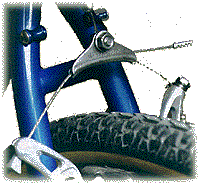
You can get double-ended yoke-cables from numerous sources. Here's one for a 180mm cable. Measure the current distance between the points where your existing cable attaches and draw a triangle to see what length cable you need to get the yoke really close to the tyre. Give yourself just enough room for a fender if you think you may need it.
https://www.oldbicyclejunk.com/zencar...d46278f0d0867a

Last edited by DannoXYZ; 11-23-10 at 05:56 AM.
11-23-10 | 07:58 AM
#19
n00b
Joined: Jan 2008
Posts: 1,397
Likes: 467
From: Austin, TX
Bikes: Surly Karate Monkey, Twin Six Standard Rando
that's not really true. set the height of the yoke first, then adjust the spring tension so that the arms are evenly spaced from the rim. then adjust the position of the pads so that they are closer to the rim. you might get more power out of the brake if the pads are spaced further from the brake arm instead of butted up against the arm. you have about and inch to work with and it looks like yours are mashed all the way in against the arm. experiment with that distance.
11-23-10 | 08:55 AM
#20
Senior Member
Joined: Jun 2010
Posts: 7,579
Likes: 6
From: Pearland, Texas
Bikes: Cannondale, Trek, Raleigh, Santana
Ithaka, True your wheels, clean the rims with Simple Green and a scotchbite pad and replace the pads, especially if the pads are OEM. Adjust the pads closer to the rim and evaluate. I agree the straddle cable is too acute an angle to put serious pressure on the rims and a shorter one will noticeably help.
Brad
Brad
11-23-10 | 08:59 AM
#21

Old fart

Joined: Nov 2004
Posts: 26,411
Likes: 5,350
From: Appleton WI
Bikes: Several, mostly not name brands.
Machined braking surfaces contribute very little to braking efficiency; they simply reduce the tendency to squeal and remove any surface transition at the seam. Dual-pivot brake calipers are the primary reason for modern bikes' improved braking response. That said, the OP's cantilevers should provide more than adequate braking power once they have been properly adjusted.
11-23-10 | 10:17 AM
#22

spathfinder34089
Joined: Jun 2007
Posts: 200
Likes: 1
From: Washington State
Bikes: fuji s12s, Schwiin Le Tour, Puegot mtn. bike, Hiawatha crusier
Ithaka, True your wheels, clean the rims with Simple Green and a scotchbite pad and replace the pads, especially if the pads are OEM. Adjust the pads closer to the rim and evaluate. I agree the straddle cable is too acute an angle to put serious pressure on the rims and a shorter one will noticeably help.
Brad
Brad
11-23-10 | 10:34 AM
#23

Senior Member
Joined: Mar 2009
Posts: 671
Likes: 1
From: Arkansas
Bikes: Surly LHT 52cm Nice Bicycle I think.
I only run Cantilever brakes on all my bicycles I have here.When setup is right don't pull to hard or you will go over the handbar.I should
know all to well lol.A good setup and you will be happy.And Have a Happy Thanksgiving too.
know all to well lol.A good setup and you will be happy.And Have a Happy Thanksgiving too.
11-23-10 | 10:45 AM
#24


surly old man

Joined: Sep 2006
Posts: 3,393
Likes: 44
From: Carlisle, PA
Bikes: IRO Mark V, Karate Monkey half fat, Trek 620 IGH, Cannondale 26/24 MTB, Amp Research B3, and more.
The disadvantage of cantis is also their advantage: there are a number of variables that can be manipulated in the set up. This makes them fiddly for some to set up. But it also means that they can be adjusted to get a fine tune.
Everything else being equal, canti brakes stop as powerfully as anything other than high-quality disc brakes.
And, while I cannot make out the model of the bike, I can see that it is a Lotus touring bike, and as such is worth putting effort into.
So, I would do the following:
-true up the wheels so that you can bring the pads right up against the rims. This is especially important for cantis, since they have such a short pull levers in the first place.
-clean up the braking surface and get some new pads.
-Bring that yoke down. Most any LBS will have a bunch of old yoke cables around of different lengths.
-Check the routing and condition of the cables and housing.
With a little work you will have a pretty damn cool old touring bike with brakes that could stop a rhino.
jim
Everything else being equal, canti brakes stop as powerfully as anything other than high-quality disc brakes.
And, while I cannot make out the model of the bike, I can see that it is a Lotus touring bike, and as such is worth putting effort into.
So, I would do the following:
-true up the wheels so that you can bring the pads right up against the rims. This is especially important for cantis, since they have such a short pull levers in the first place.
-clean up the braking surface and get some new pads.
-Bring that yoke down. Most any LBS will have a bunch of old yoke cables around of different lengths.
-Check the routing and condition of the cables and housing.
With a little work you will have a pretty damn cool old touring bike with brakes that could stop a rhino.
jim
__________________
Cross Check Nexus7, IRO Mark V, Trek 620 Nexus7, Karate Monkey half fat, IRO Model 19 fixed, Amp Research B3, Surly 1x1 half fat fixed, and more...
--------------------------
SB forever
Cross Check Nexus7, IRO Mark V, Trek 620 Nexus7, Karate Monkey half fat, IRO Model 19 fixed, Amp Research B3, Surly 1x1 half fat fixed, and more...
--------------------------
SB forever
11-23-10 | 04:19 PM
#25
Senior Member
Joined: Jul 2005
Posts: 11,754
Likes: 26
From: Mesa, AZ
Bikes: Moots RCS, tandem, beach-cruiser, MTB, Specialized-Allez road-bike, custom track-bike
that's not really true. set the height of the yoke first, then adjust the spring tension so that the arms are evenly spaced from the rim. then adjust the position of the pads so that they are closer to the rim. you might get more power out of the brake if the pads are spaced further from the brake arm instead of butted up against the arm. you have about and inch to work with and it looks like yours are mashed all the way in against the arm. experiment with that distance.
He needs to get a shorter double-ended straddle-cable first. And they're not a very common item at LBSes nowadays, but there are clamp-on barrel-ends you can get to finish off a single-ended cable.