


Threaded Axle/ Campy Record
 02-17-14 | 08:32 AM
#1
Thread Starter
Senior Member

Joined: Apr 2009
Posts: 4,638
Likes: 1,251
Threaded Axle/ Campy Record
I just bought a NOS Campagnolo Record freewheel hub, and noticed that the axle is threaded on the outside. What is the idea behind this? To prevent slippage in the dropouts? I have also noticed a slot on the side, at the end of the axle, but don't know what it's for. A special quick-release? I've been riding with a Royce, and it does not have these features.
 02-17-14 | 08:46 AM
#2

Senior Member
Joined: Dec 2009
Posts: 28,682
Likes: 63
From: Houston, TX
Bikes: 1990 Romic Reynolds 531 custom build, Merlin Works CR Ti custom build, super light Workswell 066 custom build
The axle is threaded as part of the bearing assembly. The bearing cones and locknuts screw onto the threads and tighten down to the proper bearing adjustment with the ball bearings and races that are further inside the hub shell. The slot is a key slot for a keyed washer between the cones and lock nuts so you can tighten/loosen one without turning the other by friction between the two. Or at least that is how I remember the whole thing.
02-17-14 | 08:56 AM
#3

Senior Member


Joined: Feb 2012
Posts: 19,359
Likes: 5,492
From: Rochester, NY
Bikes: Stewart S&S coupled sport tourer, Stewart Sunday light, Stewart Commuting, Stewart Touring, Co Motion Tandem, Stewart 3-Spd, Stewart Track, Fuji Finest, Mongoose Tomac ATB, GT Bravado ATB, JCP Folder, Stewart 650B ATB
The axle's threading on it's outsides is to allow the bearing cones and their associated lock nuts to thread on and be able to be tightened against each other to 'trap" their location along the axle (otherwise known as the bearing adjustment).
But is this really what you are asking? The luck nuts sometimes (and with NR Campy hubs, always) have some knurling or other surface indentations to help their "purchase" against the drop out's inner surface. BITD most all frames had horizontal slotted drop outs, not the now common vertical ones. The clamping pressure to retain the axle's location along the drop out slot is much greater with a horizontal one then a vertical one. (This is why many current QR skewers are so poorly designed, they don't have to be good).
The slot that runs lengthwise along the axle (and almost perpendicular to the threads) is to accept the tab that the lock washers have. This tab is meant to keep the lock washer from rotating when the cone or lock nuts are tightened. In theory if the lock washer stays put then the lock nut's rotation won't cause th cone to do also, making the fine adjustments of bearing preload easier. In practice the lock washer's tab often gets forced out of this slot and ends up jammed on the threads. One could file off the tab and use three cone wrenches to adjust the bearings. Two wrenches to wort the one side's lock nut against the cone, the third wrench on th other end of the axle to help control the axle's movement.
All this is basic bike repair 101 stuff and can be found in just about any good how to service your bike book. Or on line. Andy.
But is this really what you are asking? The luck nuts sometimes (and with NR Campy hubs, always) have some knurling or other surface indentations to help their "purchase" against the drop out's inner surface. BITD most all frames had horizontal slotted drop outs, not the now common vertical ones. The clamping pressure to retain the axle's location along the drop out slot is much greater with a horizontal one then a vertical one. (This is why many current QR skewers are so poorly designed, they don't have to be good).
The slot that runs lengthwise along the axle (and almost perpendicular to the threads) is to accept the tab that the lock washers have. This tab is meant to keep the lock washer from rotating when the cone or lock nuts are tightened. In theory if the lock washer stays put then the lock nut's rotation won't cause th cone to do also, making the fine adjustments of bearing preload easier. In practice the lock washer's tab often gets forced out of this slot and ends up jammed on the threads. One could file off the tab and use three cone wrenches to adjust the bearings. Two wrenches to wort the one side's lock nut against the cone, the third wrench on th other end of the axle to help control the axle's movement.
All this is basic bike repair 101 stuff and can be found in just about any good how to service your bike book. Or on line. Andy.
02-17-14 | 09:10 AM
#4
Thread Starter
Senior Member
Joined: Apr 2009
Posts: 4,638
Likes: 1,251
More specifically: Why is the axle threaded at the point where it meets the dropout? (I understand (somewhat) the inner mechanics of the threaded axle). I do not, how-ever, see why it is threaded at the dropout.
Andrew, this isn't "basic" to me. I've been riding a road bike sine 1981 and have not encountered an axle threaded on the outside. Perhaps you can suggest a better online resource than Bikeforums for finding the answer to my question ? Also, why does my Sloane's manual not answer my question? Maybe I should buy a few more bicycle repair manuals and hope that they answer my question? That way, I won't have to reach out to fellow riders at Bikeforums and bother them with questions I should already know the answer to? Maybe move to the city and take a few courses in vintage bike restoration?
Andrew, this isn't "basic" to me. I've been riding a road bike sine 1981 and have not encountered an axle threaded on the outside. Perhaps you can suggest a better online resource than Bikeforums for finding the answer to my question ? Also, why does my Sloane's manual not answer my question? Maybe I should buy a few more bicycle repair manuals and hope that they answer my question? That way, I won't have to reach out to fellow riders at Bikeforums and bother them with questions I should already know the answer to? Maybe move to the city and take a few courses in vintage bike restoration?
 02-17-14 | 12:24 PM
#8
Senior Member
Joined: Dec 2009
Posts: 28,682
Likes: 63
From: Houston, TX
Bikes: 1990 Romic Reynolds 531 custom build, Merlin Works CR Ti custom build, super light Workswell 066 custom build
The axle is threaded all the way to the end so the theeaded cones and nuts can be started there. How else would you screw them on except by starting at the end.
02-17-14 | 12:30 PM
#9

The space coyote lied.


Joined: Sep 2008
Posts: 48,778
Likes: 11,004
From: dusk 'til dawn.
Bikes: everywhere
They never expected anyone to ask. Maybe they figure it'll make sense if you read the sections on repacking and adjusting hub bearings.
I doubt that would help
Don't have to move to the city. Just order a freewheel remover, cassette remover, maybe a chainwhip, some cone wrenches, a 17mm end wrench and a pound of grease online and repack some hubs. Read up in Sloans and maybe watch some youtube videos. Repack often if you ride in the rain a lot.
02-17-14 | 01:08 PM
#10
Thread Starter
Senior Member
Joined: Apr 2009
Posts: 4,638
Likes: 1,251
My Royce hub has a piece at either end of the axle that slides into the dropout.
It is flat on both sides and the fit is exact. That is why the Campy surprised me.
Lester, maybe there are some videos on Youtube about Royce hubs. Or, maybe you
can just read up on them.
It is flat on both sides and the fit is exact. That is why the Campy surprised me.
Lester, maybe there are some videos on Youtube about Royce hubs. Or, maybe you
can just read up on them.
02-17-14 | 01:22 PM
#11


Super Moderator

Joined: Jul 2004
Posts: 21,985
Likes: 1,159
From: Ffld Cnty Connecticut
Bikes: Old Steelies I made, Old Cannondales
Any loose ball bearing hub I ever encountered since I started playing with bikes in the 1970s has a threaded axle. From the lowly department store bike to top end race bikes. Sealed bearing hubs have press fit bearing cartridges and do not need threads to install. There are always a few exceptions to every "rule" if you look hard enough.
In order for it not to have threads in the dropout area, they would have to machine down the diameter so the cones & nuts could get to the threaded area. Extra work for no benefit.
From my 30 second investigation of Royce hubs, they appear to be sealed bearing hubs. The majority of hubs (of all quality levels) , were loose bearing hubs "back in the day".
In order for it not to have threads in the dropout area, they would have to machine down the diameter so the cones & nuts could get to the threaded area. Extra work for no benefit.
From my 30 second investigation of Royce hubs, they appear to be sealed bearing hubs. The majority of hubs (of all quality levels) , were loose bearing hubs "back in the day".
__________________
Bikes: Old steel race bikes, old Cannondale race bikes, less old Cannondale race bike, crappy old mtn bike.
FYI: https://www.bikeforums.net/forum-sugg...ad-please.html
Bikes: Old steel race bikes, old Cannondale race bikes, less old Cannondale race bike, crappy old mtn bike.
FYI: https://www.bikeforums.net/forum-sugg...ad-please.html
Last edited by Homebrew01; 02-17-14 at 01:29 PM.
02-17-14 | 01:47 PM
#12
The space coyote lied.
Joined: Sep 2008
Posts: 48,778
Likes: 11,004
From: dusk 'til dawn.
Bikes: everywhere
Yep. Your Royce hubs are likely cartridge bearing units. Those were quite rare in 1981. Much more common now but not ubiquitous enough to be considered standard yet. I've swapped a lot of cartridge bottom brackets and headsets but haven't replaced cartridge bearings in wheels. Will read and watch video when that time comes.
02-17-14 | 01:58 PM
#13
Thread Starter
Senior Member
Joined: Apr 2009
Posts: 4,638
Likes: 1,251
Royce, I have heard was either one of the first, or the first company to feature sealed cartridge bearings.
when I saw the Campy, I just thought I'd maybe need an extra part or something.
The Record fits nice in my dropouts and everything's fine.
when I saw the Campy, I just thought I'd maybe need an extra part or something.
The Record fits nice in my dropouts and everything's fine.
02-17-14 | 02:03 PM
#14
Super Moderator
Joined: Jul 2004
Posts: 21,985
Likes: 1,159
From: Ffld Cnty Connecticut
Bikes: Old Steelies I made, Old Cannondales
I've got Weyless hubs from the 1970s with sealed cartridge bearings. No idea who was first though. The Classic & Vintage crowd would know.
__________________
Bikes: Old steel race bikes, old Cannondale race bikes, less old Cannondale race bike, crappy old mtn bike.
FYI: https://www.bikeforums.net/forum-sugg...ad-please.html
Bikes: Old steel race bikes, old Cannondale race bikes, less old Cannondale race bike, crappy old mtn bike.
FYI: https://www.bikeforums.net/forum-sugg...ad-please.html
Last edited by Homebrew01; 02-17-14 at 02:43 PM.
02-17-14 | 03:25 PM
#16

Senior Member
Joined: Dec 2009
Posts: 9,563
Likes: 736
From: Melbourne, Oz
Bikes: https://weightweenies.starbike.com/forum/viewtopic.php?f=10&t=152015&p=1404231


 02-18-14 | 01:15 AM
#18
Senior Member
Joined: Dec 2009
Posts: 9,563
Likes: 736
From: Melbourne, Oz
Bikes: https://weightweenies.starbike.com/forum/viewtopic.php?f=10&t=152015&p=1404231
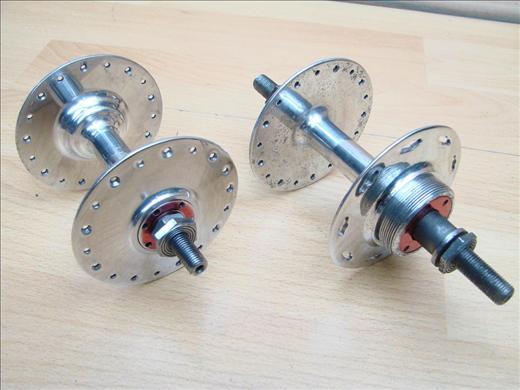
As you can see, most/many cartridge bearing hubs have threaded axle ends too (kinda necessary on track hubs).
02-18-14 | 12:22 PM
#19
Senior Member
Joined: Dec 2005
Posts: 7,848
Likes: 4
Dont get whats the problem with having the axles threaded all the way  Always been like that even in low ends manufacturers since the invention of hubs
Lot of people doesnt know old stuff, so the question the op is doing doesnt surprise me at all hehehe
Always been like that even in low ends manufacturers since the invention of hubs Lot of people doesnt know old stuff, so the question the op is doing doesnt surprise me at all hehehe
Last edited by ultraman6970; 02-18-14 at 12:28 PM.

