


How do I stop 630 32 rims from exploding all the time?
 03-01-15 | 12:43 AM
#1
Thread Starter
Junior Member
Joined: Jun 2014
Posts: 16
Likes: 0
Bikes: mid 90's Cannondale R700 (stolen, but still mine). Peugeot UO-8 (until I find a replacement)
How do I stop 630 32 rims from exploding all the time?
Hello all I hope I'm not making any horrible mistakes on my first post.
I ride an old roadbike which has 630-32mm / 27 x 1-1/4" straight side rims. According toSheldon Brown:
I've ridden this thing for a long time on the gumwall tires the bike was sold with at about 110 psi with no problems until the sidewalls gave way and I replaced the tires with non-gumwall tires, experienced a bunch of heart-stopping blowouts (thankfully never while riding it), put some gumwall tires on it and the problem went away for a while before coming back again recently. This is especially infuriating because this bike is my ONLY form of transportation besides walking.
I don't know what I'm doing wrong. I make sure the tube isn't bunched up or pinched between the tire and rim during installation. My plan after schlepping my butt over to the bike shop on foot to buy some tubes is to mark where on the tire and rim the herniation of the tube is happening, rotating the tire 180 degrees, putting on some earplugs, inflating to 90psi to see if it's a problem with the rim or the tire.
Thanks for taking your time to help me out
I ride an old roadbike which has 630-32mm / 27 x 1-1/4" straight side rims. According toSheldon Brown:
Traditional 630 mm (27 inch) rims were straight side design, but in the late '70s they evolved to a "hook edge" design which would permit the use of higher pressures.
These days, many 630 mm (27 inch) tires are marked "For hook edge rims only" (some companies use the term "crochet type" instead of "hook edge"...this is the result of poor translation.)
The fact is that modern 630 mm (27 inch) tires will work on older straight-side rims, but they won't handle as much pressure as they are capable of with hook edge rims.
Generally, the "rule of thumb" for traditional 630 mm (27 inch) tires is that they should be inflated to 70-75 psi. This shouldn't be a problem with any tire, despite whatever disclaimer the manufacturer puts on the sidewall. However, if you're restricted to this pressure range, you probably shouldn't be running tires narrower than 1 1/8, or preferably 1 1/4, unless you're a very lightweight rider.
These days, many 630 mm (27 inch) tires are marked "For hook edge rims only" (some companies use the term "crochet type" instead of "hook edge"...this is the result of poor translation.)
The fact is that modern 630 mm (27 inch) tires will work on older straight-side rims, but they won't handle as much pressure as they are capable of with hook edge rims.
Generally, the "rule of thumb" for traditional 630 mm (27 inch) tires is that they should be inflated to 70-75 psi. This shouldn't be a problem with any tire, despite whatever disclaimer the manufacturer puts on the sidewall. However, if you're restricted to this pressure range, you probably shouldn't be running tires narrower than 1 1/8, or preferably 1 1/4, unless you're a very lightweight rider.
I don't know what I'm doing wrong. I make sure the tube isn't bunched up or pinched between the tire and rim during installation. My plan after schlepping my butt over to the bike shop on foot to buy some tubes is to mark where on the tire and rim the herniation of the tube is happening, rotating the tire 180 degrees, putting on some earplugs, inflating to 90psi to see if it's a problem with the rim or the tire.
Thanks for taking your time to help me out
 03-01-15 | 01:08 AM
#2
Senior Member
Joined: Dec 2010
Posts: 6,682
Likes: 4
From: Above ground, Walnut Creek, Ca
Bikes: 8 ss bikes, 1 5-speed touring bike
"hook edge" (i'll use the terminology in the info you provided) rims can go 110 PSI easy. 75 PSI or thereabouts is about max for non edge rims. what kind do you have?
AFAIK, "hook edge" rims have been pretty standard now for about 35 years.
here's a "hook edge" rim:

and here's a cross-section showing a "hook edge" rim and tire and tube:
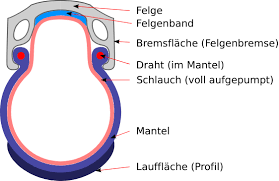
and here's a "non hook edge" rim:

AFAIK, "hook edge" rims have been pretty standard now for about 35 years.
here's a "hook edge" rim:
and here's a cross-section showing a "hook edge" rim and tire and tube:
and here's a "non hook edge" rim:
Last edited by hueyhoolihan; 03-01-15 at 01:23 AM.
03-01-15 | 01:30 AM
#3
Senior Member
Joined: Nov 2008
Posts: 7,239
Likes: 8
From: Bay Area, Calif.
The only advice I have is to try different tires to see if there's one that you can safely be run at the pressure you like, learn to live with a reduced pressure, or rebuild the wheels with hooked rims.
The OPs experience mirrors my own. Back when straight-sided rims were the norm there was no problem finding tires rated for over 100psi and they didn't suffer from such spontaneous blowouts even at 120 psi (which I used routinely on our tandem). But now that new rims are made with hooked sides the tire makers appear to have changed their tire designs slightly with the result that they no longer work reliably with straight-sided rims at pressures over about 80 psi.
The OPs experience mirrors my own. Back when straight-sided rims were the norm there was no problem finding tires rated for over 100psi and they didn't suffer from such spontaneous blowouts even at 120 psi (which I used routinely on our tandem). But now that new rims are made with hooked sides the tire makers appear to have changed their tire designs slightly with the result that they no longer work reliably with straight-sided rims at pressures over about 80 psi.
03-01-15 | 03:07 AM
#4
Senior Member
Joined: Apr 2011
Posts: 2,347
Likes: 21
Bikes: Fillet-brazed Schwinns
I ride an old roadbike which has 27 x 1-1/4" straight side rims...
...the bike was sold with at about 110 psi with no problems until the sidewalls gave way...
...I replaced the tires with non-gumwall tires, experienced a bunch of heart-stopping blowouts...
...put some gumwall tires on it and the problem went away for a while before coming back again recently.
According to Sheldon Brown:
I don't know what I'm doing wrong.
...the bike was sold with at about 110 psi with no problems until the sidewalls gave way...
...I replaced the tires with non-gumwall tires, experienced a bunch of heart-stopping blowouts...
...put some gumwall tires on it and the problem went away for a while before coming back again recently.
According to Sheldon Brown:
The fact is that modern 630 mm (27 inch) tires will work on older straight-side rims, but they won't handle as much pressure as they are capable of with hook edge rims.
Generally, the "rule of thumb" for traditional 630 mm (27 inch) tires [on straight side rims] is that they should be inflated to 70-75 psi.
Generally, the "rule of thumb" for traditional 630 mm (27 inch) tires [on straight side rims] is that they should be inflated to 70-75 psi.
03-01-15 | 11:19 AM
#6
Banned
Joined: Sep 2010
Posts: 1,555
Likes: 1
From: lower mitten
Bikes: With round 700c & 26" wheels
That's the beauty of a vintage stuff...beauty, not necessary durability or convenience. If you have so many issues with it, maybe it's time to upgrade your rims to something easier to maintain, and more worry free...
03-01-15 | 11:33 AM
#7

Really Old Senior Member


Joined: Feb 2007
Posts: 14,685
Likes: 1,922
From: Mid Willamette Valley, Orygun
Bikes: 87 RockHopper,2008 Specialized Globe. Both upgraded to 9 speeds. 2019 Giant Explore E+3
Are you using wire bead tires?
Some cheaper tires may be "stretchy" or simply a bit oversize.
When inflating-
Work up the pressure in small increments, checking after about 5, 15, 30... PSI to make sure the tire bead is concentric with the rim.
BTW, you RIMS aren't exploding. The tube is.
Some cheaper tires may be "stretchy" or simply a bit oversize.
When inflating-
Work up the pressure in small increments, checking after about 5, 15, 30... PSI to make sure the tire bead is concentric with the rim.
BTW, you RIMS aren't exploding. The tube is.
03-01-15 | 11:35 AM
#8

Senior Member

Joined: Aug 2011
Posts: 22,676
Likes: 2,643
From: CID
Bikes: 1991 Bianchi Eros, 1964 Armstrong, 1988 Diamondback Ascent, 1988 Bianchi Premio, 1987 Bianchi Sport SX, 1980s Raleigh mixte (hers), All-City Space Horse (hers)
 03-01-15 | 11:37 AM
#9

Senior Member
Joined: Aug 2006
Posts: 7,643
Likes: 68
From: Portland OR
Bikes: 61 Bianchi Specialissima 71 Peugeot G50 7? P'geot PX10 74 Raleigh GranSport 75 P'geot UO8 78? Raleigh Team Pro 82 P'geot PSV 86 P'geot PX 91 Bridgestone MB0 92 B'stone XO1 97 Rans VRex 92 Cannondale R1000 94 B'stone MB5 97 Vitus 997
You should not be inflating 32 mm tires to anywhere near 100 psi.
Unnecessary and eliminates the advantages of wide tires.
Unnecessary and eliminates the advantages of wide tires.
03-01-15 | 11:47 AM
#10
Really Old Senior Member
Joined: Feb 2007
Posts: 14,685
Likes: 1,922
From: Mid Willamette Valley, Orygun
Bikes: 87 RockHopper,2008 Specialized Globe. Both upgraded to 9 speeds. 2019 Giant Explore E+3
I've never considered 27x1-1/4 to be wide, but for some reason I consider 622X32 somewhat wide???
Probably the difference in typical 27" rims and 700c rims which tend to vary from skinny road rims like my Sun Rim M13 II's to extra wide 29'r rims.
03-01-15 | 12:13 PM
#11

Senior Member

Joined: Feb 2012
Posts: 19,381
Likes: 5,528
From: Rochester, NY
Bikes: Stewart S&S coupled sport tourer, Stewart Sunday light, Stewart Commuting, Stewart Touring, Co Motion Tandem, Stewart 3-Spd, Stewart Track, Fuji Finest, Mongoose Tomac ATB, GT Bravado ATB, JCP Folder, Stewart 650B ATB
Yet thousands of riders do without issues. As Bill k says it depends. When I tour I have close to 250# total weight, on our day riding tandem we have about 350# total weight. With 32mm tires (actual width, not label size) I'll run 105/110 F/R usually. Have for decades and many thousands of miles. Andy.
03-01-15 | 12:15 PM
#12
Thread Starter
Junior Member
Joined: Jun 2014
Posts: 16
Likes: 0
Bikes: mid 90's Cannondale R700 (stolen, but still mine). Peugeot UO-8 (until I find a replacement)
Wow I'm surprised at all the replies I got 
The big giant point is that for months on the first set of ancient decaying gumwall tires, and weeks later on some brand new gumwall tires I was able to inflate it to 110psi with no problems, and now I'm not. This leads me to believe there's something wrong with the tire but close inspection doesn't reveal anything wrong.
The big giant point is that for months on the first set of ancient decaying gumwall tires, and weeks later on some brand new gumwall tires I was able to inflate it to 110psi with no problems, and now I'm not. This leads me to believe there's something wrong with the tire but close inspection doesn't reveal anything wrong.

 03-01-15 | 12:24 PM
#14
Senior Member
Joined: Feb 2012
Posts: 19,381
Likes: 5,528
From: Rochester, NY
Bikes: Stewart S&S coupled sport tourer, Stewart Sunday light, Stewart Commuting, Stewart Touring, Co Motion Tandem, Stewart 3-Spd, Stewart Track, Fuji Finest, Mongoose Tomac ATB, GT Bravado ATB, JCP Folder, Stewart 650B ATB
Part of an inspection is the actual application process. So by that definition your inspection does find something wrong. Tires can stretch, bead wise and casings can bulge both effect fit. Rims can get flat spots that upset the tire's mounting. Rim strips can shift to be under the tire bead.
BTW what are the current tires rated to, pressure wise? Andy.
BTW what are the current tires rated to, pressure wise? Andy.
03-01-15 | 12:32 PM
#15

The space coyote lied.

Joined: Sep 2008
Posts: 48,905
Likes: 11,099
From: dusk 'til dawn.
Bikes: everywhere
Wow I'm surprised at all the replies I got
The big giant point is that for months on the first set of ancient decaying gumwall tires, and weeks later on some brand new gumwall tires I was able to inflate it to 110psi with no problems, and now I'm not. This leads me to believe there's something wrong with the tire but close inspection doesn't reveal anything wrong.
The big giant point is that for months on the first set of ancient decaying gumwall tires, and weeks later on some brand new gumwall tires I was able to inflate it to 110psi with no problems, and now I'm not. This leads me to believe there's something wrong with the tire but close inspection doesn't reveal anything wrong.
Once a tire has been blown off a rim, its bead has likely been relaxed quite a bit.
 03-01-15 | 12:44 PM
#18
Thread Starter
Junior Member
Joined: Jun 2014
Posts: 16
Likes: 0
Bikes: mid 90's Cannondale R700 (stolen, but still mine). Peugeot UO-8 (until I find a replacement)
Part of an inspection is the actual application process. So by that definition your inspection does find something wrong. Tires can stretch, bead wise and casings can bulge both effect fit. Rims can get flat spots that upset the tire's mounting. Rim strips can shift to be under the tire bead.
BTW what are the current tires rated to, pressure wise? Andy.
BTW what are the current tires rated to, pressure wise? Andy.
Haha I've never heard of this what does this do?
03-01-15 | 12:52 PM
#19
The space coyote lied.
Joined: Sep 2008
Posts: 48,905
Likes: 11,099
From: dusk 'til dawn.
Bikes: everywhere
03-01-15 | 01:14 PM
#20
Senior Member
Joined: May 2011
Posts: 3,780
Likes: 17
From: Upstate NY
Bikes: Bianchi San Mateo and a few others
The big giant point is that for months on the first set of ancient decaying gumwall tires, and weeks later on some brand new gumwall tires I was able to inflate it to 110psi with no problems, and now I'm not. This leads me to believe there's something wrong with the tire...
03-01-15 | 01:26 PM
#21
The space coyote lied.
Joined: Sep 2008
Posts: 48,905
Likes: 11,099
From: dusk 'til dawn.
Bikes: everywhere
Internet rumour has it that these hold tighter than Paselas. Not tan wall, but brownwall, at least.
https://www.biketiresdirect.com/prod...inch-road-tire
https://www.biketiresdirect.com/prod...inch-road-tire
03-01-15 | 02:09 PM
#22

Senior Member
Joined: Oct 2014
Posts: 14,192
Likes: 5,328
From: Portland, OR
Bikes: (2) ti TiCycles, 2007 w/ triple and 2011 fixed, 1979 Peter Mooney, ~1983 Trek 420 now fixed and ~1973 Raleigh Carlton Competition gravel grinder
I ride Paselas in 700c for about half my mileage but on new (Open Pro and Velocity) rims. I find them very consistent; enough so that it doesn't surprise me at all that if you had issues with one of those tires and your rims, that you would have the same issue on a regular basis.
There are tire-rim combos that don't work. This may be more prevalent with new tires and old-style rims, but it always been true. Another point that I haven't seen raised: are you checking carefully to make sure the bead is seated evenly all the way around on both sides? Panaracer puts a good, visible molded line on their tires that you should see (or not see any of depending on the bury of your bead) uniformly all the way around. I put ~20psi in my tire, hold the wheel by the axle ends and spin it, watching for any jumps or dips in that bead. Also to see the uniformity of the tread. Does it hop or move to one side? Only after I am satisfied that the tire is seated uniformly do I inflate it the rest of the way. This check may well be more important with the new tires (bigger, looser bead) and an old-style rim where all of the bead is against the middle portion of the rim with no reference to help guide it vertically. It will be will off the bottom of the rim cavity and there is no upper bead to guide it, so it is all up to the person installing the tire.
All that said, 32c Paselas and 100 pounds? You haven't said what your rider plus bike weighs, but that sounds like a lot! I ride those tires (700c) with 70 pounds on smooth roads. 80 psi is rock hard. I ride 60 pounds in the wet. (155# rider + 26# bike + say 15# stuff = 196#) (Andy's 350# at 110 psi ~= 62 psi at my weight.)
Ben
There are tire-rim combos that don't work. This may be more prevalent with new tires and old-style rims, but it always been true. Another point that I haven't seen raised: are you checking carefully to make sure the bead is seated evenly all the way around on both sides? Panaracer puts a good, visible molded line on their tires that you should see (or not see any of depending on the bury of your bead) uniformly all the way around. I put ~20psi in my tire, hold the wheel by the axle ends and spin it, watching for any jumps or dips in that bead. Also to see the uniformity of the tread. Does it hop or move to one side? Only after I am satisfied that the tire is seated uniformly do I inflate it the rest of the way. This check may well be more important with the new tires (bigger, looser bead) and an old-style rim where all of the bead is against the middle portion of the rim with no reference to help guide it vertically. It will be will off the bottom of the rim cavity and there is no upper bead to guide it, so it is all up to the person installing the tire.
All that said, 32c Paselas and 100 pounds? You haven't said what your rider plus bike weighs, but that sounds like a lot! I ride those tires (700c) with 70 pounds on smooth roads. 80 psi is rock hard. I ride 60 pounds in the wet. (155# rider + 26# bike + say 15# stuff = 196#) (Andy's 350# at 110 psi ~= 62 psi at my weight.)
Ben
03-01-15 | 02:50 PM
#23
Banned
Joined: Sep 2010
Posts: 1,555
Likes: 1
From: lower mitten
Bikes: With round 700c & 26" wheels
100-110 PSI it's a lot of pressure that is trapped in a small space.
Car tires takes 20-40 PSI, and can kill when they explode.
Luckily bicycle tires don't have enough mass to kill, but they sure can hurt you.
Car tires takes 20-40 PSI, and can kill when they explode.
Luckily bicycle tires don't have enough mass to kill, but they sure can hurt you.
03-01-15 | 02:53 PM
#24
Senior Member
Joined: Aug 2006
Posts: 7,643
Likes: 68
From: Portland OR
Bikes: 61 Bianchi Specialissima 71 Peugeot G50 7? P'geot PX10 74 Raleigh GranSport 75 P'geot UO8 78? Raleigh Team Pro 82 P'geot PSV 86 P'geot PX 91 Bridgestone MB0 92 B'stone XO1 97 Rans VRex 92 Cannondale R1000 94 B'stone MB5 97 Vitus 997

Thread
Thread Starter
Forum
Replies
Last Post
well biked
Classic & Vintage
26
04-01-16 10:38 AM
