


Speaking Of Headtube Angle
 07-02-15 | 08:42 PM
#26
Senior Member
Joined: Apr 2011
Posts: 2,347
Likes: 21
Bikes: Fillet-brazed Schwinns
Curious about the question of measuring STA and HTA relative to the top tube and assuming the top tube is exactly parallel to a line through the front and rear dropouts, I measured the angles of my 2007 Waterford RS-22. From all appearances the top tube is level and there is nothing on the factory geometry drawing to indicate a slope.
In fact, the top tube has a 0.7° slope down from the head tube to the seat tube.
In fact, the top tube has a 0.7° slope down from the head tube to the seat tube.
 07-02-15 | 10:01 PM
#27


Decrepit Member
Joined: Aug 2005
Posts: 10,488
Likes: 94
From: Santa Rosa, California
Bikes: Waterford 953 RS-22, several Paramounts
In that case either the factory drawing geometry is wrong (unlikely) or a combination of tolerance stack, geometry variations due to frame size differences (geometry varies slightly in sizes other than on the official drawing) and finally measurement accuracy all contributed to your 0.7° measurement. I would still consider that a horizontal top tube even if it was possibly built or measured slightly different from what was intended.
I have several other frames with "horizontal" top tubes that I'll check. A 0.7° slope in the TT could throw off the actual HTA and STA by that much if they are measured relative to the top tube.
 07-02-15 | 10:18 PM
#28

Senior Member

Joined: May 2015
Posts: 4,049
Likes: 124
Bikes: 2015 22 Speed
It could be 74. I would guess, not under 73.
UPDATE: link to some newer Ti frame stats that puts this Colnago at 73. The discussion of headtube angle is interesting. Maybe you can compare some of the other stats as a compare:
https://www.ebay.com/itm/271418315394
UPDATE: link to some newer Ti frame stats that puts this Colnago at 73. The discussion of headtube angle is interesting. Maybe you can compare some of the other stats as a compare:
https://www.ebay.com/itm/271418315394
Last edited by McBTC; 07-02-15 at 10:46 PM.
07-02-15 | 10:19 PM
#29


In that case either the factory drawing geometry is wrong (unlikely) or a combination of tolerance stack, geometry variations due to frame size differences (geometry varies slightly in sizes other than on the official drawing) and finally measurement accuracy all contributed to your 0.7° measurement. I would still consider that a horizontal top tube even if it was possibly built or measured slightly different from what was intended.
Level top tubes are not gospel, I do not know any builder who uses that tube as a datum, so no problem.
Unless you want to use it as a datum later on for reverse engineering... Then you get errors.
I really like using the wheel axle centers, makes it pretty easy to measure off bottom bracket drop too.
That is more interesting than the accuracy of a level top tube.
07-02-15 | 10:46 PM
#30
Senior Member
Joined: Apr 2011
Posts: 2,347
Likes: 21
Bikes: Fillet-brazed Schwinns
The drawings of bikes with horizontal top tubes seem to use the TT as a datum and mark the HTA and STA angles from the top tube, thus it is easiest to measure the same way. I believe that tolerance stack, measurement accuracy and inconsistent changes made to the lengths/angles of tubes of different frame sizes contribute to +/- 1 degree of accuracy.
07-02-15 | 11:29 PM
#31
Decrepit Member
Joined: Aug 2005
Posts: 10,488
Likes: 94
From: Santa Rosa, California
Bikes: Waterford 953 RS-22, several Paramounts
Most, but not all, drawings I've seen use the baseline through the dropout centers as the datum, and the STA and HTA are referenced to that line.
This one is from Schwinn.
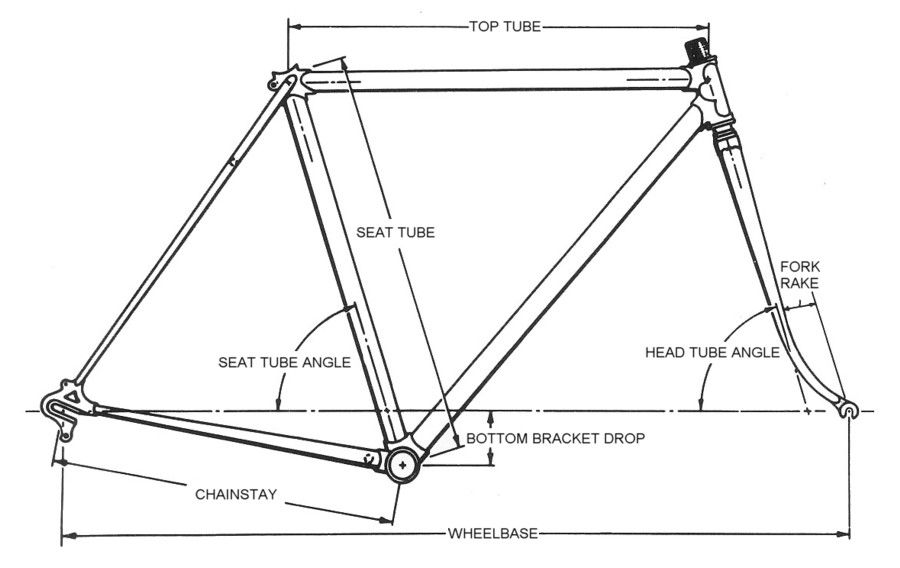
This one is from Schwinn.
07-02-15 | 11:33 PM
#32
Senior Member
Joined: Apr 2011
Posts: 2,347
Likes: 21
Bikes: Fillet-brazed Schwinns
Catalog drawings like that are often incomplete vs. the actual engineering drawings. In this case I believe that drawing also intended to show a horizontal top tube. Within tolerances of course. 
In other words I would guess if you asked the Schwinn engineers at the time that drawing was published they would say that the top tube was intended to be horizontal. I believe that tolerance stack, frame size changes and of course measurement accuracy could easily add up to a +/- 1 degree variation.
In other words I would guess if you asked the Schwinn engineers at the time that drawing was published they would say that the top tube was intended to be horizontal. I believe that tolerance stack, frame size changes and of course measurement accuracy could easily add up to a +/- 1 degree variation.
Last edited by Metacortex; 07-02-15 at 11:43 PM.
07-02-15 | 11:38 PM
#33
Senior Member

Joined: Oct 2013
Posts: 3,454
Likes: 910
From: Connecticut
Bikes: are fun!
The second half of #30 above is an important point. The drawing sheet is a target. Real world, accurate measurements of the steel are fact. People introduce a bit of error and correction into the intent of the drawing. Measuring from a baseline of axle centers makes a whole lot of sense - that relates all measurements to the contact patches assuming the wheels are good. Interesting note to measure w/o tires.
07-04-15 | 02:57 PM
#34
Decrepit Member
Joined: Aug 2005
Posts: 10,488
Likes: 94
From: Santa Rosa, California
Bikes: Waterford 953 RS-22, several Paramounts
Here's my 1973 24" Super Sport frame. Same setup, but I centered the rear "axle" midway along the horizontal dropout before measuring the angles.
Here's the setup.
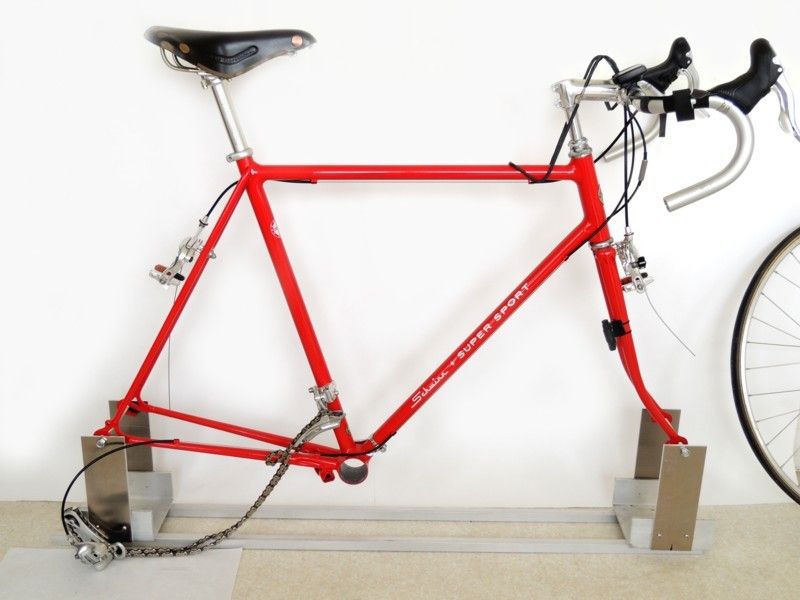
Angle gauge "zeroed" on box beam.

Top tube has 1.0° slope relative to horizontal line through F & R dropout centers.

HTA is 72.5°.

STA is 71.9°.

Here's the setup.
Angle gauge "zeroed" on box beam.
Top tube has 1.0° slope relative to horizontal line through F & R dropout centers.
HTA is 72.5°.
STA is 71.9°.
07-04-15 | 03:11 PM
#35
Senior Member
Joined: Apr 2011
Posts: 2,347
Likes: 21
Bikes: Fillet-brazed Schwinns
According to the Schwinn Reporter (dealer newsletter) in May '73 in an article on frames the men's fillet-brazed bikes are supposed to have 73 degree HT and ST angles. I've measured those angles using the level top tube as a reference on several of mine, and it verifies for me to within less than half a degree. By comparison the electro-forged models (Varsity, Continental, etc.) were 70/70 degree HT/ST, and that measures out for me as well.
07-04-15 | 03:32 PM
#36
Decrepit Member
Joined: Aug 2005
Posts: 10,488
Likes: 94
From: Santa Rosa, California
Bikes: Waterford 953 RS-22, several Paramounts
According to the Schwinn Reporter (dealer newsletter) in May '73 in an article on frames the men's fillet-brazed bikes are supposed to have 73 degree HT and ST angles. I've measured those angles using the level top tube as a reference on several of mine, and it verifies for me to within less than half a degree. By comparison the electro-forged models (Varsity, Continental, etc.) were 70/70 degree HT/ST, and that measures out for me as well.
I maintain that the only truly accurate datum is a line through the front and rear dropout centers. Everything else, especially the top tube slope, can vary.
07-04-15 | 03:59 PM
#37
Senior Member
Joined: Apr 2011
Posts: 2,347
Likes: 21
Bikes: Fillet-brazed Schwinns
I believe that merely points out the level of precision to which those bikes were made. Are you going to find hand-made bikes (especially those made during the frantic boom years) a little "off" here and there? I believe so. Take into account the level of accuracy of the instrument and you are within a half a degree of the spec on both angles. I measured multiple FB frames with a similar gauge and they all came out to within a half a degree (or less) of 73 degrees parallel on the HT/ST. Schwinn sourced tubular forks from multiple suppliers, tolerances and variations thereof may also throw off the TT angle. I'm convinced it was intended to be horizontal, just as the HT/ST angles were intended to be 73 degrees. The reality varied somewhat.
07-04-15 | 04:22 PM
#38

Senior Member
Joined: Aug 2013
Posts: 1,200
Likes: 6
From: Vermont
Bikes: Pinarello Montello, Merckx MX Leader, Merckx Corsa Extra, Pinarello Prologo, Tredici Magia Nera, Tredici Cross
I ride 57-58cm bikes. Most of my 80's racing frames are in the range of 74 Head Tube angle. Seems about optimum for my size, with the correct wheel setback.
07-04-15 | 04:26 PM
#39

Thread Starter
Senior Member

Joined: Jul 2004
Posts: 13,358
Likes: 665
From: northern michigan
Bikes: '77 Colnago Super, '76 Fuji The Finest, '88 Cannondale Criterium, '86 Trek 760, '87 Miyata 712
 07-04-15 | 04:39 PM
#40
Senior Member
Joined: Aug 2013
Posts: 1,200
Likes: 6
From: Vermont
Bikes: Pinarello Montello, Merckx MX Leader, Merckx Corsa Extra, Pinarello Prologo, Tredici Magia Nera, Tredici Cross
07-04-15 | 05:07 PM
#41
I believe that merely points out the level of precision to which those bikes were made. Are you going to find hand-made bikes (especially those made during the frantic boom years) a little "off" here and there? I believe so. Take into account the level of accuracy of the instrument and you are within a half a degree of the spec on both angles. I measured multiple FB frames with a similar gauge and they all came out to within a half a degree (or less) of 73 degrees parallel on the HT/ST. Schwinn sourced tubular forks from multiple suppliers, tolerances and variations thereof may also throw off the TT angle. I'm convinced it was intended to be horizontal, just as the HT/ST angles were intended to be 73 degrees. The reality varied somewhat.
In my book it is to understand the geometry in total, of which angles play a good part in how the bike handles.
That information is in relation to the ground. What the top tube does on a bike that has a "level" top tube is not really part of the equation. It is interesting to note as it might give some indication as to how the mfg practice allowed for variation, but does not mean much when wanting to know the how's and whys of how the bike is perceived by you while riding. So, you better know the top tube length too, and seating position in relation to the bottom bracket.
Noting the actual angles can give insight as to why sister bikes of the same brand don't behave the same, it encourages further investigation of other dimensions, which can play an equal or bigger part. Having the correct measure of the head angle will greatly help in figuring out the actual trail of the steering system, useful in assessing comparison just as much as the head angle.
In short, relying and expecting a level top tube is a lazy way to pull off actual useful dimensions and might well result in errors of assessment. Why waste the time when a more accurate way is easy to obtain that adds useful information in a comprehensive understanding that can be compared between similar fitting steeds?
07-04-15 | 05:26 PM
#42
Decrepit Member
Joined: Aug 2005
Posts: 10,488
Likes: 94
From: Santa Rosa, California
Bikes: Waterford 953 RS-22, several Paramounts
Here is basically how I view angles. Forget what the drawing prescribes, why does one want to know the actual as built angles?
In my book it is to understand the geometry in total, of which angles play a good part in how the bike handles.
That information is in relation to the ground. What the top tube does on a bike that has a "level" top tube is not really part of the equation. It is interesting to note as it might give some indication as to how the mfg practice allowed for variation, but does not mean much when wanting to know the how's and whys of how the bike is perceived by you while riding. So, you better know the top tube length too, and seating position in relation to the bottom bracket.
Noting the actual angles can give insight as to why sister bikes of the same brand don't behave the same, it encourages further investigation of other dimensions, which can play an equal or bigger part. Having the correct measure of the head angle will greatly help in figuring out the actual trail of the steering system, useful in assessing comparison just as much as the head angle.
In short, relying and expecting a level top tube is a lazy way to pull off actual useful dimensions and might well result in errors of assessment. Why waste the time when a more accurate way is easy to obtain that adds useful information in a comprehensive understanding that can be compared between similar fitting steeds?
In my book it is to understand the geometry in total, of which angles play a good part in how the bike handles.
That information is in relation to the ground. What the top tube does on a bike that has a "level" top tube is not really part of the equation. It is interesting to note as it might give some indication as to how the mfg practice allowed for variation, but does not mean much when wanting to know the how's and whys of how the bike is perceived by you while riding. So, you better know the top tube length too, and seating position in relation to the bottom bracket.
Noting the actual angles can give insight as to why sister bikes of the same brand don't behave the same, it encourages further investigation of other dimensions, which can play an equal or bigger part. Having the correct measure of the head angle will greatly help in figuring out the actual trail of the steering system, useful in assessing comparison just as much as the head angle.
In short, relying and expecting a level top tube is a lazy way to pull off actual useful dimensions and might well result in errors of assessment. Why waste the time when a more accurate way is easy to obtain that adds useful information in a comprehensive understanding that can be compared between similar fitting steeds?
07-04-15 | 05:44 PM
#43
Senior Member
Joined: Apr 2011
Posts: 2,347
Likes: 21
Bikes: Fillet-brazed Schwinns
Using one physical example of a specific model to measure is also a problem, I'll see if I can measure at least 10 to maybe 20 Schwinn fillet-brazed frames to find the angles based off the top tube. That won't happen today though.
07-04-15 | 09:03 PM
#44
The design and drawing are what was intended to be produced while the actual production frames may vary, especially on hand made models. I normally assign frame angles by the design/build intention, since measuring 10 hand built frames down to the tenth of a degree will likely result in 10 slightly different results, especially if they are different sizes. I think there is way too much over-analysis going on here.
Using one physical example of a specific model to measure is also a problem, I'll see if I can measure at least 10 to maybe 20 Schwinn fillet-brazed frames to find the angles based off the top tube. That won't happen today though.
Using one physical example of a specific model to measure is also a problem, I'll see if I can measure at least 10 to maybe 20 Schwinn fillet-brazed frames to find the angles based off the top tube. That won't happen today though.
07-04-15 | 09:53 PM
#45
Senior Member
Joined: Apr 2011
Posts: 2,347
Likes: 21
Bikes: Fillet-brazed Schwinns
Earlier you acknowledged, my paraphrasing that a top tube could be .7 degrees off, I agree, no problem, except if that is your Datum then the head angle will be off an equal amount and the trail measure will be off too. That could well be significant if you wanted to compare different brand bikes and or wanted to replicate a bike you have and liked.
07-05-15 | 12:51 PM
#46
Decrepit Member
Joined: Aug 2005
Posts: 10,488
Likes: 94
From: Santa Rosa, California
Bikes: Waterford 953 RS-22, several Paramounts
I think repechage's point - and I agree - is that everything on the Waterford drawing (most significantly HTA and STA) except the top tube slope match the angles and dimensions I measured when a baseline through the front and rear dropout centers are used as the datum which is parallel to the ground if the front and rear wheels/tires have the same radius. I have accurately measured the Waterford's fork rake at 42mm and the Campy headset stack height is part of the design. With an HTA of 73° and 700c x 23 wheels, the trail is 59.1mm. If I assume the top tube is level (parallel to the baseline through the dropouts and the ground) and use the top tube as a reference to measure the HTA and STA, the HTA becomes 73.7° and the trail becomes 54.8mm. That gives us a trail 4.3mm shorter than it actually is. Admittedly, a 4.3mm difference in trail may not be detectable by many of us, but it is significant. With the 1973 Super Sport having a 1.0° top tube slope it becomes even more significant.
I'm honestly trying not to be pedantic here.

I'm honestly trying not to be pedantic here.
Last edited by Scooper; 07-05-15 at 12:56 PM.
07-05-15 | 04:05 PM
#47
Senior Member
Joined: Apr 2011
Posts: 2,347
Likes: 21
Bikes: Fillet-brazed Schwinns
I think repechage's point - and I agree - is that everything on the Waterford drawing (most significantly HTA and STA) except the top tube slope match the angles and dimensions I measured when a baseline through the front and rear dropout centers are used as the datum which is parallel to the ground if the front and rear wheels/tires have the same radius.
07-05-15 | 06:40 PM
#48
Decrepit Member
Joined: Aug 2005
Posts: 10,488
Likes: 94
From: Santa Rosa, California
Bikes: Waterford 953 RS-22, several Paramounts
My take is that the 0.7° top tube slope wasn't nearly as much of a concern to the framebuilder (Dave Wages, BTW) as getting the HTA and STA relative to the dropout centerline datum right, so it wound up where it is in spite of the identical angles shown on the drawing at both the baseline and the top tube. This is the reason I don't think it's a good idea to use the top tube as a datum.
07-05-15 | 09:19 PM
#49
Again that would mean that either the Waterford drawing is incorrect or they weren't made as precisely as we would like to believe. I think when you are dealing with hand-made components the latter is more likely, but only Waterford knows for sure in this case. The drawing referenced the HTA/STA off both the TT and dropouts (and both are the same) so one is correct while the other is not. It sure would be interesting to hear Waterford's take on this. Maybe the spec. was revised between the drawing and actual production? Maybe they just had a fork and/or headset that worked closely enough without matching the drawing exactly and didn't think people would be trying to measure things so precisely in the future?
07-05-15 | 09:21 PM
#50
My take is that the 0.7° top tube slope wasn't nearly as much of a concern to the framebuilder (Dave Wages, BTW) as getting the HTA and STA relative to the dropout centerline datum right, so it wound up where it is in spite of the identical angles shown on the drawing at both the baseline and the top tube. This is the reason I don't think it's a good idea to use the top tube as a datum.