


Something else for you nerds
 11-26-18 | 11:38 AM
#26

Cyclotouriste


Joined: Aug 2009
Posts: 11,784
Likes: 6,995
From: South Holland, NL
Bikes: Yes, please.
Cool stuff. I am already picturing myself showing up at a seller's house, armed with my phone and my mallet, to see if the bike for sale is worth anything.
 11-26-18 | 12:02 PM
#27

aka Tom Reingold


Joined: Jan 2009
Posts: 44,138
Likes: 6,363
From: New York, NY, and High Falls, NY, USA
Bikes: 1962 Rudge Sports, 1971 Raleigh Super Course, 1971 Raleigh Pro Track, 1974 Raleigh International, 1975 Viscount Fixie, 1982 McLean, 1996 Lemond (Ti), 2002 Burley Zydeco tandem
As before, I look forward to follow-ups!
__________________
Tom Reingold, tom@noglider.com
New York City and High Falls, NY
Blogs: The Experienced Cyclist; noglider's ride blog
“When man invented the bicycle he reached the peak of his attainments.” — Elizabeth West, US author
Please email me rather than PM'ing me. Thanks.
Tom Reingold, tom@noglider.com
New York City and High Falls, NY
Blogs: The Experienced Cyclist; noglider's ride blog
“When man invented the bicycle he reached the peak of his attainments.” — Elizabeth West, US author
Please email me rather than PM'ing me. Thanks.
 11-26-18 | 02:42 PM
#29

I forgot to note that Masi forks appear to be ride superior in the dampening dept. 
Having written that, I have a bunch to test, with Fischer crowns (with and without slots) , Cinelli MC crowns, Twin plate crowns, Henry James crowns...
What I can report is that the twin plate crown forks almost always ride smother and absorb bumps better...
Save for every once in a while they seem to amplify vibrations. Touch the front the brake, and all goes away.
Having written that, I have a bunch to test, with Fischer crowns (with and without slots) , Cinelli MC crowns, Twin plate crowns, Henry James crowns...
What I can report is that the twin plate crown forks almost always ride smother and absorb bumps better...
Save for every once in a while they seem to amplify vibrations. Touch the front the brake, and all goes away.
11-26-18 | 03:44 PM
#31
Senior Member
Joined: Aug 2007
Posts: 5,959
Likes: 2,139
From: Evanston, IL
Bikes: many
I wonder if it would have a noticeable effect in extreme situations, say, high-speed descents. Perhaps the magnitude of the higher frequencies would be too small to notice, but I wouldn't want to risk winding up in a "just so" situation.
__________________
My bikes
My bikes
11-26-18 | 03:55 PM
#32

Master Parts Rearranger

Joined: Mar 2015
Posts: 4,842
Likes: 2,788
From: Portlandia's Kuiper Belt, OR
Bikes: 1987 Woodrup Competition - 2025 Trek Checkpoint SL 6 Gen 3 - 1987 Lotus Legend - 2024 Trek Emonda ALR Rim Brake - 1980 Trek 510 - 1988 Cannondale SR500 - 1985 Trek 670 - 1982 Trek 730
I wonder how an all aluminum Cannondale fork (1989 3.0 series and newer) would fare with this test. That could be very telling!
11-26-18 | 04:00 PM
#33

Senior Member
Joined: Jul 2006
Posts: 11,475
Likes: 4,880
From: San Jose (Willow Glen) Ca
Bikes: Kirk Custom JK Special, 86 De Rosa Pro, '84 Team Miyata,(dura ace old school) 80?? SR Semi-Pro 600 Arabesque
[MENTION=190941]jimmuller[/MENTION] OK I just have to ask......what do you do or did you do for work? Inquiring Nerds want to know (not sure I qualify a nerd anymore, but I broke down a lot of cobol dumps BITD)
__________________
Life is too short not to ride the best bike you have, as much as you can.
Life is too short not to ride the best bike you have, as much as you can.
11-26-18 | 04:27 PM
#34

Bike Butcher of Portland
Joined: Jul 2014
Posts: 12,436
Likes: 7,952
From: Portland, OR
Bikes: It's complicated.
I have a SWAG for the higher frequency vibrations on the Peugeot that went away once the dropouts were straightened.
All physical vibrations can be modeled as a spring-mass-damper system. You mentioned torsional vibration, which could meant that one or both of the dropouts were twisted. Once the wheel is clamped in, there's an induced torque on one or both of the fork blades. As you bend the fork vertically, the torque probably increases. When it vibrates, the torque increases and decreases as a function of the vertical fork flex. The torsional harmonic frequency is probably different than the vertical. Once Peter Mooney straightened those up the induced torque went away. At least I think my model matches the data, which is the most important thing when making up a good story...
At any rate, that's some great data, and gives some good insight as to why good frame alignment helps optimize ride characteristics.
All physical vibrations can be modeled as a spring-mass-damper system. You mentioned torsional vibration, which could meant that one or both of the dropouts were twisted. Once the wheel is clamped in, there's an induced torque on one or both of the fork blades. As you bend the fork vertically, the torque probably increases. When it vibrates, the torque increases and decreases as a function of the vertical fork flex. The torsional harmonic frequency is probably different than the vertical. Once Peter Mooney straightened those up the induced torque went away. At least I think my model matches the data, which is the most important thing when making up a good story...
At any rate, that's some great data, and gives some good insight as to why good frame alignment helps optimize ride characteristics.
__________________
If someone tells you that you have enough bicycles and you don't need any more, stop talking to them. You don't need that kind of negativity in your life.
If someone tells you that you have enough bicycles and you don't need any more, stop talking to them. You don't need that kind of negativity in your life.
11-26-18 | 06:43 PM
#35

Thread Starter
What??? Only 2 wheels?
Joined: Apr 2010
Posts: 13,496
Likes: 940
From: Boston-ish, MA
Bikes: 72 Peugeot UO-8, 82 Peugeot TH8, 87 Bianchi Brava, 76? Masi Grand Criterium, 74 Motobecane Champion Team, 86 & 77 Gazelle champion mondial, 81? Grandis, 82? Tommasini, 83 Peugeot PF10
More followup...
Once upon a time (i.e. last March) I started this hoping to see the shape of tire deformation over a bump. That turns out to be harder than I thought because it happens so fast. I have not given up on that part, actually tried it once more but decided the data wasn't clean enough to draw good conclusions. When weather and time permit I intend to do that again.
[MENTION=381793]gugie[/MENTION], your model is similar to my thoughts. The two fork arms were twisted a little by the skewer but also pulled up or down differently. With different stress pre-load it would not be surprising if the fore & aft movement of the two arms were different, resulting in the wheel wobbling side to side. The wobble would be higher frequency than the main fork oscillation because of the lower moment of inertia and the greater stiffness. The data shows that the wobble happens but it doesn't directly explain how it comes about from a blow radial to the wheel. That's where our thought models come in.
[MENTION=61707]squirtdad[/MENTION], I spend my days renovating houses with high-dielectric rim tape. Okay, I lie. I don't do that very much. I am a scientist-turned-software-engineer. I could have retired five years ago but I like what I am doing so I keep doing it. Plus I can ride to work when the weather permits.
What can one feel? Good question. Some of my initial measurement were vertical acceleration of the front axle during my commute. I was surprised to see what may have been 10cm wavelength vibration on the seemingly smooth surface of the Minuteman Bikeway. I thought it was the fork, then thought it was the pavement. On my next ride I paid attention to the feel of the handlebar and realized that it vibrated quite a bit. I had just never noticed it before, never paid attention. One could certainly feel vibrations in the range I show here, but it depends on how strong they are amid all the other sensory inputs.
In those graphs the simple oscillations are vertical acceleration (in g's) vs time on the horizontal axis. (I should label the graphs better.) The actual vertical units are not normalized to anything but it doesn't really matter. The horizontal time scale matters only to the extent that one is trying determine actual frequency. IIRC, the phone's sample rate is 409 samples/sec so aliasing isn't an issue.
In the spectrum plots the vertical axis is also unnormalized but the only thing that matters is the relative amounts of any frequency compared to the others. The horizontal scale is frequency, but the actual values must be computed from the sampling interval and the length of the FFT. The important thing you need to know is that the big peak of the main resonance is about 31Hz. The rest you can deduce from the position along the x axis.
Okay, that's enough for now. You are getting sleepy...
Once upon a time (i.e. last March) I started this hoping to see the shape of tire deformation over a bump. That turns out to be harder than I thought because it happens so fast. I have not given up on that part, actually tried it once more but decided the data wasn't clean enough to draw good conclusions. When weather and time permit I intend to do that again.
[MENTION=381793]gugie[/MENTION], your model is similar to my thoughts. The two fork arms were twisted a little by the skewer but also pulled up or down differently. With different stress pre-load it would not be surprising if the fore & aft movement of the two arms were different, resulting in the wheel wobbling side to side. The wobble would be higher frequency than the main fork oscillation because of the lower moment of inertia and the greater stiffness. The data shows that the wobble happens but it doesn't directly explain how it comes about from a blow radial to the wheel. That's where our thought models come in.
[MENTION=61707]squirtdad[/MENTION], I spend my days renovating houses with high-dielectric rim tape.
Okay, I lie. I don't do that very much. I am a scientist-turned-software-engineer. I could have retired five years ago but I like what I am doing so I keep doing it. Plus I can ride to work when the weather permits.What can one feel? Good question. Some of my initial measurement were vertical acceleration of the front axle during my commute. I was surprised to see what may have been 10cm wavelength vibration on the seemingly smooth surface of the Minuteman Bikeway. I thought it was the fork, then thought it was the pavement. On my next ride I paid attention to the feel of the handlebar and realized that it vibrated quite a bit. I had just never noticed it before, never paid attention. One could certainly feel vibrations in the range I show here, but it depends on how strong they are amid all the other sensory inputs.
In those graphs the simple oscillations are vertical acceleration (in g's) vs time on the horizontal axis. (I should label the graphs better.) The actual vertical units are not normalized to anything but it doesn't really matter. The horizontal time scale matters only to the extent that one is trying determine actual frequency. IIRC, the phone's sample rate is 409 samples/sec so aliasing isn't an issue.
In the spectrum plots the vertical axis is also unnormalized but the only thing that matters is the relative amounts of any frequency compared to the others. The horizontal scale is frequency, but the actual values must be computed from the sampling interval and the length of the FFT. The important thing you need to know is that the big peak of the main resonance is about 31Hz. The rest you can deduce from the position along the x axis.
Okay, that's enough for now. You are getting sleepy...
__________________
Real cyclists use toe clips.
With great bikes comes great responsibility.
jimmuller
Real cyclists use toe clips.
With great bikes comes great responsibility.
jimmuller
Last edited by jimmuller; 11-26-18 at 06:47 PM.
11-27-18 | 03:37 PM
#36
Senior Member
Joined: Mar 2016
Posts: 162
Likes: 0
Originally Posted by jimmuller
I had known that the fork blades weren't aligned. Tightening the QR skewer always pulled the wheel over to one side, and bolts mounted to the insides of the DO's were neither aligned nor even parallel.
Where do we go from here?
11-28-18 | 06:01 AM
#37
Thread Starter
What??? Only 2 wheels?
Joined: Apr 2010
Posts: 13,496
Likes: 940
From: Boston-ish, MA
Bikes: 72 Peugeot UO-8, 82 Peugeot TH8, 87 Bianchi Brava, 76? Masi Grand Criterium, 74 Motobecane Champion Team, 86 & 77 Gazelle champion mondial, 81? Grandis, 82? Tommasini, 83 Peugeot PF10
So what comes next? I think the PFN10 question has been answered. But there is more to be done w.r.t. frame dynamics. I want to repeat my bump experiments, comparing accelerometer data from the front axle to data from the headset or stem. Not sure what happens after that.
As a quick review, here is some stuff from the previous posting. First, three fork measurements from the Bianchi.
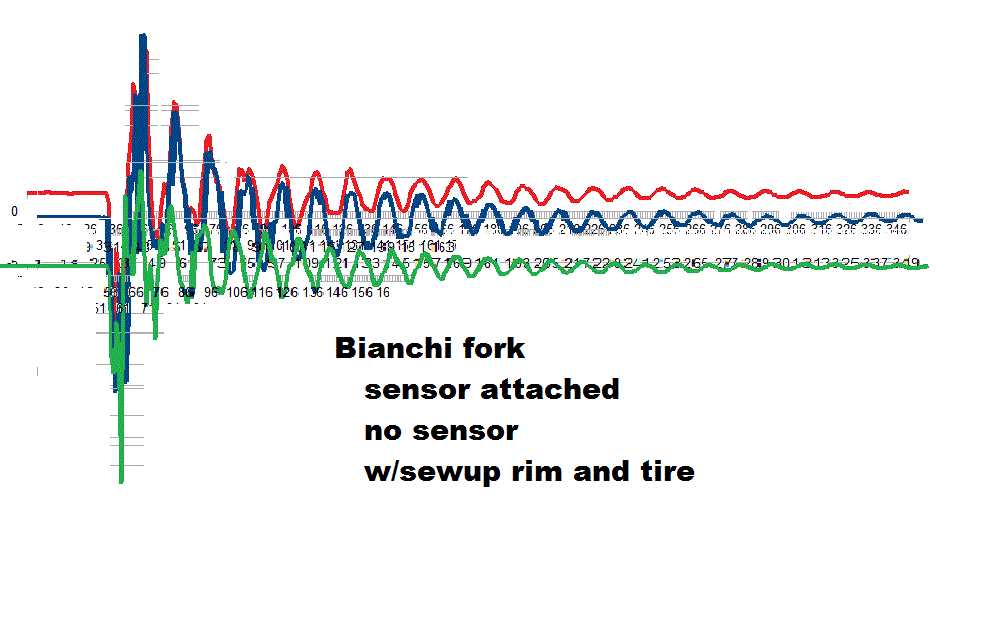
The top line line is the fork resonance with a Pocketlab Voyager (accelerometer) attached to the axle, and second line is the same but with the Pocketlab removed. The point is that the extra mass of the Pocketlab had no effect on the fork's behavior, not surprising since it is so light. The bottom line is the same measurement but with the clincher wheel and tire replaced with a sew-up wheel and tire. The frequency is visibly faster, an expected result from having a lighter mass on the same fork.
For comparison, here is my UO-8 with 32mm 27" clincher tire on alloy rim.
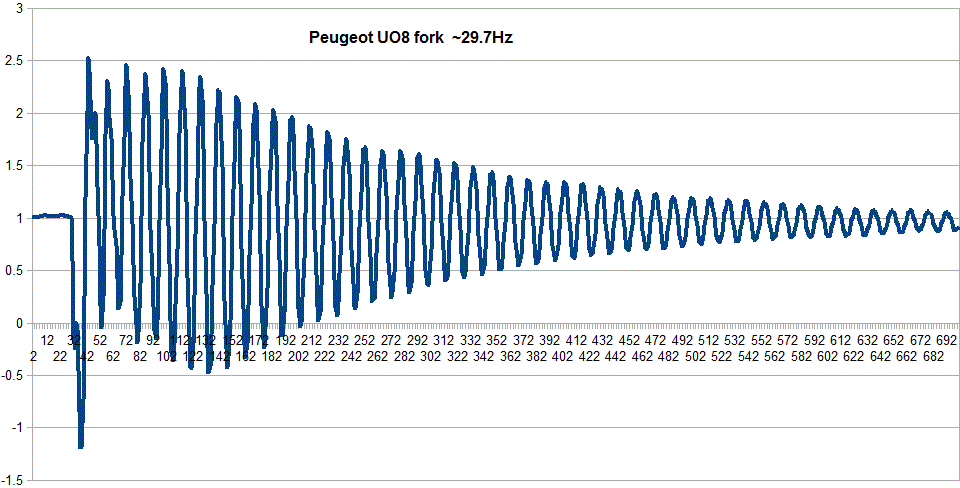
The fundamental frequency is a bit lower, characteristic of having a heavier wheel and possibly a more softly sprung fork. It would interesting to do this again with a 25mm or 23mm 700c wheel, to see if the frequency more closely matches the other bikes. If so it would suggest the fork isn't all that different from the higher-end bikes.
__________________
Real cyclists use toe clips.
With great bikes comes great responsibility.
jimmuller
Real cyclists use toe clips.
With great bikes comes great responsibility.
jimmuller
Last edited by jimmuller; 11-28-18 at 06:34 AM.
11-28-18 | 09:18 AM
#38
Senior Member
Joined: Mar 2016
Posts: 162
Likes: 0
If you have time on your hands you can compare compliances of the front and the back (in mm per kg in left-right direction without a wheel). It's easy and you will have something meaningful to compare. I do it for some years.
It's interesting what you are doing. Thanks from nerds.
11-28-18 | 03:24 PM
#39

Here's my SWAG on the Peugeot fork: The fork alignment made the fork's resonant frequency more pure since the mechanical shape was more symmetrical. This reduced the mechanical modes at the other various frequencies seen on the misaligned fork. After alignment, you can see more energy at the dominant resonance (31 Hz) and less energy spread around the other higher frequencies. In other words, the fork is more like a tuning fork after alignment and less like a metal blob. There are marvelous tools to do animated 3D FEA simulations that would probably answer this is in more detail if you can find someone who has access to that kind of thing, and the time to pursue it.
Having said all that, it would be interesting to see how the fork rides and feels aligned vs misaligned. The aligned fork should have more tendency to vibrate at 31 Hz since the peak of the response is higher.
Having said all that, it would be interesting to see how the fork rides and feels aligned vs misaligned. The aligned fork should have more tendency to vibrate at 31 Hz since the peak of the response is higher.

