Truing Stand Recommendations?
 12-05-18 | 01:36 PM
#26

Senior Member


Joined: Nov 2015
Posts: 4,900
Likes: 1,125
I have a Minoura truing stand and it works really nicely. They all come with a centering "T" bar that you use to center your feeler gauges on the stand before you insert your wheel and star truing it. It's supposed to eliminate the need for a dishing tool.
 12-05-18 | 02:38 PM
#27
Senior Member

Joined: Jan 2008
Posts: 15,105
Likes: 4,754
From: Beaverton, OR
Bikes: Yes

__________________
My Bikes
My Bikes
12-05-18 | 03:49 PM
#28

Senior Member
Joined: Aug 2006
Posts: 7,643
Likes: 68
From: Portland OR
Bikes: 61 Bianchi Specialissima 71 Peugeot G50 7? P'geot PX10 74 Raleigh GranSport 75 P'geot UO8 78? Raleigh Team Pro 82 P'geot PSV 86 P'geot PX 91 Bridgestone MB0 92 B'stone XO1 97 Rans VRex 92 Cannondale R1000 94 B'stone MB5 97 Vitus 997
Being able to flip the wheel in the truing stand to check dish is helpful because most dishing gauges require you to remove the tire. No problem when building but when maintaining a wheel, that ranges from a slight pain with tubes to a bigger pain with tubeless to a big pain with tubular. So, I'd get the TS 2.2 at a minimum. Or build your own as shown above.
I think that high tire pressures can at least theoretically affect spoke tension. I have a set of Fiamme Ergal tubular wheels on the Raleigh Team Pro. They require low tension, removing the tire to true and tension is a non starter, and the rims need to be trued fairly often. Of course that is an usually weak and light rim.
I think that high tire pressures can at least theoretically affect spoke tension. I have a set of Fiamme Ergal tubular wheels on the Raleigh Team Pro. They require low tension, removing the tire to true and tension is a non starter, and the rims need to be trued fairly often. Of course that is an usually weak and light rim.
12-05-18 | 08:13 PM
#29
Randomhead
Joined: Aug 2008
Posts: 25,930
Likes: 4,825
From: Happy Valley, Pennsylvania
recently, there was a TS-2 on CL near here for $75. i have always wanted one, but when I bought my TS-2.2 the TS-2's were going for too much so I just bought new. I like the TS-2 better, but it's not as versatile. And now I have 29'ers, which is why they came out with the TS-2.2 to supersede the TS-2
12-05-18 | 08:29 PM
#30
I AM AI
Joined: Aug 2013
Posts: 4,288
Likes: 1,170
From: Tucson, AZ
Bikes: 2008 S-Works Roubaix SL, 1979 Raleigh Comp GS, 1978 Schwinn Volare
Well this is a timely thread. I've been eyeballing a TS-2 on CL for a while now but the guy refuses to budge from his $150 ask. Now I hear some reliable voices talking up the Minoura at half the price. I do believe my problem is solved. 
__________________
A race bike in any era is a highly personal choice that at its "best" balances the requirements of fit, weight, handling, durability and cost tempered by the willingness to toss it and oneself down the pavement at considerable speed. ~Bandera
A race bike in any era is a highly personal choice that at its "best" balances the requirements of fit, weight, handling, durability and cost tempered by the willingness to toss it and oneself down the pavement at considerable speed. ~Bandera
12-05-18 | 09:05 PM
#31


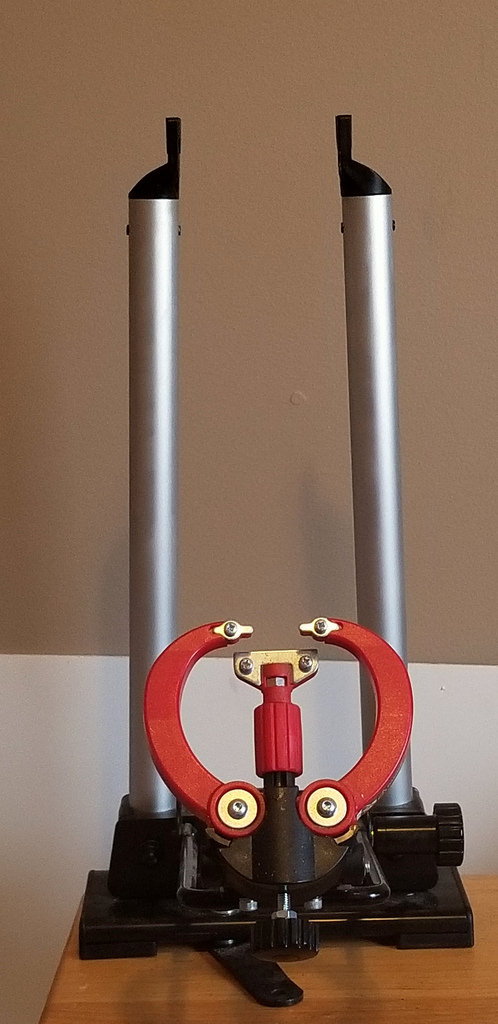
I've had a Spin Doctor truing stand for a long time. $79 at performance now. The photo hides the center radial feeler.
I like the independent feeler probes. I twist and push in one side at a time, until the plastic tip touches the high spots on that side. I can hear when it's contacting the rim, and I work on the highest spots: locate the high spot, jog the wheel back and forth to localize it, then adjust the nearby spokes. There's often another, similar high spot farther around on the rim. Make just a small spoke adjustment, often even less than 1/8 turn, on a pair of spokes at a time, one from each side of the hub. Or it might be the pair on each side of a spoke near the top of the offset, usually turning the center one twice as much as the two offsetting side spokes.
Then pull that feeler away, and work on the other side's high spots. Repeat until done.
Turn the spoke wrench more than your target amount, then back partway, to limit spoke windup. On flat spokes, I cut off a $1 screwdriver handle, then slotted it with a fine hacksaw blade, to turn the spoke blade back to the plane of the wheel.
I can get a reasonable centering test from the centering piece. I usually use a couple of pieces of masking tape to line up with the edges of the rim. I'll carefully flip the wheel, and use a similar amount of force on the quick release, then compare if the rim matches the previous tape marks.
I like the independent feeler probes. I twist and push in one side at a time, until the plastic tip touches the high spots on that side. I can hear when it's contacting the rim, and I work on the highest spots: locate the high spot, jog the wheel back and forth to localize it, then adjust the nearby spokes. There's often another, similar high spot farther around on the rim. Make just a small spoke adjustment, often even less than 1/8 turn, on a pair of spokes at a time, one from each side of the hub. Or it might be the pair on each side of a spoke near the top of the offset, usually turning the center one twice as much as the two offsetting side spokes.
Then pull that feeler away, and work on the other side's high spots. Repeat until done.
Turn the spoke wrench more than your target amount, then back partway, to limit spoke windup. On flat spokes, I cut off a $1 screwdriver handle, then slotted it with a fine hacksaw blade, to turn the spoke blade back to the plane of the wheel.
I can get a reasonable centering test from the centering piece. I usually use a couple of pieces of masking tape to line up with the edges of the rim. I'll carefully flip the wheel, and use a similar amount of force on the quick release, then compare if the rim matches the previous tape marks.
Last edited by rm -rf; 12-05-18 at 09:18 PM.
12-05-18 | 09:32 PM
#32
Senior Member
Joined: Sep 2015
Posts: 1,685
Likes: 103
From: New Jersey
As others have stated, a dish stick is required, not optional.
12-06-18 | 09:47 AM
#33
Senior Member

Joined: Mar 2018
Posts: 966
Likes: 216
Bikes: 2015 Spec. AWOL Elite,2022 Spec. Diverge, 1984 Trek 620 1985 Trek 620, 1979 Trek 710
I've been building my own wheels, but taking them to a LBS to get them tensioned and trued. I have three wheels to build this winter, so It's time for me to learn how to do that.
I'm looking for a good truing stand. I was thinking of a used Park TS-2 but even used they can be pricey.
What stand are you using to build and true your wheels? Do you use a dishing tool? Which one?
Thanks
I'm looking for a good truing stand. I was thinking of a used Park TS-2 but even used they can be pricey.
What stand are you using to build and true your wheels? Do you use a dishing tool? Which one?
Thanks
The Park WAG-5 dish gauge and Park TM-1 tension meter work well and will only set you back about $100 total.
12-06-18 | 10:21 AM
#34
And, get yourself a dishing tool and spoke tension gauge - worth the money to eliminate frustration and enjoy the process more. Some folks find these tools to be unnecessary, but as a novice I found them indispensable.
The Park WAG-5 dish gauge and Park TM-1 tension meter work well and will only set you back about $100 total.
The Park WAG-5 dish gauge and Park TM-1 tension meter work well and will only set you back about $100 total.
I suppose that 32 or 36 spoke wheels are more forgiving, but tension is quite critical on low spoke wheels.
12-06-18 | 10:40 AM
#35

feros ferio

Joined: Jul 2000
Posts: 22,410
Likes: 1,876
From: www.ci.encinitas.ca.us
Bikes: 1959 Capo Modell Campagnolo; 1960 Capo Sieger (2); 1962 Carlton Franco Suisse; 1970 Peugeot UO-8; 1982 Bianchi Campione d'Italia; 1988 Schwinn Project KOM-10;
Although I have a 50-year-old VAR truing stand, I generally just true wheels on the bike, using the brake pads as guides. I also like the "braille" system of putting a thumb against the end of the brake pad for stability, then feeling the high spots (either laterally or radially) as I spin the wheel.
__________________
"Far and away the best prize that life offers is the chance to work hard at work worth doing." --Theodore Roosevelt
Capo: 1959 Modell Campagnolo, S/N 40324; 1960 Sieger (2), S/N 42624, 42597
Carlton: 1962 Franco Suisse, S/N K7911
Peugeot: 1970 UO-8, S/N 0010468
Bianchi: 1982 Campione d'Italia, S/N 1.M9914
Schwinn: 1988 Project KOM-10, S/N F804069
"Far and away the best prize that life offers is the chance to work hard at work worth doing." --Theodore Roosevelt
Capo: 1959 Modell Campagnolo, S/N 40324; 1960 Sieger (2), S/N 42624, 42597
Carlton: 1962 Franco Suisse, S/N K7911
Peugeot: 1970 UO-8, S/N 0010468
Bianchi: 1982 Campione d'Italia, S/N 1.M9914
Schwinn: 1988 Project KOM-10, S/N F804069
12-06-18 | 10:55 AM
#36
Senior Member
Joined: Mar 2018
Posts: 966
Likes: 216
Bikes: 2015 Spec. AWOL Elite,2022 Spec. Diverge, 1984 Trek 620 1985 Trek 620, 1979 Trek 710
1) To not undershoot or overshoot the target tension value on any spoke.
2) To compare the relative tension values of DS and NDS spokes , especially on the rear wheel. I like to map the value of each spoke on the entire wheel 2 or 3 times as I sneak-up on the target value.
I find that if I don't rush and keep an eye on true/round as I progress, the tension values seem to take care of themselves.
12-06-18 | 11:14 AM
#37
Banned
Joined: Aug 2013
Posts: 6,480
Likes: 450
The Park Prof. has its faults and have experienced like those mentioned above. But I'm learning and always listening to the experts on wheel building, dealing with idiosyncrasies. Regardless the Park is a robust and quality made truing stand.
One issue I've been dealt with this last year are 29er high tension factory built wheels with through axles. I'm considering the single side arm from Feedback Sports.
I've turned (pun) away two riding buds in repairing their wheels. Both are aggressive, big fellows and don't ride lightly, breaking bikes and wheels is normal. Anyways, replacing a single spoke for lower spoke count high tension type are kind of like playing with fire. Hehe
One issue I've been dealt with this last year are 29er high tension factory built wheels with through axles. I'm considering the single side arm from Feedback Sports.
I've turned (pun) away two riding buds in repairing their wheels. Both are aggressive, big fellows and don't ride lightly, breaking bikes and wheels is normal. Anyways, replacing a single spoke for lower spoke count high tension type are kind of like playing with fire. Hehe
12-06-18 | 02:07 PM
#38
Senior Member
Joined: Apr 2018
Posts: 917
Likes: 473
From: Los Banos, CA
Bikes: 2020 Argon 18 Krypton Pro, 1985 Masi 3V Volumetrica, 1985 3Rensho Super Record Aero, 1989 Colnago 1989 XL, 2022 Trek District 4.
I had a broken spoke on a Fulcrum Racing 5 rear wheel. After waiting for the ridiculously expensive spoke kit to arrive, all I did was pull the old, put in the new, and when the "ting" of the plucked spoke sounded like the ones to either side, I put it on the bike, and spun it... perfect without any trying. so my limited experience with these high tension, low spoke count wheels is "no problem, easy peasy"! YMMV as they say
12-06-18 | 02:10 PM
#39
Senior Member
Joined: Apr 2018
Posts: 917
Likes: 473
From: Los Banos, CA
Bikes: 2020 Argon 18 Krypton Pro, 1985 Masi 3V Volumetrica, 1985 3Rensho Super Record Aero, 1989 Colnago 1989 XL, 2022 Trek District 4.
also FWIW, i have never seen the utility of, or used a spoke tension gauge. i have always gone b feel, the way I was taught!
12-06-18 | 04:00 PM
#40

Senior Member


Joined: Nov 2014
Posts: 27,576
Likes: 5,474
From: Eugene, Oregon, USA
I had a broken spoke on a Fulcrum Racing 5 rear wheel. After waiting for the ridiculously expensive spoke kit to arrive, all I did was pull the old, put in the new, and when the "ting" of the plucked spoke sounded like the ones to either side, I put it on the bike, and spun it... perfect without any trying. so my limited experience with these high tension, low spoke count wheels is "no problem, easy peasy"! YMMV as they say

Of course, the issue is that it is much more difficult to roadside true the wheel enough to get home on one less spoke, I think.
I did a century ride a couple of years ago on a 31 or 35 spoke wheel. It broke early in the day, just trued it up, and kept going. Of course, when I got home to fix it properly, whew, that truing was a MESS!!!! But, at least I got home in one piece.
 12-06-18 | 04:15 PM
#41

aka Tom Reingold
Joined: Jan 2009
Posts: 44,299
Likes: 6,556
From: New York, NY, and High Falls, NY, USA
Bikes: 1962 Rudge Sports, 1971 Raleigh Super Course, 1971 Raleigh Pro Track, 1974 Raleigh International, 1975 Viscount Fixie, 1982 McLean, 1996 Lemond (Ti), 2002 Burley Zydeco tandem
I broke two spokes on the rear riding home from work. The wheel was 36 spokes. The wobble was too bad to let the wheel spin through the chain stays. Luckily I had a spoke wrench, and I was able to get it straight enough to spin. Otherwise, it would have been a long, uphill walk with the heavy bike on my shoulder.
And yet, I once broke a spoke on super light 24-spoke rear wheel. I didn't have to do anything to get home except pedal. I don't know why the 36-spoke wheel deformed more than a 24-spoke wheel. It's probably because of differences in rim stiffness.
And yet, I once broke a spoke on super light 24-spoke rear wheel. I didn't have to do anything to get home except pedal. I don't know why the 36-spoke wheel deformed more than a 24-spoke wheel. It's probably because of differences in rim stiffness.
__________________
Tom Reingold, tom@noglider.com
New York City and High Falls, NY
Blogs: The Experienced Cyclist; noglider's ride blog
“When man invented the bicycle he reached the peak of his attainments.” — Elizabeth West, US author
Please email me rather than PM'ing me. Thanks.
Tom Reingold, tom@noglider.com
New York City and High Falls, NY
Blogs: The Experienced Cyclist; noglider's ride blog
“When man invented the bicycle he reached the peak of his attainments.” — Elizabeth West, US author
Please email me rather than PM'ing me. Thanks.
12-10-18 | 02:15 PM
#42
Member
Joined: Dec 2016
Posts: 37
Likes: 15
From: Metro NYC
Bikes: Basso Loto, Andre Bertain, Schwinn Madison, Litespeed Unicoi, Easton full sustension, Macau non-suspended MTN, Merlin Agilis, A-D Superlicht, Daccordi Piuma, Scott CR1 (former owner Thomas Frischnecht), Van Diesel CX, Alan Top Cross, Scattante CX, Ri
I personally do not use a dishing tool. I just flip the wheel over. Been building my own and truing since 1992 with a TS-2. I did mount some dial indicators on them but mostly just use the adjustable guides. I also do minor adjustments right on the bike using the brake pads as a lateral guide.
I also find it hard to understand how you built but did not true. Also bought a Wheelsmith spoke tension meter but mostly just pluck the spokes to determine tension and uniformity.
I also find it hard to understand how you built but did not true. Also bought a Wheelsmith spoke tension meter but mostly just pluck the spokes to determine tension and uniformity.
12-10-18 | 02:28 PM
#43
Randomhead
Joined: Aug 2008
Posts: 25,930
Likes: 4,825
From: Happy Valley, Pennsylvania
I have always flipped the wheel in the stand as well.
One thing to look for on a part TS stand is that the pivot bolts aren't too loose. If they are, it can cause it not to be centered except for one width. The pivot bolts should be tight enough that the uprights don't have any slop
One thing to look for on a part TS stand is that the pivot bolts aren't too loose. If they are, it can cause it not to be centered except for one width. The pivot bolts should be tight enough that the uprights don't have any slop
12-10-18 | 02:39 PM
#44
Georgia Traveler
Joined: Jul 2005
Posts: 139
Likes: 5
Been using the original Park truing stand since 1970. As with any tool, buy the best you can reasonably afford. For occasional home use, it doesn't have to be extravagant. My grandfather and dad built and trued thousands of wheels for many years using only old bicycle forks to hold them in place, their fingers for gauges, their calibrated eyeballs and the tone of plucked spokes for tension.
12-10-18 | 03:09 PM
#45

Senior Member
Joined: Oct 2014
Posts: 14,180
Likes: 5,312
From: Portland, OR
Bikes: (2) ti TiCycles, 2007 w/ triple and 2011 fixed, 1979 Peter Mooney, ~1983 Trek 420 now fixed and ~1973 Raleigh Carlton Competition gravel grinder
I use the tension meter for two purposes:
1) To not undershoot or overshoot the target tension value on any spoke.
2) To compare the relative tension values of DS and NDS spokes , especially on the rear wheel. I like to map the value of each spoke on the entire wheel 2 or 3 times as I sneak-up on the target value.
I find that if I don't rush and keep an eye on true/round as I progress, the tension values seem to take care of themselves.
1) To not undershoot or overshoot the target tension value on any spoke.
2) To compare the relative tension values of DS and NDS spokes , especially on the rear wheel. I like to map the value of each spoke on the entire wheel 2 or 3 times as I sneak-up on the target value.
I find that if I don't rush and keep an eye on true/round as I progress, the tension values seem to take care of themselves.
Ben
12-16-18 | 10:51 AM
#46
Thread Starter
Full Member
Joined: Aug 2015
Posts: 363
Likes: 24
From: Metro West, Boston
Bikes: 75 Raleigh Gran Sport, 88 Bridgestone RB3, 72 Raleigh Super Course, 75 Jeunet 620, 95 Fuji Team
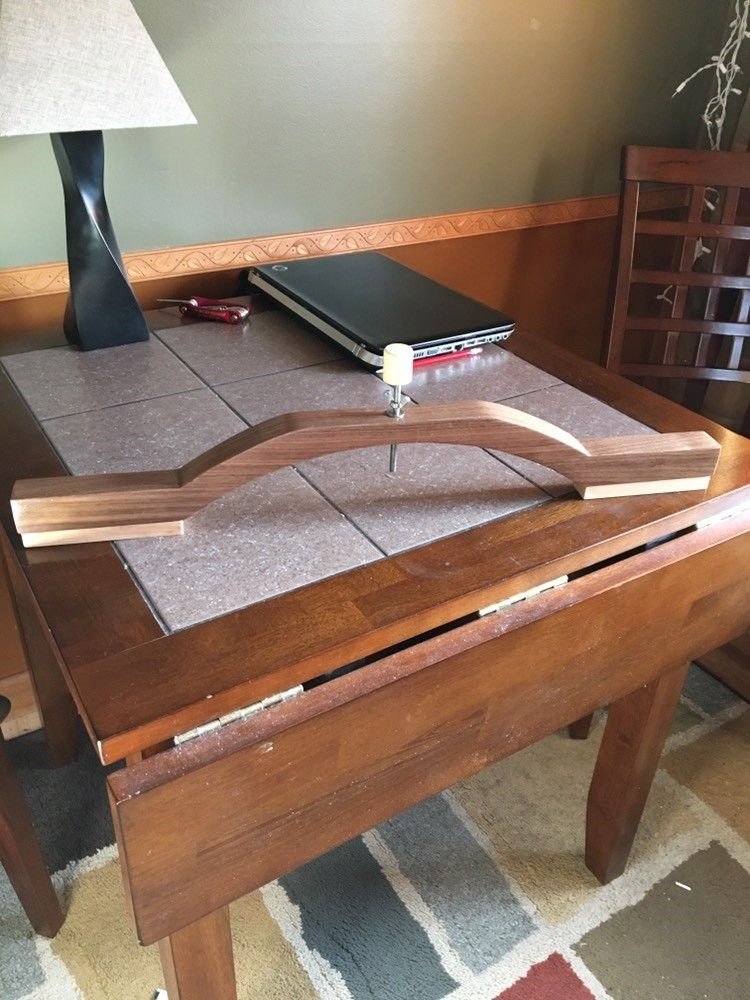
I went with the DIY approach and built a stand from the plans in Roger Musson's book.
It sort of turned into a woodworking project... Made it from Birch and Walnut veneer. Making the dishing tool today.


It sort of turned into a woodworking project... Made it from Birch and Walnut veneer. Making the dishing tool today.
Last edited by rickrob; 12-16-18 at 10:55 AM.
12-16-18 | 03:02 PM
#48

Senior Member
Joined: Oct 2015
Posts: 16,174
Likes: 9,549
From: PDX
Bikes: Merz x 5 + Specialized Merz Allez x 2, Strawberry/Newlands/DiNucci/Ti x3, Gordon, Fuso/Moulton x2, Bornstein, Paisley,1958-74 Paramounts x3, 3rensho, 74 Moto TC, 73-78 Raleigh Pro's x5, Marinoni x2, 1960 Cinelli SC, 1980 Bianchi SC, PX-10 X 2
 12-16-18 | 08:30 PM
#49
Senior Member
Joined: Jan 2015
Posts: 5,836
Likes: 3,421
From: Los Angeles
Bikes: 82 Medici, 85 Ironman, 2011 Richard Sachs
Nice job. Looking forward to the dishing tool. My dad shiny tool is a piece of luan and an old saber saw blade that holds a setting remarkably well
12-18-18 | 12:31 PM
#50
Thread Starter
Full Member
Joined: Aug 2015
Posts: 363
Likes: 24
From: Metro West, Boston
Bikes: 75 Raleigh Gran Sport, 88 Bridgestone RB3, 72 Raleigh Super Course, 75 Jeunet 620, 95 Fuji Team