


Lbs installed cranks and this was the result..Normal?
 06-20-23 | 10:17 PM
#1
Thread Starter
Senior Member

Joined: Aug 2012
Posts: 809
Likes: 132
Lbs installed cranks and this was the result..Normal?
Lbs put on new bb (Shimano) and had them just throw on some Campy cranks.
Is it because its Shimano BB with Campy cranks?
Is this normal? Or what should I do? Drive side and Non-drive sides gap differs..
Thank You!
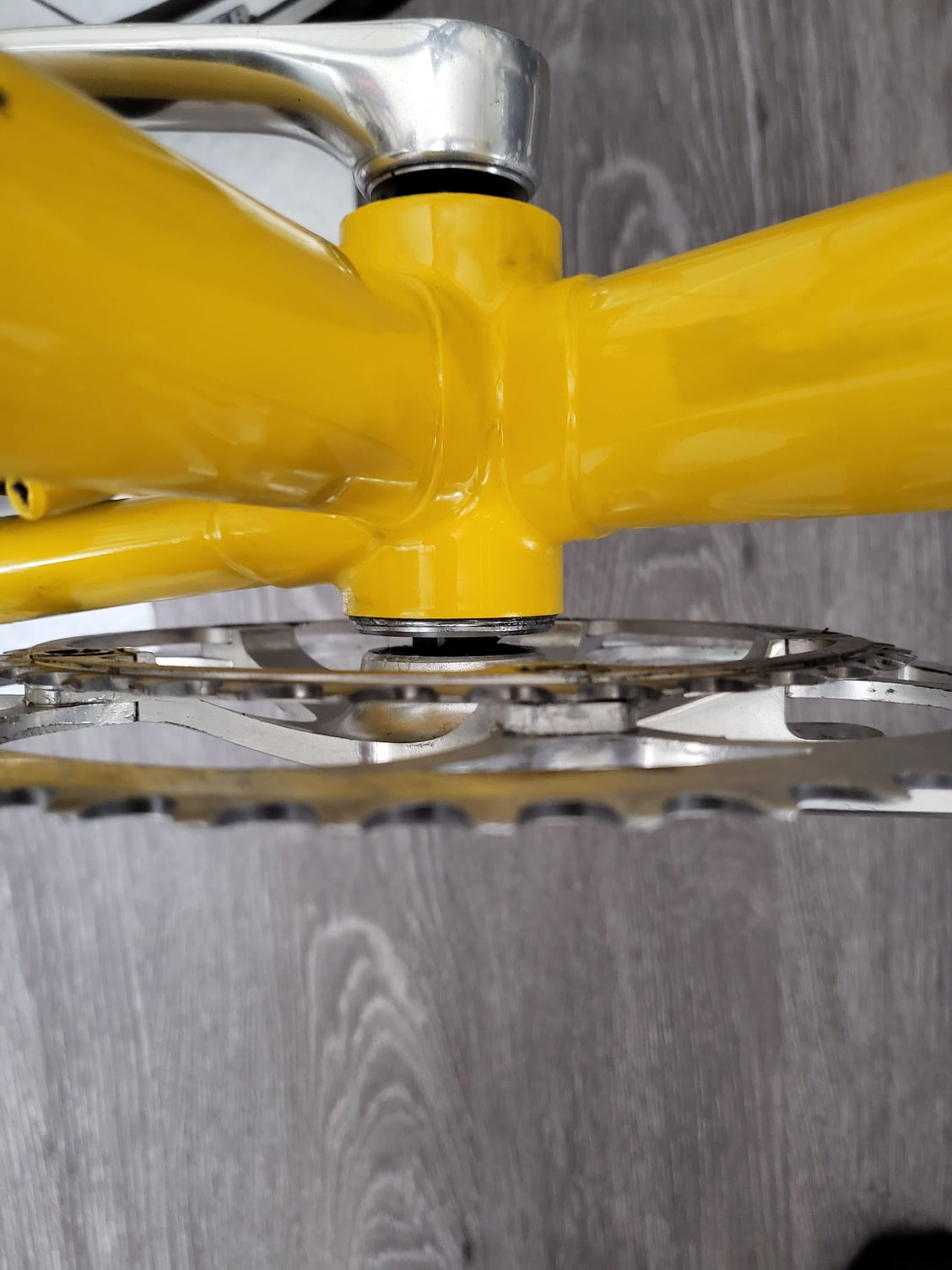
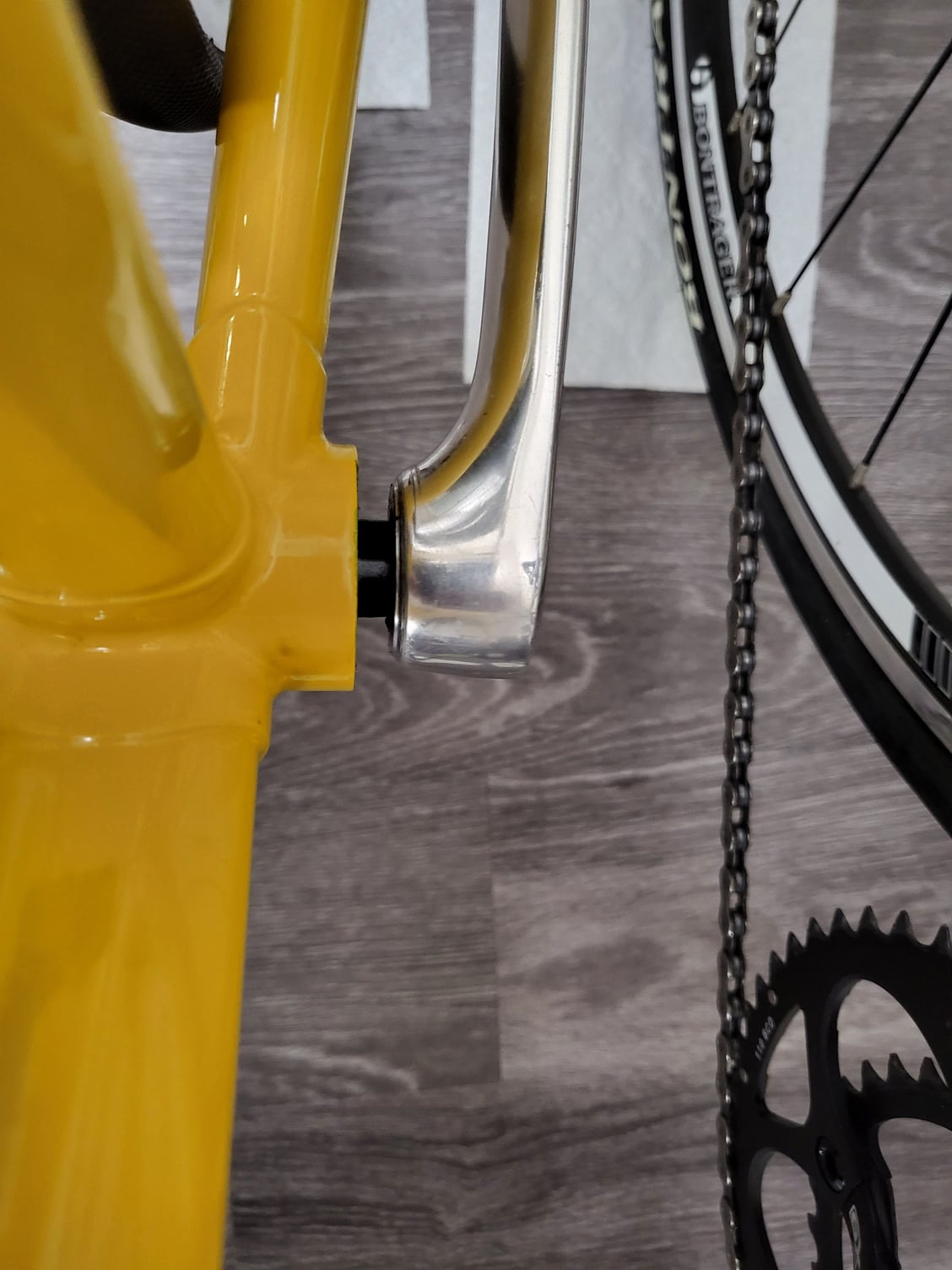
Is it because its Shimano BB with Campy cranks?
Is this normal? Or what should I do? Drive side and Non-drive sides gap differs..
Thank You!


 06-20-23 | 11:03 PM
#4

Senior Member
Joined: Nov 2010
Posts: 22,994
Likes: 10,498
From: Sacramento, CA
Bikes: old ones
.
...as long as there's no interference between the chain rings and the frame (on the drive side), and the chain line looks good, the difference in spacing of the two crank arms is not a big deal. Some people actually prefer a bigger "Q" (the overall space between your feet as you ride with them on the pedals). There's probably a defined spindle length for your chosen crank, and maybe Campagnolo makes a proprietary offset BB unit for it, but I think it's unlikely.
But anyway, I own and ride a number of bicycles where this spacing is different, for one reason or another. Make sure you retorque the crank arm bolts after you ride 50-100 miles.
...as long as there's no interference between the chain rings and the frame (on the drive side), and the chain line looks good, the difference in spacing of the two crank arms is not a big deal. Some people actually prefer a bigger "Q" (the overall space between your feet as you ride with them on the pedals). There's probably a defined spindle length for your chosen crank, and maybe Campagnolo makes a proprietary offset BB unit for it, but I think it's unlikely.
But anyway, I own and ride a number of bicycles where this spacing is different, for one reason or another. Make sure you retorque the crank arm bolts after you ride 50-100 miles.
06-20-23 | 11:06 PM
#5
Pedal to the medal

Joined: Sep 2012
Posts: 1,444
Likes: 331
From: The Arsenal of Democracy
Bikes: 1991 Team Miyata Track, 1992 Lemond Alpe d'Huez, 19?? Schwinn High Serra, 1982 Trek 614, 198X Raleigh Alyeska
Yes it's likely because you used a shimano bb which is probably JIS taper with a campy crank which is ISO taper. I say probably because the more I learn about bb and crank taper compatibility, the less I know. Apparently there were years when campy cranks were closer to JIS taper?? but I'm highly confident that is probably the issue. If the bike rides fine you could ride it as is, although some may caution that doing so might damage the taper on the crank and I am one of those people, but it's your bike! Sheldon has a great write up about this and he states most people make too big a deal about this stuff.
Hope this helps!
Hope this helps!
 06-20-23 | 11:07 PM
#6
Senior Member
Joined: Nov 2010
Posts: 22,994
Likes: 10,498
From: Sacramento, CA
Bikes: old ones
The backwards spindle thing usually comes up with a loose ball, cup and cone bottom bracket. some of them have asymmetric spindles.
06-20-23 | 11:23 PM
#7

Senior Member
Joined: Jun 2015
Posts: 3,379
Likes: 2,020
From: Pacific Northwest
Bikes: Yes.
The more important thing is the crank arm clearance at the chainstays. It ought to be moreorless symmetrical.
AFAIK: JIS/ISO taper is the same taper. Only ISO tapers smaller and thus the spindle measures a bit longer for a given crank inboard/outboard position.
Sometimes the spindle is asymmetrical. This mostly comes up in older loose spindle applications. A common bike shop hack is to flip the spindle 180 degrees (reverse left/right) when converting to/from double/triple installations for chainring to chainstay clearance.
You need not make too much of it unless the pedals are egregiously out of symmetry. +/- a mm or 2 could simply be crank arm tightness & manufacturing tolerances of all the various pieces involved.
I agree that the drive-side flange is on the drive-side. Very unlikely for a sealed cartridge unit to be installed backwards.
AFAIK: JIS/ISO taper is the same taper. Only ISO tapers smaller and thus the spindle measures a bit longer for a given crank inboard/outboard position.
Sometimes the spindle is asymmetrical. This mostly comes up in older loose spindle applications. A common bike shop hack is to flip the spindle 180 degrees (reverse left/right) when converting to/from double/triple installations for chainring to chainstay clearance.
You need not make too much of it unless the pedals are egregiously out of symmetry. +/- a mm or 2 could simply be crank arm tightness & manufacturing tolerances of all the various pieces involved.
I agree that the drive-side flange is on the drive-side. Very unlikely for a sealed cartridge unit to be installed backwards.
Last edited by base2; 06-20-23 at 11:27 PM.
06-21-23 | 03:22 AM
#9

Senior Member
Joined: Mar 2015
Posts: 3,172
Likes: 963
From: Western MI
Always tough from pics but I don’t really see a gap difference. I think the DS cup is less flush than the NDS cup making the gap look different. That said, there does seem to be a quite a bit of exposed flat which is probably due to difference in taper. As long as the arm is far enough (gotta use the “far enough wrench”) on the spindle, it should be fine. Hopefully the mechanic was qualified to make this call.
As mentioned above, the arms will be more outward than if they were further down the spindle, creating a wider Q factor. I like a narrow Q so this would probably drive me nuts. Others might never notice. YMMV
As mentioned above, the arms will be more outward than if they were further down the spindle, creating a wider Q factor. I like a narrow Q so this would probably drive me nuts. Others might never notice. YMMV
06-21-23 | 05:05 AM
#10
Senior Member

Joined: Apr 2018
Posts: 917
Likes: 473
From: Los Banos, CA
Bikes: 2020 Argon 18 Krypton Pro, 1985 Masi 3V Volumetrica, 1985 3Rensho Super Record Aero, 1989 Colnago 1989 XL, 2022 Trek District 4.
Is it just me, or does it seem that the DS cup isn't in all the way. I see a gap (maybe) under the "flange" which would explain why the NDS cup is not visible. Anyone else see it this way? If that is the case, and this is ITA BB, then the OP will find out as the DS cup un-screws!
 06-21-23 | 05:55 AM
#12
Senior Member
Joined: Jul 2014
Posts: 1,677
Likes: 823
If that's a typical road double, the chainline should be 43.5mm. You need to actually measure. That's the all-important measurement, not the gap between the frame and the crank.
Also, I'm no expert but I believe that Campy square taper was different than normal JIS square taper, and are not compatible. The shop should have known that.
Also, I'm no expert but I believe that Campy square taper was different than normal JIS square taper, and are not compatible. The shop should have known that.
06-21-23 | 06:12 AM
#13
Senior Member
Joined: Jun 2021
Posts: 2,037
Likes: 2,029
Bikes: '38 Schwinn New World, '72 Peugeot PX-10, 78 Raleigh Comp GS, ’80 Peugeot TH-8 tandem
06-21-23 | 07:16 AM
#14


If that's a typical road double, the chainline should be 43.5mm. You need to actually measure. That's the all-important measurement, not the gap between the frame and the crank.
Also, I'm no expert but I believe that Campy square taper was different than normal JIS square taper, and are not compatible. The shop should have known that.
Also, I'm no expert but I believe that Campy square taper was different than normal JIS square taper, and are not compatible. The shop should have known that.
the traditional way to check chain line was a STRAIGHT edge passed between the two front rings, undisturbed by any pins (allowance for today) should pass at the midpoint of the cogs in back.
‘the notion that there should be equal distance to the chain stays to the crank arms is a fallacy. The bicycle drivetrain pushes this off to more room on the drive side.
06-21-23 | 08:10 AM
#15
Senior Member
Joined: Jul 2014
Posts: 1,677
Likes: 823
yes, but….
the traditional way to check chain line was a STRAIGHT edge passed between the two front rings, undisturbed by any pins (allowance for today) should pass at the midpoint of the cogs in back.
‘the notion that there should be equal distance to the chain stays to the crank arms is a fallacy. The bicycle drivetrain pushes this off to more room on the drive side.
the traditional way to check chain line was a STRAIGHT edge passed between the two front rings, undisturbed by any pins (allowance for today) should pass at the midpoint of the cogs in back.
‘the notion that there should be equal distance to the chain stays to the crank arms is a fallacy. The bicycle drivetrain pushes this off to more room on the drive side.
After you've got the chainline correct, you can measure symmetry by lining up each crank arm up with the seat tube, and measure that distance. If one of them sits slightly further out it's not the end of the world, but if it's more than a few mm then you probably have some sort of mismatch. Some cranks are made for assymetrical crank axles, so even if you've got the chainline right, the crank arms might sit uneven.
The OPs bike just needs to be looked at by a competent mechanic. The fact that they put a Campy crankset on a Shimano JIS square taper tells me that he may need a better bike shop.
Last edited by Jeff Neese; 06-21-23 at 08:19 AM.
06-21-23 | 08:41 AM
#16
I suppose there are multiple ways to measure it. I just use my calipers and measure from between the two rings, to the center of the seat tube. You don't line anything up with the cogs in the back. You start with the correct measurement in front, and work from there. If your wheel is built correctly and you're using the right size hubs and cassette, you'll get the same chainline in back and then it will line up. If it doesn't, then something is off.
After you've got the chainline correct, you can measure symmetry by lining up each crank arm up with the seat tube, and measure that distance. If one of them sits slightly further out it's not the end of the world, but if it's more than a few mm then you probably have some sort of mismatch. Some cranks are made for assymetrical crank axles, so even if you've got the chainline right, the crank arms might sit uneven.
The OPs bike just needs to be looked at by a competent mechanic. The fact that they put a Campy crankset on a Shimano JIS square taper tells me that he may need a better bike shop.
After you've got the chainline correct, you can measure symmetry by lining up each crank arm up with the seat tube, and measure that distance. If one of them sits slightly further out it's not the end of the world, but if it's more than a few mm then you probably have some sort of mismatch. Some cranks are made for assymetrical crank axles, so even if you've got the chainline right, the crank arms might sit uneven.
The OPs bike just needs to be looked at by a competent mechanic. The fact that they put a Campy crankset on a Shimano JIS square taper tells me that he may need a better bike shop.
06-21-23 | 08:54 AM
#17
Senior Member
Joined: Nov 2010
Posts: 22,994
Likes: 10,498
From: Sacramento, CA
Bikes: old ones
06-22-23 | 04:59 AM
#18
Senior Member
Joined: Jul 2014
Posts: 1,677
Likes: 823
the variations between a 5 speed, ultra Six, Seven speed freewheels, 7 speed cassette, 8,9, 10. All frequently discussed on the C&V forum have many variables. Exchanging brands and tapers, makes of cranks, measurements are safe for a system design, for the typical kludge use here, evaluate the real world assembly is my point of view.
There aren't "many variables". Yes, there are a number of standards (dropout spacing, chainline measurement, bottom bracket and crankset types and so on) that might seem confusing to beginners. But every drivetrain part is designed to be compatible with one of those standards. I've been building and riding bikes a long time and have never had a need to kludge anything. Just use compatible parts. A Campy crank on a Shimano BB ain't right. I'm 100% sure that the mechanics at my LBS know that.
06-22-23 | 08:42 AM
#19
This was done by a bike shop, not someone going into their parts bin and saying "I wonder if I can get this to work." There was no need for any kludge. They simply didn't know what they were doing.
There aren't "many variables". Yes, there are a number of standards (dropout spacing, chainline measurement, bottom bracket and crankset types and so on) that might seem confusing to beginners. But every drivetrain part is designed to be compatible with one of those standards. I've been building and riding bikes a long time and have never had a need to kludge anything. Just use compatible parts. A Campy crank on a Shimano BB ain't right. I'm 100% sure that the mechanics at my LBS know that.
There aren't "many variables". Yes, there are a number of standards (dropout spacing, chainline measurement, bottom bracket and crankset types and so on) that might seem confusing to beginners. But every drivetrain part is designed to be compatible with one of those standards. I've been building and riding bikes a long time and have never had a need to kludge anything. Just use compatible parts. A Campy crank on a Shimano BB ain't right. I'm 100% sure that the mechanics at my LBS know that.
‘Many bike shops just are not familiar with separate component bottom brackets. The way of things.
‘Incompetent? More likely the mechanic is just not old enough., does not know about these archaic parts.
an argument could be made that they should not have accepted the job to begin with.
‘I have not seen a Sutherland’s manual for decades, be interesting if it has decent information now.
06-22-23 | 10:11 AM
#20

Senior Member

Joined: Dec 2005
Posts: 1,446
Likes: 116
From: Cape Vincent, NY
Bikes: Specialized Tarmac Expert, Giant Iguana,Schwinn Mesa, Huffy Rock Creek 29er, Fuji Cambridge, 1970s-era Ross ten speed. Various parts bikes in various stages of disassembly.
I'd measure the distance from the inside of each pedal to the front downtube.
06-22-23 | 10:22 AM
#21
Senior Member♣️
Joined: Jan 2016
Posts: 4,075
Likes: 3,004
I can't imagine that it would make a huge difference as long as the chain line is good. Ideally the spindle would be correct for the smaller ATF Campagnolo crank set. Last time I modified a spindle I found that the Camp. is .002" per side smaller than JIS. I just set it up on one of my precision grinders and ground it . After that I just looked for the correct spindle . If the spindle was right , then I think this would've lined up better. The down side to not having the right dimension is that there is not as much surface engaged inside the square taper.
06-22-23 | 10:27 AM
#22
Senior Member
Joined: Nov 2010
Posts: 22,994
Likes: 10,498
From: Sacramento, CA
Bikes: old ones
.
...to the OP. If you have enough OCD that this continues to bother you (unlikely), it is probably possible to order a Phil Wood bottom bracket that will fit the crank you have installed (which you have as yet not named). The installation of those allows a side to side adjustment of several millimeters, using the Italian installation rings (separate purchase). They are much more expensive than what you have installed now, and require a proprietary installation tool. They do last a long time, and are of high quality.
Or you can look on Velobase, for the crankset in question. That might (or might not) tell you if this particular Campy crank requires some sort of special asymmetric spindle unit, which you might (or might not), be able to find available for sale with an internet search.
I have installed, reinstalled, and retrofitted dozens of older Campagnolo cranks. I try to do it correctly, and as I stated before, I don't think your repair is problematic. It does change the "Q". Apparently I am not bothered by that as much as some others giving you advice. That's about all I can tell you, other than threads like this tend to drag on, based more on differences of opinion on what is "right", than any practical concerns. Enjoy your bicycle, that's a lovely yellow color.
...to the OP. If you have enough OCD that this continues to bother you (unlikely), it is probably possible to order a Phil Wood bottom bracket that will fit the crank you have installed (which you have as yet not named). The installation of those allows a side to side adjustment of several millimeters, using the Italian installation rings (separate purchase). They are much more expensive than what you have installed now, and require a proprietary installation tool. They do last a long time, and are of high quality.
Or you can look on Velobase, for the crankset in question. That might (or might not) tell you if this particular Campy crank requires some sort of special asymmetric spindle unit, which you might (or might not), be able to find available for sale with an internet search.
I have installed, reinstalled, and retrofitted dozens of older Campagnolo cranks. I try to do it correctly, and as I stated before, I don't think your repair is problematic. It does change the "Q". Apparently I am not bothered by that as much as some others giving you advice. That's about all I can tell you, other than threads like this tend to drag on, based more on differences of opinion on what is "right", than any practical concerns. Enjoy your bicycle, that's a lovely yellow color.
06-22-23 | 10:38 AM
#23
Senior Member
Joined: Nov 2010
Posts: 22,994
Likes: 10,498
From: Sacramento, CA
Bikes: old ones
Note to the above, from the Phil Wood site:
Please note: Bottom brackets with a length of 110.5 - 120 mm can be offset. If you need your bottom bracket spindle to be offset please include this information in the notes section when checking out, thank you.
