


Chasing hub axle threads?
 08-31-25 | 12:59 PM
#1
Thread Starter
Vintage Trek Black Hole


Joined: Sep 2013
Posts: 1,396
Likes: 1,335
From: Portland, Cascadia
Bikes: 1976 Merz' Tourer, 1984 Strawberry, 1978 Trek 910, 1982 Trek 950, 1982 Trek 720, 1981 Trek 510
Chasing hub axle threads?
I recently bought a nice Campy record high flange hub, and when it came to me the lock nuts were just barely threaded on. I assumed this was from the former owner checking a date code. When I went to tighten them down, I found the locknuts would only go a turn or two before jamming up.
You're probably thinking what I was thinking: someone swapped the axle and hardware for a non-Italian axle, but kept the lock nuts.
Well, I went to unthread everything to pull the axle and lo and behold the cones are genuine Campy marked 10x26. They thread just fine until they get to the ends of the axle and won't come off.
A closer look at the axle ends shows the threads are quite smashed. I would presume this is from being mashed into the dropout hundreds of times?

Anyway, is there any hope of "chasing" these threads so th lock nuts can go on?
You're probably thinking what I was thinking: someone swapped the axle and hardware for a non-Italian axle, but kept the lock nuts.
Well, I went to unthread everything to pull the axle and lo and behold the cones are genuine Campy marked 10x26. They thread just fine until they get to the ends of the axle and won't come off.
A closer look at the axle ends shows the threads are quite smashed. I would presume this is from being mashed into the dropout hundreds of times?
Anyway, is there any hope of "chasing" these threads so th lock nuts can go on?
 08-31-25 | 01:04 PM
#2

Tinker-er

Joined: Oct 2007
Posts: 1,609
Likes: 1,565
From: Mid-Atlantic
Bikes: 1956 Rudge; 1981 Miyata; 1994 Breezer; 1987 Raleigh Mtn Trials; 1952 R.O. Harrison; 1994 Concorde; 1949 Rotrax; 1964 A.S. Gillott; Early 60s Frejus; ~1979 RRB track; Unknown Interwar track
Yes, there is a tool for that. Specific files for specific threads. We have a few sets of them at the shop. Doubtful you'll be showing up in Philly with your wheel though. The files do exist though! Someone out there has to have one.
Phil
Phil
08-31-25 | 01:54 PM
#3

Senior Member

Joined: Dec 2016
Posts: 2,937
Likes: 1,797
From: Long Island, NY
Bikes: Trek 800 x 2, Schwinn Heavy Duti, Schwinn Traveler, Schwinn Le Tour Luxe, Schwinn Continental, Cannondale M400 and Lambert, Schwinn Super Sport
08-31-25 | 01:55 PM
#4

Full Member
Joined: May 2023
Posts: 364
Likes: 2,250
From: Big Sur California
Bikes: 1946 Holdsworth Cyclone, 1969 Cinelli SC, 1972 Raleigh Pro, 1973 Merz road bike, 1974 Alex Singer Sportif, 1974 Merz track bike, 1975 Teledyne Titan, 1976 Ritchey road bike, 1977 DiNucci built Merz track bike, 1977 (?) Exxon Graftek, many more!
Campy rear axles from this period are 10m x 26 TPI with 55 deg thread angle. This is a thread size that is about as obscure as it gets. Not a chance of finding a die this size. Even it you found one the a new axle would be much less money. I would take the cone and lock nut off of the other side so you can remove the axle from the hub. Hold the axle on the untreaded center portion, soft jaws in a vice for instance. Unscrew the cone, it's made from hardened bearing steel so it will force the soft damaged axle thread back into shape. Worst case, you need a new axle and cone. If you want to avoid the chance of ruining the cone, just cut the damaged thread off of the axle with a hack saw and file the end smooth. In this case you will need another axle. Jim Merz
 08-31-25 | 02:03 PM
#5
Senior Member
Joined: Dec 2016
Posts: 2,937
Likes: 1,797
From: Long Island, NY
Bikes: Trek 800 x 2, Schwinn Heavy Duti, Schwinn Traveler, Schwinn Le Tour Luxe, Schwinn Continental, Cannondale M400 and Lambert, Schwinn Super Sport
You could also use a triangular file to carefully remove the smooshed part of the the thread. You will need one of the small triangular files. You only need to remove a small amount of material that has been pushed into the area where the mating thread wants to go.
Another way is if you have a spare Campagnolo cone or another 10mm x 26 tpi cone, cut a groove into it the threads on the cone to make it into a die and run it onto the axle. You could also grind a lead-in to the cone so that it cuts more progressively. You would be making a thread die out of the cone.
Another way is if you have a spare Campagnolo cone or another 10mm x 26 tpi cone, cut a groove into it the threads on the cone to make it into a die and run it onto the axle. You could also grind a lead-in to the cone so that it cuts more progressively. You would be making a thread die out of the cone.
08-31-25 | 03:21 PM
#6
Senior Member
Joined: Feb 2020
Posts: 4,001
Likes: 2,317
Just had to do this, used a triangular file - with a loupe it's a doddle, 5 minutes.
And if you don't have - or want to use - a vise to hold the axle just jam the cone and locknut on the other end together, and hold the jammed cone when you unscrew the cone-which-won't-unscrew.
And if you don't have - or want to use - a vise to hold the axle just jam the cone and locknut on the other end together, and hold the jammed cone when you unscrew the cone-which-won't-unscrew.
08-31-25 | 03:23 PM
#7

Senior Member

Joined: Apr 2009
Posts: 3,719
Likes: 5,504
From: Seattle
If it's just the last one or two threads, you could just shorten the axle by that much. Axles of this type are almost always a few mm longer than they need to be.
The threads don't carry the weight of the rider, the axle nuts do, once the QR is tight. So even a mm or two of axle stickout past the locknut is enough to locate the wheel while closing the QR.
This isn't idle speculation; I've done it multiple times, and Saint Sheldon himself has approved this.
If you need to remove more than one or two mm, you can shift the axle over to split the width reduction between both ends.
Another tip, just force the cone to thread all the way off the damaged side (holding the axle by the middle unthreaded part), and it'll re-form the threads at least partly. The cone is harder metal than the axle, so little chance of damaging the cone. I'd probably do that only after shortening the axle by a thread or three.
The threads don't carry the weight of the rider, the axle nuts do, once the QR is tight. So even a mm or two of axle stickout past the locknut is enough to locate the wheel while closing the QR.
This isn't idle speculation; I've done it multiple times, and Saint Sheldon himself has approved this.
If you need to remove more than one or two mm, you can shift the axle over to split the width reduction between both ends.
Another tip, just force the cone to thread all the way off the damaged side (holding the axle by the middle unthreaded part), and it'll re-form the threads at least partly. The cone is harder metal than the axle, so little chance of damaging the cone. I'd probably do that only after shortening the axle by a thread or three.
08-31-25 | 04:18 PM
#8
Thread Starter
Vintage Trek Black Hole
Joined: Sep 2013
Posts: 1,396
Likes: 1,335
From: Portland, Cascadia
Bikes: 1976 Merz' Tourer, 1984 Strawberry, 1978 Trek 910, 1982 Trek 950, 1982 Trek 720, 1981 Trek 510
Campy rear axles from this period are 10m x 26 TPI with 55 deg thread angle. This is a thread size that is about as obscure as it gets. Not a chance of finding a die this size. Even it you found one the a new axle would be much less money. I would take the cone and lock nut off of the other side so you can remove the axle from the hub. Hold the axle on the untreaded center portion, soft jaws in a vice for instance. Unscrew the cone, it's made from hardened bearing steel so it will force the soft damaged axle thread back into shape. Worst case, you need a new axle and cone. If you want to avoid the chance of ruining the cone, just cut the damaged thread off of the axle with a hack saw and file the end smooth. In this case you will need another axle. Jim Merz
As far as shortening the axle, I believe this is a 120mm but I will double check.
08-31-25 | 06:53 PM
#9
Full Member
Joined: May 2023
Posts: 364
Likes: 2,250
From: Big Sur California
Bikes: 1946 Holdsworth Cyclone, 1969 Cinelli SC, 1972 Raleigh Pro, 1973 Merz road bike, 1974 Alex Singer Sportif, 1974 Merz track bike, 1975 Teledyne Titan, 1976 Ritchey road bike, 1977 DiNucci built Merz track bike, 1977 (?) Exxon Graftek, many more!
It is unlikely that you will get a file to cut grooves inside the cone, it's RC62 or something hard. Just back it off over the damaged threads. Put some oil on first.
Jim Merz
Jim Merz
 08-31-25 | 07:14 PM
#10

Cantilever believer
Joined: Nov 2021
Posts: 3,121
Likes: 4,778
From: Phoenix, AZ
If it's just the last one or two threads, you could just shorten the axle by that much. Axles of this type are almost always a few mm longer than they need to be. The threads don't carry the weight of the rider, the axle nuts do, once the QR is tight. So even a mm or two of axle stickout past the locknut is enough to locate the wheel while closing the QR. This isn't idle speculation; I've done it multiple times, and Saint Sheldon himself has approved this.
__________________
Richard C. Moeur, PE - Phoenix AZ, USA
https://www.richardcmoeur.com/bikestuf.html
Richard C. Moeur, PE - Phoenix AZ, USA
https://www.richardcmoeur.com/bikestuf.html
08-31-25 | 08:24 PM
#11
Thread Starter
Vintage Trek Black Hole
Joined: Sep 2013
Posts: 1,396
Likes: 1,335
From: Portland, Cascadia
Bikes: 1976 Merz' Tourer, 1984 Strawberry, 1978 Trek 910, 1982 Trek 950, 1982 Trek 720, 1981 Trek 510
09-01-25 | 03:25 AM
#12
Senior Member
Joined: Feb 2020
Posts: 4,001
Likes: 2,317
Thought they do not have such a size in their catalog I'd bet a fiver they would make one.
They do have just about every other cycle-related threading tool - and not too dear either.
www. tracytools.com
09-01-25 | 09:04 AM
#13
Full Member
Joined: May 2023
Posts: 364
Likes: 2,250
From: Big Sur California
Bikes: 1946 Holdsworth Cyclone, 1969 Cinelli SC, 1972 Raleigh Pro, 1973 Merz road bike, 1974 Alex Singer Sportif, 1974 Merz track bike, 1975 Teledyne Titan, 1976 Ritchey road bike, 1977 DiNucci built Merz track bike, 1977 (?) Exxon Graftek, many more!
Easy solution for this problem
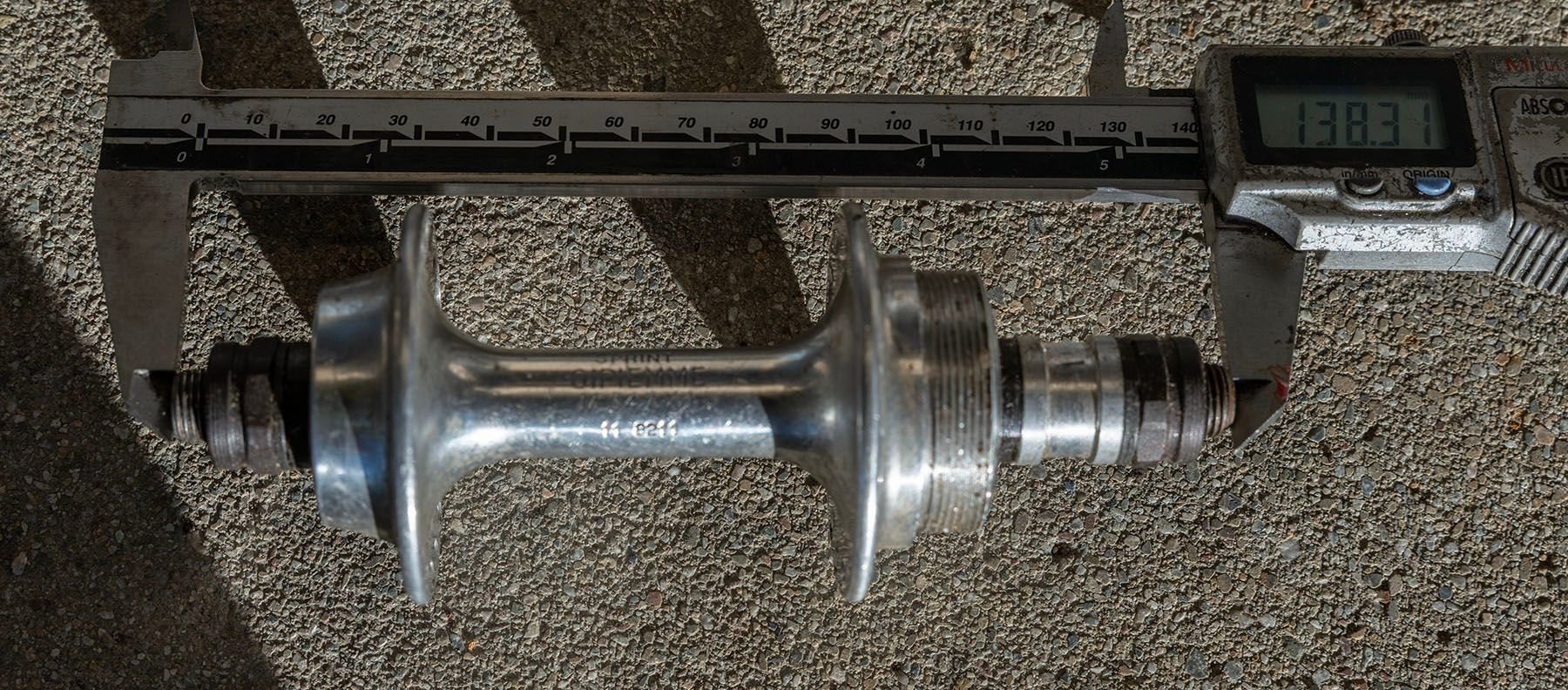
All these answers about purchasing files and dies require more money than just getting another axle. The comment by oneclick mentions tracytools. I looked at the webpage, no dies in this tread size. Americans will not be able to purchase anything shipped using post from outside of the USA starting today due to onerous import restrictions. Here is a NOS genuine Campagnolo Record rear axle that is suitable for a 6 speed, 126 OLD hub as shown in the original post. $20. I also have a NOS Gipipemme rear hub that has a M10 x 26 tpi 55 deg threaded axle. It is about 6mm longer than the 6 speed Campy axle. The cones, balls, locknuts and washers all interchange with the Record rear hub. This axle does not have grooves for the tab washer. The hub body has a French freewheel thread, M34.7 x 1, not very useful but the axle hardware is. $20. Shipping at my cost, should be around $5. Jim Merz

Last edited by Portlandjim; 09-01-25 at 09:11 AM.
09-01-25 | 09:24 AM
#14
Senior Member
Joined: Apr 2009
Posts: 3,719
Likes: 5,504
From: Seattle
I would strongly advise not having a custom die made, even if it were cheap. Which of course it won't be. I doubt even Campagnolo has one of those weird M10 x 26tpi dies, since their axle threads (back then) were rolled, not cut. The other M10 x 26 tpi thread they made, the screw that attaches the R. der. to the dropout, was almost certainly made on an automatic screw machine using a single-point tool, not a die.
But lets say you bit the bullet and had a custom die made, now what? The problem is, how do you start a threading die on a screw with the first couple threads mangled? There's no way to start it in-phase with the good threads farther down, so the die will probably start cutting out of phase with the good threads, and ruin all the threads, even the previously-good ones. I'm not even talking about the problem of starting the die aligned with the axis of the part; that can be achieved on a lathe, or with some sort of custom-made pilot on the die holder (but you have to make the pilot, it's not a stock part anyone sells). But no amount of skill or technology will overcome this phasing problem; only blind luck will save you, maybe one out of a thousand tries.
The only way I know to do this precisely (not counting the thread file or triangle file, which are only approximate) is on a lathe, with a single-point cutting tool. I could do that, but that's putting $100 worth of labor into saving a $20 part. Even though I have a lathe, I still would fix that axle with a triangle file, or by just forcing the cone over it as I mentioned earlier. Or just cut the mangled end off, and re-center the axle with less stickout on both ends.
Maybe it could be done with a segmented die that can be expanded to go over the bad threads, then closed onto the good threads, and run in reverse to re-cut the mangled thread. If one of those existed in M10 x 26 tpi, which they almost certainly do not. I have no experience with those 3-part segmented dies, only heard of them, but I believe they are large and super-expensive, and run on a dedicated machine. But now I'm being ridiculous, no one is going to spend five or six figures to make a custom tool to repair that $20 part.
The only segmented expanding die I've even heard of was owned by Tesch, who made his forks in big batches with long unthreaded steerers, the cut them to length as needed and added the threads last. As you may know, 1" x 24 tpi threading dies exist, but pretty often they screw up (no pun intended) and absolutely ruin all the threads. They cut beautifully going down, but then something goes wrong while unthreading the die back up. The expanding die gets around that, and saves time, by opening after the threads are cut, never backing up. The shop where I worked sometimes sent a fork to Dave to have that done, if the fork was valuable enough to be worth the round-trip shipping and the time it took. Not a service he offered to anyone, but we had a special relationship because he bought his lugs, BB shells and fork crowns from us. He saved our bacon a few times. Or at least we didn't have to make a new fork and paint it to match, sometimes the only other choice.
I still like threaded headsets and quill stems, for sentimental reasons, but man what a PITA those steerer threads were sometimes!
But lets say you bit the bullet and had a custom die made, now what? The problem is, how do you start a threading die on a screw with the first couple threads mangled? There's no way to start it in-phase with the good threads farther down, so the die will probably start cutting out of phase with the good threads, and ruin all the threads, even the previously-good ones. I'm not even talking about the problem of starting the die aligned with the axis of the part; that can be achieved on a lathe, or with some sort of custom-made pilot on the die holder (but you have to make the pilot, it's not a stock part anyone sells). But no amount of skill or technology will overcome this phasing problem; only blind luck will save you, maybe one out of a thousand tries.
The only way I know to do this precisely (not counting the thread file or triangle file, which are only approximate) is on a lathe, with a single-point cutting tool. I could do that, but that's putting $100 worth of labor into saving a $20 part. Even though I have a lathe, I still would fix that axle with a triangle file, or by just forcing the cone over it as I mentioned earlier. Or just cut the mangled end off, and re-center the axle with less stickout on both ends.
Maybe it could be done with a segmented die that can be expanded to go over the bad threads, then closed onto the good threads, and run in reverse to re-cut the mangled thread. If one of those existed in M10 x 26 tpi, which they almost certainly do not. I have no experience with those 3-part segmented dies, only heard of them, but I believe they are large and super-expensive, and run on a dedicated machine. But now I'm being ridiculous, no one is going to spend five or six figures to make a custom tool to repair that $20 part.
The only segmented expanding die I've even heard of was owned by Tesch, who made his forks in big batches with long unthreaded steerers, the cut them to length as needed and added the threads last. As you may know, 1" x 24 tpi threading dies exist, but pretty often they screw up (no pun intended) and absolutely ruin all the threads. They cut beautifully going down, but then something goes wrong while unthreading the die back up. The expanding die gets around that, and saves time, by opening after the threads are cut, never backing up. The shop where I worked sometimes sent a fork to Dave to have that done, if the fork was valuable enough to be worth the round-trip shipping and the time it took. Not a service he offered to anyone, but we had a special relationship because he bought his lugs, BB shells and fork crowns from us. He saved our bacon a few times. Or at least we didn't have to make a new fork and paint it to match, sometimes the only other choice.
I still like threaded headsets and quill stems, for sentimental reasons, but man what a PITA those steerer threads were sometimes!
