


Are these SAFE?
 11-14-12 | 06:23 PM
#1

Thread Starter
Senior Member
Joined: Apr 2005
Posts: 16,748
Likes: 138
From: Wherever
Are these SAFE?
Definitely the most questionable drillium I've seen. Can you imagine trying to lace these up?
https://www.ebay.com/itm/CAMPAGNOLO-N...item4609e9d190
https://www.ebay.com/itm/CAMPAGNOLO-N...item4609e9d190
 11-14-12 | 06:32 PM
#3

Senior Member
Joined: Jul 2009
Posts: 11,128
Likes: 39
Bikes: 1986 Alan Record Carbonio, 1985 Vitus Plus Carbone 7, 1984 Peugeot PSV, 1972 Line Seeker, 1986(est.) Medici Aerodynamic (Project), 1985(est.) Peugeot PY10FC
You're right about questioning such seemingly overzealous drilliumization of such components like those hubs. The driller seems to have really gone literally "overbored" on them.......I personally might not ride those, but they could still make out to be nice blinggy Christmas ornaments on a tree...
JMOs,...........but maybe DD can give us a better judgement on them.
Chombi
JMOs,...........but maybe DD can give us a better judgement on them.
Chombi
11-14-12 | 06:34 PM
#4
Thread Starter
Senior Member
Joined: Apr 2005
Posts: 16,748
Likes: 138
From: Wherever


 11-14-12 | 06:47 PM
#8
Senior Member
Joined: Jul 2009
Posts: 11,128
Likes: 39
Bikes: 1986 Alan Record Carbonio, 1985 Vitus Plus Carbone 7, 1984 Peugeot PSV, 1972 Line Seeker, 1986(est.) Medici Aerodynamic (Project), 1985(est.) Peugeot PY10FC
Both hubs never been ridden and only the front laced up at one time, per the eBay auction ad, might give us a good hint how much the owner trusted them him/herself......
Chombi
Chombi
11-14-12 | 07:39 PM
#9

Get off my lawn!


Joined: Nov 2010
Posts: 6,035
Likes: 118
From: The Garden State
Bikes: 1917 Loomis, 1923 Rudge, 1930 Hercules Renown, 1947 Mclean, 1948 JA Holland, 1955 Hetchins, 1957 Carlton Flyer, 1962 Raleigh Sport, 1978&81 Raleigh Gomp GS', 2010 Raliegh Clubman
Ok, I'd ride the drilled Nittto bars from last week's thread...these...eh....maybe not.
11-14-12 | 07:50 PM
#10

Bianchi Goddess
Joined: Apr 2009
Posts: 28,888
Likes: 4,133
From: Shady Pines Retirement Fort Wayne, In
Bikes: Too many to list here check my signature.
I can't remember if it was a pair but I know I did have front wheel with a hub like that.
__________________
“One morning you wake up, the girl is gone, the bikes are gone, all that's left behind is a pair of old tires and a tube of tubular glue, all squeezed out"
Sugar "Kane" Kowalczyk
“One morning you wake up, the girl is gone, the bikes are gone, all that's left behind is a pair of old tires and a tube of tubular glue, all squeezed out"
Sugar "Kane" Kowalczyk
11-14-12 | 07:58 PM
#11
I don't like the asymetrical hole in the webbing. From a purely aesthetic point of view I would have used two holes or centered the one. A few look a little off-center as well.
11-14-12 | 08:02 PM
#12

Banned.
Joined: Jul 2009
Posts: 12,292
Likes: 4,863
From: PAZ
I think they're the Schwinn hubs, too - that's a classic part-save story. And I'm with Otis on the sloppy additional drillings in the webbing; maybe he was trying to keep the holes from being too close to the oval cutout's edges. While that would be a smart idea, the execution was a bit iffy.
Since I've never drilled a hub - LF or HF - I really have nothing more to contribute. Carry on
DD
Since I've never drilled a hub - LF or HF - I really have nothing more to contribute. Carry on
DD

 11-14-12 | 09:35 PM
#14
Thread Starter
Senior Member
Joined: Apr 2005
Posts: 16,748
Likes: 138
From: Wherever
Thanks for posting that pic, Calstar. Wish I knew how to do that.
Yeah, pretty sloppy job on some of the holes. I think it looks lousy anyway. Perhaps if they had used holes smaller than the spoke holes in between. Maybe laced up it would look different but ....eh....not me.
Yeah, pretty sloppy job on some of the holes. I think it looks lousy anyway. Perhaps if they had used holes smaller than the spoke holes in between. Maybe laced up it would look different but ....eh....not me.

 )
11-14-12 | 10:44 PM
)
11-14-12 | 10:44 PM
#18
Banned.
Joined: May 2011
Posts: 4,816
Likes: 29
From: on the beach
Bikes: '73 falcon sr, '76 grand record, '84 davidson
i have some drilled rings and love them. but drillium elsewhere often has the too common tendency to apear terribly cheap, even when done orderly. it often approaches 'ugly,' like the machinist's gone mad.
probably in the minority on this. which normally suits me.
probably in the minority on this. which normally suits me.
11-14-12 | 11:28 PM
#19
Senior Member
Joined: Oct 2011
Posts: 428
Likes: 3
From: SF Bay Area
Bikes: 2003 Lemond Zurich; 1987 Schwinn Tempo; 1968 PX10; 1978 PX10LE, Peugeot Course; A-D Vent Noir
I don't think that the extra holes will seriously compromize the flange strength (but I don't know for sure). What I do worry about is that the wheelbuilder will have to be careful to properly set the spokes in the right holes (i.e. in the "non-drilliumed" factory spoke holes).
11-15-12 | 07:38 AM
#20

www.theheadbadge.com


Joined: Sep 2005
Posts: 29,005
Likes: 5,494
From: Southern Florida
Bikes: https://www.theheadbadge.com
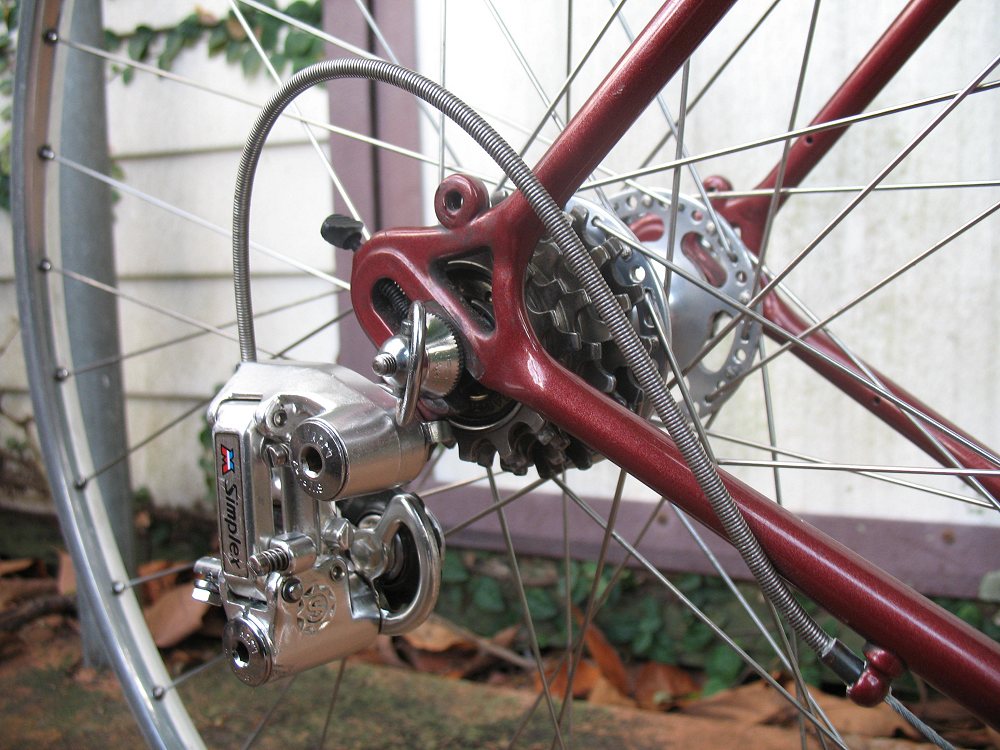
Someone more likely than not wished to do a build with these hubs and couldn't locate an original set.
As for strength, they're no better or worse than the Schwinn variant; probably better, due to the smaller secondary hole. Unlike C-Record, I've yet to hear of one of these exploding while being ridden.
-Kurt
__________________


11-15-12 | 10:06 AM
#21
Senior Member
Joined: Nov 2004
Posts: 23,212
Likes: 3,122
The typical flange failure (in crossed spokes patterns) occurs when stress cracks appear at the hole and propogate between adjacent holes and to the outside of the flange. Examination of hubs starting to fail suggests the initial crack radiates from the hole to the outside of the flange and is rougly tangential to the spoke orientation. Once this propogates, the crack between adjacent holes forms. This indacates that the critical and more highly stressed area is the material between the hole and outside flange, which has not been altered in the subject hubs.
Of course, it is possible to reduce the spacing between holes to the point where it will fail first. Brandt suggests a rule of thumb of 1.5X the spoke hole diameter as the amount of material between adjacent spoke holes. However, in a standard hub there are spokes in adjacent holes pulling towards each other, so half the material betwen the holes (i.e. 0.75X hole diameter) is carrying the load for an individual spoke. The subject hubs appear to have at least this much material between a spoke occupied hole and the adjacent unoccupied hole.
The other potential area for failure are the six inner holes. The spacing between these holes and any spoke hole is not less than that between the factory's oval holes and any spoke hole, so this should not be a concern. Also the total mimimum distance between these holes and the two adjacent oval holes appears to be equal to the miniumum distance between two adjcent oval holes, so there should be no concern from this perspective either.
Overall, I can't see any case for concern, unless there are some holes that are significantly off location and not readily apparent in the photos. The basic concept appears sound.
Of course, it is possible to reduce the spacing between holes to the point where it will fail first. Brandt suggests a rule of thumb of 1.5X the spoke hole diameter as the amount of material between adjacent spoke holes. However, in a standard hub there are spokes in adjacent holes pulling towards each other, so half the material betwen the holes (i.e. 0.75X hole diameter) is carrying the load for an individual spoke. The subject hubs appear to have at least this much material between a spoke occupied hole and the adjacent unoccupied hole.
The other potential area for failure are the six inner holes. The spacing between these holes and any spoke hole is not less than that between the factory's oval holes and any spoke hole, so this should not be a concern. Also the total mimimum distance between these holes and the two adjacent oval holes appears to be equal to the miniumum distance between two adjcent oval holes, so there should be no concern from this perspective either.
Overall, I can't see any case for concern, unless there are some holes that are significantly off location and not readily apparent in the photos. The basic concept appears sound.
Last edited by T-Mar; 11-15-12 at 10:09 AM.

Thread
Thread Starter
Forum
Replies
Last Post
Mr. Spadoni
Classic & Vintage
13
12-29-17 09:21 PM
