


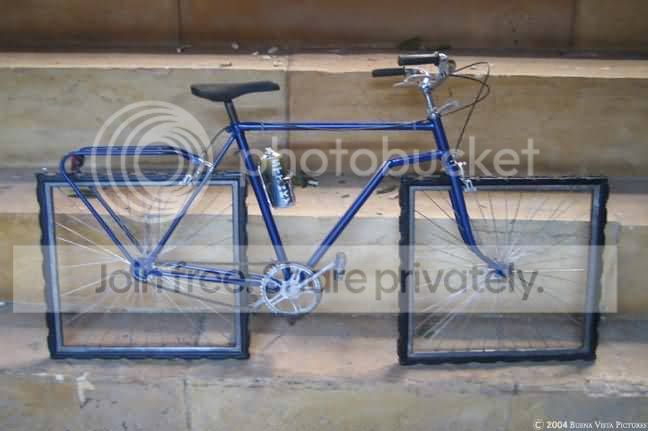
Early Biopace
 12-26-12 | 06:57 PM
#1

Thread Starter
You gonna eat that?
Joined: Sep 2008
Posts: 14,917
Likes: 543
From: Fort Worth, Texas Church of Hopeful Uncertainty
Bikes: 1966 Raleigh DL-1 Tourist, 1973 Schwinn Varsity, 1983 Raleigh Marathon, 1994 Nishiki Sport XRS
Early Biopace
The concept needed a little work.

__________________
I stop for people / whose right of way I honor / but not for no one.
 Originally Posted by bragi
  "However, it's never a good idea to overgeneralize."
I stop for people / whose right of way I honor / but not for no one.
Originally Posted by bragi "However, it's never a good idea to overgeneralize."

 12-26-12 | 07:21 PM
#3

Velocommuter Commando
Joined: Nov 2007
Posts: 2,683
Likes: 38
From: Houston, Texas
Bikes: '88 Specialized Sirrus, '89 Alpine Monitor Pass, two '70 Raligh Twenties, '07 Schwinn Town & Country Trike, '07 Specialized Sirrus Hybrid


 12-26-12 | 08:05 PM
#6

Senior Member
Joined: May 2009
Posts: 2,741
Likes: 151
From: Kitchener, ON
Heh, a Reuleaux Triangle. The same shape can be used to make drill bits that drill square holes. Unfortunately I'm too drunk to grasp why this would be good for a crank.
12-26-12 | 08:11 PM
#7

Senior Member

Joined: Aug 2011
Posts: 22,676
Likes: 2,643
From: CID
Bikes: 1991 Bianchi Eros, 1964 Armstrong, 1988 Diamondback Ascent, 1988 Bianchi Premio, 1987 Bianchi Sport SX, 1980s Raleigh mixte (hers), All-City Space Horse (hers)
Heh, a Reuleaux Triangle. The same shape can be used to make drill bits that drill square holes. Unfortunately I'm too drunk to grasp why this would be good for a crank.
12-26-12 | 09:04 PM
#9

Senior Member


Joined: Apr 2007
Posts: 12,567
Likes: 2,740
From: Thunder Bay, Ontario, Canada - burrrrr!
Bikes: 1958 Rabeneick 120D, 1968 Legnano Gran Premio, 196? Torpado Professional, 2000 Marinoni Piuma
wonder how that rides
__________________
"98% of the bikes I buy are projects".
"98% of the bikes I buy are projects".
12-26-12 | 09:21 PM
#10

Senior Member
Joined: Jun 2009
Posts: 1,613
Likes: 337
From: Plano, IL.
In this article............ https://sheldonbrown.com/biopace.html ..........Sheldon claims to have run biopace/fixed gear on personal bikes with success.
__________________
Be where your feet are.......Lisa Bluder
Be where your feet are.......Lisa Bluder
12-26-12 | 11:56 PM
#13
Chainstay Brake Mafia
Joined: Mar 2011
Posts: 6,007
Likes: 19
From: California
In this article............ https://sheldonbrown.com/biopace.html ..........Sheldon claims to have run biopace/fixed gear on personal bikes with success.

 12-27-12 | 01:44 AM
#14

Ride, Wrench, Swap, Race
Joined: Jan 2010
Posts: 9,831
Likes: 1,809
From: Northern California
Bikes: Cheltenham-Pedersen racer, Boulder F/S Paris-Roubaix, Varsity racer, '52 Christophe, '62 Continental, '92 Merckx, '75 Limongi, '76 Presto, '72 Gitane SC, '71 Schwinn SS, etc.
Heh, the first thing one needs to know about BioPace is that the big ring is always almost round, only 3.5% radius variation, I measured it.
Next thing is that most of the later BioPace variants that Shimano sold had the same, mere 3.5% variation, which played nice with front derailers and could be SPUN. These were named BioPace II, BioPace HP and BioPace SG, in that chronological order iir.
The smaller ring(s) of earlier BioPace cranks had fully 8% radial variation, which made any downshift from the big ring seem like a bigger drop in gearing than it was. This was pretty awful.
I've raced almost exclusively on BioPace HP rings since 1997. I cannot detect any BioPacing once I've ridden one lap on them, the effect is so subtle.
The pictured triangular chainring is very odd in that the left and right leg seem to get opposite effects from it. It would thus seem to be difficult to adapt to and of course very difficult to spin.
Ever try to pedal a cotter-cranked bike with both cotters installed pointing in the same direction?
I think that BioPace is helpful when you get stuck in a much too high gear, as the torque peak is spread out over a larger number of degrees of crank rotation, i.e. is less peaked. This helps prevent stall-out in any bog-down situation.
The late Edmund Polchlopek, noted French funnybike pioneer, created his own specially shaped rings by modifying (hot-forming iir) standard alloy chainrings. These were actually made in small production batches in the early 1980's.
Next thing is that most of the later BioPace variants that Shimano sold had the same, mere 3.5% variation, which played nice with front derailers and could be SPUN. These were named BioPace II, BioPace HP and BioPace SG, in that chronological order iir.
The smaller ring(s) of earlier BioPace cranks had fully 8% radial variation, which made any downshift from the big ring seem like a bigger drop in gearing than it was. This was pretty awful.
I've raced almost exclusively on BioPace HP rings since 1997. I cannot detect any BioPacing once I've ridden one lap on them, the effect is so subtle.
The pictured triangular chainring is very odd in that the left and right leg seem to get opposite effects from it. It would thus seem to be difficult to adapt to and of course very difficult to spin.
Ever try to pedal a cotter-cranked bike with both cotters installed pointing in the same direction?
I think that BioPace is helpful when you get stuck in a much too high gear, as the torque peak is spread out over a larger number of degrees of crank rotation, i.e. is less peaked. This helps prevent stall-out in any bog-down situation.
The late Edmund Polchlopek, noted French funnybike pioneer, created his own specially shaped rings by modifying (hot-forming iir) standard alloy chainrings. These were actually made in small production batches in the early 1980's.
12-27-12 | 02:48 AM
#15
Chainstay Brake Mafia
Joined: Mar 2011
Posts: 6,007
Likes: 19
From: California
I've raced almost exclusively on BioPace HP rings since 1997. I cannot detect any BioPacing once I've ridden one lap on them, the effect is so subtle.
...
I think that BioPace is helpful when you get stuck in a much too high gear, as the torque peak is spread out over a larger number of degrees of crank rotation, i.e. is less peaked. This helps prevent stall-out in any bog-down situation.
...
I think that BioPace is helpful when you get stuck in a much too high gear, as the torque peak is spread out over a larger number of degrees of crank rotation, i.e. is less peaked. This helps prevent stall-out in any bog-down situation.
I prefer round rings but have a biopace ring on my single speed (mostly because i had the ring on hand and don't have any spare round ones right now) I'm not sure if it makes much difference but if it is beneficial in instances where you're in a too high gear, then it would be useful on a single speed i suppose.
12-27-12 | 03:01 AM
#16

Cisalpinist
Joined: Jan 2011
Posts: 5,557
Likes: 18
From: Holland
Bikes: blue ones.
Heh, a Reuleaux Triangle. The same shape can be used to make drill bits that drill square holes. Unfortunately I'm too drunk to grasp why this would be good for a crank.

 12-27-12 | 09:27 PM
#18

Retro Grouch
Joined: Oct 2007
Posts: 2,210
Likes: 3
From: Santa Cruz
Bikes: Yes
While your chainring looks vintage, there is a rather contemporary chainring that looks very similar; here's
The Curious Case of Osymetric Chainrings
https://www.competitivecyclist.com/wh...rings.415.html
The Curious Case of Osymetric Chainrings
https://www.competitivecyclist.com/wh...rings.415.html
Last edited by onespeedbiker; 12-27-12 at 09:32 PM.
12-27-12 | 10:49 PM
#19

Senior Member
Joined: Sep 2012
Posts: 2,443
Likes: 502
From: High desert
Somewhat the same topic: Back in the 80's, I bought a bike fitted with the Houdaille ExO PowerCam. It used a cam drive to spread the torque to maximum at the 3:00 and 9:00 positions and least at the 12:00 and 6:00 positions.
Sounds like a great idea, no? In theory, yes. In practice, it forced me to have a much slower cadence...almost killed my knees. Tried to like it but couldn't, although great fun at parties - the pulsing was quite pronounced, more than any small ring Biopace. I wound up selling it for cheap and shouldn't have...they're collector's items now.
Sounds like a great idea, no? In theory, yes. In practice, it forced me to have a much slower cadence...almost killed my knees. Tried to like it but couldn't, although great fun at parties - the pulsing was quite pronounced, more than any small ring Biopace. I wound up selling it for cheap and shouldn't have...they're collector's items now.
12-28-12 | 03:37 AM
#20
Ride, Wrench, Swap, Race
Joined: Jan 2010
Posts: 9,831
Likes: 1,809
From: Northern California
Bikes: Cheltenham-Pedersen racer, Boulder F/S Paris-Roubaix, Varsity racer, '52 Christophe, '62 Continental, '92 Merckx, '75 Limongi, '76 Presto, '72 Gitane SC, '71 Schwinn SS, etc.
My front derailer cannot be lowered below the height for a 52t round big ring.
With BioPace rings, I am using a 50t big ring, which is the one ring I use for almost all of my time spent racing and road riding.
While BioPace HP rings escape my notice while I'm riding, I have noticed a slight improvement with them (in situations where I might stall out and have to unclip to save a fall). I just hang in there and pedal with some extra confidence that I can pull out of tight situation, as when re-mounting awkwardly in technical terrain.
In shorter mass-start events like cyclocross, a strong start is more important. Here, I appreciate the ability to shift earlier without feeling the spike of too much resistance at the pedals (and my knees). The earlier shifting gets me up to speed faster since it eliminates the sharp fall-off in pedal torque as the cadence gets too high. This is exaggerated by the lag in the actual ratio change from when each upshift is initiated, so each upshift gets me another half-bike-length ahead of the guys at each of my elbows. My STI-using competitors have it even worse, because their upshift isn't initiated until they have pressed and released their STI lever, while my thumbshifter moves the cable more immediately.

Thread
Thread Starter
Forum
Replies
Last Post
bikemanbob
Classic & Vintage
4
09-24-11 09:20 AM
