


Too much spread?

 06-19-13 | 09:47 PM
#2

Ride, Wrench, Swap, Race

Joined: Jan 2010
Posts: 9,815
Likes: 1,790
From: Northern California
Bikes: Cheltenham-Pedersen racer, Boulder F/S Paris-Roubaix, Varsity racer, '52 Christophe, '62 Continental, '92 Merckx, '75 Limongi, '76 Presto, '72 Gitane SC, '71 Schwinn SS, etc.
I've spread a few 120mm frames out to 130mm, so as long as you have controlled leverage and can bend each side separately while measuring each side's 5mm movement, this is quite do-able.
This frame is a track bike?
Also, to help the stay's resist coming out of alignment while riding, it's best to bend each stay 6mm, then back 1mm. You'll see that it takes quite minimal force to bend back that 1mm, which is merely a stress-relieving process that helps the widened frame hold it's "adjustments" better later under riding stress.
This frame is a track bike?
Also, to help the stay's resist coming out of alignment while riding, it's best to bend each stay 6mm, then back 1mm. You'll see that it takes quite minimal force to bend back that 1mm, which is merely a stress-relieving process that helps the widened frame hold it's "adjustments" better later under riding stress.

 06-19-13 | 10:58 PM
#4
Thread Starter
Senior Member
Joined: Sep 2006
Posts: 215
Likes: 1
From: Montara, CA
I've spread a few 120mm frames out to 130mm, so as long as you have controlled leverage and can bend each side separately while measuring each side's 5mm movement, this is quite do-able.
This frame is a track bike?
Also, to help the stay's resist coming out of alignment while riding, it's best to bend each stay 6mm, then back 1mm. You'll see that it takes quite minimal force to bend back that 1mm, which is merely a stress-relieving process that helps the widened frame hold it's "adjustments" better later under riding stress.
This frame is a track bike?
Also, to help the stay's resist coming out of alignment while riding, it's best to bend each stay 6mm, then back 1mm. You'll see that it takes quite minimal force to bend back that 1mm, which is merely a stress-relieving process that helps the widened frame hold it's "adjustments" better later under riding stress.
06-19-13 | 11:00 PM
#5
Thread Starter
Senior Member
Joined: Sep 2006
Posts: 215
Likes: 1
From: Montara, CA
06-20-13 | 06:07 AM
#6
Senior Member

Joined: Nov 2004
Posts: 23,212
Likes: 3,122
+1. I've done changes of that amount to Reynolds 531 without issue. The only way you'll damage the stay is by getting too aggressive, usually on the first try. The best approach for a beginniner is to ease into things, gradually increasing your force until you get a permanent deflection.
06-21-13 | 03:59 PM
#7
Thread Starter
Senior Member
Joined: Sep 2006
Posts: 215
Likes: 1
From: Montara, CA
+1. I've done changes of that amount to Reynolds 531 without issue. The only way you'll damage the stay is by getting too aggressive, usually on the first try. The best approach for a beginniner is to ease into things, gradually increasing your force until you get a permanent deflection.
06-21-13 | 04:15 PM
#8

Get off my lawn!

Joined: Nov 2010
Posts: 6,035
Likes: 118
From: The Garden State
Bikes: 1917 Loomis, 1923 Rudge, 1930 Hercules Renown, 1947 Mclean, 1948 JA Holland, 1955 Hetchins, 1957 Carlton Flyer, 1962 Raleigh Sport, 1978&81 Raleigh Gomp GS', 2010 Raliegh Clubman
10cm? All day long! It's wise to clamp the Bridge so you don't put stress on the joint. I spread this from 110 to 120 without any issue. 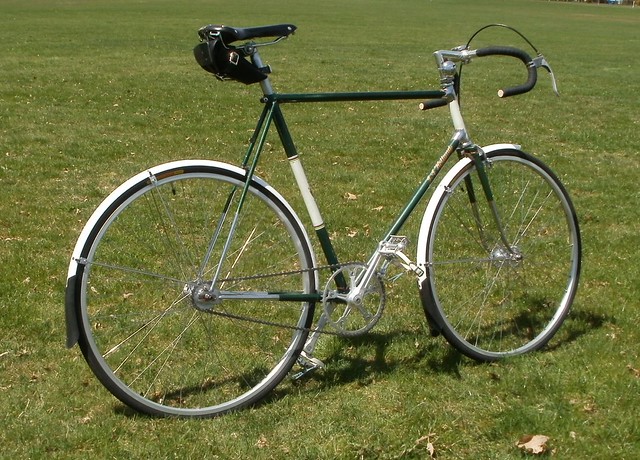
06-23-13 | 10:51 AM
#9
Thread Starter
Senior Member
Joined: Sep 2006
Posts: 215
Likes: 1
From: Montara, CA
I presume that you mean both the chain stay bridge and the brake bridge. What method of clamping did you use? That's a gorgeous bike. BTW, I also have a Maclean Featherweight, 1957, KD403.

Thread
Thread Starter
Forum
Replies
Last Post
wroomwroomoops
Mountain Biking
2
07-22-11 02:30 PM
