


Why a Stainless Frame?
 12-10-14 | 08:09 AM
#101


Decrepit Member
Joined: Aug 2005
Posts: 10,488
Likes: 93
From: Santa Rosa, California
Bikes: Waterford 953 RS-22, several Paramounts
With some error, stainless can be tested with a magnet. Many (most) stainless steels aren't magnetic. Those that are, aren't very magnetic. The magnet will just barely stick. I would think that oldy57s frame would hold a magnet very well if it's nickel plated steel not so much if it's stainless.
Is Stainless Steel Magnetic? | PhysLink
More details:
Magnetic Properties of Stainless Steels | Carpenter Technology (Carpenter is the manufacturer of the raw material for Reynolds 953 tubing, Carpenter Custom 455).
Reynolds 953 does attract a magnet, although not quite as strongly as 4130 chromoly does.
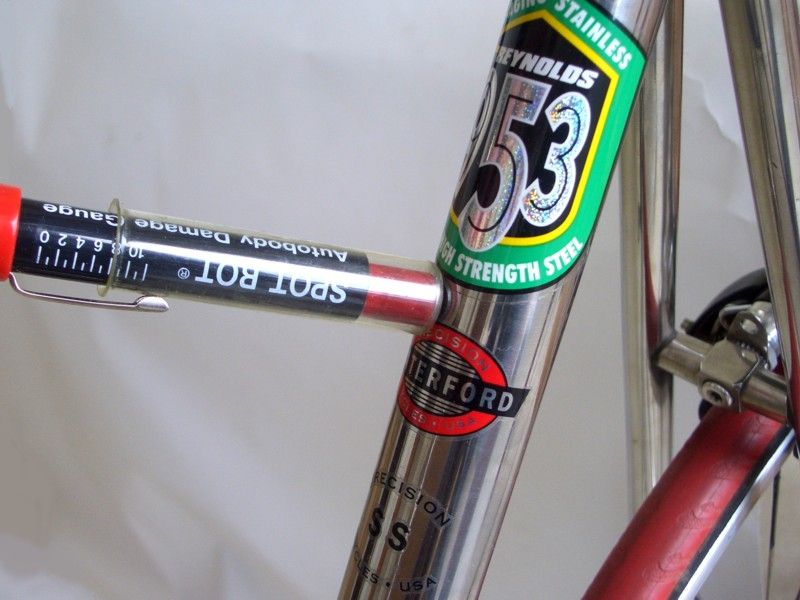
Reynolds 953 and 931, Columbus XCr, and KVA MS2 and MS3 are all Martensitic; Reynolds 921 is Austenitic.

Last edited by Scooper; 12-10-14 at 12:37 PM. Reason: added Carpenter link


 12-10-14 | 05:38 PM
#103

Full Member

Joined: Jan 2004
Posts: 274
Likes: 0
From: Woodstown NJ
Bikes: 1975 Schwinn Voyageur II (Made by Panasonic), 1988 Schwinn Voyaguer (touring)
[QUOTE=J T CUNNINGHAM;17376945]There were a number of SS T Birds and Continentals during, at least, the 1960's.
Correct. The information at the Heinz History Museum (Pgh PA) where a 30's stainless steel Ford is displayed, stated Allegheny Ludlum supplied Ford SS around 1963. They have a picture of a 63 T-Bird with the bullet shaped fenders. What a style, in CS or SS.
I'm from Pgh, so I'm partial to the museum, which is only about 30 years old. In a 9 story building originally built to store ice. Very thick walls.
John Hawrylak
Woodstown NJ
Correct. The information at the Heinz History Museum (Pgh PA) where a 30's stainless steel Ford is displayed, stated Allegheny Ludlum supplied Ford SS around 1963. They have a picture of a 63 T-Bird with the bullet shaped fenders. What a style, in CS or SS.
I'm from Pgh, so I'm partial to the museum, which is only about 30 years old. In a 9 story building originally built to store ice. Very thick walls.
John Hawrylak
Woodstown NJ
12-10-14 | 07:18 PM
#104
Senior Member
Joined: Nov 2006
Posts: 813
Likes: 0
From: TORONTO , ONT , CA
Bikes: '86 AMBROSI / C RECORD. PINARELLO MONTELLO / FRAME, FORK.
From the Web:
From the archives: Allegheny Ludlum?s stainless-steel Fords | Hemmings Daily
Regards,
J T
From the archives: Allegheny Ludlum?s stainless-steel Fords | Hemmings Daily
Regards,
J T
12-10-14 | 07:31 PM
#105
Decrepit Member
Joined: Aug 2005
Posts: 10,488
Likes: 93
From: Santa Rosa, California
Bikes: Waterford 953 RS-22, several Paramounts
From the Web:
From the archives: Allegheny Ludlum?s stainless-steel Fords | Hemmings Daily
Regards,
J T
From the archives: Allegheny Ludlum?s stainless-steel Fords | Hemmings Daily
Regards,
J T
Talk about rare!
12-10-14 | 08:11 PM
#106
Senior Member
Joined: Nov 2006
Posts: 813
Likes: 0
From: TORONTO , ONT , CA
Bikes: '86 AMBROSI / C RECORD. PINARELLO MONTELLO / FRAME, FORK.
Truth be known, and I know that I will receive a lot of flack for this, but the pic of the "1967 Continental" is not that at all; it's a 1966 Continental.
The reason I write that, is that it has The Continental Star upon it's "before the wheelhouse panel". That being written, (HA!) seeing that the
1966 & 67 Continentals use the identical front fenders, along with all other body panels, my question is "Why was the old Star emblem
fixed to a one year newer auto?"
LOL.
I am a Continental Freak, having owned a 1956 Mark II; a 1965 Lehmann - Peterson and a 1967 Lehmann - Peterson.
EDIT:
https://automotivemileposts.com/linco...lesssteel.html
Now that explains everything!
Regards,
J T
The reason I write that, is that it has The Continental Star upon it's "before the wheelhouse panel". That being written, (HA!) seeing that the
1966 & 67 Continentals use the identical front fenders, along with all other body panels, my question is "Why was the old Star emblem
fixed to a one year newer auto?"
LOL.
I am a Continental Freak, having owned a 1956 Mark II; a 1965 Lehmann - Peterson and a 1967 Lehmann - Peterson.
EDIT:
https://automotivemileposts.com/linco...lesssteel.html
Now that explains everything!
Regards,
J T
Last edited by J T CUNNINGHAM; 12-11-14 at 12:43 AM.
12-14-14 | 09:11 PM
#108

curmudgineer
Joined: Dec 2009
Posts: 4,417
Likes: 113
From: Chicago SW burbs
Bikes: 2 many 2 fit here
I'm sorry, I didn't deliberately ignore your post; it must have been a busy week back then.
My memory must have failed me when I wrote 4x. Depending whether you are looking at the difference in energy, momentum, speed, or distance, the factor for rotating mass versus non-rotating mass varies.
Here is a simplified analysis I typed up offline. It's off the top of my head, so I stand to be corrected for typos or logical blunders.
Suppose you have an imaginary unicycle that is suspended by the frame and the only mass is in the rim-- everything else is massless. Suppose the rim has mass of 1 kg. Suppose the radius of the rim is 1 m. Suppose the rim is initially motionless and you pedal to accelerate the rim to a peripheral speed of 1 m/sec. You have just raised the kinetic energy of the rim from zero to (1/2*m*v^2) = (0.5 kg*m^2)/(s^2).
Now suppose the frame is massless, and the rim is in frictional contact with the ground. In this imaginary system, you are able to pedal the wheel without participating in the kinematics, i.e., your own mass and movement are not relevant for this simplified analysis.
As above, you accelerate the wheel to 1 m/sec, and the wheel moves along the ground without slipping. In this case, in addition to the rotational kinetic energy you have added to the wheel, you have given it a linear kinetic energy as its centre of mass translates parallel to the ground at 1 m/sec. The translational kinetic energy you have added, in addition to the rotational kinetic energy, is 1/2*m*v^2 = (0.5 kg*m^2)/(s^2). So the total energy you added to the now rotating and translating wheel is the sum of the two energies, or (0.5 + 0.5) = (1 kg*m^2)/(s^2).
Now as a counter example, lets suppose we exchange the wheel described above for (another imaginary) wheel that has a massless rim, and a hub that is infinitesimally small radially, but which has a mass of 1 kg.
To raise the rotational speed of this wheel from zero to 1 m/sec (or any speed) takes no energy (ignoring rotational friction, which is irrelevant to this simplified analysis).
Putting the rim in contact with the ground, as above, and accelerating the wheel to 1 m/sec, you have added the same amount of translational kinetic energy as before, i.e. (0.5 kg*m^2)/(s^2). This is the total energy you have added, since the rotational energy you added was zero.
You can see from the above extreme cases of two wheels with the same mass, that it takes only half the energy to accelerate a wheel (in frictional contact with the ground) which has all its mass at the centre, compared to a wheel that has all its mass at the periphery.
Now let's think about what speed you could accelerate the wheel to with the same amount of energy in both cases.
Take the energy you put into the wheel with all the mass at the rim: (1 kg*m^2)/(s^2)
How fast would this energy make the other wheel with the massless rim go?
E = 1/2 * m * v^2
Let's solve for v...
v^2 =[E/(1/2) * m)]
v = [E/(1/2) * m)]^0.5
E = 1
m = 1
therefore,
v = [(1/(0.5) * 1)]^0.5
v = [ 2]^0.5
v = 1.41 (m/sec)
So in this imaginary unicycle race, with both vehicles accelerated from rest with 1 Joule (1 kg*m^2/s^2) of energy, the one with the massless rim would accelerate to 1.41 m/sec while the one with the massive rim would only accelerate to 1 m/sec.
This is what you experience on bicycles with differing amounts of mass near the periphery of the wheels.
My memory must have failed me when I wrote 4x. Depending whether you are looking at the difference in energy, momentum, speed, or distance, the factor for rotating mass versus non-rotating mass varies.
Here is a simplified analysis I typed up offline. It's off the top of my head, so I stand to be corrected for typos or logical blunders.
Suppose you have an imaginary unicycle that is suspended by the frame and the only mass is in the rim-- everything else is massless. Suppose the rim has mass of 1 kg. Suppose the radius of the rim is 1 m. Suppose the rim is initially motionless and you pedal to accelerate the rim to a peripheral speed of 1 m/sec. You have just raised the kinetic energy of the rim from zero to (1/2*m*v^2) = (0.5 kg*m^2)/(s^2).
Now suppose the frame is massless, and the rim is in frictional contact with the ground. In this imaginary system, you are able to pedal the wheel without participating in the kinematics, i.e., your own mass and movement are not relevant for this simplified analysis.
As above, you accelerate the wheel to 1 m/sec, and the wheel moves along the ground without slipping. In this case, in addition to the rotational kinetic energy you have added to the wheel, you have given it a linear kinetic energy as its centre of mass translates parallel to the ground at 1 m/sec. The translational kinetic energy you have added, in addition to the rotational kinetic energy, is 1/2*m*v^2 = (0.5 kg*m^2)/(s^2). So the total energy you added to the now rotating and translating wheel is the sum of the two energies, or (0.5 + 0.5) = (1 kg*m^2)/(s^2).
Now as a counter example, lets suppose we exchange the wheel described above for (another imaginary) wheel that has a massless rim, and a hub that is infinitesimally small radially, but which has a mass of 1 kg.
To raise the rotational speed of this wheel from zero to 1 m/sec (or any speed) takes no energy (ignoring rotational friction, which is irrelevant to this simplified analysis).
Putting the rim in contact with the ground, as above, and accelerating the wheel to 1 m/sec, you have added the same amount of translational kinetic energy as before, i.e. (0.5 kg*m^2)/(s^2). This is the total energy you have added, since the rotational energy you added was zero.
You can see from the above extreme cases of two wheels with the same mass, that it takes only half the energy to accelerate a wheel (in frictional contact with the ground) which has all its mass at the centre, compared to a wheel that has all its mass at the periphery.
Now let's think about what speed you could accelerate the wheel to with the same amount of energy in both cases.
Take the energy you put into the wheel with all the mass at the rim: (1 kg*m^2)/(s^2)
How fast would this energy make the other wheel with the massless rim go?
E = 1/2 * m * v^2
Let's solve for v...
v^2 =[E/(1/2) * m)]
v = [E/(1/2) * m)]^0.5
E = 1
m = 1
therefore,
v = [(1/(0.5) * 1)]^0.5
v = [ 2]^0.5
v = 1.41 (m/sec)
So in this imaginary unicycle race, with both vehicles accelerated from rest with 1 Joule (1 kg*m^2/s^2) of energy, the one with the massless rim would accelerate to 1.41 m/sec while the one with the massive rim would only accelerate to 1 m/sec.
This is what you experience on bicycles with differing amounts of mass near the periphery of the wheels.

Thread
Thread Starter
Forum
Replies
Last Post
Robert C
General Cycling Discussion
24
07-18-15 01:33 PM
