


Gave up on bike commuting
 01-02-17 | 04:00 PM
#51


I know it's not supposed to be but to me bike commuting is pretty much an extreme sport and I don't blame anyone for not taking it up the same way I resist the Thai kickboxing lessons down the stripmall from my office.
 01-02-17 | 04:16 PM
#52
Senior Member
Joined: Jul 2013
Posts: 3,498
Likes: 646
From: Toronto
Bikes: Sekine 1979 ten speed racer
Is there a local bicycle club or advocacy group you can speak with? Can you go to the media and your local municipal politician about traffic enforcement and behaviour? America is supposed to be the land of free choice. Here we have someone's lifestyle being forced to change because bad driving behaviour and its associated fatalities are viewed as acceptable.
01-03-17 | 10:17 AM
#54

Senior Member
Joined: Apr 2012
Posts: 7,391
Likes: 13
From: Memphis TN area
Bikes: 2011 Felt Z85 (road/commuter), 2006 Marin Pine Mountain (utility/commuter E-bike), 1995 KHS Alite 1000 (gravel grinder)
The OP has been posting over in the Touring forum the last few days. Doesn't really seem like a troll like some others I've seen.
01-03-17 | 02:30 PM
#55

Keepin it Wheel


Joined: Aug 2011
Posts: 10,969
Likes: 5,247
From: San Diego
Bikes: Surly CrossCheck, Krampus
Anyway, I'd be curious to know where the OP is from to have a better idea of that region's attitude toward cyclists. I just came from visiting my kids out in Palm Springs, CA and I commented to a local out there about all the painted bike lanes on the roadways. His response was "Yeah, that's how all the gay guys get around" -- and he said it as if anyone on the street in Palm Springs would concur. This idiot is a successful surgeon, so that goes to show how disdain for cyclists crosses all educational and economical boundaries.
01-03-17 | 02:36 PM
#56
Keepin it Wheel
Joined: Aug 2011
Posts: 10,969
Likes: 5,247
From: San Diego
Bikes: Surly CrossCheck, Krampus
OP, thanks for your story. I'm sorry that you are forced off the road (and like everybody else, would like to know where it is the drivers are so terrible).
Your tragic tale reminds me how much better drivers are in my area, and helps me not take my situation for granted, but to be thankful.
Your tragic tale reminds me how much better drivers are in my area, and helps me not take my situation for granted, but to be thankful.
01-03-17 | 09:34 PM
#57
Senior Member
Joined: Mar 2014
Posts: 1,206
Likes: 3
From: Cascadia
Bikes: Jamis Quest Comp
 01-04-17 | 12:50 PM
#59
Thread Starter
Senior Member
Joined: Dec 2016
Posts: 110
Likes: 1
I'm not trolling. I gave up cycling because I fear for my safety too much to continue doing it.
I have not replied because I don't feel like I have anything else to add to the discussion.
Carolinas, USA, by the way.
I'm sorry some of you feel "they" are "winning" by me giving in. You're welcome to put your health on the line in hopes that one day cycling to work in USA is safe. I am not. I sincerely wish you the best of luck on your commutes.
I will be involved at the advocacy level, but that is as far as I'll take it.
01-04-17 | 05:19 PM
#60

Senior Member
Joined: May 2005
Posts: 6,301
Likes: 14
From: La La Land (We love it!)
Bikes: Gilmour road, Curtlo road; both steel (of course)
 01-05-17 | 04:46 PM
#62

Senior Member
Joined: Oct 2009
Posts: 2,402
Likes: 48
I've known a number of people who've given up commuting or riding. It only takes a few close calls for many to realize how vulnerable bicycle riders are in the U.S.
I've posted this before, but it bears repeating:
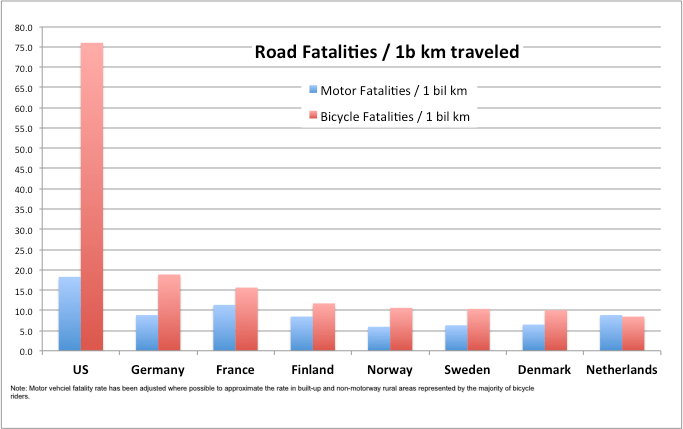
U.S. roads are the most dangerous of all developed countries. This for people in cars and much more so for people walking or riding. U.S. roads have been designed to be dangerous because the focus of traffic engineers is on reducing delay, not on reducing fatalities, injuries, and crashes. The U.S. has, overwhelmingly, the lowest modal share of bike commuting in the world — because people are rightly scared to share the road with 4000 lb cars being driven by people paying more attention to their phone than to what they are doing with their 4000 lb car all while driving quite fast because, well, why not, the road is wide, no need to slow down or pay attention.
But even in the countries with much safer road systems they recognize that the only way for bicycle riders to be remotely safe is to provide protected bikeways. The quality of protected bikeways matches closely with the safety indicated above; Netherlands is safest, Denmark next, etc.
I've posted this before, but it bears repeating:
U.S. roads are the most dangerous of all developed countries. This for people in cars and much more so for people walking or riding. U.S. roads have been designed to be dangerous because the focus of traffic engineers is on reducing delay, not on reducing fatalities, injuries, and crashes. The U.S. has, overwhelmingly, the lowest modal share of bike commuting in the world — because people are rightly scared to share the road with 4000 lb cars being driven by people paying more attention to their phone than to what they are doing with their 4000 lb car all while driving quite fast because, well, why not, the road is wide, no need to slow down or pay attention.
But even in the countries with much safer road systems they recognize that the only way for bicycle riders to be remotely safe is to provide protected bikeways. The quality of protected bikeways matches closely with the safety indicated above; Netherlands is safest, Denmark next, etc.
Last edited by CrankyOne; 01-05-17 at 04:55 PM.
01-05-17 | 06:37 PM
#64

Senior Member
Joined: Dec 2012
Posts: 919
Likes: 15
From: South Austin, Texas
Bikes: 2010 Origin8 CX700, 2003 Cannondale Backroads Cross Country, 1997 Trek mtn steel frame converted commuter/tourer, 1983 Univega Sportour, 2010 Surly LHT, Others...
My real concerns around street safety in Austin, Texas, and the US are for my children. 3 out of 4 commute by bike on our city streets. Drivers' behavior is not improving, here, to say the least.
01-06-17 | 03:26 PM
#65
Thread Starter
Senior Member
Joined: Dec 2016
Posts: 110
Likes: 1
Well looks like I'm getting my settlement, so there's good news.
Since I already bought a new bike out of pocket, maybe I'll take what they're giving me to cover the bike and invest in a nice trainer setup.
Since I already bought a new bike out of pocket, maybe I'll take what they're giving me to cover the bike and invest in a nice trainer setup.
01-09-17 | 09:13 AM
#66

Senior Member
Joined: Jan 2015
Posts: 855
Likes: 0
From: Montpelier VT
Bikes: Scott Genius, Surly Crosscheck, Yuba Mundo cargo, Specialized Dolce Triple (stolen 5/8/15)
i think he's (OP) from kentucky or west virginia? [MENTION=452833]sexy cyclist[/MENTION] - he mentioned riding "up to" Ohio in a post. tagging him here to see where he is experiencing this.
OP i empathize and feel sorry that you have to give up bike commuting, esp. as you have concerns over your kid(s) and responsibility as a father. i hope you find some solace in mountain biking and that those of us here feel your pain on some level.
both hubs and i bike commute everyday and we have a kid. my parents are constantly trying to guilt us into giving it up b/c both of us have endured trips to the hospital - one serious (the offender got away), one not (one of us was physically assaulted by another and that person was arrested and charged by the DA representing one of us). here in NYC the culture is not amazing but it is changing slowly. we feel if we don't, it will be a worse off world for the little one in the long term and we couldn't do that. we are both very cautious and law-abiding as we can be and very experienced altogether - however, i've learned a lot in our time bike commuting - and so has hubs. law enforcement is not on our side and judging by #blacklivesmatter - it never will be. i will sooner expect pigs flying. the ways in which i've tried to enact change is by following Transportation Alternatives in NYC and advocate at community boards and writing my local reps. that is the only time i've seen change happen. when we ride, we steer clear of unpredictable idiots for one, which means sometimes riding onto the sidewalk. our lives mean something to us and our loved ones but not to these heartless jerks on the road. driving should be a privilege - but it isn't treated as one in the U.S. - people act as if it's their right to own the road. it's disgusting, but it's also a very typical American thing to do (for example, Americans expect the French to speak English when visiting France - the behavior is imperialist and it's wrong).
until i see Americans change their attitudes, i will continue to expect to face this on the road. there's a general animosity. but most drivers that i see are simply oblivious of how badly they are driving, texting while driving, and just not paying attention to the road in general. so even if you get away from the heartless jerks, you will face the people who just haven't a clue and are looking at their phones while driving. these are the people that get into car crashes, killing themselves and others in the process b/c of their thoughtlessness. so it's not just cyclists - pedestrians and passengers and safe drivers have all suffered (if you see, car crash statistics are up year on year). Transportation Alternatives advocates for better infrastructure but i think it is really hard to implement in non-city areas.
OP i empathize and feel sorry that you have to give up bike commuting, esp. as you have concerns over your kid(s) and responsibility as a father. i hope you find some solace in mountain biking and that those of us here feel your pain on some level.
both hubs and i bike commute everyday and we have a kid. my parents are constantly trying to guilt us into giving it up b/c both of us have endured trips to the hospital - one serious (the offender got away), one not (one of us was physically assaulted by another and that person was arrested and charged by the DA representing one of us). here in NYC the culture is not amazing but it is changing slowly. we feel if we don't, it will be a worse off world for the little one in the long term and we couldn't do that. we are both very cautious and law-abiding as we can be and very experienced altogether - however, i've learned a lot in our time bike commuting - and so has hubs. law enforcement is not on our side and judging by #blacklivesmatter - it never will be. i will sooner expect pigs flying. the ways in which i've tried to enact change is by following Transportation Alternatives in NYC and advocate at community boards and writing my local reps. that is the only time i've seen change happen. when we ride, we steer clear of unpredictable idiots for one, which means sometimes riding onto the sidewalk. our lives mean something to us and our loved ones but not to these heartless jerks on the road. driving should be a privilege - but it isn't treated as one in the U.S. - people act as if it's their right to own the road. it's disgusting, but it's also a very typical American thing to do (for example, Americans expect the French to speak English when visiting France - the behavior is imperialist and it's wrong).
until i see Americans change their attitudes, i will continue to expect to face this on the road. there's a general animosity. but most drivers that i see are simply oblivious of how badly they are driving, texting while driving, and just not paying attention to the road in general. so even if you get away from the heartless jerks, you will face the people who just haven't a clue and are looking at their phones while driving. these are the people that get into car crashes, killing themselves and others in the process b/c of their thoughtlessness. so it's not just cyclists - pedestrians and passengers and safe drivers have all suffered (if you see, car crash statistics are up year on year). Transportation Alternatives advocates for better infrastructure but i think it is really hard to implement in non-city areas.
Last edited by snow_echo_NY; 01-09-17 at 09:16 AM.
01-09-17 | 09:45 AM
#67
Senior Member
Joined: Dec 2012
Posts: 919
Likes: 15
From: South Austin, Texas
Bikes: 2010 Origin8 CX700, 2003 Cannondale Backroads Cross Country, 1997 Trek mtn steel frame converted commuter/tourer, 1983 Univega Sportour, 2010 Surly LHT, Others...
@YehudaMoon
"I often get asked by motorists, "Why don't you just drive?" Though they never really seem to be listening for an answer..."
2017-01-09 - Kickstand Comics featuring Yehuda Moon
01-09-17 | 09:55 AM
#68
Senior Member
Joined: Jul 2013
Posts: 3,498
Likes: 646
From: Toronto
Bikes: Sekine 1979 ten speed racer
6000 cyclist and pedestrian deaths a year in the US is high. In 2015, 817 were cyclists. So that means being a pedestrian is much riskier. But 30,000 motorist deaths is even higher. So no matter which way you slice it (by the mile or straight numbers), presenting the stats to your municipal government points to the need of motorist safety.
How many motorists do you know who has never been involved in a collision? Insurance industry average says a motorist is likely to file a claim every 17.9 years.
How many motorists do you know who has never been involved in a collision? Insurance industry average says a motorist is likely to file a claim every 17.9 years.
01-09-17 | 10:57 AM
#69

Senior Member
Joined: Apr 2011
Posts: 15,278
Likes: 342
From: Alpharetta, GA
Bikes: Nashbar Road
[MENTION=345638]Daniel4[/MENTION], it does not mean that being a pedestrian is much riskier because there are a lot more pedestrian trips than bicycle trips. When you normalize traffic* accidents by number of trips, a cyclist has 1.5 times the risk of fatality as does the pedestrian, and almost 7 times the risk of non-fatal injury. I got those numbers from Motor Vehicle Crash Injury Rates by Mode of Travel, United States: Using Exposure-Based Methods to Quantify Differences
* I want to note that I see two issues with this, and we should take it as a very rough estimate only. One, they are estimating trips and injuries from FARS data and a database dependent on police-reported incidents. Two, because of those sources, only those incidents involving motor vehicles, and where the police were called or were present, are included in the data. As a result, the injuries suffered by cyclists are under-reported by a factor of at least 10! Bicycle-related ER visits are somewhere around 485,000 per year, but only 48,000 of them are in this data. Pedestrian numbers are surely also skewed this way. So please take it for what it is: an estimate of risk for bicycles and pedestrians from motor vehicles.
* I want to note that I see two issues with this, and we should take it as a very rough estimate only. One, they are estimating trips and injuries from FARS data and a database dependent on police-reported incidents. Two, because of those sources, only those incidents involving motor vehicles, and where the police were called or were present, are included in the data. As a result, the injuries suffered by cyclists are under-reported by a factor of at least 10! Bicycle-related ER visits are somewhere around 485,000 per year, but only 48,000 of them are in this data. Pedestrian numbers are surely also skewed this way. So please take it for what it is: an estimate of risk for bicycles and pedestrians from motor vehicles.
01-09-17 | 03:17 PM
#70
Senior Member
Joined: Jul 2013
Posts: 3,498
Likes: 646
From: Toronto
Bikes: Sekine 1979 ten speed racer
There is something fundamentally wrong with comparing fatality or injuries per unit distance of the different methods of transportation. It assumes that the methods of transportation are independent of each other when in fact one does have a direct affect on the other.
This statement from the link ( Motor Vehicle Crash Injury Rates by Mode of Travel, United States: Using Exposure-Based Methods to Quantify Differences) makes more sense.
“The fatality rates for motor vehicle occupants, pedestrians, and bicyclists were 12.7, 1.6, and 0.3 per 100,000 population, respectively (2).”
The fatality rates of cyclists and motorists are directly related to the number of motorists on the road. Where there are no motorists on any stretch of road the risk of fatality drops dramatically but not down to zero. Motorists and cyclists can still lose control over road conditions and smash into things.
However, a reduction of the number of cyclists will not show any reduction to the fatality rate of any motorist and a small reduction (1 every five years perhaps) to pedestrians.
We can also assume that there is a relationship between the number of motor vehicles on the road and the population of that district.
If you want a real indication of estimated risks, it’s more meaningful to list the fatalities per motor vehicle. So in the above statement, one would expect fatalities per 100,000 motor vehicles would be approximately 10 motor vehicle deaths, around 1 pedestrian death and less than one cyclist death. (I'm now guessing so I challenge anyone to get the real stats per 100K motor vehicles).
And if you think cyclist deaths are under-reported by a factor of 10, we come up with a result that the fatality is equal to motorist deaths.
This statement from the link ( Motor Vehicle Crash Injury Rates by Mode of Travel, United States: Using Exposure-Based Methods to Quantify Differences) makes more sense.
“The fatality rates for motor vehicle occupants, pedestrians, and bicyclists were 12.7, 1.6, and 0.3 per 100,000 population, respectively (2).”
The fatality rates of cyclists and motorists are directly related to the number of motorists on the road. Where there are no motorists on any stretch of road the risk of fatality drops dramatically but not down to zero. Motorists and cyclists can still lose control over road conditions and smash into things.
However, a reduction of the number of cyclists will not show any reduction to the fatality rate of any motorist and a small reduction (1 every five years perhaps) to pedestrians.
We can also assume that there is a relationship between the number of motor vehicles on the road and the population of that district.
If you want a real indication of estimated risks, it’s more meaningful to list the fatalities per motor vehicle. So in the above statement, one would expect fatalities per 100,000 motor vehicles would be approximately 10 motor vehicle deaths, around 1 pedestrian death and less than one cyclist death. (I'm now guessing so I challenge anyone to get the real stats per 100K motor vehicles).
And if you think cyclist deaths are under-reported by a factor of 10, we come up with a result that the fatality is equal to motorist deaths.
01-09-17 | 03:41 PM
#71
Senior Member
Joined: Apr 2011
Posts: 15,278
Likes: 342
From: Alpharetta, GA
Bikes: Nashbar Road
If you want a real indication of estimated risks, it’s more meaningful to list the fatalities per motor vehicle.
And if you think cyclist deaths are under-reported by a factor of 10, we come up with a result that the fatality is equal to motorist deaths.
01-09-17 | 05:32 PM
#72
Senior Member
Joined: Mar 2009
Posts: 811
Likes: 185
From: US
Last Wednesday someone dented the front quarter panel and bent up and pulled away the molding on our vehicle. I don't think the issue is drivers vs bicyclists. I think it is people not caring about other, but only about themselves.
01-09-17 | 06:09 PM
#73
Thread Starter
Senior Member
Joined: Dec 2016
Posts: 110
Likes: 1
6000 cyclist and pedestrian deaths a year in the US is high. In 2015, 817 were cyclists. So that means being a pedestrian is much riskier. But 30,000 motorist deaths is even higher. So no matter which way you slice it (by the mile or straight numbers), presenting the stats to your municipal government points to the need of motorist safety.
How many motorists do you know who has never been involved in a collision? Insurance industry average says a motorist is likely to file a claim every 17.9 years.
How many motorists do you know who has never been involved in a collision? Insurance industry average says a motorist is likely to file a claim every 17.9 years.
The other one I narrowly avoided t-boning someone that pulled out in front of me on a 45mph road. I swerved to the right and plowed into a snow bank, ripping off the plastic protective barrier on the underside of my Accord, but otherwise me and my car were completely unharmed.
I have been seriously bike commuting since 2013, and gave up in 2016. In that time I was involved in four collisions.
Two of those were people pulling out in front of me while I was riding on the sidewalk. I ended up being fine except for some bruises and needing my front wheel trued.
The next was being hit from behind while stationary at a red light. I sprained a wrist, scratched my arms, legs and face, and my vehicle was no longer operable. I had to drop my bike off at a shop and get a ride home.
The fourth accident, which motivated me to give up cycling on the roads where I live, involved a driver making a left turn coming from the opposite direction right in front of me. I did not have enough time to react in a way to avoid the collision, and struck his passenger side front door and flipped over the car. I suffered a sprained wrist, a heavily damaged knee that put me on crutches for weeks, a concussion that left my memory blank for a 16 hour period (Still can't recall anything to this day), and left my bicycle snapped in half.
National statistics are one thing, personal experience is another. Cycling has been incredibly dangerous compared to driving in my experience. I feel much safer having 2000lbs of armor surrounding me, with advanced airbags, a seatbelt etc. Minor collisions on a bike result in a fall and personal injury. 45mph collisions in a car I can walk away from. I feel so much more at ease these days traveling by car, though I do miss the enjoyment, exercise and fresh air cycling offered.
If that last accident occurred in a car I would have been inconvenienced and exchanged insurance information, then most likely have driven myself home. Since I was on a bike, I lost my primary form of transportation and spent a night in the emergency room, unable to even tell the hospital what my name was.

BTW I have that last incident on video. Might post it here someday.
Last edited by sexy cyclist; 01-09-17 at 06:13 PM.
01-09-17 | 07:34 PM
#74
Senior Member
Joined: Oct 2009
Posts: 2,402
Likes: 48
If that last accident occurred in a car I would have been inconvenienced and exchanged insurance information, then most likely have driven myself home. Since I was on a bike, I lost my primary form of transportation and spent a night in the emergency room, unable to even tell the hospital what my name was.
This is also why The Netherlands is the only country where riding a bicycle is safer than riding in a car.
Here's a good explanation from a US perspective:
01-09-17 | 08:09 PM
#75
Senior Member
Joined: Dec 2012
Posts: 919
Likes: 15
From: South Austin, Texas
Bikes: 2010 Origin8 CX700, 2003 Cannondale Backroads Cross Country, 1997 Trek mtn steel frame converted commuter/tourer, 1983 Univega Sportour, 2010 Surly LHT, Others...
This is a critical bit that vehicular cyclists (or bicycle drivers or whatever they want to call themselves this year) don't get and is a critical reason that someone riding a bicycle in the US is 5 times as likely to be killed as someone in a car.
This is also why The Netherlands is the only country where riding a bicycle is safer than riding in a car.
Here's a good explanation from a US perspective: https://www.youtube.com/watch?v=5aNtsWvNYKE
This is also why The Netherlands is the only country where riding a bicycle is safer than riding in a car.
Here's a good explanation from a US perspective: https://www.youtube.com/watch?v=5aNtsWvNYKE