


Features for longer commutes
 05-14-20 | 04:10 PM
#1
Thread Starter
Junior Member
Joined: May 2020
Posts: 12
Likes: 0
Features for longer commutes
Currently commuting 15 miles each way in NYC on a '91 Schwinn Paramount. Shimano rx100's (I've heard they're the equivalent of 105's but not sure that's true) and switched to a positive angle stem. It's comfortable and fine for now but doesn't quite fit me. I'll be looking to upgrade at some point. Rather than ask which bike is best, here's my question: what features do you think are essential on a commuter doing 150M/week in 3 seasons?
 05-14-20 | 04:18 PM
#2

Pokemon Master
Joined: Dec 2008
Posts: 1,107
Likes: 8
From: Arkansas
Bikes: All City Cosmic Stallion, Salsa Colossal, Surly Preamble, 1985 Schwinn High Sierra x3
What does your commute look like? Are you able to bring the bike inside at work? Do you ride in your work clothes, or do you change once you're at work? Is this bike only for commuting, or is it a "one bike to rule them all" situation?
05-14-20 | 04:25 PM
#3
Thread Starter
Junior Member
Joined: May 2020
Posts: 12
Likes: 0
Bridges, a bit of elevation, and some pretty rough roads. I can store the bike inside and can keep clothes at work, but will also need to be able to show up wherever and look like not a cyclist for a few hours, pick up groceries on the way home, etc. I want it to do everything and look sharp while doing it. So panniers and fenders are on the list, but beyond that?
 05-15-20 | 01:06 PM
#6
Senior Member

Joined: Dec 2010
Posts: 9,694
Likes: 2,616
From: northern Deep South
Bikes: Fuji Touring, Novara Randonee
Once you've narrowed the field to tires with wide tires (for bad pavement), reasonably low gearing (for bridges and approaches), plenteous attachment points (for racks and fenders), and reasonably stout frames (bad roads, again), you've cut out 3/4 of the bikes in the shops. Personally, I'd go for drop bars (for windy days) mounted high (for easy traffic checking around you), and cut out 2/3 of what's left.
Then it's time to head to the bike shops and start test riding whatever they have that fits the bill. You're going to spend a lot of time on the bike, so you want it to be comfortable and fun. Once you run into one of those, buy it, ride it, and don't look back. (At least for 2-3 years!)
Then it's time to head to the bike shops and start test riding whatever they have that fits the bill. You're going to spend a lot of time on the bike, so you want it to be comfortable and fun. Once you run into one of those, buy it, ride it, and don't look back. (At least for 2-3 years!)
05-15-20 | 02:44 PM
#7
Senior Member
Joined: Dec 2006
Posts: 1,020
Likes: 703
From: Houston, TX
Bikes: 2017 Co-op ADV 1.1; ~1991 Novara Arriba; 1990 Fuji Palisade; mid-90's Moots Tandem; 1985 Performance Superbe
My context is about 8 miles one way, mostly on 40-45 mph posted roads with few cross streets and about a mile of MUP. I ran for about 12 years with a flatbar aluminum hybrid before the frame cracked. I replaced it with a steel touring setup. For my commute, the touring bike is better but I notice that the slow-speed, tight handling is not near as good. I really like the bar end shifters, but they get in the way when turning tight. Also, the wider flat bars gave more leverage.
One other issue I ran across is the drop bar with bar end shifters has very little real estate for lights and mirrors. I got a bar extender to solve the light problem, and I learned to use a helmet mirror.
I'm glad I switched, but if I had a more urban, crowded route I'd sing a different song.

Current steel tourer.
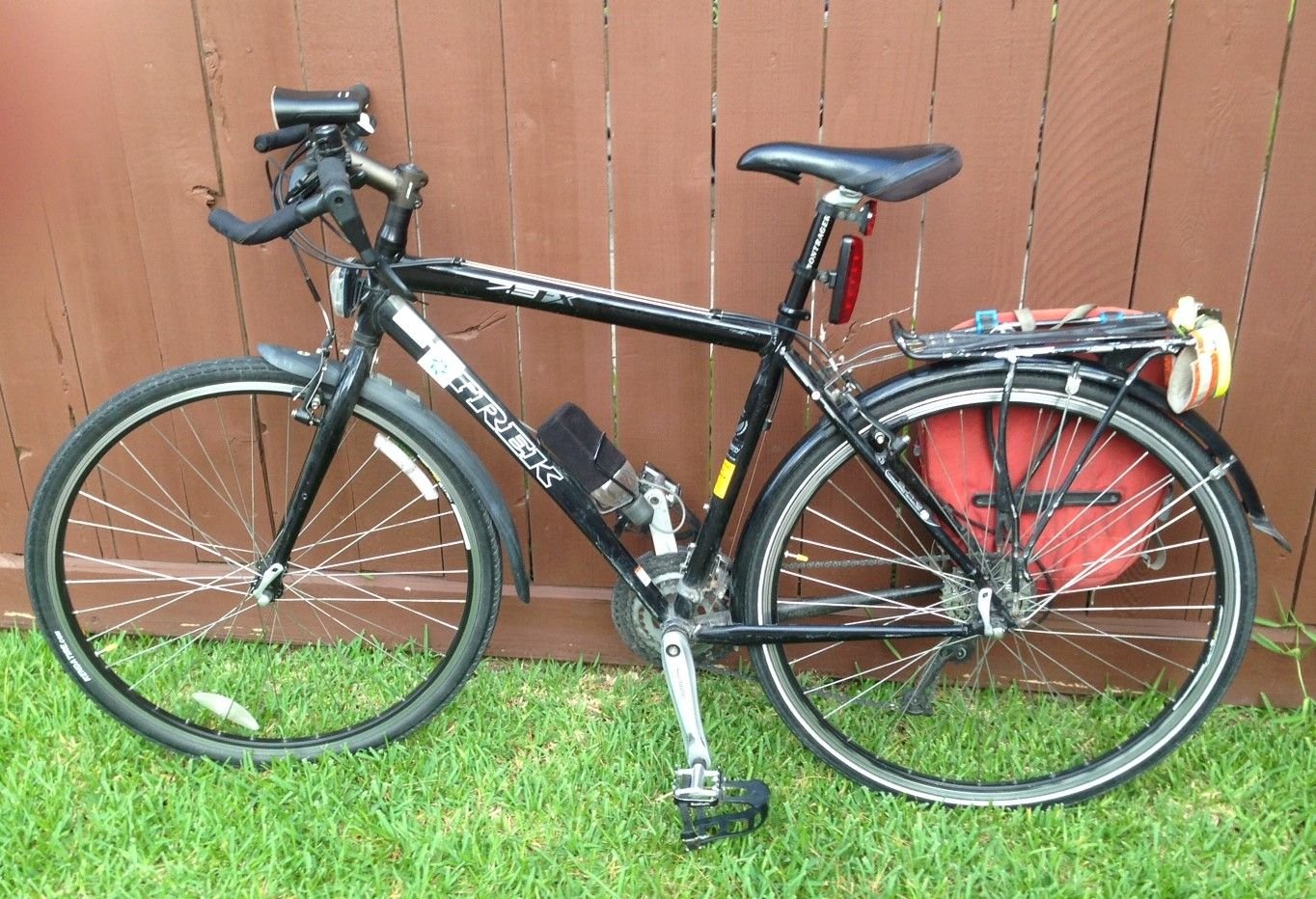
Previous aluminum hybrid.
05-16-20 | 11:53 AM
#9

Full Member

Joined: Jul 2015
Posts: 206
Likes: 65
From: Memphis, TN
Bikes: A few older US made Cannondales, a modern Soma Saga (no longer made, alas!), and one gifted crabon Specialized. Never enough.
Going all over the place with this reply, but figured it might give some help?
My commuter is a Soma Saga disc touring frame in 61cm. I chose a solid touring frame for the geometry, disc brakes, and ample mount points for fenders and racks. I had a used Trek 720 disc before this that worked OK as a transition from an old Cannondale M800 frame to which I added slick tires, a rack and fenders. The M800 was more trail than commute friendly. Managed to crack the Trek frame after three years of what I thought was gentle riding, but that’s a rant I will hold off on. Regardless, the Trek was not an ideal choice as it is not a true touring frame, but I made it work while it lasted. I really think the Saga is the end all for my commuting needs. As a plus, I could always take up touring again.
Below is the current build that I used most days of the week until the Covid fun began, along with rationale for the choices. I went through a bunch of upgrades and modifications before settling on the current mix. My commute was 75% MUP, with the remainder <40mph roads, and I used to ride year round. The previously near empty MUP is now too crowded to ride with any level of safe distancing, and I work in a hospital so patient (and mine own) safety takes a back seat to my bike commute until winter.
2x11 105/Ultegra mix and STI levers — transferred from previous frame and I like brifters for road bikes
Shimano XT SPD pedals — MTB cleat shoes can be walked in
TRP Spyres front and rear — tried HY/RDs but found them too finicky; Spyres are solid mechanical dual sided brakes
30 degree redshift shockstop stem on uncut and well stacked steerer — I’m a tall Clyde, arthritis pain is an intermittent issue, this helps somewhat
Spank flare 25 (?) road bar in widest they had — I like drops even if I spend 90% of ride on hoods, same as above, marginal difference I think?
Velocity rim and hub on the rear — good solid wheels w/36 spokes for a Clyde
Velocity rim and Shimano dyno hub on the front — dynamo is the way to go for any distance
40mm Schwalbe marathon hs420 tires —relatively inexpensive tires with ample flat protection
SK longboard fenders — fenders a must on commutes; longboards prevent spraying
B&M iq-x front and line brake plus rear — single best upgrade for commuting
Ortlieb commuter bags on Ortlieb Rack 3 for QL3 bags — bags are pricey but built like tanks and hold everything but kitchen sink
Revelate designs tangle frame bag — keeps essentials on bike (tubes, mini pump, co2, tools, pepper gel, chain lock that can be used for defense since I ride through some interesting areas)
Garmin Edge 1030, Virb elite cam front, Cycliq fly 6 light/cam rear — cameras for safety, computer for tracking and incident detection (for the wife/widow)
My commuter is a Soma Saga disc touring frame in 61cm. I chose a solid touring frame for the geometry, disc brakes, and ample mount points for fenders and racks. I had a used Trek 720 disc before this that worked OK as a transition from an old Cannondale M800 frame to which I added slick tires, a rack and fenders. The M800 was more trail than commute friendly. Managed to crack the Trek frame after three years of what I thought was gentle riding, but that’s a rant I will hold off on. Regardless, the Trek was not an ideal choice as it is not a true touring frame, but I made it work while it lasted. I really think the Saga is the end all for my commuting needs. As a plus, I could always take up touring again.
Below is the current build that I used most days of the week until the Covid fun began, along with rationale for the choices. I went through a bunch of upgrades and modifications before settling on the current mix. My commute was 75% MUP, with the remainder <40mph roads, and I used to ride year round. The previously near empty MUP is now too crowded to ride with any level of safe distancing, and I work in a hospital so patient (and mine own) safety takes a back seat to my bike commute until winter.
2x11 105/Ultegra mix and STI levers — transferred from previous frame and I like brifters for road bikes
Shimano XT SPD pedals — MTB cleat shoes can be walked in
TRP Spyres front and rear — tried HY/RDs but found them too finicky; Spyres are solid mechanical dual sided brakes
30 degree redshift shockstop stem on uncut and well stacked steerer — I’m a tall Clyde, arthritis pain is an intermittent issue, this helps somewhat
Spank flare 25 (?) road bar in widest they had — I like drops even if I spend 90% of ride on hoods, same as above, marginal difference I think?
Velocity rim and hub on the rear — good solid wheels w/36 spokes for a Clyde
Velocity rim and Shimano dyno hub on the front — dynamo is the way to go for any distance
40mm Schwalbe marathon hs420 tires —relatively inexpensive tires with ample flat protection
SK longboard fenders — fenders a must on commutes; longboards prevent spraying
B&M iq-x front and line brake plus rear — single best upgrade for commuting
Ortlieb commuter bags on Ortlieb Rack 3 for QL3 bags — bags are pricey but built like tanks and hold everything but kitchen sink
Revelate designs tangle frame bag — keeps essentials on bike (tubes, mini pump, co2, tools, pepper gel, chain lock that can be used for defense since I ride through some interesting areas)
Garmin Edge 1030, Virb elite cam front, Cycliq fly 6 light/cam rear — cameras for safety, computer for tracking and incident detection (for the wife/widow)
Last edited by But its me; 05-16-20 at 11:56 AM.
05-16-20 | 09:34 PM
#10
Senior Member
Joined: Dec 2006
Posts: 1,020
Likes: 703
From: Houston, TX
Bikes: 2017 Co-op ADV 1.1; ~1991 Novara Arriba; 1990 Fuji Palisade; mid-90's Moots Tandem; 1985 Performance Superbe
Issues (at about 2 years of operation, about 10k miles):
1. Chain failed at quick link after about 2 weeks. Probably installed loose; I've had no problems with the KMC chains/quick links I've installed myself.
2. Rear brake cable is binding up. It is somewhere in the cable housing from the brake lever to the frame. It's not too bad and I'll fix it when I re-tape the handlebars.
3. Not a build issue, but I did install a longer stem to get more reach. It gave me more knee clearance on the bar end shifters and I found the bike less "twitchy" with the longer stem.
I'm happy with it.
Clearly you could get a build with "brifters" instead of bar-end shifters and that would have the advantage of mirror mount location and less knee-clearance issues. I lean toward simple tech. (Some Luddites probably think of me as a Luddite..)
05-17-20 | 07:20 AM
#11
Senior Member
Joined: Aug 2012
Posts: 526
Likes: 191
From: Broomfield, Colorado
Bikes: 2017 Gunnar CrossHairs Rohloff, 2022 Detroit Bikes Cortello
From Jun2017 to mid-March of this year, I did the weekly distance you're talking about on the bike shown. Now I'm working from home. The Rohloff has been excellent, very low maintenance, I use Connex 8SX chain and get lots of miles before needing replacement. The shop that set this bike up did a stellar job on bike fit, and this is one comfy bike. I got rid of the Thudbuster seatpost and put on a Thomson Masterpiece, quit using the panniers and went to a big seat bag from Rivendell. It holds my laptop and lunch well. I also run with fenders when commuting, of course.

Gunnar
Gunnar
05-29-20 | 11:51 PM
#12
Senior Member
Joined: Dec 2011
Posts: 305
Likes: 41
I have done a similar commute (17 mi one way) on suburban streets for the past 4 years. Since it sounds like you have access to a locker and shower at work, you can be pretty minimal. I used to use a waterproof pannier, but have switched recently to bar bag + large saddle bag setup, which I find balances out my handling and gives me a lot more free speed because it’s not such an aero drag.
05-30-20 | 12:16 AM
#13

Senior Member

Joined: May 2010
Posts: 2,528
Likes: 152
From: midwest
Bikes: 2018 Roubaix Expert Di2, 2016 Diverge Expert X1
I commuted 32mi RT. What others said about bikes. I would add that you should invest in proper biking specific clothes and shoes for the three seasons. It will make a lot of difference in your commuting experience.
