


To rear rack or not to rear rack
 02-12-15 | 05:31 PM
#1
Thread Starter
Junior Member

Joined: Jan 2008
Posts: 103
Likes: 3
From: Utah
Bikes: CAAD10 105
To rear rack or not to rear rack
II've recently relocated and now I have a 12 mile commute instead of 6 mile commute. My hardtail MTB with road slicks was just fine before. I'm looking at getting a better road specific bike for a longer commute. I put a rear rack on my MTB and it made a world of difference on sweat level when I got to work. I would really like to get something like a CAAD 10 that I could jump into some races with, but I also want to be able to have a rear rack for the commute. I'm a little torn, i've been eyeing road bikes for a while and I was planning on keeping my current commuter, but now with a longer commute i'm wondering if I should lean more towards a touring style road bike.
I'm very interested in racing (and maybe tri's) but i'll definitely get more riding in if i'm commuting. I'm a father of a few small children and i'm finding the time for my hobbies is hard to find. so:
1- I know I like biking, and it will be hard to dedicate 4 hours every saturday to do rides without the family if I were training
2- Integrating my bike time into the commute is awesome
3- I like to go fast
Do I Just give up on the racing bike for now and get a solid touring bike? A lighter bike will definitely be quicker, but is it worth the back sweat? I don't really need to race to enjoy biking, what high quality bike should I look for?
I've had the time struggle for a while, my oldest is 5 now. I enjoy running and i've limited myself to half marathons so I don't spend too much time training so that I can spend more time with the family. I've always had the battle of wanting to do epic endurance races and family time. I've slowly been reducing the races I do, accepting that my priority is time with family.
I'm very interested in racing (and maybe tri's) but i'll definitely get more riding in if i'm commuting. I'm a father of a few small children and i'm finding the time for my hobbies is hard to find. so:
1- I know I like biking, and it will be hard to dedicate 4 hours every saturday to do rides without the family if I were training
2- Integrating my bike time into the commute is awesome
3- I like to go fast
Do I Just give up on the racing bike for now and get a solid touring bike? A lighter bike will definitely be quicker, but is it worth the back sweat? I don't really need to race to enjoy biking, what high quality bike should I look for?
I've had the time struggle for a while, my oldest is 5 now. I enjoy running and i've limited myself to half marathons so I don't spend too much time training so that I can spend more time with the family. I've always had the battle of wanting to do epic endurance races and family time. I've slowly been reducing the races I do, accepting that my priority is time with family.
 02-12-15 | 05:50 PM
#2

Senior Member
Joined: Aug 2006
Posts: 7,643
Likes: 68
From: Portland OR
Bikes: 61 Bianchi Specialissima 71 Peugeot G50 7? P'geot PX10 74 Raleigh GranSport 75 P'geot UO8 78? Raleigh Team Pro 82 P'geot PSV 86 P'geot PX 91 Bridgestone MB0 92 B'stone XO1 97 Rans VRex 92 Cannondale R1000 94 B'stone MB5 97 Vitus 997
How about putting drop bars on the MTB? With drop bars and 1" to 1.5" slicks, there wouldn't be too much speed penalty vs a road bike, and if you use your commute for training, you want to be working a little harder anyway.
https://www.bikeforums.net/classic-vi...nversions.html
https://www.bikeforums.net/classic-vi...nversions.html
02-12-15 | 06:06 PM
#3
Senior Member
Joined: Mar 2007
Posts: 5,737
Likes: 10
If you want to race fast, get a real road bike.
Country/Adventure/Gravel Grinder road bikes are not built for speed. They're built for comfortable all-day riding, to let you haul stuff and to get you anywhere you want to go.
So if you want to race someday, spend the money to get a light and fast bike just for the road.
Don't try to convert another bike because you won't have as much as fun riding it and it will never go fast.
Country/Adventure/Gravel Grinder road bikes are not built for speed. They're built for comfortable all-day riding, to let you haul stuff and to get you anywhere you want to go.
So if you want to race someday, spend the money to get a light and fast bike just for the road.
Don't try to convert another bike because you won't have as much as fun riding it and it will never go fast.
02-12-15 | 06:18 PM
#4

curmudgineer
Joined: Dec 2009
Posts: 4,417
Likes: 113
From: Chicago SW burbs
Bikes: 2 many 2 fit here
I and many of my cohorts who frequent the C&V forum and commute on our vintage bikes have found 70's & 80's steel road bikes to be excellent platforms for commuting. Especially touring-specific road bikes have ideal geometry and features, but the sportier models work fine also. If you do your own wrenching, they can be very inexpensive to acquire, modify to your needs, and maintain.
As for racks, in addition to a rear rack, I like to have some kind of front cargo device as well, be it a rack & trunk, panniers, handlebar bag, or any feasible combination. This helps distribute the load for better handling and dynamics.
I like and need to go fast, as my commutes have typically been in the 10-15 mile range, and on a good day, traffic permitting, I can reach nearly 20mph average speed, door to door.


As for racks, in addition to a rear rack, I like to have some kind of front cargo device as well, be it a rack & trunk, panniers, handlebar bag, or any feasible combination. This helps distribute the load for better handling and dynamics.
I like and need to go fast, as my commutes have typically been in the 10-15 mile range, and on a good day, traffic permitting, I can reach nearly 20mph average speed, door to door.
02-12-15 | 07:45 PM
#6
Senior Member
Joined: Dec 2006
Posts: 2,207
Likes: 45
From: Northern VT
Bikes: recumbent & upright
Echo the "vintage" road bike. We got our teenage son one during one of his huge growth spurt years. Cost was small, put on new tires and brake pads, swapped the saddle. It was a catchy red color, really caught his eye - took about half an hour for him to get comfortable with the down tube shifters. He rode it around 1200 km during one season, including a 500 km trip with us. I think he was suprised how nice the steel frame rode and seemed sad when he outgrew it. Got more at a bike swap than we paid for it.
02-12-15 | 08:32 PM
#8
Senior Member
Joined: Aug 2006
Posts: 65
Likes: 1
From: Minneapolis, MN, USA
I convinced my wife to turn her road bike into her commuter a few years back and she couldn't be happier. Most of her miles are commuting, so why not get the most out of your favorite bike? There are racks that work well with road bikes. I like the Axiom Streamliner. Just make sure you have a good place to lock it on the work side of things.
02-12-15 | 08:40 PM
#9
elcraft
Joined: Sep 2008
Posts: 840
Likes: 120
From: Greater Boston
I and many of my cohorts who frequent the C&V forum and commute on our vintage bikes have found 70's & 80's steel road bikes to be excellent platforms for commuting. Especially touring-specific road bikes have ideal geometry and features, but the sportier models work fine also. If you do your own wrenching, they can be very inexpensive to acquire, modify to your needs, and maintain.
As for racks, in addition to a rear rack, I like to have some kind of front cargo device as well, be it a rack & trunk, panniers, handlebar bag, or any feasible combination. This helps distribute the load for better handling and dynamics.
I like and need to go fast, as my commutes have typically been in the 10-15 mile range, and on a good day, traffic permitting, I can reach nearly 20mph average speed, door to door.
As for racks, in addition to a rear rack, I like to have some kind of front cargo device as well, be it a rack & trunk, panniers, handlebar bag, or any feasible combination. This helps distribute the load for better handling and dynamics.
I like and need to go fast, as my commutes have typically been in the 10-15 mile range, and on a good day, traffic permitting, I can reach nearly 20mph average speed, door to door.
Last edited by elcraft; 02-12-15 at 08:43 PM. Reason: spelling
02-12-15 | 08:55 PM
#10
curmudgineer
Joined: Dec 2009
Posts: 4,417
Likes: 113
From: Chicago SW burbs
Bikes: 2 many 2 fit here
Could you provide some details and photos of the added-on canti pivots that you have on the blue Ross? I have used the same type of front rack on Canti/linear pull equipped bikes, but I haven't figured out a way to create the canti studs on a fork that didn'tcome so equipped.


Last edited by old's'cool; 02-13-15 at 06:04 PM. Reason: photos added
02-12-15 | 08:58 PM
#11
Senior Member
Joined: Nov 2008
Posts: 7,239
Likes: 8
From: Bay Area, Calif.
So get the CAAD 10 and put a rear rack on it. It's easy enough to remove prior to a race and reinstall prior to the Monday commute.
02-12-15 | 09:07 PM
#12

Senior Member

Joined: Aug 2011
Posts: 22,676
Likes: 2,642
From: CID
Bikes: 1991 Bianchi Eros, 1964 Armstrong, 1988 Diamondback Ascent, 1988 Bianchi Premio, 1987 Bianchi Sport SX, 1980s Raleigh mixte (hers), All-City Space Horse (hers)
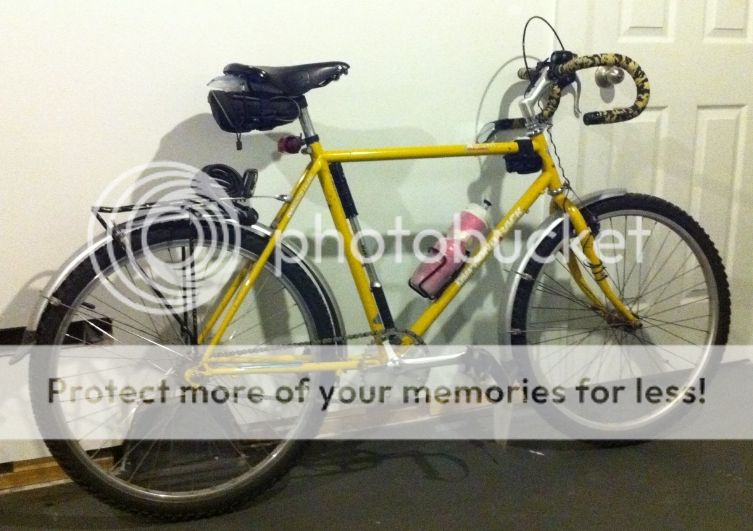
Put some dirt drops (or regular drop bars) on that MTB and you'll pick up some speed. This bike has become a favorite for club rides and commuting, and has seen the other side of 25 MPH many times. 
 02-12-15 | 09:58 PM
#13
Senior Member

Joined: Jun 2008
Posts: 9,201
Likes: 289
From: Vancouver, BC
If you plan to race and want to use your commute time for training, I would just get the CAAD10 and a backpack. My commute is a little over an hour and backpack or not I need a shower at work so I live with the backpack. Feel kind of naked when I ride on the weekend 
02-12-15 | 10:26 PM
#14
elcraft
Joined: Sep 2008
Posts: 840
Likes: 120
From: Greater Boston
Old's' Cool,
I think I get it, but a photo or two would really help out. The oval fork blades found on many C&V bikes tend to distort P clamps; your success would inspire me........
I think I get it, but a photo or two would really help out. The oval fork blades found on many C&V bikes tend to distort P clamps; your success would inspire me........
Last edited by elcraft; 02-12-15 at 10:28 PM. Reason: better reference
02-13-15 | 12:44 AM
#15
Senior Member
Joined: Nov 2013
Posts: 470
Likes: 3
From: Napa, California
But, to be honest, I'd go more touring or endurance road that can fit at least 32 tires. Not a big fan of the high bb on cross bikes.
02-13-15 | 07:49 AM
#16
Senior Member
Joined: Mar 2014
Posts: 2,306
Likes: 22
From: Mooresville, NC (Charlotte suburb)
Bikes: Cannondale Synapse, Trek 5000 TCT, Giant OCR
There are several rear rack options that just clamp on the seat tube. A quick release is all that holds it on. Depending on how much you need to carry this could work too.
02-13-15 | 08:12 AM
#17

Senior Member
Joined: Jun 2007
Posts: 8,101
Likes: 17
From: Minneapolis
I've been where you are at. I wouldn't bother with MTB conversions or even vintage road bikes. With road racing you will quickly feel that anything less than a modern road bike will be a liability. 95% of it is still the engine, but you aren't going to want to cede that 5% to the other racers.
Triathlons have a different feel and there are different tactics. Being able to maintain a strong steady pace is more important than quick acceleration. If you only do one now and then, almost any bike will do. Once you start getting serious about your times, again, you will want a modern road bike.
Triathlons have a different feel and there are different tactics. Being able to maintain a strong steady pace is more important than quick acceleration. If you only do one now and then, almost any bike will do. Once you start getting serious about your times, again, you will want a modern road bike.
Last edited by tjspiel; 02-13-15 at 08:21 AM.
02-13-15 | 08:49 AM
#18

Did I catch a niner?
Joined: Dec 2010
Posts: 542
Likes: 1
From: a van down by the river
Bikes: Vassago Fisticuff/Surly Ogre/Surly Pugsley/Surly Pugsley 29+
I would still use the MTB for commuting. There is going to be wear and tear and I would rather put this on a cheaper bike. Still get a CAAD 10 and enjoy your weekend rides/races on this bike.
The example I will give is a sad example.
A good friend of mine bought a nice Trek road bike to which she put a rack on and road it all year. I told her when she got it she should just use her old bike to get to work and use this bike on weekends or maybe just Fridays. Well she did not listen to me and about 6 months later it was stolen. On top of that it had a lot of scratches the drivetrain was wearing down, bar tape was peeling, and so on and so forth.
I am not saying this is going to happen to you, she took this bike everywhere all day everyday (no car). And her older bike is older and not a nice looking bike to which no one would really want (hybrid upright type bike) I think she would still have the Trek.
Just less opportunity of a nice bike getting stolen if you are not commuting on it everyday is all I am saying. Bikes are expensive I think.
The example I will give is a sad example.
A good friend of mine bought a nice Trek road bike to which she put a rack on and road it all year. I told her when she got it she should just use her old bike to get to work and use this bike on weekends or maybe just Fridays. Well she did not listen to me and about 6 months later it was stolen. On top of that it had a lot of scratches the drivetrain was wearing down, bar tape was peeling, and so on and so forth.
I am not saying this is going to happen to you, she took this bike everywhere all day everyday (no car). And her older bike is older and not a nice looking bike to which no one would really want (hybrid upright type bike) I think she would still have the Trek.
Just less opportunity of a nice bike getting stolen if you are not commuting on it everyday is all I am saying. Bikes are expensive I think.
Last edited by Mr Pink57; 02-13-15 at 08:55 AM.
02-13-15 | 09:15 AM
#19

Senior Member
Joined: Aug 2014
Posts: 2,977
Likes: 5
From: Columbia, SC
Bikes: 2014 Cannondale Synapse Carbon 4 Rival; 2014 Cannondale Trail 7 29; 1972 Schwinn Suburban, 1996 Proflex 756, 1987(?) Peugeot, Dahon Speed P8; 1979 Raleigh Competition GS; 1995 Stumpjumper M2 FS, 1978 Raleigh Sports, Schwinn Prologue
If you want to race fast, get a real road bike.
Country/Adventure/Gravel Grinder road bikes are not built for speed. They're built for comfortable all-day riding, to let you haul stuff and to get you anywhere you want to go.
So if you want to race someday, spend the money to get a light and fast bike just for the road.
Don't try to convert another bike because you won't have as much as fun riding it and it will never go fast.
Country/Adventure/Gravel Grinder road bikes are not built for speed. They're built for comfortable all-day riding, to let you haul stuff and to get you anywhere you want to go.
So if you want to race someday, spend the money to get a light and fast bike just for the road.
Don't try to convert another bike because you won't have as much as fun riding it and it will never go fast.
OP: I would get yourself a road bike. Skip the racks and stuff. Commute on your heavier mtb, but take extra clothes and stuff with you at least once a week and enjoy your commute on your "fast" bike. The extra weight of riding your commuter will make you stronger. I have a similar distance commute and ride it on a very heavy bike most of the time, and like to bring extra clothes and ride in on either my 89 Schwinn or my carbon Synapse. It's just fun to do that sometimes.
02-13-15 | 09:17 AM
#20
Senior Member
Joined: Jun 2007
Posts: 8,101
Likes: 17
From: Minneapolis
I would still use the MTB for commuting. There is going to be wear and tear and I would rather put this on a cheaper bike. Still get a CAAD 10 and enjoy your weekend rides/races on this bike.
The example I will give is a sad example.
A good friend of mine bought a nice Trek road bike to which she put a rack on and road it all year. I told her when she got it she should just use her old bike to get to work and use this bike on weekends or maybe just Fridays. Well she did not listen to me and about 6 months later it was stolen. On top of that it had a lot of scratches the drivetrain was wearing down, bar tape was peeling, and so on and so forth.
I am not saying this is going to happen to you, she took this bike everywhere all day everyday (no car). And her older bike is older and not a nice looking bike to which no one would really want (hybrid upright type bike) I think she would still have the Trek.
Just less opportunity of a nice bike getting stolen if you are not commuting on it everyday is all I am saying. Bikes are expensive I think.
The example I will give is a sad example.
A good friend of mine bought a nice Trek road bike to which she put a rack on and road it all year. I told her when she got it she should just use her old bike to get to work and use this bike on weekends or maybe just Fridays. Well she did not listen to me and about 6 months later it was stolen. On top of that it had a lot of scratches the drivetrain was wearing down, bar tape was peeling, and so on and so forth.
I am not saying this is going to happen to you, she took this bike everywhere all day everyday (no car). And her older bike is older and not a nice looking bike to which no one would really want (hybrid upright type bike) I think she would still have the Trek.
Just less opportunity of a nice bike getting stolen if you are not commuting on it everyday is all I am saying. Bikes are expensive I think.
I can keep my bike in my office and I commuted with the same road bike I used for triathlons 8 or 9 months out of the year. It's not a suitable bike for winter otherwise I would have ridden it year round.
As far as wear and tear goes, to be a good racer or triathlete, you NEED to put miles and miles and miles on that bike. Commuting will only be a part of it but you might was well take advantage of it, especially if you're like the OP and have young kids. Bar tape will wear. So will cassettes and chains. You replace them as needed.
You may want different tires for race day and if you had money to spare you might even want a training bike, - but it should still be a decent road bike that's going to be similar to your race bike in how it handles.
Tons of people in the US have bikes but only use them sporadically. Compared to that, commuting is a harder life for a bike. A harder life still is in store for a bike used for training and racing.
Last edited by tjspiel; 02-13-15 at 09:22 AM.
02-13-15 | 09:22 AM
#21
Senior Member
Joined: Aug 2014
Posts: 2,977
Likes: 5
From: Columbia, SC
Bikes: 2014 Cannondale Synapse Carbon 4 Rival; 2014 Cannondale Trail 7 29; 1972 Schwinn Suburban, 1996 Proflex 756, 1987(?) Peugeot, Dahon Speed P8; 1979 Raleigh Competition GS; 1995 Stumpjumper M2 FS, 1978 Raleigh Sports, Schwinn Prologue
I and many of my cohorts who frequent the C&V forum and commute on our vintage bikes have found 70's & 80's steel road bikes to be excellent platforms for commuting. Especially touring-specific road bikes have ideal geometry and features, but the sportier models work fine also. If you do your own wrenching, they can be very inexpensive to acquire, modify to your needs, and maintain.
As for racks, in addition to a rear rack, I like to have some kind of front cargo device as well, be it a rack & trunk, panniers, handlebar bag, or any feasible combination. This helps distribute the load for better handling and dynamics.
I like and need to go fast, as my commutes have typically been in the 10-15 mile range, and on a good day, traffic permitting, I can reach nearly 20mph average speed, door to door.
As for racks, in addition to a rear rack, I like to have some kind of front cargo device as well, be it a rack & trunk, panniers, handlebar bag, or any feasible combination. This helps distribute the load for better handling and dynamics.
I like and need to go fast, as my commutes have typically been in the 10-15 mile range, and on a good day, traffic permitting, I can reach nearly 20mph average speed, door to door.

 02-13-15 | 09:55 AM
#23
Senior Member
Joined: Jun 2007
Posts: 8,101
Likes: 17
From: Minneapolis
If you're going to use your commute for training, you're going to have back sweat, front sweat, head sweat, etc, etc. If the backpack makes you uncomfortable to the point that affects your training, that is a different matter.
02-13-15 | 10:23 AM
#24


Plays in traffic
Joined: May 2006
Posts: 6,971
Likes: 15
From: Rochester, NY
Bikes: 1996 Litespeed Classic, 2006 Trek Portland, 2013 Ribble Winter/Audax, 2016 Giant Talon 4
You don't have to go with a touring bike to get a rack.
You don't have to go with vintage (READ: Downtube shifters) to get a rack either.
There are many fans of both kinds of bikes. I respect their choices. I'm not putting them down. They're just not my preference.
I like STI shifters. If it weren't for STI, I wouldn't own a bike. Period. I won't try to convert downtube (or bar-end) fans, so please don't try to convert me.
I like a bike that handles crisply and makes the best of my meager output to gallop along.
One of my commuters is based on cyclocross geometry.

The other, well the main triangle has exactly the same angles and measurements as those of my Litespeed. The difference is that the fork has room for fenders and bigger tires, as does the rear triangle. The core things that give the bike its feel are identical between the two.

Yes, they both look a bit frumpy with the full fenders. I need (and like) them, you may not.
I don't keep up on current bike shop makes and models, so I don't have specific recommendations. I'm just saying your choices aren't limited to those championed above.
Although the Ribble is always available at ribblecycles.co.uk as either a fully-built bike or as a frame-only, the way I bought mine. It was cheap too. The frame was $130, carbon fork $115, headset $22, and trans-Atlantic air freight $80. So I could afford to throw $700 of custom handbuilt wheels at it, along with full 105 and dynamo lights.
Despite full commuterization, my bikes aren't sluggish. I don't get passed often. I lost to him, but one night last summer on the way home from work I gave a much younger guy on a fully tricked-out Venge a really good run for his money. The stoplights evened us out.
So it is possible to commuterize a fast bike without turning it into a slug. (Just takes a little more HTFU, which isn't a bad thing either.)
You don't have to go with vintage (READ: Downtube shifters) to get a rack either.
There are many fans of both kinds of bikes. I respect their choices. I'm not putting them down. They're just not my preference.
I like STI shifters. If it weren't for STI, I wouldn't own a bike. Period. I won't try to convert downtube (or bar-end) fans, so please don't try to convert me.
I like a bike that handles crisply and makes the best of my meager output to gallop along.
One of my commuters is based on cyclocross geometry.
The other, well the main triangle has exactly the same angles and measurements as those of my Litespeed. The difference is that the fork has room for fenders and bigger tires, as does the rear triangle. The core things that give the bike its feel are identical between the two.
Yes, they both look a bit frumpy with the full fenders. I need (and like) them, you may not.
I don't keep up on current bike shop makes and models, so I don't have specific recommendations. I'm just saying your choices aren't limited to those championed above.
Although the Ribble is always available at ribblecycles.co.uk as either a fully-built bike or as a frame-only, the way I bought mine. It was cheap too. The frame was $130, carbon fork $115, headset $22, and trans-Atlantic air freight $80. So I could afford to throw $700 of custom handbuilt wheels at it, along with full 105 and dynamo lights.
Despite full commuterization, my bikes aren't sluggish. I don't get passed often. I lost to him, but one night last summer on the way home from work I gave a much younger guy on a fully tricked-out Venge a really good run for his money. The stoplights evened us out.
So it is possible to commuterize a fast bike without turning it into a slug. (Just takes a little more HTFU, which isn't a bad thing either.)
02-13-15 | 12:03 PM
#25
Senior Member
Joined: Jul 2008
Posts: 6,431
Likes: 44
From: Minneapolis, MN
People have suggested beam racks, but they're a real pain because they swing from side to side behind you. Especially if you like going fast and taking corners and turns.
The solution for the op is to buy a rack that's designed to go onto a bike with no rack mounts.
On the cheaper end, the Axiom Streamliner disc:
Amazon.com : Axiom DLX Streamliner Disc Cycle Rack, Black : Bike Racks : Sports & Outdoors

On the more expensive but super lightweight end of things, the Bontrager BackRack Lightweight:
Bontrager: BackRack Lightweight (Model #08214)
Here is a picture of it on a Trek Domane, a full carbon bike with no rack mounts:

There are other options as well, but if I try to list them all out my post gets really long.
Basically they work by attaching to the bike in 2 places - on the bottom through the wheel skewer, which is designed to hold all your weight so it's a solid point on the bike. And at the top under the brake mount, a point designed to withstand the forces of you hitting the brakes hard as you're going down a hill, so again another solidly designed point on the bike.
I would add one more thing. If what you carry back and forth is relatively lightweight this works great. Like I just carry an extra layer (warmer in the evening heading home than it is in the morning), maybe a rain jacket sometimes if it's iffy, lunch. That kind of thing. These works excellent for something like that.
But if you're trying to carry something fairly heavy - like a heavy laptop - you probably don't want to do this with a fast twitchy race bike. If you put significant weight on the back it makes the handling real weird and possibly dangerous. I own a high end full carbon race bike - carrying like a rain coat is no problem, but carrying something significantly heavy in a pannier is a real problem for the handling of the bike. If you need to carry something heavy better to get a more stable handling bike.
The solution for the op is to buy a rack that's designed to go onto a bike with no rack mounts.
On the cheaper end, the Axiom Streamliner disc:
Amazon.com : Axiom DLX Streamliner Disc Cycle Rack, Black : Bike Racks : Sports & Outdoors
On the more expensive but super lightweight end of things, the Bontrager BackRack Lightweight:
Bontrager: BackRack Lightweight (Model #08214)
Here is a picture of it on a Trek Domane, a full carbon bike with no rack mounts:
There are other options as well, but if I try to list them all out my post gets really long.
Basically they work by attaching to the bike in 2 places - on the bottom through the wheel skewer, which is designed to hold all your weight so it's a solid point on the bike. And at the top under the brake mount, a point designed to withstand the forces of you hitting the brakes hard as you're going down a hill, so again another solidly designed point on the bike.
I would add one more thing. If what you carry back and forth is relatively lightweight this works great. Like I just carry an extra layer (warmer in the evening heading home than it is in the morning), maybe a rain jacket sometimes if it's iffy, lunch. That kind of thing. These works excellent for something like that.
But if you're trying to carry something fairly heavy - like a heavy laptop - you probably don't want to do this with a fast twitchy race bike. If you put significant weight on the back it makes the handling real weird and possibly dangerous. I own a high end full carbon race bike - carrying like a rain coat is no problem, but carrying something significantly heavy in a pannier is a real problem for the handling of the bike. If you need to carry something heavy better to get a more stable handling bike.